
By Bryan Moir | Junk Economics | QSix
There are moments when professional training becomes an inconvenience. Numbers refuse to applaud on cue. Balance sheets decline to salute the party banner. Arithmetic, stubborn old thing that it is, insists that liabilities remain liabilities even after the communications department renames them “strategic investments.”
I spent years studying economics and finance and then decades practising the craft. That does not make me infallible, but it has taught me to begin with the accounts rather than the announcement. And when I examine Ontario’s accounts, I cannot find the economic miracle Peter Bethlenfalvy is advertising.
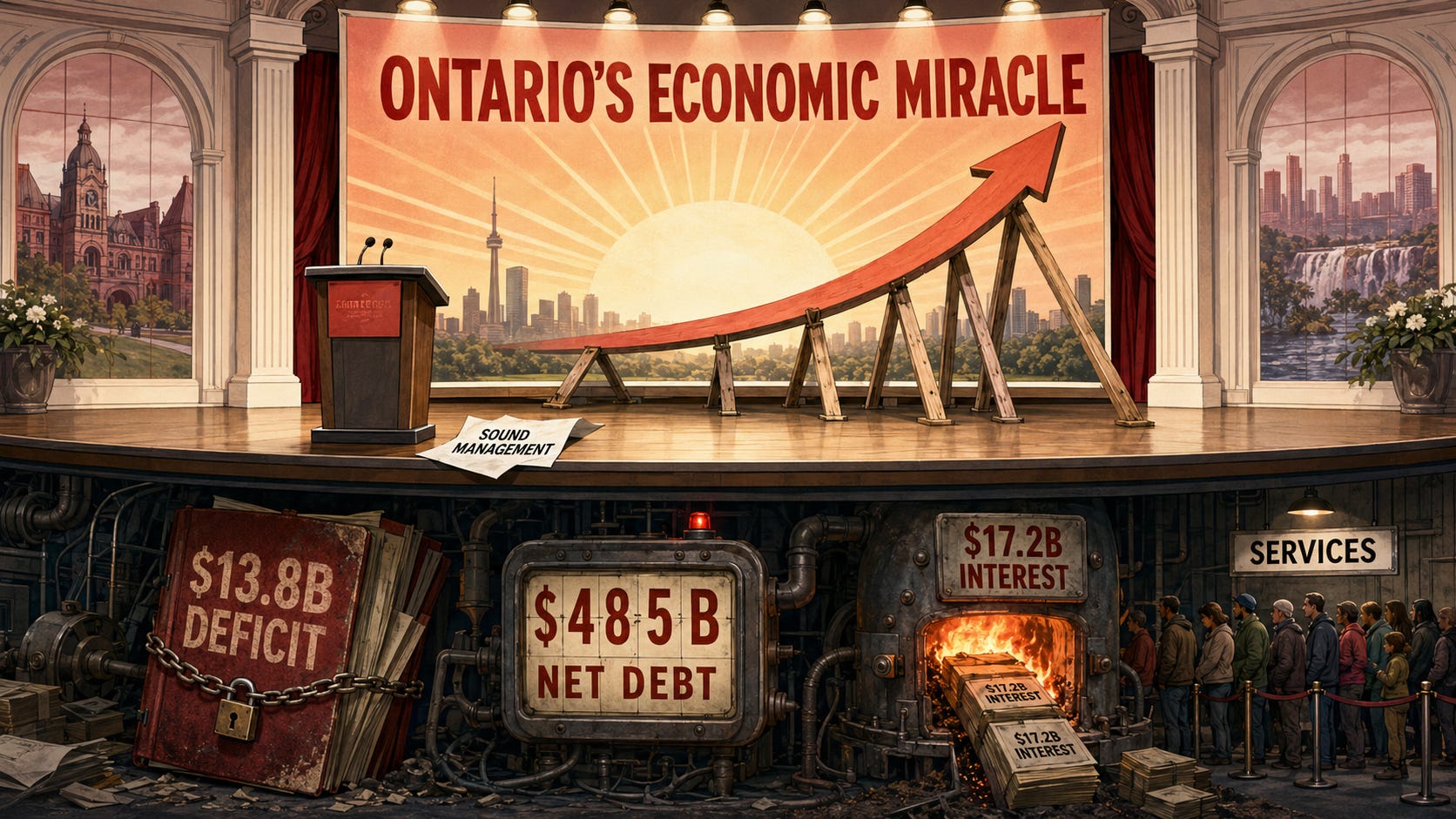
I see a $13.8-billion deficit—$12.7 billion larger than in 2024–25—net debt approaching $485 billion, debt exceeding $30,000 per Ontarian, $17.2 billion in annual interest costs and an economy that contracted in two consecutive quarters. Private-sector economists have nearly halved Ontario’s expected 2026 growth from 1.1 per cent to 0.6 per cent.
Queen’s Park calls this a “stronger financial position” produced by “sound management.” That conclusion cannot be reconciled with the direction of the government’s own figures. It can survive only if Ontarians never read beyond the Facebook graphic—within that peculiar political state of consciousness where borrowing more, owing more and growing less constitute prudent fiscal management.
Welcome to Junk Economics, where the press release is sunny because the balance sheet has been instructed not to make eye contact.
Bethlenfalvy’s statement is not merely optimistic. It is directionally wrong.
Ontario’s own 2026–27 First Quarter Finances projects:
a deficit of $13.844 billion, compared with $1.090 billion in 2024–25;
net debt of $485.082 billion, compared with $427.050 billion in 2024–25;
net debt per capita of $30,131, compared with $26,451;
net debt equal to 37.7 per cent of GDP, up from 35.7 per cent;
net debt equal to 210.7 per cent of annual revenue, up from 191.2 per cent; and
annual interest and debt-servicing costs of $17.237 billion, up from $15.122 billion.
That is not one unfortunate statistic cherry-picked from an otherwise flourishing orchard. The deficit is worse. The debt is worse. Debt per citizen is worse. Debt relative to GDP is worse. Debt relative to revenue is worse. Interest expense is worse.
Even the economy has been moving backwards. Real GDP declined 0.3 per cent in the fourth quarter of 2025 and another 0.1 per cent in the first quarter of 2026. Two consecutive quarterly contractions may not satisfy every technical or institutional definition of recession, but they do satisfy the ordinary English definition of “not an economic miracle.”
Private-sector forecasters have also cut their estimate of Ontario’s 2026 real growth from 1.1 per cent to 0.6 per cent. Population growth can therefore make the aggregate economy look less sick than the experience of the person living inside it. If total output barely grows while the number of people sharing it grows faster, prosperity per person declines even while politicians point at a larger nominal GDP number.
The government’s defence is that its forecast remains consistent with the budget. That is a remarkable standard of achievement. The original plan anticipated a large deficit, and the update confirms the same large deficit. Apparently predicting one’s own deterioration now counts as preventing it.
In the narrow statutory sense, the government may be able to defend the slogan. It did not necessarily increase the legislated rate on a named tax.
But that is political grammar, not economic analysis.
Ontario expects taxation revenue to rise from $151.5 billion in 2024–25 to $163.6 billion in 2026–27—an increase of more than $12 billion. Personal income-tax revenue alone is projected to rise from $55.7 billion to $65.1 billion, or nearly 17 per cent in two years.
Higher tax revenue does not, by itself, prove that tax rates were increased. Revenue can rise because incomes, prices, employment or corporate profits rise. That is precisely why Bethlenfalvy’s wording is so slippery. “We did not raise a tax rate” is converted into “we imposed no additional burden.” Those are not the same claim.
Taxation is not confined to the number printed beside a bracket in a statute. The relevant economic question is how much command over household income and resources government absorbs—directly, indirectly, today or tomorrow.
The Ford government has not abolished the bill. It has diversified the collection methods.
Yes—economically, although not legally.
Ontario will spend $17.2 billion this year servicing debt. That is approximately $47 million every day. It buys no nurse, teacher, bridge, subway car or long-term-care bed. It is payment for resources consumed or capital commitments made in the past.
There are only a few ways to meet that obligation:
collect more revenue;
reduce or defer public services;
sell assets;
borrow again; or
rely on economic growth and inflation to shrink the burden relative to nominal income.
None is magic. Borrowing merely changes the date on the tax bill and obscures the identity of the taxpayer who will ultimately receive it.
Debt-financed infrastructure can be legitimate when a long-lived asset produces benefits over decades. Matching part of its cost to future beneficiaries is defensible. But persistent operating deficits and rising interest expense are different. They transfer current political consumption to future taxpayers while allowing today’s government to advertise benefits without displaying the full price.
Interest is therefore a deferred tax when it requires future revenue, and a service tax when it displaces current programs. Every dollar sent to bondholders is a dollar unavailable for something else unless government extracts or borrows another dollar.
The Financial Accountability Office has described the interest-to-revenue ratio as a measure of budgetary flexibility: as the ratio rises, less revenue remains available for programs. Ontario’s own forecast shows that ratio increasing from 5.5 per cent in 2024–25 to 6.7 per cent this year, with 7.1 per cent projected by 2028–29.
The government boasts that it did not raise taxes while arranging for more future income to be pre-committed before taxpayers earn it. This is rather like celebrating that the restaurant did not increase menu prices while quietly adding the meal to your children’s credit card.
Inflation is commonly described as a tax because it reduces the purchasing power of money and nominal claims without requiring Parliament or Queen’s Park to pass a tax bill. Cash loses value. Wages that fail to keep pace buy less. Nominal investment gains may be taxed even when the investor has experienced little or no real gain. Governments with fixed-rate nominal debt may benefit because inflation reduces the real value of what they owe.
But intellectual honesty requires an important qualification: Ontario does not control Canadian monetary policy, and Doug Ford cannot reasonably be blamed for every increase in the national price level. The Bank of Canada sets monetary policy; global supply shocks, federal fiscal policy, energy, housing constraints, exchange rates and private demand all matter.
That does not make inflation irrelevant to Ontario’s boast.
First, provincial policy can raise the cost of housing, electricity, transportation, construction and doing business through taxes, charges, regulation, restricted supply and poor infrastructure decisions. Not every price increase is monetary inflation, but every government-created increase still lands in the household budget.
Second, inflation flatters government accounts. Nominal GDP rises. Nominal incomes rise. Tax receipts rise. The debt-to-GDP ratio can improve even when real output per person and household purchasing power do not. A government can therefore collect more, report a larger economy and claim fiscal progress while families become materially poorer.
Statistics Canada reported Canadian CPI inflation of 2.8 per cent in June 2026. That is the twelve-month rate, not a reversal of the cumulative price increases already embedded since 2020. A slower rate of inflation means prices are rising more slowly; it does not mean the earlier loss of purchasing power has been restored.
Inflation is the perfect political tax because nobody sends an invoice. The supermarket, landlord, insurer and utility deliver the bad news one transaction at a time, while each government insists the culprit lives in another jurisdiction.
Absolutely. It is payment extracted in a different unit.
Suppose a citizen pays taxes for timely health care but waits months in pain for diagnosis or surgery. The cost may appear as lost wages, reduced productivity, unpaid family caregiving, travel, medication or payment for private treatment. The government has not recorded a tax increase, but the citizen has surrendered time, income and welfare because the promised service was rationed by delay.
Waiting is a time tax.
If a classroom becomes more crowded, a court matter takes longer, a road deteriorates, transit becomes unreliable or access to a public program is narrowed, the household may purchase substitutes privately. Tutoring, physiotherapy, home care, security, transportation and legal assistance become the second invoice for a service the first invoice—taxation—was supposed to provide.
Service reduction is therefore a quality-adjusted tax increase. If citizens pay the same amount and receive less, the effective price of government has risen. If they pay more and receive less, even the euphemism department should blush.
Ontario’s comparatively low program spending is not automatically evidence of efficiency. The FAO found that in 2024–25 Ontario’s per-capita health spending was the second lowest among the provinces and its “all other” program spending per person was the lowest. Low cost is admirable only if outcomes and access are maintained. Otherwise, it is not efficiency; it is rationing wearing an accountant’s visor.
There is also a distributional cruelty hidden in service delays. The wealthy purchase an alternative. The middle class pays twice and winces. The poor wait. A nominally universal service can therefore become progressively less universal without any minister announcing a formal cut.
It has mastered the fiscal version of shrinkflation.
The package costs more. The debt is larger. Interest consumes more revenue. Economic growth has weakened. The customer waits longer and increasingly purchases missing pieces elsewhere. Yet the label announces “sound management” because the statutory tax rate printed on the side has not changed.
Some of Ontario’s borrowing finances real capital assets, and some public investments may raise future productivity. It would be unserious to treat every borrowed dollar as waste. Credit-rating agencies have maintained Ontario’s AA ratings with stable outlooks, and a 37.7 per cent net-debt-to-GDP ratio is below the government’s self-imposed ceiling of 40 per cent.
But staying below a ceiling is not the same as strengthening the foundation. The government’s other debt target—net debt below 200 per cent of revenue—is already being missed. The ratio is projected at 210.7 per cent this year. More importantly, the ceiling itself does not convert deterioration into improvement. A man gaining ten pounds may remain below the maximum capacity of his bathroom scale. He has not thereby become thinner.
Nor should a credit rating be confused with a certificate of good government. Credit agencies primarily assess whether creditors are likely to be paid. Ontario possesses a large, diversified economy and extensive taxation powers. Bondholders can be safe precisely because taxpayers are available to be squeezed.
That brings us back to Bethlenfalvy’s triumphant Facebook declaration:
“Through sound management, our government has put Ontario’s finances in a stronger financial position so we can make strategic investments to protect workers and families, all without ever raising a tax.”
Nearly every clause is doing political work that the accounts cannot support.
“Sound management” describes a $13.8-billion deficit.
“Stronger financial position” describes rising debt, rising debt ratios and rising interest costs.
“Strategic investments” merges productive capital with ordinary spending, subsidies and political announcements under one flattering noun.
“Protect workers and families” assumes that whatever government spends necessarily achieves its advertised purpose.
“Without ever raising a tax” confines the definition of taxation to the one collection method the government chose not to increase visibly.
It excludes the deferred tax of debt, the purchasing-power tax of inflation, the time tax of waiting, the replacement tax of buying privately what government failed to deliver, and the opportunity cost of $17.2 billion diverted annually to debt service.
This is not economic analysis. It is a semantic protection racket.
The government takes more resources, promises more benefits, borrows the difference and presents the absence of a formal rate increase as proof of thrift. Future taxpayers inherit the liability. Present taxpayers absorb the inflation, delays and diminished services. Bondholders receive their interest. Politicians receive the graphic.
Everybody gets something—except an honest accounting.
Ontario’s economic miracle is not that the government has strengthened the province without raising taxes. The miracle is that it can publish numbers showing the opposite and expect applause for its restraint.
That requires more than creative accounting.
It requires an altered state of consciousness.
Ontario Ministry of Finance, 2026–27 First Quarter Finances, August 14, 2026.
Ontario Ministry of Finance, 2026 Ontario Budget: Chapter 3 — Ontario’s Fiscal Plan and Outlook, March 26, 2026.
Financial Accountability Office of Ontario, 2026 Ontario Budget Note.
Financial Accountability Office of Ontario, 2024–25 Interprovincial Budget Comparison.
Financial Accountability Office of Ontario, Economic and Budget Outlook, Winter 2026.
Statistics Canada, Consumer Price Index Portal.
No posts
Comments
Nothing yet. Say the first thing.
Sign in to join the conversation.