
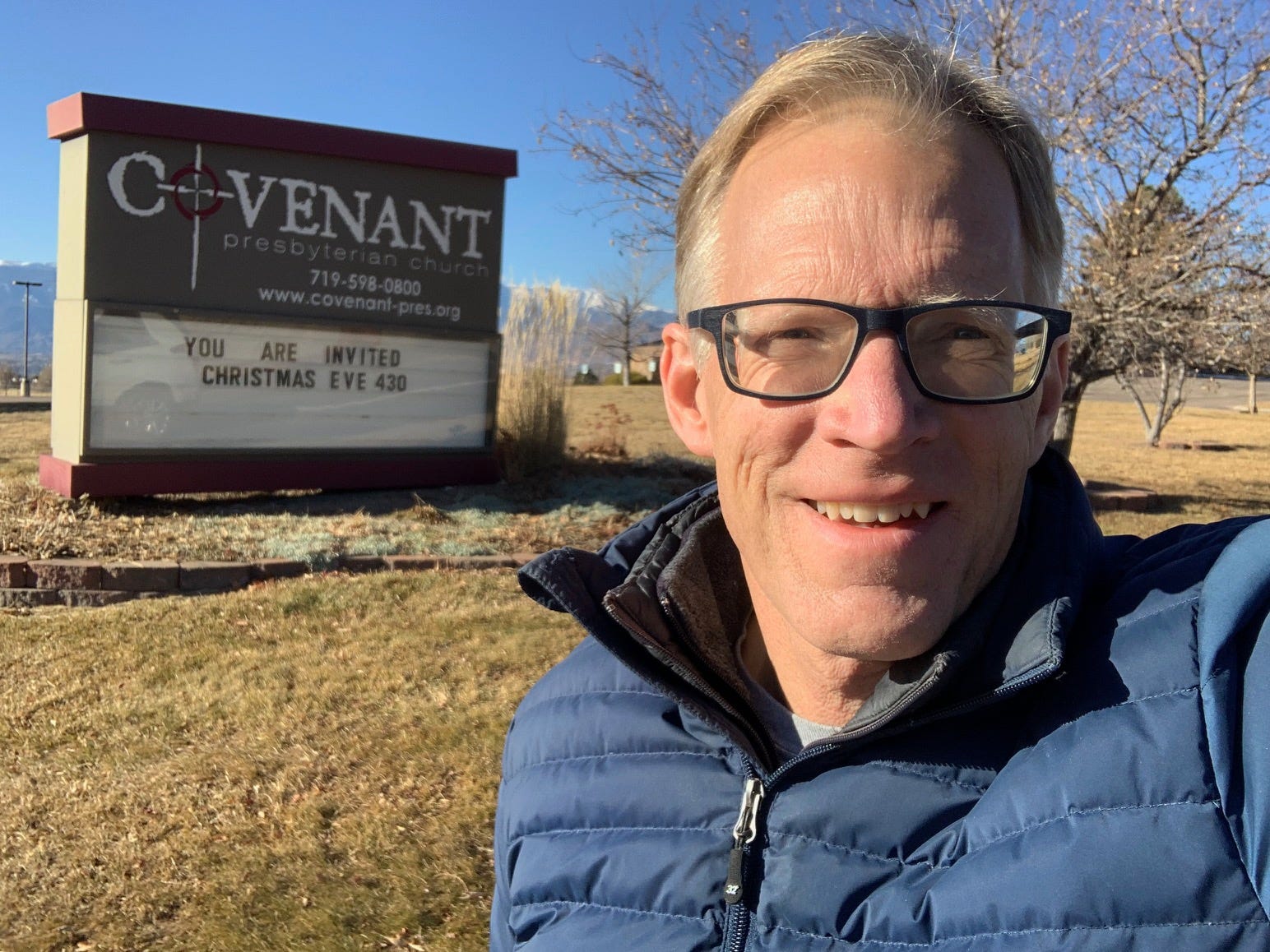
One of the things I’m most grateful for from 2023 is that Tamara and I have started attending church together. In our previous church I had a Sunday school class that I really enjoyed but for Tamara as friends had moved away from our church and the involvement of our kids had changed she found herself staying home to watch our 10-year-old on Sunday mornings.
Eventually Tamara began a process of trying to find a church that would be a place where she felt understood and connected. We talked about several possibilities, and I suggested a church I used to attend back when I first moved to Colorado Springs. Tamara started her search with that church and liked it so much she didn’t look any further.
So we’re now attending Covenant Presbyterian Church, though I’m also trying to join my Sunday school class at our previous church whenever I can.
It’s been a pleasure for Tamara and I to meet new people together as well as to get reacquainted with people I used to know a couple of decades ago.
As I talked to one of those friends from many years ago, and we got caught up on a few of the events we had missed in each other’s lives, I mentioned my trip to Dubai for the United Nations climate conference. He asked me, “Would you be willing to teach about that?” He explained that the church has a class for adults that meets on Sunday mornings. He thought the class would enjoy learning more about God’s calling to take care of creation.
As we talked about what this could look like he suggested a four-week series. I had to take a deep breath at the thought of coming up with four hours of content. At this point, creation care was a passion of mine that mostly involved soaking up as much knowledge as possible to satisfy my own curiosity. Saying “yes” to this class would force me to transition to learning for the sake of teaching others. For this reason, the opportunity seemed like a gift from God. I said yes, with both trepidation and excitement.
From that instant on, I have approached the creation care subject differently. When I read climate-related news, like a Wired article yesterday about how warming temperatures will affect farmers, I evaluate whether I might want to teach others about that, and if so I take notes about what I’ve read.
I’ve also done a lot of thinking about my audience. I’ve wondered, what might the people at this class want to know that they don’t already know? What might they want to discuss? In my little blurb to the class I asked, “Do you have questions about climate change? Have humans really caused it? Is there any hope for our planet? Does God have anything to say about this subject that could help us or guide us today?”
I also decided to divide the content up into these four parts:
--Week One (January 14): Does the Bible have anything to say about climate change?
--Week Two (January 21): Two reasons Christians owe the world an apology.
--Week Three (January 28): The latest facts about the state of the planet.
--Week Four (February 4): What can we do?
In future blogs I plan to share with you some of what we will discuss and learn together in this class.
Also, if you live in the Colorado Springs area, I want to invite you to come to the class. It will be held at Covenant Presbyterian Church, 2845 Parliament Drive, in rooms 208/209 from 9:00 to 10:00 a.m. starting on Sunday, January 14. It would be wonderful to see you there.
Finally, I want to share one nugget that I’ve been contemplating as I’ve been thinking about the subject of our first class. I heard this quote from a Christian college professor I met during my time in Dubai. We were sitting next to each other on a bus ride, and I asked him how he teaches his environmental studies class. He mentioned that the science and Bible verses are all useful, but the main thing is how people feel about the world God made. He quoted from Baba Dioum, a forestry researcher from Senegal who presented a paper at a conservation of nature meeting in India: “In the end, we will conserve only what we love.”
The professor told me that as a way to help students appreciate God’s creation in a tangible way he makes them try gardening. Some of his students have told him their favorite part of the class was the planting they did. The professor laughed at this, “Really?” he said. “When I made you dig a hole, that was your favorite part?”
Is it possible to help people develop a greater sense of love for God’s creation? I think it is, and I hope to start the four-week series this way. We might not dig any holes, but I have some other ideas.
No posts
Comments
Nothing yet. Say the first thing.
Sign in to join the conversation.