
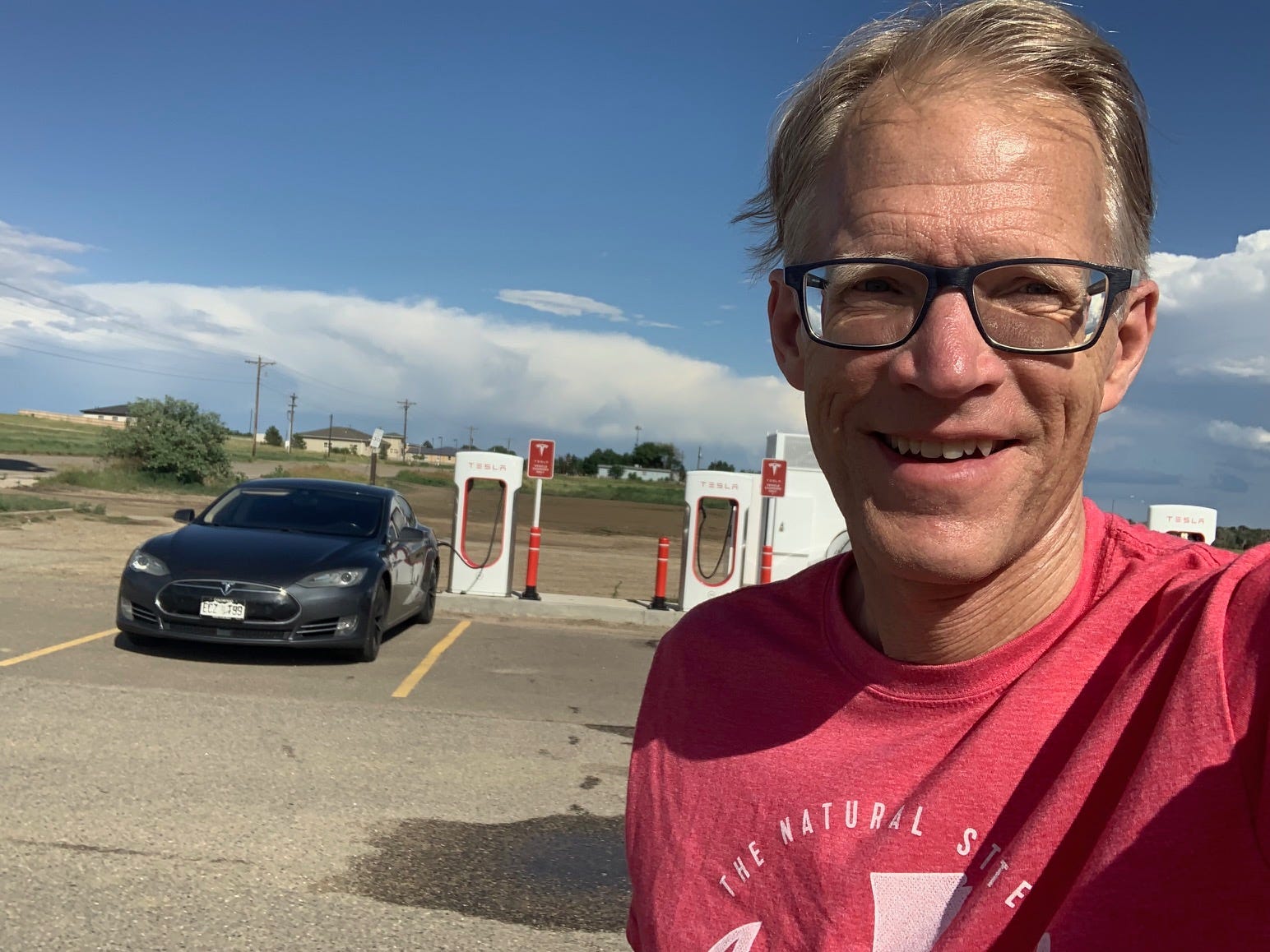
I’ve just returned from a 6,418 mile road trip in an electric vehicle, and I thought you might like to know what I’ve learned from it. From the people I met on my journey, I can tell there’s still some mystery around electric cars. A lot of people still wonder, are there enough charging stations to go where you want to go? And what are the risks? What are the chances of getting stranded in the middle of nowhere at a broken-down charger?
I certainly had these questions. I was intimidated about this trip and intrigued at the same time.
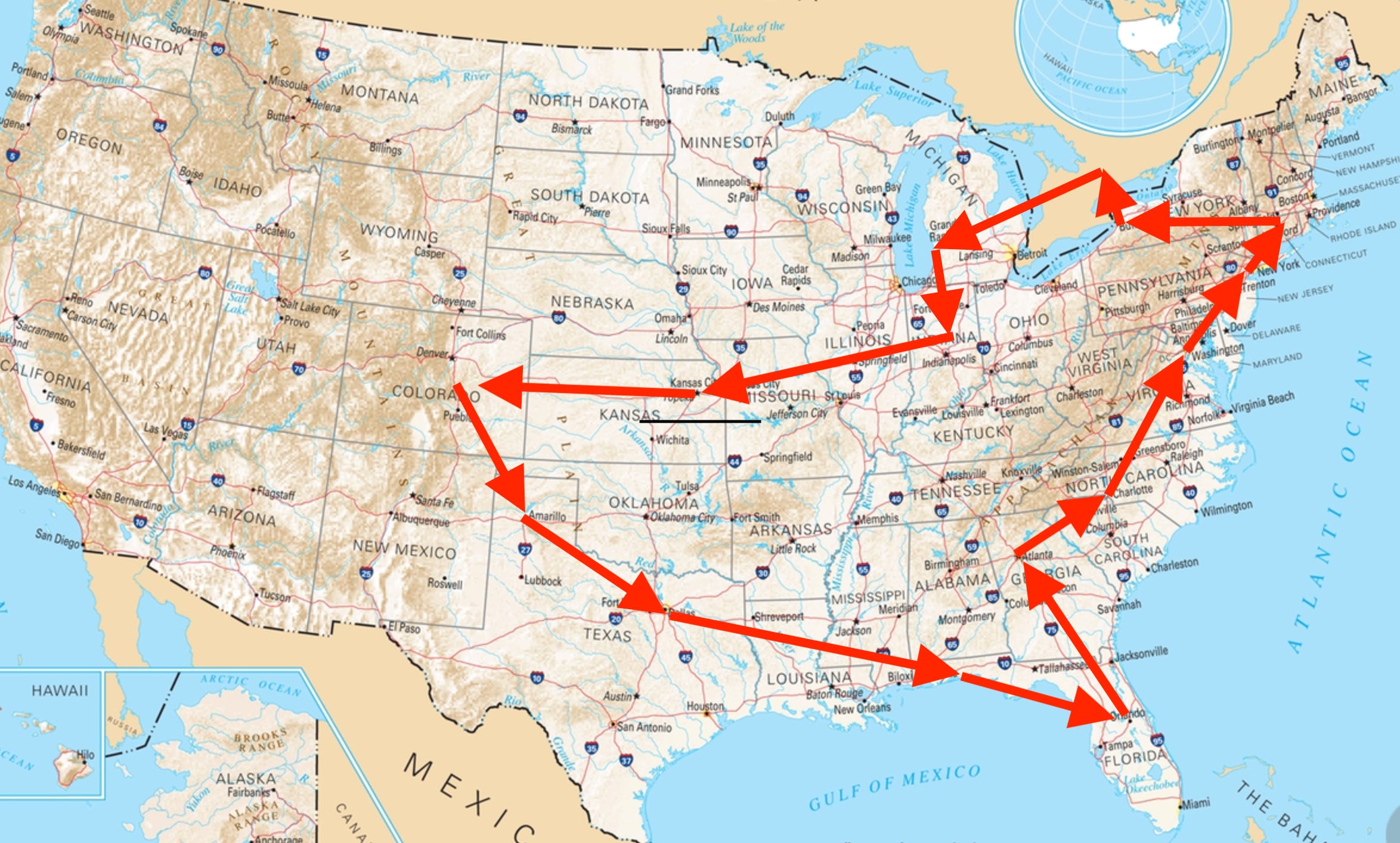
I decided to go, and to do it in our electric car, for three reasons. The first was that I wanted to visit people who have been an important part of my life, both friends and family. These people all live to the east of me and I last had a chance to visit them ten years ago. To see them all would require a vast loop covering half of the USA and even a part of Canada.
The second reason was to have a bonding experience with my 12-year-old son, who accompanied me on every mile, whether sitting next to me in the passenger seat or sprawled out behind me. For his sake, the trip included a stop at the beach in Pensacola, and visits to Washington DC, New York City, and Niagara Falls.
The third reason was to do something for the planet as an act of resistance. I could have taken our gas-powered car on this trip. It would have meant many less hours behind the wheel. But I chose to take the electric car because I want to do what I can to push back against what’s happening these days to the environment. Right now, climate-change deniers have the momentum in the USA. I want to do whatever I can to say, no, the science is very clear that greenhouse gasses are already bringing destruction to our planet. The warming climate creates intense storms, dangerous heat waves, and rising water levels. As a Christian, I firmly believe that I am called to take care of the world that God made. My response to that calling might involve making choices that feel personally uncomfortable, like taking a zero-emission vehicle out into the unknown.
As I pulled out of my driveway on June 16, I knew I was making myself vulnerable and also my son. Would our 10-year-old car break down? If so, how could I get Tesla service in places like rural Louisiana? What would I do if one of our run-flat tires picked up a nail? Worse yet, what would happen if I arrived at a remote charging station with 20 percent of battery left only to find that none of the charging stalls worked? How would I ever be able to get to the next charger, which might be 100 miles away? I knew that the trip would require me to visit 61 charging stations. It seemed like I would need a miracle to get back to this driveway after 22 days on the road.
Before I tell you what happened, I have to apologize about our car. We got an electric car because we wanted to do whatever we could to limit our contribution to the carbon dioxide in the atmosphere. We also have icy roads in Colorado and we felt safer getting a car with four-wheel drive. The only affordable car we could find that met both of those criteria was a Tesla, an old Tesla. That meant getting a sports car, because the old Teslas are all sports cars. By the time we bought the car two years ago the price had fallen a lot and with the $4,000 used EV tax credit it was quite affordable. We think it made a lot of economic sense to buy it. The cost of electricity is far less than the cost of gas, so much so that over the lifetime of the car we think we might save enough money on gas to equal the entire purchase price.
Unfortunately, and here’s where the apology comes in, the car doesn’t look affordable. To my eye, it still looks like an expensive sports car. For me, that’s a problem because I rely on donations to do my work. I don’t want anyone to think that I have wasted their money on a flashy vehicle. Taking the car on this trip meant some of our financial partners would see it in person. I decided to send them an explanation of the finances about the car in advance, so I wouldn’t have to awkwardly try to talk about it in person. I think that helped, although a couple of them laughed at my struggle with this issue.
With that, here are five lessons I learned from our marathon road trip in an EV.
When I first contemplated buying an electric vehicle, I thought of getting a plug-in hybrid. I figured it offered the best of both worlds. We could do most of our driving on the 30 miles of range the car offered on full electric, and then we could use the gas engine for road trips. I mentioned this thinking to a friend of mine who owns a full electric Nissan Leaf and he said, “No. Don’t get a hybrid. Go all the way and get an electric. You won’t regret it.” In the end, I took his advice, but secretly I was thinking, the electric car will be half a car. We can use it for running around town. For all the other stuff we need a car for, like road trips and towing a trailer and hauling seven passengers, we can use our gas powered vehicle.
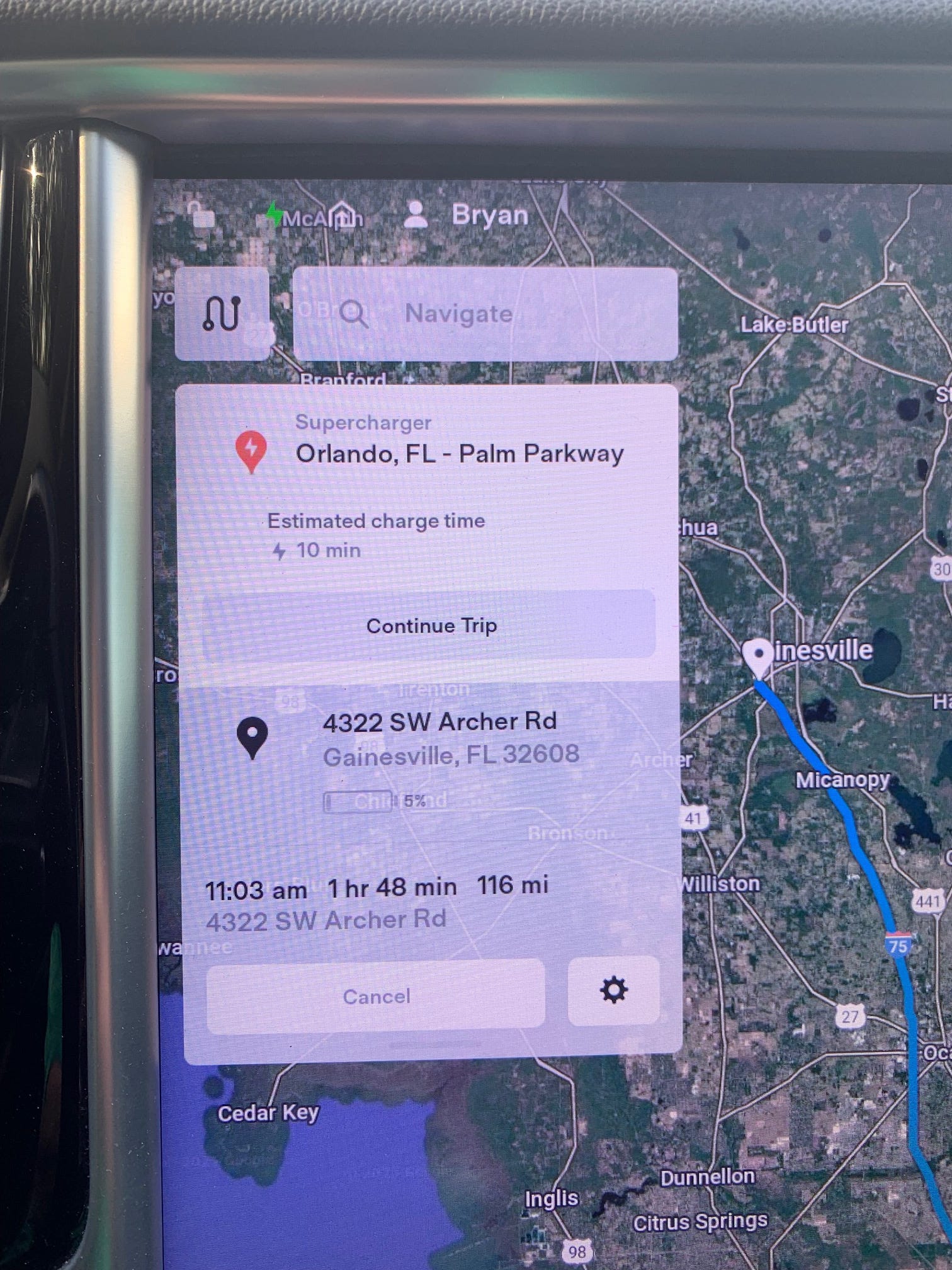
After 6,000 miles across the USA and Canada I think I can say that for most people, you can do a road trip in an electric car. Most people will take major roads and most will stay somewhere near towns and cities. If you do that, you will most likely find enough charging stations to get you where you want to go. If you’re going to go lots of miles through sparsely populated territory, then that might be a different story. My uncle, who is now retired from a career as a truck driver in Toronto, asked me, “But what about the north?” He explained that most Canadians live near the USA border. They would find enough charging stations. But what about those who live in the north? The reality is, for some people, the network hasn’t expanded far enough. For the majority, though, I think I can say, you can do a road trip. Tesla alone claims they have 70,000 charging stalls worldwide. They also claim a more than 99% up time. Increasingly, non-Tesla owners can take advantage of these stations. EVs are moving toward the Tesla plug standard, and there are adapters for non-Tesla plugs. On our trip I shared charging stations with a Ford Lightning, Rivians, Kias, and Hyundais.
One of my greatest fears for this trip was coming to a non-functional charging station. A couple of times I thought I had. In Concordia, Missouri for example, I came to a station with eight stalls and no one else there. I backed up to the first stall. Nothing happened when I plugged in. No blue light showing that it was talking to Tesla. No flickering green light showing that juice was flowing. Just black. Second stall, same thing. Third stall, same thing. Now I was worried. I had googled the reviews on every one of the 61 chargers I planned to stop at. I wanted to make sure each one worked. But maybe they shut this one down since the last review. On the fourth stall, blue light and green light! I raised my hands and said, “Hallelujah!”
For me, the fact that I can do a road trip like this means my car is not half a car. If we had to have only one car my wife and I would choose an electric. For those who need to haul seven passengers, some EVs offer that now. For those who pull a trailer, that’s a little more complicated. I didn’t see many people pulling trailers on my trip. Part of the problem is finding a way to plug in to a charger while towing a trailer. Another problem would be the reduction in range from towing a trailer and another problem, for campers, would be finding a charger near enough to the remote places where people like to camp. But I think for some people it could still work.
I suppose you could just jump into an electric car and use the car’s navigation system to find places to charge, but I think you would be taking too many risks. I’m a planner by nature, so I put a lot of time into thinking about the trip before we set off. It took time to look at the reviews for 61 charging stations, but I was very, very glad I did. It gave me peace of mind as I drove along and watched the battery percentage drop.
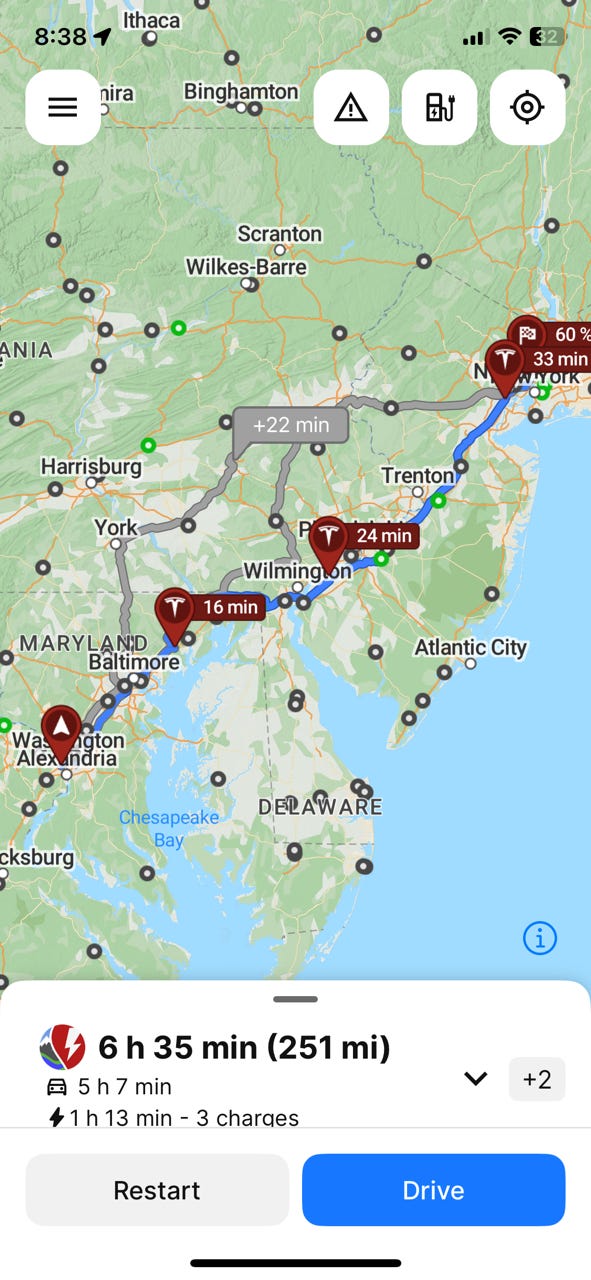
There are some good tools to help a person plan a road trip with an EV. My favorite tool is an app called A Better Route Planner. I used this tool to rough out the trip, getting an estimate of how long it would take to go from place to place in an electric car. Then when I had specific addresses, the app could tell me exactly where to charge, how much battery percentage I would have left at each charger, and how much range I would have in reserve when I reached each destination. The tools in the car helped too. I put in each destination into the navigation system and if I was wondering if a headwind was making me use too much electricity I could bring up a chart that would show the estimated energy use for the trip compared to my actual use. If I was worried about doing more poorly than anticipated, as I was a couple of times, I could drive a little slower.
I’m notorious for pushing my passengers hard on road trips. One of the people we saw on this trip was our grown son who lives in Indiana. He reminded me how on a 12 hour journey we would only stop twice and the kids knew they had 15 minutes max to go to the bathroom, fill up their water bottles and buy a snack with the $5 I gave them per day.
Now, with six charging stops of 20-40 minutes each on a 12-hour journey, I could be more civilized with my son. We could walk around. I could make lunch for myself or him. We even threw a hackeysack back and forth one time in a green area near a charger. It was easier on my body, I had time to stay connected to people who texted or emailed me and I just had a break from constant driving. I can honestly say that I almost never watched the time remaining on a charge with impatience. There was almost always something I wanted to do. On the last day, for example, I took a walk because my back was hurting. I followed a dirt road that led me to the edge of a vast corn field. I was struck by the sound it made. As the wind blew over the fat leaves they rustled and taken together over acres and acres the sound was full, almost like ocean waves. I’ve driven past thousands of corn fields, but I have almost never stood near enough to listen to one of them. I can thank my electric car for that!
In my experience, when you do something to care for creation you put yourself in a position where you could talk about it. For me, taking an electric car to go and visit so many family and friends created more opportunities to talk than I expected. I got the impression that many of the people I visited have been thinking about electric vehicles but they might not have had many people to ask about it. Almost everywhere I went the people I visited made a point of asking me about my car. One person asked, “How much extra electricity do you use now that you plug in an electric car?” Another person said, “I’ve heard these cars are fun to drive. Is it fun to take one on a road trip?” Another person asked, “Why would you do this? Why would you take a car that requires so much extra time to charge up?” Someone half-joking said, “Has anyone attacked your car because it’s a Tesla?” Katharine Hayhoe, a Christian climate scientist, says the best thing we can do to care for creation is to talk about it. Taking an electric car on a road trip provided a lot of fun ways to talk.
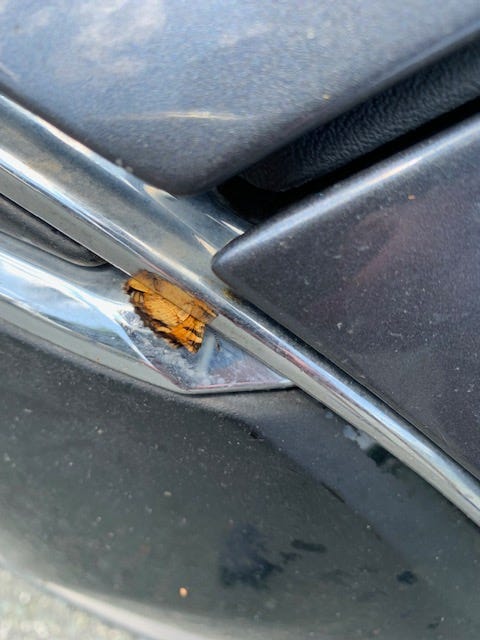
One of the things I find really creepy about the destruction humans have done to the planet is not so much that whole categories of things have been wiped out, like all bats, but that there are fewer of so many things. It’s like a sci-fi movie where everything looks normal but all the people are gone. There are staggering statistics about this. Many studies show that insect populations have declined 45 percent in the last four decades. A huge research effort revealed that the numbers of vertebrates (mammals, fish, birds) have shrunk by 60 percent since 1970. So when I look at my backyard, it might be that I’m seeing half the bees I would have seen in 1970, and half the butterflies, and half the birds. I thought about this statistic when I stopped and looked at the relatively clean front of our car. It certainly doesn’t prove anything, but compared with the experience I had decades ago with road trips I took with our older kids, there used to be carnage on the front of the car when we stopped.
We have lost so many insects and so much wildlife. I find this tremendously disheartening. We humans simply must use our brains to figure out how to live with animals and plants in a way that encourages their flourishing and not their destruction. We can figure this out. Climate change is one part of the reason for biodiversity loss, so driving an EV does help.
One of the features of our car is its license plate. It’s a black and white nighttime picture of a wolf. The people who choose these plates agree to pay an extra $50 per year to support the reintroduction of wolves to Colorado. It’s not been an easy process. Despite efforts to keep wolves and livestock separated, some cattle have been killed. Ranchers need to be compensated, and this plate helps raise money for this. We contribute to this cause because we believe humans need to learn how to live in harmony with animals and plants and the rest of creation. It’s not simple, but God has given us good minds.
He also gives us his grace, which I suppose can mean freedom from accidents and breakdowns when I have done nothing to deserve it, and I was praising God for that as my son and I pulled back into our driveway.
No posts
Comments
Nothing yet. Say the first thing.
Sign in to join the conversation.