

As I was getting ready to head to Dubai for the UN climate conference, it occurred to me that I would be writing things in my blog that would make you wonder just where I stand on the issue of climate change. So I decided to try to sum up my views. In my post I tried to cover the subject quickly because I didn’t want to give the impression I would be writing long essays every time I posted something on this blog.
But in hindsight I left out a key piece of information. One of my friends asked me about a chart I included. I’ll include that chart again here so you’ll know what I’m talking about. The chart shows levels of carbon dioxide in the atmosphere over time. On the chart it’s easy to see that the carbon dioxide level fluctuated in a certain range over thousands of years and then starting in the 20th Century (the graph shows 1950), after a century of burning a lot of fossil fuels, it shows very rapid increase to almost 1.5 times the saturation it ever had.
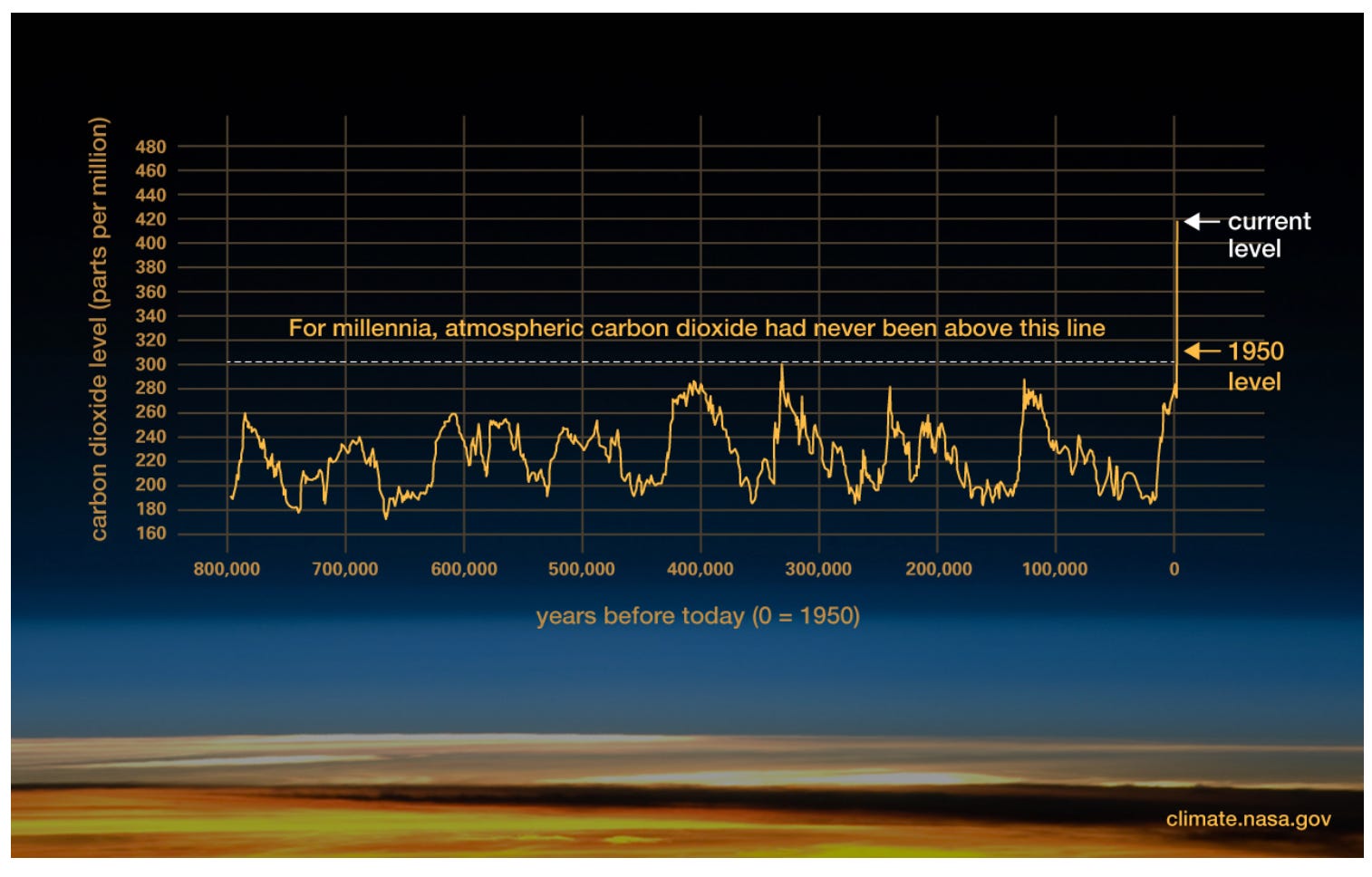
I think it’s a chart that shows pretty clearly the huge increase in the amount of CO2 in the air as a result of human activity. But the aspect that makes the chart seem fishy—in spite of the fact that it comes from NASA, a pretty reliable source—is the number of years. The chart goes back 800,000 years. My friend asked, and it’s a very good question, how could we possibly know the CO2 level of a time hundreds of thousands of years ago?
The answer lies in the ice at the poles. If you drill down in the right part of an ice cap, the part that doesn’t flow in one direction or another, you can pull out a tube of ice, called a core, that dates back incredibly far into history. In fact, Ben Richards, the climate scientist I work with, told me a team is now trying to get a core that will go back a million years, the oldest ever. You can often tell exactly how far back in history the core goes by measuring the lines from each year. When snow falls and is compressed over the course of a year it makes a line in the core. For recent years, Ben said, a person can actually see the lines and can count them. Deeper in the ice, further back in history, when the ice is under greater pressure, the scientists run a probe over the core to measure the annual variations and count the years. Also every now and then they find a layer of volcanic ash from a big eruption—and because each eruption’s ash is unique, these can be used to compare different ice core timings exactly. When they get to a year or section of years they want to analyze, they cut that section out, put it in a vacuum chamber, melt it, and measure the gasses present in air bubbles trapped in the ice. They can measure carbon dioxide and methane levels in parts per million.
You might wonder how the scientists know they haven’t made some mistake. Ben said first of all they test recent years and compare their findings to the CO2 levels measured from the air for each of those years to make sure their results match. They also can compare results from other ice cores. Ben showed me a fascinating chart that shows the CO2 levels over tens of thousands of years as measured from cores taken from the Arctic (Greenland) and the Antarctic. The results almost completely match.
As you imagine me talking to Ben about this, I want you to picture him sitting on one side of the Dubai metro train and me sitting on the other, talking louder and louder as more and more people filled up the car. It was fascinating for me to learn more about this science and maybe anyone who spoke English near us learned something too—they certainly seemed to be interested. I hope you find it helpful.
If you would like more information about ice cores, here are a few sites Ben recommended:
https://climate.nasa.gov/news/2616/core-questions-an-introduction-to-ice-cores/ A nice story-style introduction.
https://icecores.org/about-ice-cores Lots of information, pictures and videos of the process of extracting an ice core.
https://en.wikipedia.org/wiki/Ice_core Lots of technical aspects of the ice core interpretation, as well as narrative of several specific projects.
No posts
Comments
Nothing yet. Say the first thing.
Sign in to join the conversation.