
Hey! 👋
Welp, it’s been a few months since my latest post. And over the past few months, I’ve realized something that’s been hiding in plain sight.
Whether I’m coaching engineers, leading teams, building AI tools, or reading leadership books... I keep running into the exact same problem.
Communication.
Not talking more.
Communicating better.
Doing great work has never been enough. The people who consistently create opportunities for themselves know how to make their impact visible. The same is true for teams. And, as I’m learning, it’s true for AI too.
Three very different experiences this month drove that lesson home.
Let’s dive in. 👇
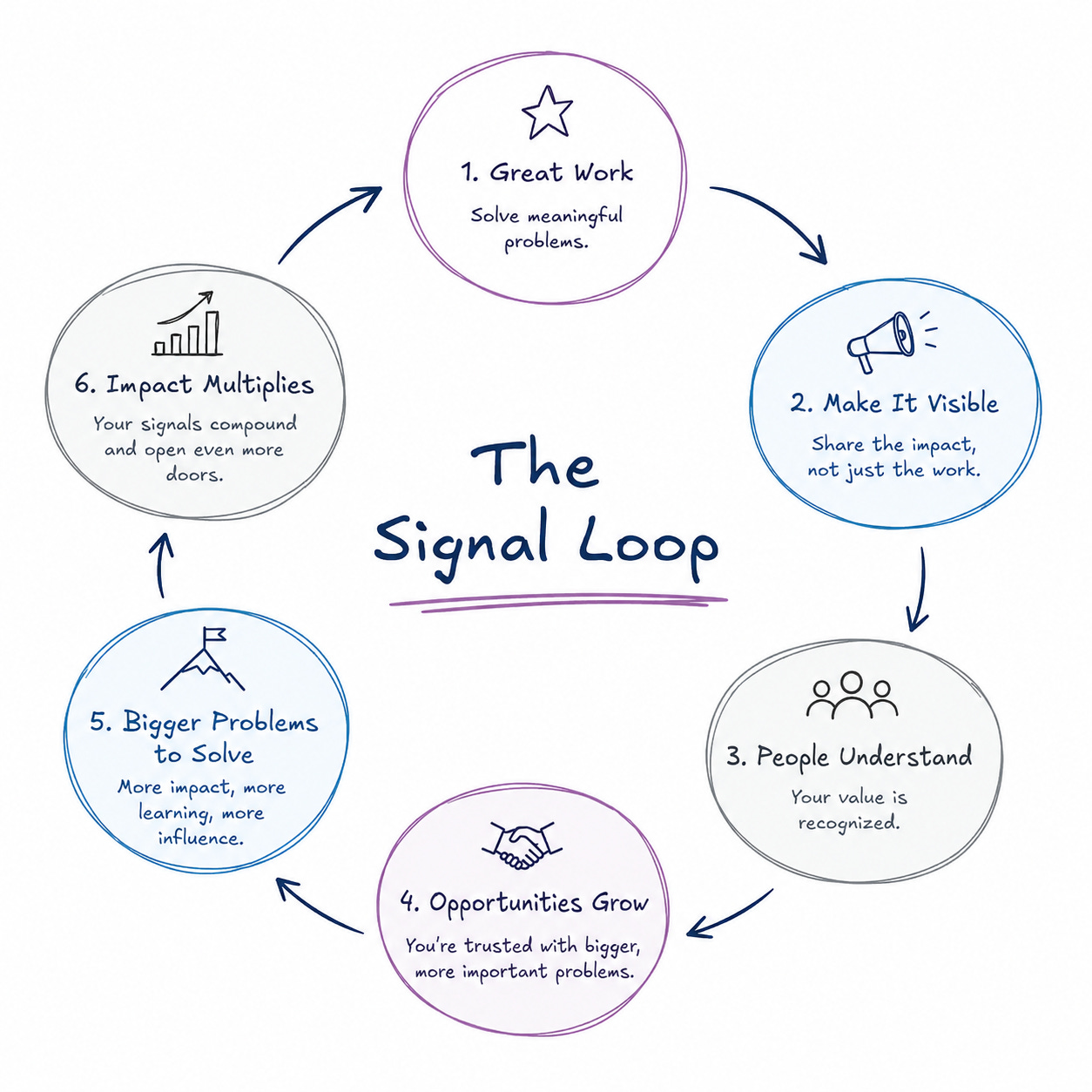
My latest blog post, "Invisible Signals: Why Smart Engineers Still Get Overlooked” came from reviewing résumés and helping coach engineers prepare for interviews.
I’d finish reading a résumé from a talented engineer and still be left wondering...
What actually changed because you were there?
Most people dedicate huge portions of their résumé to what essentially boils down to recreating a job description. And then during the interview phase, if you ask, “Tell me about yourself and your work at your current company,” they spend ten minutes regurgitating facts about how they solved a problem but almost no time explaining why it mattered.
Meanwhile, the impact—the part people actually make decisions on—gets buried. People can’t evaluate what they can’t see.
That’s what Invisible Signals™ is really about.
It’s not about learning to market yourself or inflate your accomplishments. It’s about making the value you already create easier for other people to recognize.
The more I’ve thought about it, the more I believe this is one of the most overlooked career skills in engineering.
👉 Read the full article here:
https://annycedavis.com/2026/06/invisible-signals-why-smart-engineers-still-get-overlooked.html
Surrounded by Idiots - Thomas Erikson
Someone recommended this book to me in a one-on-one. I came for the title. 😁 I stayed for the content.
Erikson introduces four broad communication styles (Red, Yellow, Green, and Blue). Like any personality framework, it’s an oversimplification. There are, of course, caveats, nuance, etc. But it’s been really useful as a reminder that people don’t hear the same message the same way.
One quote, in particular, has stuck with me:
“What remains of what you said to someone after it has been filtered through that person’s frame of reference, views, attitudes, experiences, prejudices, and preconceived notions is ultimately the message that has been understood.”
I know this, but how often do I consider it before opening my mouth? 👀
As leaders, we often judge communication by what we intended to say. Our teams experience it based on what they actually heard.
That distinction matters.
I also wasn’t surprised to discover that I’m primarily a Red personality: direct, decisive, fast-moving, and focused on solving problems. What surprised me was reading how those same behaviors can be experienced by everyone else. 😥
What feels like clarity to me can feel abrupt to someone else.
What feels like urgency can create anxiety.
What feels like decisiveness can leave people feeling unheard.
None of those things are ever my intent — but intent isn’t the same as impact.
That’s become one of my biggest leadership takeaways this year. Great communicators don’t just deliver the perfect message. They adapt the message so the other person can actually hear it.
Thanks for reading @brwngrldev! This post is public so feel free to share it.
Over the past few months, I built an AI-powered automation to streamline our monthly business process reviews. It gathers data, synthesizes progress, and generates a polished presentation in minutes.
The automation worked. Honestly better than I expected. But the technology wasn't the interesting part. What fascinated me was everything that happened after.
Some teams immediately embraced it.
Others questioned it. And that’s likely an understatement. They picked apart every last aspect of it: the input, the AI-generated summaries, the format of the generated deck. To me, it seemed like they thought I made the worst tool to ever see the light of day.
Then there was the third group who realized their project data wasn’t detailed enough to generate meaningful insights. But they were willing to give it a try.
Same tool. Completely different reactions.
Besides gaining one more gray hair, it reminded me that AI can accelerate communication, but it can’t create understanding.
AI isn’t replacing communication. If anything, it’s exposing who’s actually good at it.
The AI tooling can generate a polished presentation. But what it can’t do is tell the full story behind it. It can’t answer your boss’ follow-up questions or explain why a tradeoff was worth making. At least not yet.
That’s still our job.
Ironically, it’s the same lesson behind Invisible Signals™. Whether you’re interviewing for your next role, presenting to executives, or leading a team through change, people don’t make decisions based on everything you know.
They make decisions based on what they understand.
And that's a communication problem—not a technology problem.
This month started with what felt like three unrelated topics:
Writing about Invisible Signals™.
Reading a book on communication.
Experimenting with AI at work.
Somewhere along the way, I realized they were all teaching me the same lesson. The people who create the biggest impact aren’t always the smartest people in the room. They’re the ones who make their thinking visible. That’s a skill worth practicing.
If you’ve seen examples of “invisible signals” in your own career—or you’ve been thinking about how AI is changing the way we communicate—I’d love to hear your perspective.
Until next time,
Annyce
“My mission in life is not merely to survive, but to thrive; and to do so with some passion, some compassion, some humor, and some style.”
- Maya Angelou
Links:
https://www.linkedin.com/in/annycedavis/
https://bsky.app/profile/brwngrldev.bsky.social

No posts
Comments
Nothing yet. Say the first thing.
Sign in to join the conversation.