
In our last post, we talked about how mallets work best with upright lie angles. But what if your body type and posture require longer putters with flatter lie angles? In this situation, we look at blades or designs with the center of mass closer to the face. This is based on the assumption that a flatter lie angle creates a more shallow stroke plane.
Hot Take Alert! The putter head does not always move on the same plane as the shaft. You can easily have the putter head travel on an upright arc plane with a flat lie angle. Conversely, with arched wrists and an upright lie angle, you can create a very shallow arc plane. This is, of course, due to the complex angles involved in a putting set-up. The number of ways we can move is basically unlimited. It is because of the complex angles that different styles prefer different putters. This preference is normally dictated by how the putter feels in response to how you move. Torque is an awful description. To help understand what is going on, I prefer to think in terms of resistance. Some putters resist the motion, some putters move freely with the motion. Blades move freely
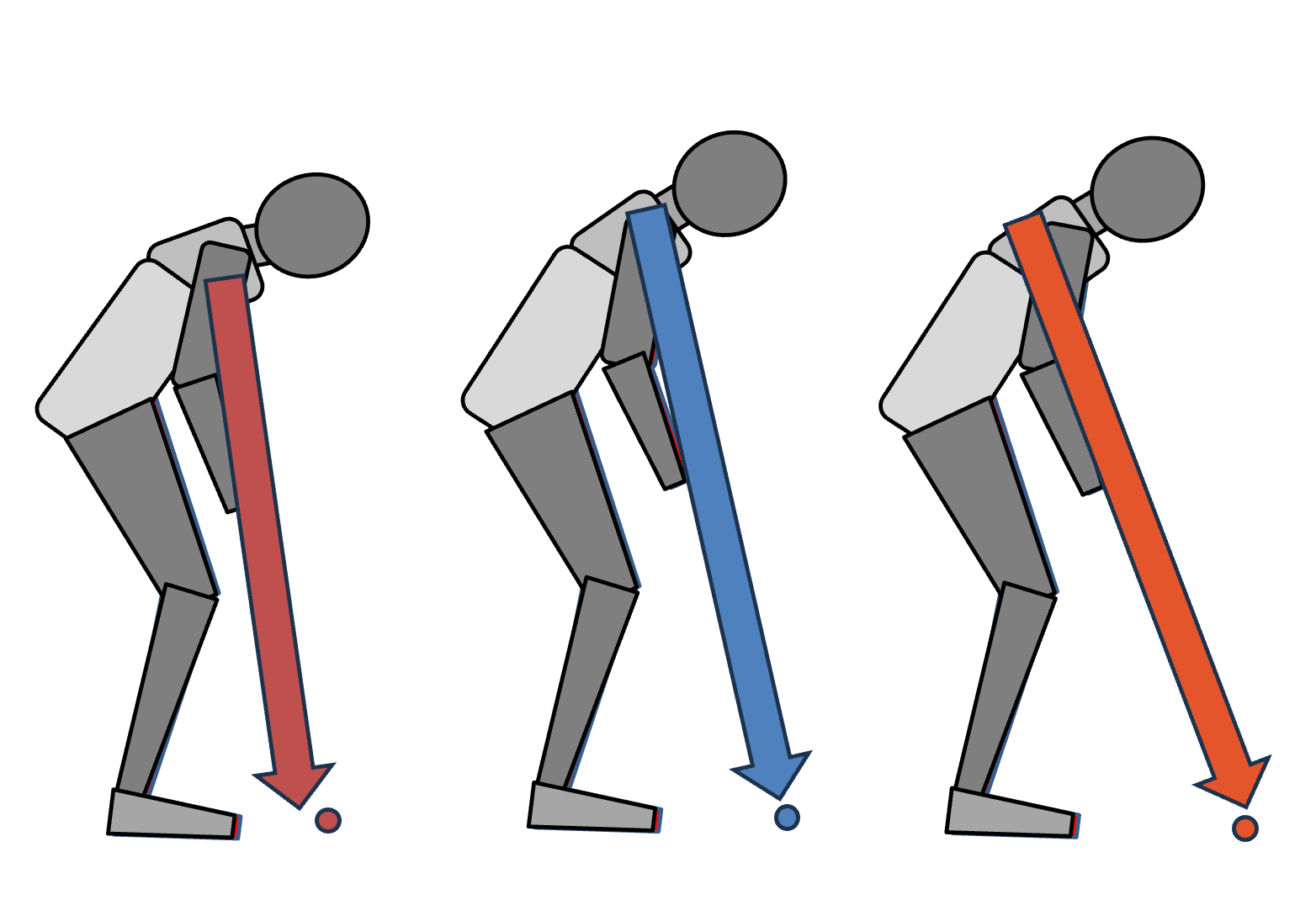
.
As the stroke plane is more shallow than the lie angle, or the player swings the putter in a different direction than the body is aligned, we like to reduce the resistance to the motion to allow for what can be a more complex motion. A simple rule of thumb? The more the putter hangs toe down, the flatter the lie angle where it works best. When you play a putter with a high degree of toe hang in an upright lie angle, the putter least resists the heel moving first, closing the face as the putter swings back. My old boss and mentor used heel-shafted, full toe hang putters with a square-to-square strategy the majority of his career. He was not alone. In every case I am aware (more than a few), it was combined with a posture very close to the ball, creating an upright stroke plane. Our theory is because there is very little resistance to rotation in any direction, these face-aware players could more easily sense the position of the face during the stroke.
Example Far Right Player is 6’3” tall with a wingspan 2 inches shorter than his height, with broad shoulders and chest. His visual requirement is 14° off the ball. To fit the visual and body type, he plays a putter 37” long at a 66° lie angle. Profile 8. He has tried every putter ever built. Always comes back to the blade and currently uses the Burnt Edges, heel hosel bias 320 gram head with around 75° of toe hang. At a 66° lie angle, the toe of the putter moves freely along the arc path with no resistance. So instead of closed to open in the first example, it now can easily move open to closed.
Note. Whenever you see a demonstration of the blade swinging shut, it is moving on an upright plane.
While it is fun for me to discuss the merits of different putters, at the end of the day, what we are looking for is, “What putter design is easiest to strike the ball on the sweet spot of the face?” Playing the miss is a path to average. Go into the decision without the influence of marketing or hype. What do you do and what do you need to be your best at what you do!
In the next series of articles, I am going into some depth on why my putters were designed and built the way they are. I will refer back to past articles often. I hope you will follow along. It is probably the most comprehensive sharing of information concerning a company’s putter designs ever. All the strengths, the weaknesses, everything is on the table. If you are new to this site, I hope you will stick around. If you are a long-time follower, thanks and buckle up.
No posts
Comments
Nothing yet. Say the first thing.
Sign in to join the conversation.