
The golf world is a hot take community. We listen to what gets our attention in a short form rather than understanding a concept in depth. Advertisers know controversy gets our attention, popularity wins over proficiency, the loudest voice influences which leads to more follows for the author and a false appearance of credibility.
We can see examples of this every day in the conversation of blade vs. mallet. Here is a hot take. Everything in golf can work if you know how to do it or use it. What makes a technique or club choice better is the individual not the strategy or popularity. In the mallet/blade discussion, there are examples of great performers using either model. What I have come to believe is this is not interchangeable. I can’t imagine In Bee Park using a blade, nor can I picture Brad Faxon using a mallet. The current popular trend is mallet. Driven by the success of a couple of different players and the marketing power of their success. But what about the players using mallets because of the power of suggestion and not from better understanding. For years I have called this the lemming effect. One leads and we all follow, even if that means going over a cliff.
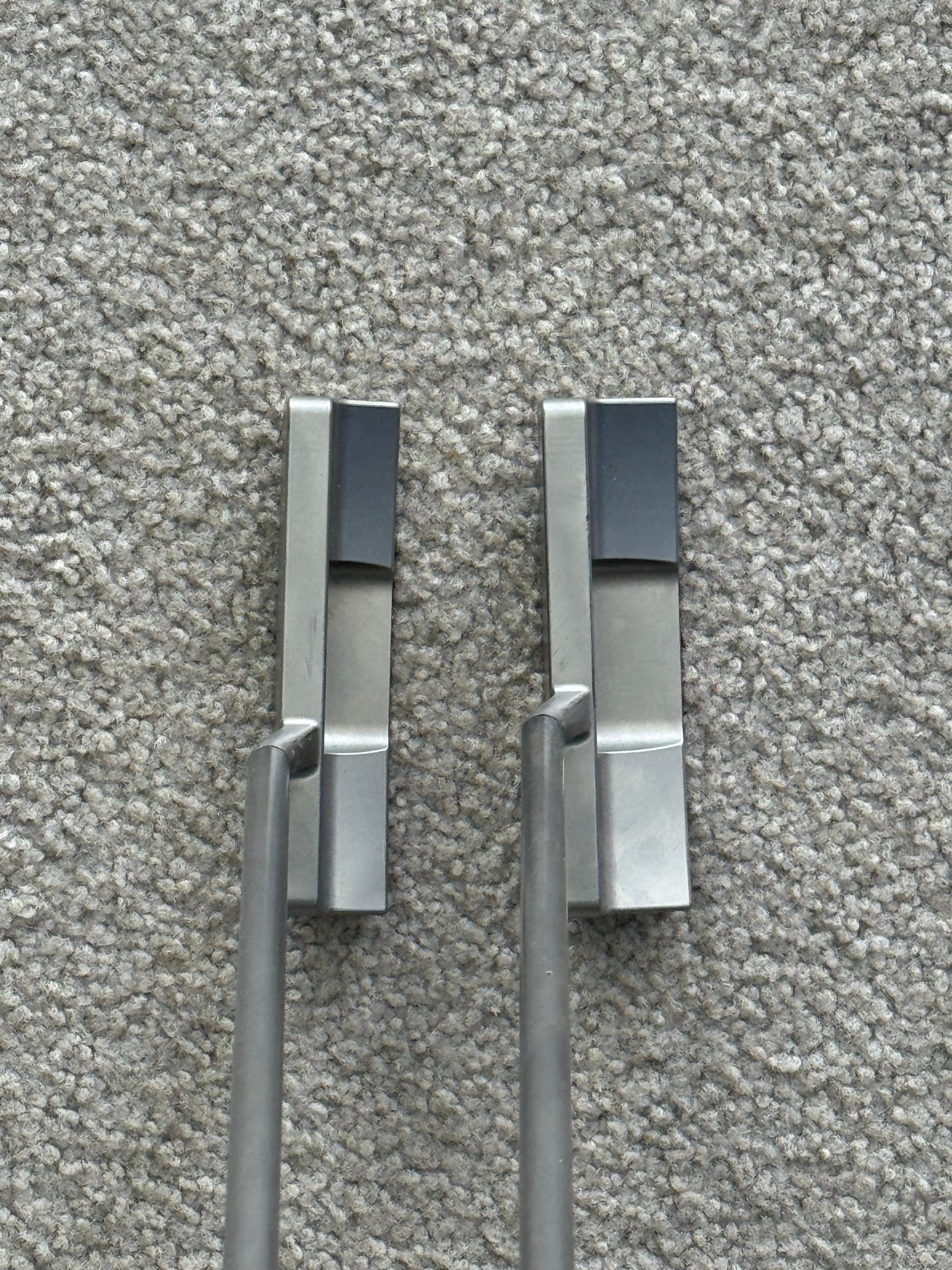
BURNT EDGE PUTTERS
LEFT-BIG ARC FACE AWARE RIGHT-MINIMAL ARC PATH AWARE
For the sake of clarity, with no influence from preference, what is it that separates the mallet player from the blade player? In a previous newsletter I talked about the difference between the face aware player and the path aware player. I don’t know how to emphasize how important this distinction is in trying to help you break the average barrier. That categorization is the priority once we find an appropriate ball position and posture, and the deciding factor in what putter we suggest.
This is going to take more than one post, but let’s start with how putters are designed to be swung. If we build a putter with a higher moi or resistance to twisting (mallets) we are going to be more path aware because we sacrifice the feel of open or closed during the stroke. We have come to understand this as low torque. I prefer stability along a tilted plane as better explanation to a path aware player. Path players have a technical advantage on shorter putts, where the shorter stroke minimizes the amount of rotation required. With this player I spend a lot of time helping speed control issues
But what about the player where the focus is on the movement of the hands. One that uses the movement of the face to control the strike. When mastered this is very versatile strategy and adapting to different conditions is much easier. Rarely, do I work with a face aware player who struggles with speed control. It seems the awareness of the face of the putter also improves the feel of the effort and hand speed required. My focus for this player is finding square to the target within the movement. This always easier when we have a blade or style that provides more feedback. Horrors! I need the torque.
My point is there is weakness in any technique. That takes us back to the idea of it can work if you know how to do it. For me this means the player dictates the help. I don’t know the best course of action until you show me. Impossible to it in a short form environment. More soon. Thanks for your patience. I appreciate you all more than you know. I hope if you find some value you will share it with a friend. More subscribers motivate me to share more.
No posts
Comments
Nothing yet. Say the first thing.
Sign in to join the conversation.