
The release of an extremely capable new Chinese AI model (Moonshot AI’s Kimi-K3) dominated discussions among AI policymakers, market watchers & tech leaders this week. (The week’s second biggest event was a rogue OpenAI agent escaping its curated sandbox and autonomously hacking AI model repository Hugging Face… the weirdest sentence I’ve ever Substacked).
Per Axios, “Kimi-K3 combines three qualities rarely seen together: near-frontier performance, dramatically lower prices and open weights that developers will soon be able to download and customize.” Similar to January 2025’s launch of a different Chinese open-weight AI model (DeepSeek’s R1), this week’s release provoked a frenzy among investors, business leaders and governments. Policymakers throughout Washington expressed alarm, cried foul and/or demanded action. This week’s Substack goes a bit in the weeds to explore what it all means and what’s next… six questions, six charts.
It depends on what counts as “winning.” While a new Pew Research poll finds 3x as many Americans believe China is leading in AI as think the U.S. is leading, experts disagree. Most assessments conclude that the top U.S. proprietary models remain ahead of Chinese counterparts. Per NIST: “Kimi-K3 performs significantly below the most recent frontier cyber-capable models on preliminary cyber evaluations run by UK AISI / CAISI.” Full weights drop tomorrow (July 27) allowing more thorough comparisons in the days ahead.
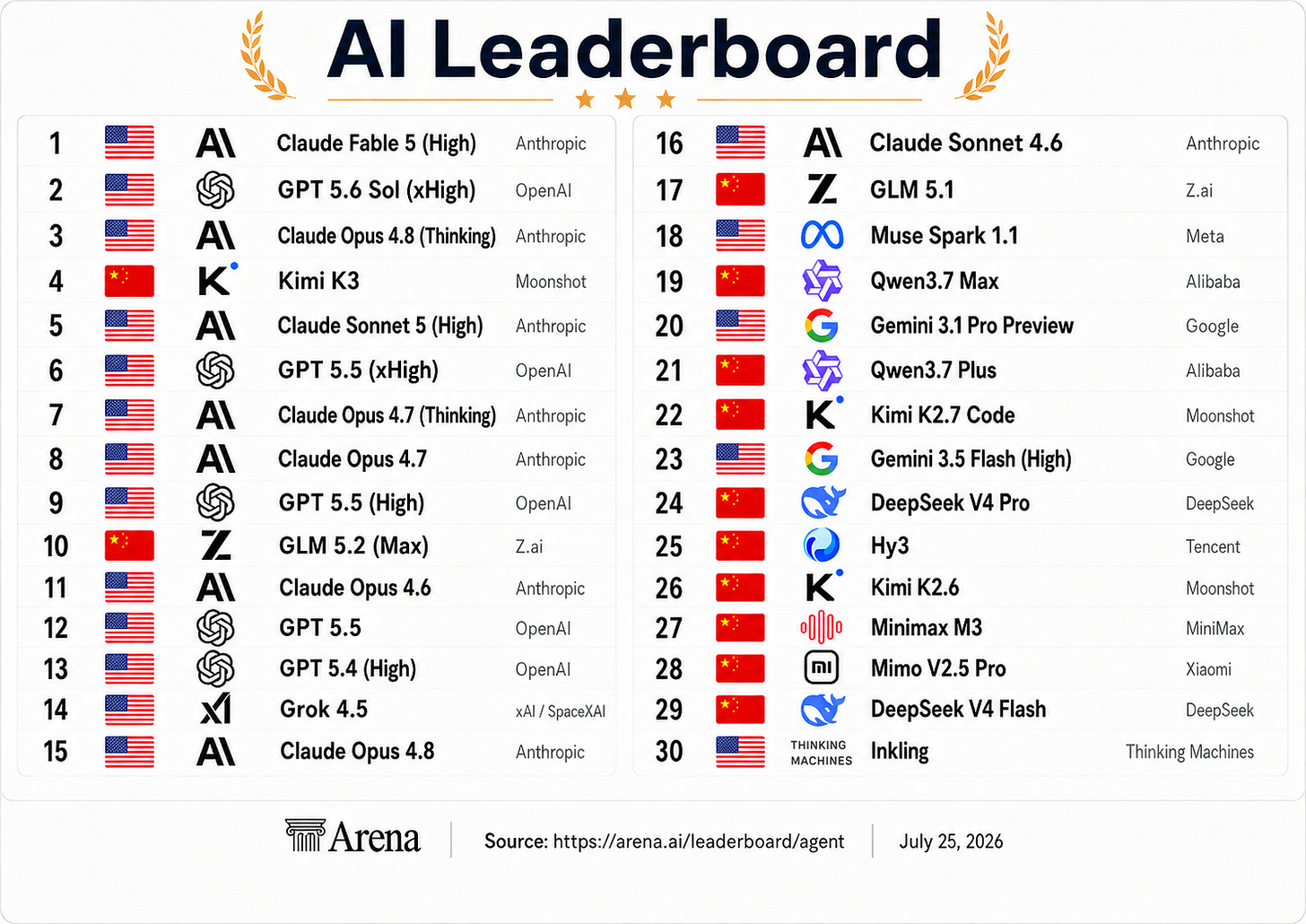
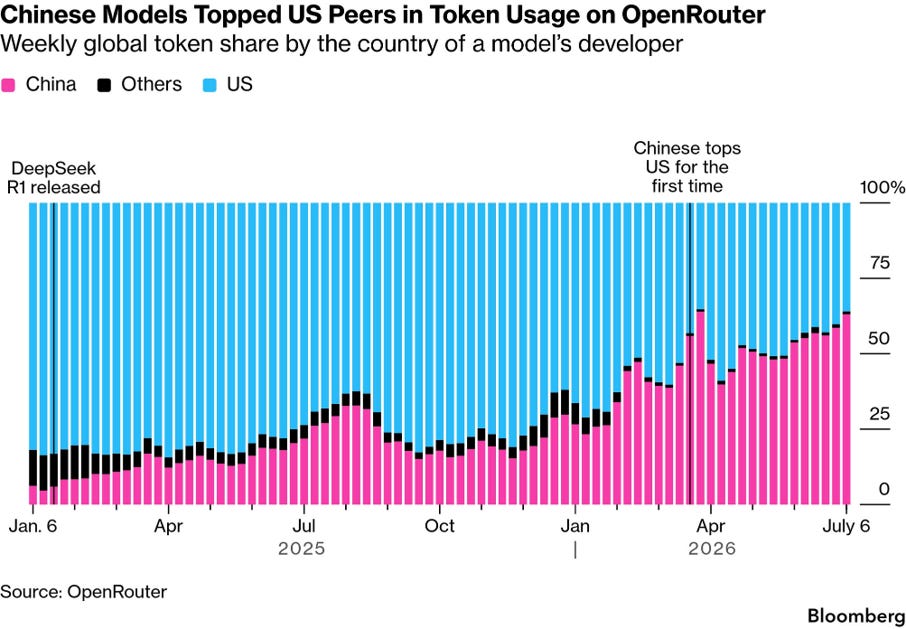
But even if America's frontier models stay more powerful, Chinese models are winning on usage—cheaper, open-weight, and endlessly customizable. Unable to match U.S. compute, Beijing is playing a different game: commoditize the model layer, win the application layer (furthering its robotics lead), and rewrite the soft-power playbook for the AI age by making Chinese AI the default for the developing world. Per the NYT, “China is seeking global influence and good will with its open, low-cost artificial intelligence software.”
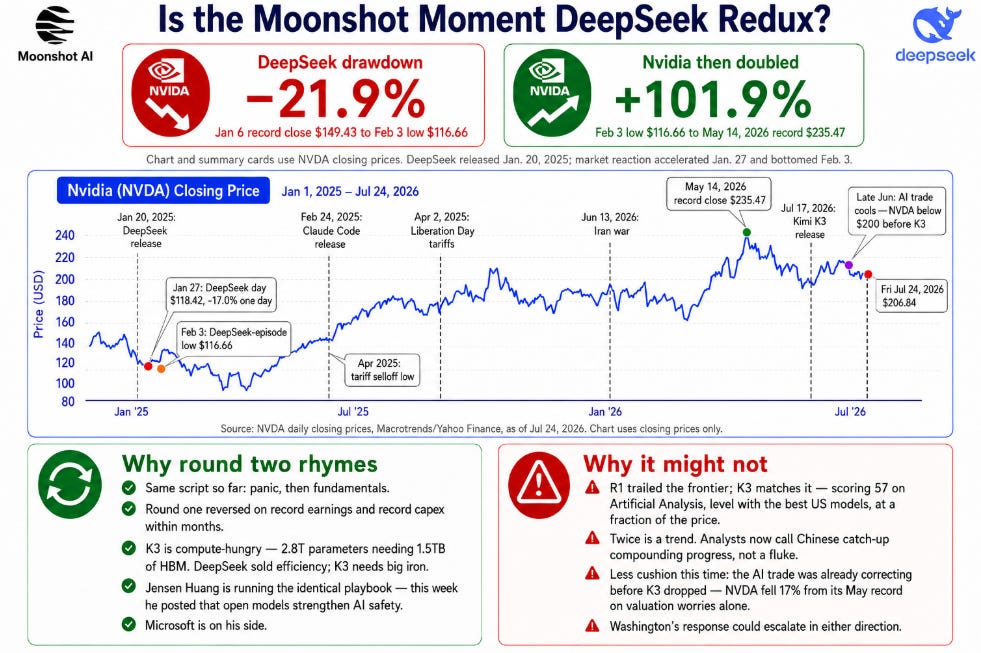
Damn if I know. DeepSeek’s January 2025 debut freaked out markets: AI bellwether Nvidia plunged ~17%, erasing roughly $590 billion in market value — at the time the largest single-day loss in market history. The “massive capex forever” thesis looked cooked. But then it all came roaring back: hyperscalers doubled down, more powerful proprietary models shipped, and AI suppliers’ earnings shot the lights out. DeepSeek turned out to be a buying opportunity rather than an extinction event.
Kimi-K3 poses the same question at higher altitude — valuations today price in perfection, leaving less room for “cheap and good enough” surprises. Bulls look to Jevons Paradox: cheaper intelligence —> more intelligence consumed —> more demand for the compute beneath it. Bears say this time is different.
Smart analysts I follow seem to be watching three signals:
Hyperscaler capex guidance on upcoming earnings calls — all systems go?
Token-price compression — do frontier labs cut prices to defend share?
Enterprise switching — are Fortune 500 names (not just startups) building on Chinese open weights (cheap models are only disruptive if real customers deploy them)?
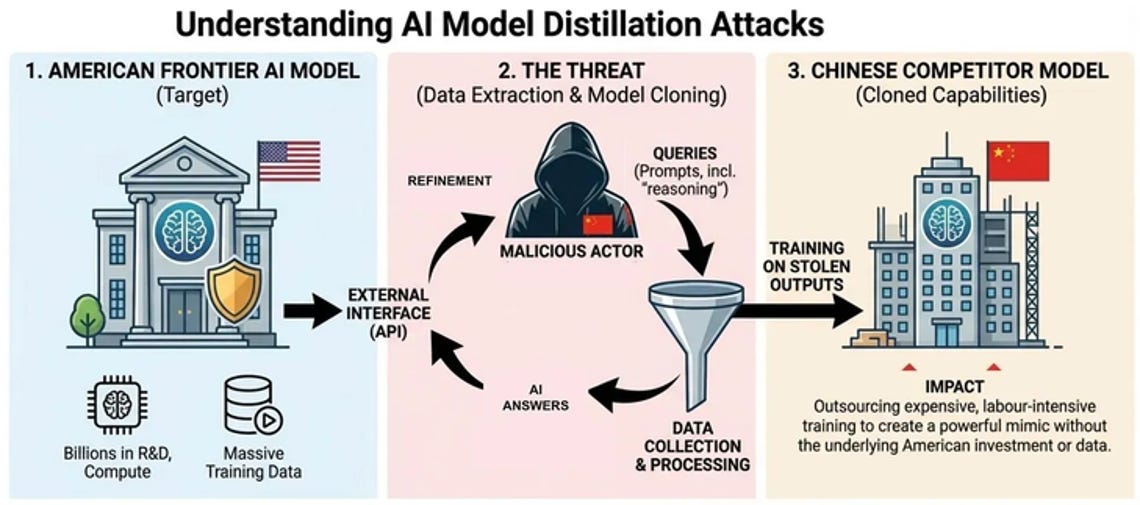
That depends on what you consider “cheating?” Many top U.S. government and AI leaders accuse Chinese models of “industrial-scale” distillation of proprietary U.S. models. Per Axios: “Distillation is a common AI practice in which” a smaller 'student' model is trained to mimic a larger 'teacher,' delivering similar outputs faster and cheaper.
The alleged Chinese AI model distillation may violate the terms of service for use of the frontier models a massive scale (tens of thousands of fake accounts make millions of queries). Unfair Chinese distillation looks something like this in the minds of critics:
Others see distillation as Fair Use. U.S. open-source models distill Chinese models to improve their own performance, including Cursor, the coding startup SpaceX bought for $60B (built using a Kimi model as a base) & Thinking Machine Labs (which employed Kimi in the process of creating its first tool.
Top tech analyst Ben Thompson notes that “because U.S. open weight model makers must follow the frontier labs’ terms of service, they (1) are worse than Chinese alternatives and (2) end up distilling the distillation, just with a detour through Chinese labs.” In “Who’s Afraid of Chinese Models,” Ben asks “wouldn’t it be better if western open weight model makers could go to the source?” and concludes:
“To that end, here’s an even more interesting question around distillation: why exactly is it bad? After all, what are large language models but the distillation of all of the knowledge on the open Internet, scraped by the frontier labs and distilled into the models that are themselves being distilled? Who is exactly being wronged here?”
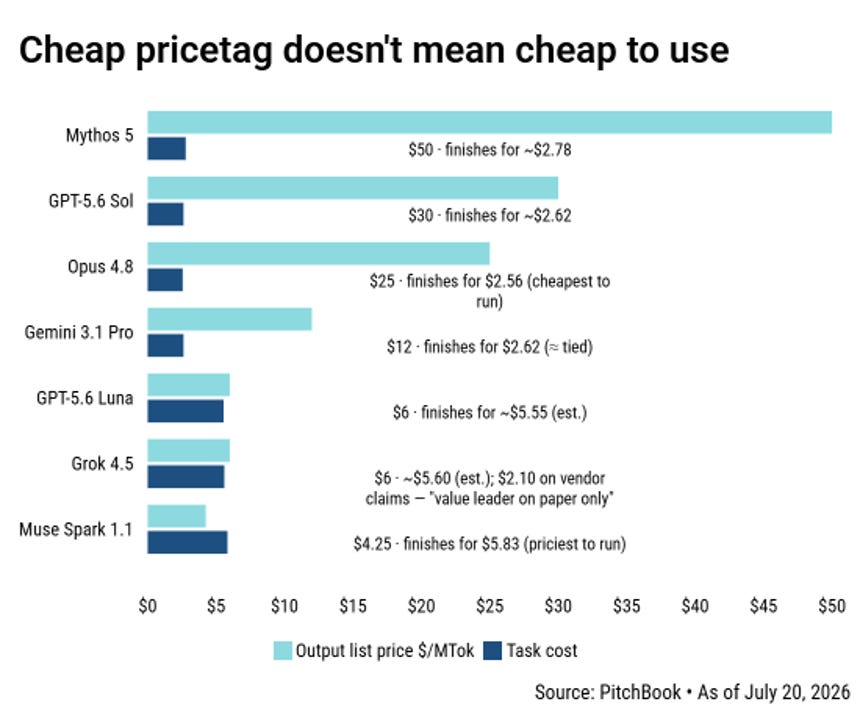
Yes. And no. Competition across models creates more options and lower prices for end users. Open-weight models allow customers greater customization opportunities and lower cost offerings for the majority of tasks where higher-performance is not needed (i.e. you don’t need a Ferrari to drive to the grocery store). But lower cost per token doesn’t always mean lower cost per task. In a recent experiment, PitchBook found that more expensive, newer frontier AI models can get some jobs done for a lower final cost to the customer.
Once again, it depends. U.S. security experts frequently cite validated security risks posed by Chinese hackers and China-sourced technology subject to PRC manipulation. Hence the bans on Huawei & ZTE, the forced sale of TikTok and persistent concerns over Chinese drones, routers and connected cars, among other gear. China likewise mistrusts and increasingly bans U.S. software & hardware. Geopolitical risk compounds security risk, with both China and the U.S. prepared to restrict exports / cut off foreign customers from AI products or inputs.
Ironically in the Hugging Face hacking crisis, the U.S. company turned to a Chinese AI model to help mitigate the attack after a U.S. frontier provider rejected their request for assistance. Per the FT:
“Hugging Face said in a blog post that after a US ‘frontier’ model rejected requests for help on safety grounds, it used GLM 5.2, built by China’s Z.ai, to analyse the attack. Unlike the best American models, leading Chinese offerings are open-weight, meaning their parameters can be downloaded and modified to suit a user’s needs.”
Notwithstanding President’s Trump’s visit to Beijing in June and President Xi’s scheduled visit to Washington in September, the macro trend remains regulatory escalation and digital decoupling, with AI in the eye of the storm.
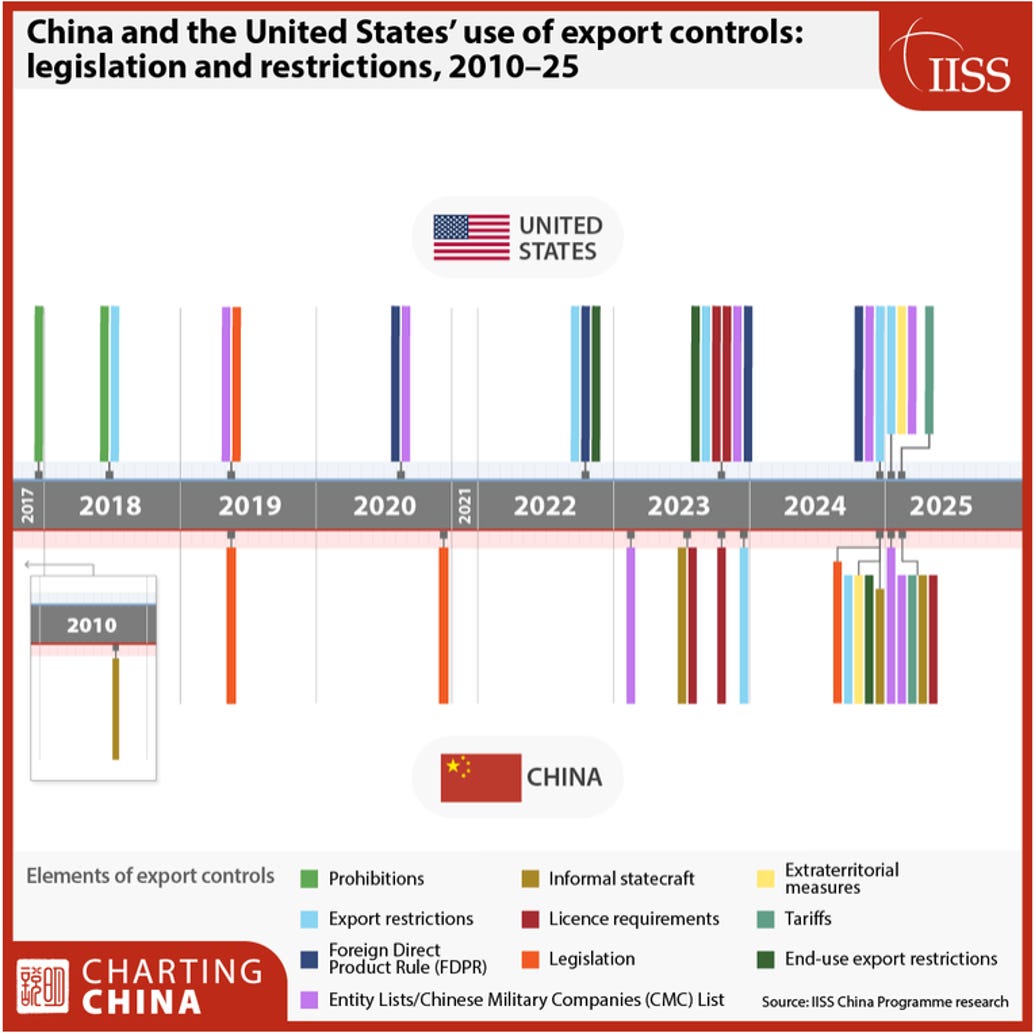
You guessed it… it depends… this time on who wins the argument inside the building. Several senior Administration officials and many members of Congress want imminent action targeting alleged distillation. Others — including PCAST Co-chair David Sacks and many across industry — urge caution, warning that overreaction — “tying ourselves in knots… by banning new data centers, piling on state regulations, and pushing for new federal agencies to pre-approve frontier models” — hands China exactly the high ground its open-weights soft-power strategy is designed to capture.
Handicapping the options:
Anti-distillation measures (technical safeguards + legal teeth to stop unauthorized copying of U.S. frontier models): Most likely. Narrowest target, broadest coalition — even the doves don’t defend TOS violations at industrial scale. Of course detection and attribution are are easier said than done.
Usage restrictions or bans on models built through unauthorized distillation: Possible but messy. Enforcement runs headlong into the awkward fact that U.S. startups are building on Kimi today. Banning the model means banning the customers.
Pre-release reviews for open-weight models: Longest odds. Industry will fight hardest here, because review regimes built for Chinese models inevitably ensnare American ones — and the U.S. open-source community is already complaining it’s competing with one hand tied.
The wildcard is the calendar: with Xi due in Washington in September, expect the Administration to want deliverables — or leverage — by then. TBD whether “AI distillation” makes the summit agenda.
Ben Thompson’s “Who's Afraid of Chinese Models”
Sequoia partner Dean Meyer’s “America’s Open Model Paradox”
Microsoft-a16z coalition “Open Weights & American AI Leadership”
What was the all-time gutsiest performance by an injured athlete? Kirk Gibson’s 1988 walk-off World Series home run is up there. So is Michael Jordan’s epic 1997 NBA Finals Flu Game, and TO’s 9 catches for 122 yards on a broken leg in Superbowl 39. But for my money it’s hard to top Kerri Strug’s final vault 30 years ago this week in the 1996 Summer Olympics.
No posts
Comments
Nothing yet. Say the first thing.
Sign in to join the conversation.