
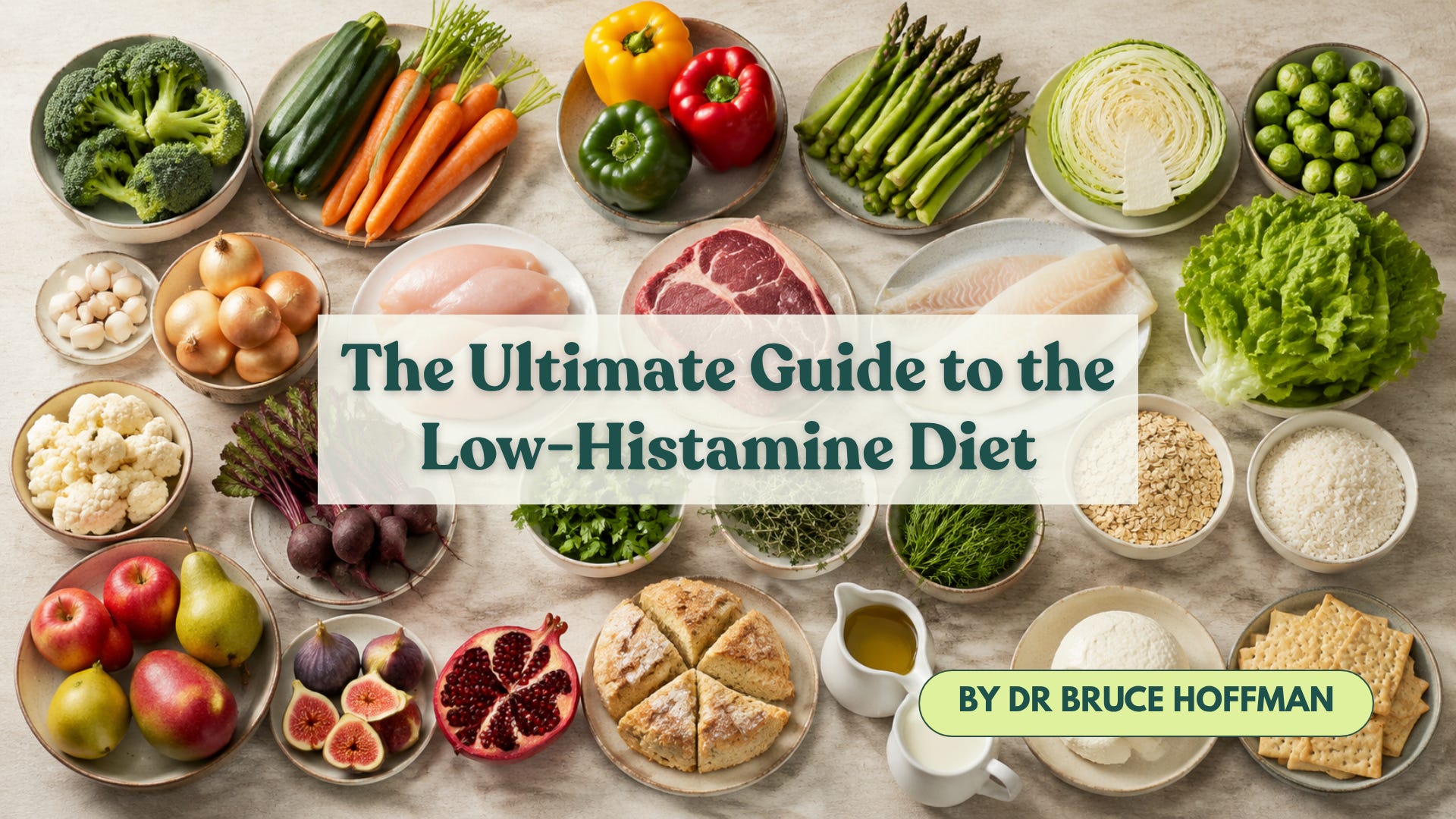
Ask a patient with hayfever, histamine intolerance, mast cell activation syndrome (MCAS), chronic hives or migraines what their doctor said about diet, and the answer is almost always nothing. Food gets mentioned in passing, as something to “watch”, rarely as the daily variable that may be driving one’s symptomatology.
That’s a strange gap, because the mechanism isn’t obscure. Histamine isn’t only the molecule behind hay fever. It’s released by mast cells as part of the body’s threat-response system, and it’s also present, in widely varying amounts, in the foods we eat every day. Two enzymes do the work of clearing it: DAO, produced largely in the gut lining, and HNMT, which works inside cells, including in the brain, and depends on a methylation cycle that shifts with stress, nutrient depletion, and toxin load. In a well-regulated system, release and clearance stay roughly matched. Symptoms appear when that balance tips, either because mast cells are firing more than the situation warrants, because the clearance enzymes are underperforming, or both.
Diet sits at the intersection of both sides of that equation. Certain foods, particularly anything aged, fermented, or left to sit, carry high histamine loads, adding to what the body has to clear. Other foods and additives can trigger mast cell degranulation through pathways that have nothing to do with classic allergy. And the gut itself, which produces the DAO needed to break down dietary histamine in the first place, is shaped by what passes through it daily. A gut lining under chronic low-grade inflammation produces less DAO, which means less capacity to handle the histamine arriving in the next meal, which compounds the inflammation. None of this shows up as a single abnormal number. It shows up as a pattern that builds over weeks.
Usually, a patient presenting with a histamine-related condition is offered antihistamines, H1 and H2 blockers, sometimes a mast cell stabilizer. These have a place, and for many patients they bring real relief. But none of them touch the histamine entering the system in the first place. They address the surface, blocking the signal once it’s already been released. Diet is the only variable a patient controls that affects how much histamine arrives into the system in the first place, and it’s frequently ignored or dismissed.
Many patients do try a low-histamine diet, and many give up within a few weeks, having seen little change. In my experience, this is almost always a sequencing problem. A patient cuts out the obvious high-histamine foods, aged cheese, wine, leftovers, but keeps taking probiotics containing histamine-producing strains, or hasn’t addressed the gut inflammation that’s keeping their own DAO production low, or starts supplementing B6 and quercetin without first lowering the load those enzymes are meant to be clearing. The diet looks right on paper and doesn’t deliver, because the rest of the system it’s meant to support hasn’t been prepared to use it. Applied correctly, with the right sequencing, I have seen a low-histamine diet produce more potent and lasting results than medications that only ever address the downstream symptoms.
This is why diet can’t be addressed as an afterthought as something to “clean up” once supplements and testing are sorted. Understanding what’s driving the load, recognizing which foods and habits are filling it, and making targeted changes before or alongside any supplement protocol gives the rest of the plan somewhere to land.
In my clinic working with patients presenting with multi-system, multi-symptom conditions such as MCAS and histamine intolerance, the low-histamine paleo-ketogenic diet is foundational to how I approach these cases. What follows is the detailed clinical handout that I use.
It includes:
How histamine functions as an inflammatory signal, and the five classic signs of inflammation it drives
The full range of symptoms associated with histamine intolerance, from migraines and hives to palpitations, brain fog, and disrupted sleep
The difference between histamine intolerance and the broader mast cell activation syndrome, including the other inflammatory mediators MCAS involves
How DAO and HNMT work, what causes each to underperform, and the role of the methylation cycle
The genetic, hormonal, and gut-related factors that commonly drive histamine overload
Detailed food lists: what’s high in histamine, what triggers mast cell activation through other mechanisms, and what’s generally well tolerated
Why alcohol is a double problem, both a histamine source and a direct block on DAO production
The supplement protocol I use most often, including dosing considerations for vitamin C, B6, quercetin, and DAO enzymes
Which probiotic strains support a low-histamine approach, and which ones make things worse
This is the same 12-page clinical handout I give to my patients and the one I rely on every day, available to you as a downloadable PDF. Whether you want to use it in your own clinic, bring it to your practitioner, or use it to map your own symptomatology against the patterns described within, I hope you find it useful.
Comments
Nothing yet. Say the first thing.
Sign in to join the conversation.