

This newsletter is called The Nonlinear Life.
Why?
A lot of people are new around here, so I thought I would take a minute to reintroduce myself and retell the story of how I came to believe that nonlinearity is a defining issue of our time—and how the end of the predictable, linear life course explains a lot of the confusion people feel about their lives.
To boil this idea to its essence: We have linear expectations but nonlinear realities. The gap between these two is responsible for a lot of our persistent anxiety and stress.
Let’s go back to the beginning.
The story opens almost a decade ago, when I was attending a college reunion. I drove from Brooklyn to Connecticut with a friend, who toggled between phone calls—on one line he was closing a $400 million real estate deal; while on the other he was comforting a colleague whose 9-month-old baby had gone down for a nap the previous day and never woken up.
My friend was both on top of the world and completely devastated.
I was moderating a panel of prominent classmates that afternoon. I looked out at the auditorium full of people, took the résumés of the panelists, and ripped them in half. “I don’t care about your successes,” I said. “Tell them to your mother. I want to hear about your struggles, your challenges, what keeps you awake at night.”
That evening, classmate after classmate came up and poured out their own heartbreaking stories:
My wife went into the hospital with a routine headache and died the next morning.
My mother’s an alcoholic.
My boss is a crook.
I’m being sued for malpractice.
I’m being treated for depression.
I’m afraid.
What everybody was saying, in one way or the other, was the same thing:
My life has been disrupted, my dreams shattered, my confidence punctured.
There’s a gap between the upward, predictable life I was sold, and the unstable, unpredictable, utterly fluid life I’m forced to contend with.
The life I’m living is not the life I was expecting to live.
The idea that life follows a series of carefully calibrated linear progressions—childhood to young adulthood to middle age to old age; dating to marriage to children to empty nest; low-level job to mid-level job to senior-level job to retirement—is actually relatively new.
For most of human history, there were no clocks or linear time. People lived in agricultural economies and thought life followed a cyclical path.
To every season turn, turn, turn.
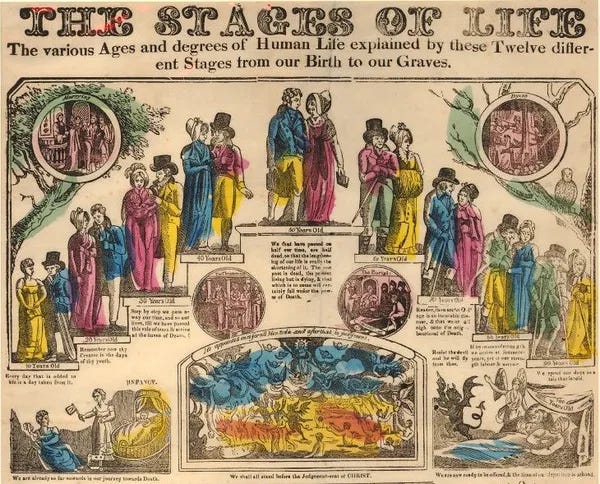
That conviction began to change in the West with the Hebrew Bible, which introduced the idea of linear time. By the Middle Ages, followers of the monotheistic religions believed that life was a straight line up to middle age, then a straight line down.
No second career, second relationship, or retiring and moving to Boca to open a B&B or Airbnb. Straight up, then straight down.
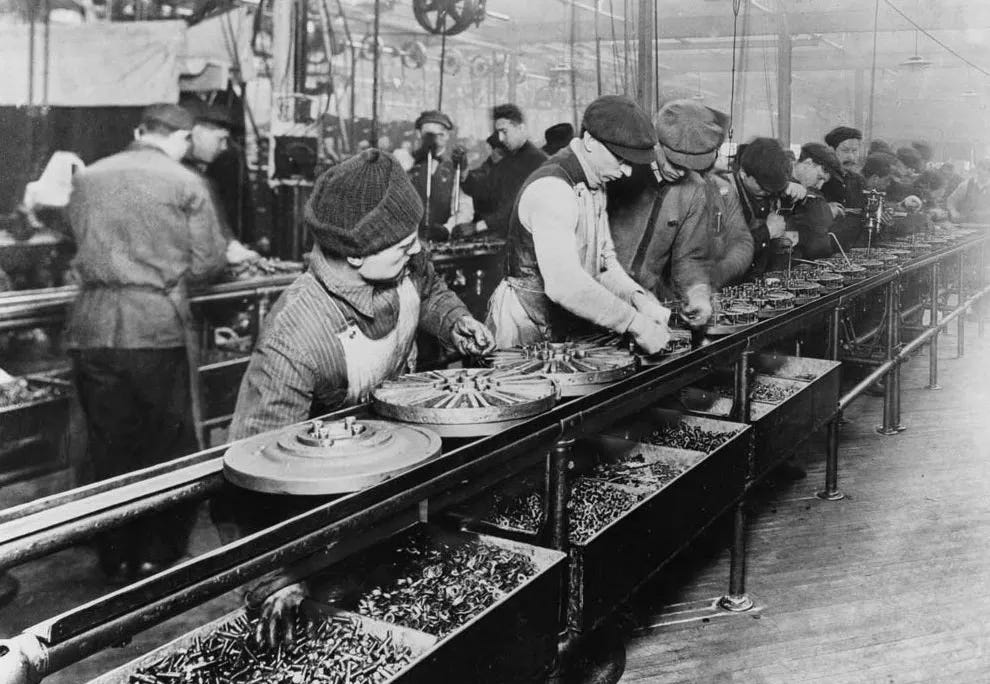
The idea that life followed an upward linear trajectory began in the nineteenth century with the Industrial Revolution, with its assembly lines, conveyor belts, and other emblems of progress and efficiency.
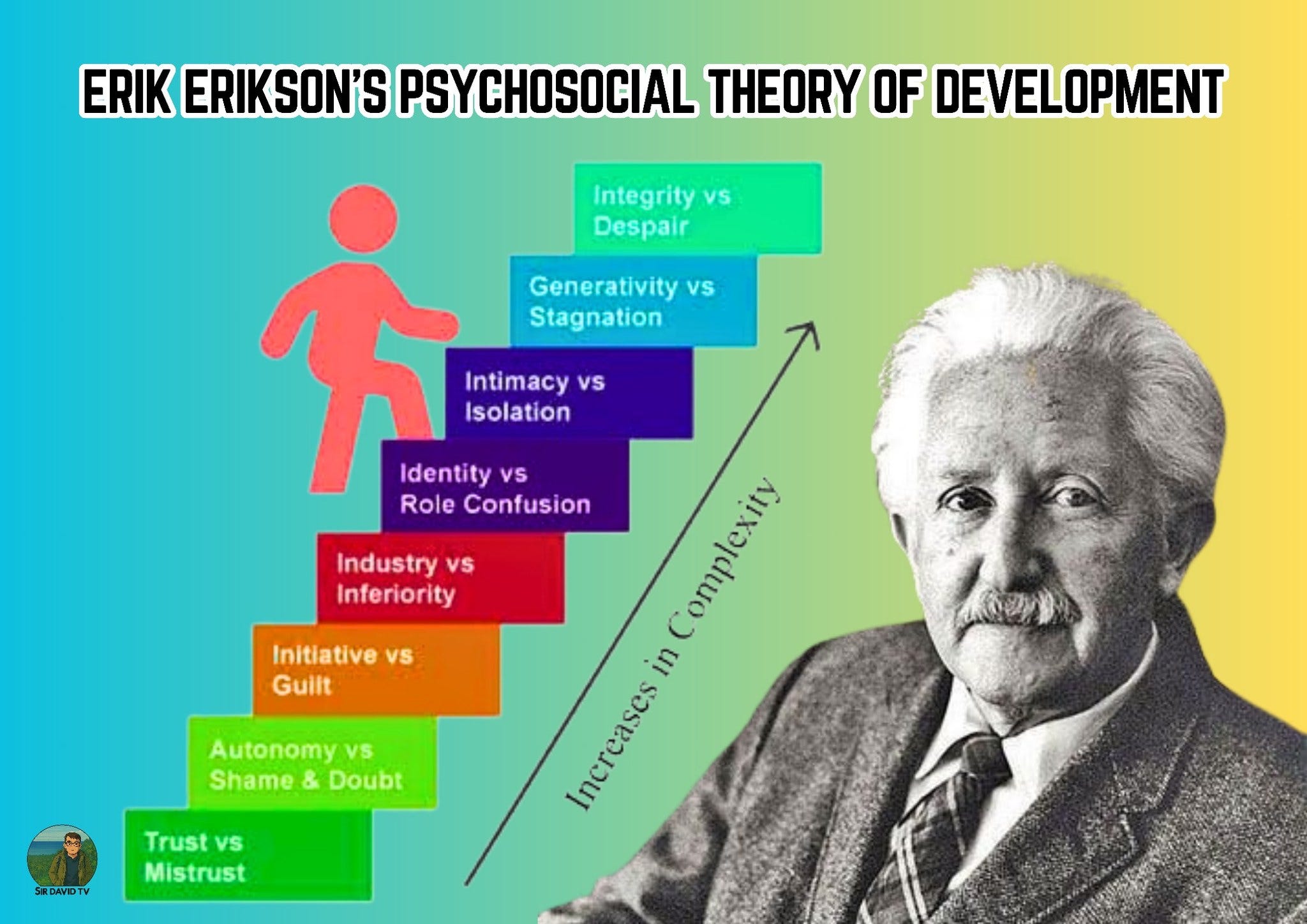
All through the twentieth century, linear models prevailed: Freud’s psychosexual stages; Erikson’s eight stages of moral development; the Five Stages of Grief. These are all linear constructs. This model peaked in the 70s, with the idea that everyone does the same thing in their 20s, same thing in their 30s, then has a midlife crisis between 39 and 44 1/2.
It’s hard to overstate how powerful that idea was.
There’s only one problem: None of this is true.
Today, we don’t live in an industrial age; we live in a global, interconnected, post-industrial world where information, opportunity, threats, and change come at us at all times from all directions.
Our lives follow a similar pattern of being rattled and rearranged—not just by events in our own families and neighborhoods, but, as in the pandemic, by events from all corners of the globe at any moment.
Instead of passing through a series of preordained life stages interrupted by periodic crises on birthdays that end in zero, we experience life as a complex swirl of celebrations, setbacks, triumphs, and rebirths across the full span of our years.
Linear thinking, writes the physicist F. David Peat, views the world in terms of quantification, symmetry, and mechanism. Nonlinear thinking frees us from those confines. “We begin to envision the world as a flux of patterns enlivened with sudden turns, strange mirrors, subtle and surprising relationships.”
As James Gleick, an early chronicler of this new science, wrote: “Nonlinearity means that the act of playing the game changes the rules.”
It’s like walking through a maze whose walls rearrange themselves with each step you take. In previous breakthroughs in science, once observers identified a phenomenon like nonlinearity in the world, the rest of us would begin to recognize it in our own lives.
Some of that has happened.
During the hundreds of life story interviews I’ve conducted since 2017, person after person described their lives as fluid, fickle, changeable, adaptable. But for whatever reason, no unifying expression has emerged to capture this variability.
I believe that nonlinearity can serve that purpose.
Just as our world is nonlinear, we should acknowledge that our lives are nonlinear, too. Just as the cyclical life was replaced by the linear life, the linear life is being replaced by the nonlinear life.
Once you appreciate that life is nonlinear, you see examples everywhere:
Lin-Manuel Miranda picking up a random biography of a forgotten founding father at a bookstore in Manhattan.
Lana Turner being discovered at a diner on Sunset Boulevard.
Buddy Holly needing to do laundry after eleven nights on the road, so he charters a plane to carry some of his concert mates to Minneapolis.
Just last week I was reading Staring at the Sun by the great psychologist Irvin Yalom, who points out that grief is nonlinear. Regression is normal, he writes; setbacks are routine; lapses are common.
“When we are tired, we are attacked by ideas we conquered long ago.”
And it’s not just grief. Mood disorders, anxiety, trauma, PTSD, and OCD are all now explained as being nonlinear with sudden gains and losses that can feel abrupt and unexpected.
Scholars call these moments of change “critical fluctuations” and indicate that these periods both intensify our feelings of instability and open the possibility of self-awareness and growth. The same is true for aging. Cutting-edge molecular research this decade has revealed that we don’t age in steady, linear ways—a little bit every day—but instead experience critical fluctuations in our forties and sixties. Scholars call the phenomenon “nonlinear aging.”
As one Nobel laureate summed up our emerging understanding: “We are becoming more and more conscious of the fact that on all levels, from elementary particles to cosmology, randomness and irreversibility play an ever-increasing role. Science is rediscovering time.”
Thanks for reading The Nonlinear Life! This post is public so feel free to share it.
Nonlinearity is at once a more accurate way of describing our lives and a more liberating one, too. Once you accept that your life is not going to proceed along preordained upward trajectories but follow a bespoke fingerprint of loops, curves, and whorls, it becomes easier to see those oscillations as normal.
If we go even further and view the biggest of those undulations—the lifequakes that all of us experience periodically—as “critical fluctuations,” then it becomes simpler to embrace the idea that we need rituals to soothe those fluctuations and help reconnect us with others at the moments we feel most confused, isolated, and fearful.
Nonlinearity suggests that instead of resisting upheavals and uncertainties like these, we should accept them. Yours is not the only life that seems to be following its own inscrutable path.
Everyone else’s is, too.
Today we live a nonlinear life. My goal in The Nonlinear Life newsletter is to play a small role in helping all of us figure out what this liquid life means for us—and how we can turn the chaos around us into a life of meaning, purpose, and joy.
🌞
Thank you for reading The Nonlinear Life. This is a reader-supported newsletter. You can support my work by pre-ordering a copy of A Time to Gather or any of my other books. Click on the photo below to learn more.
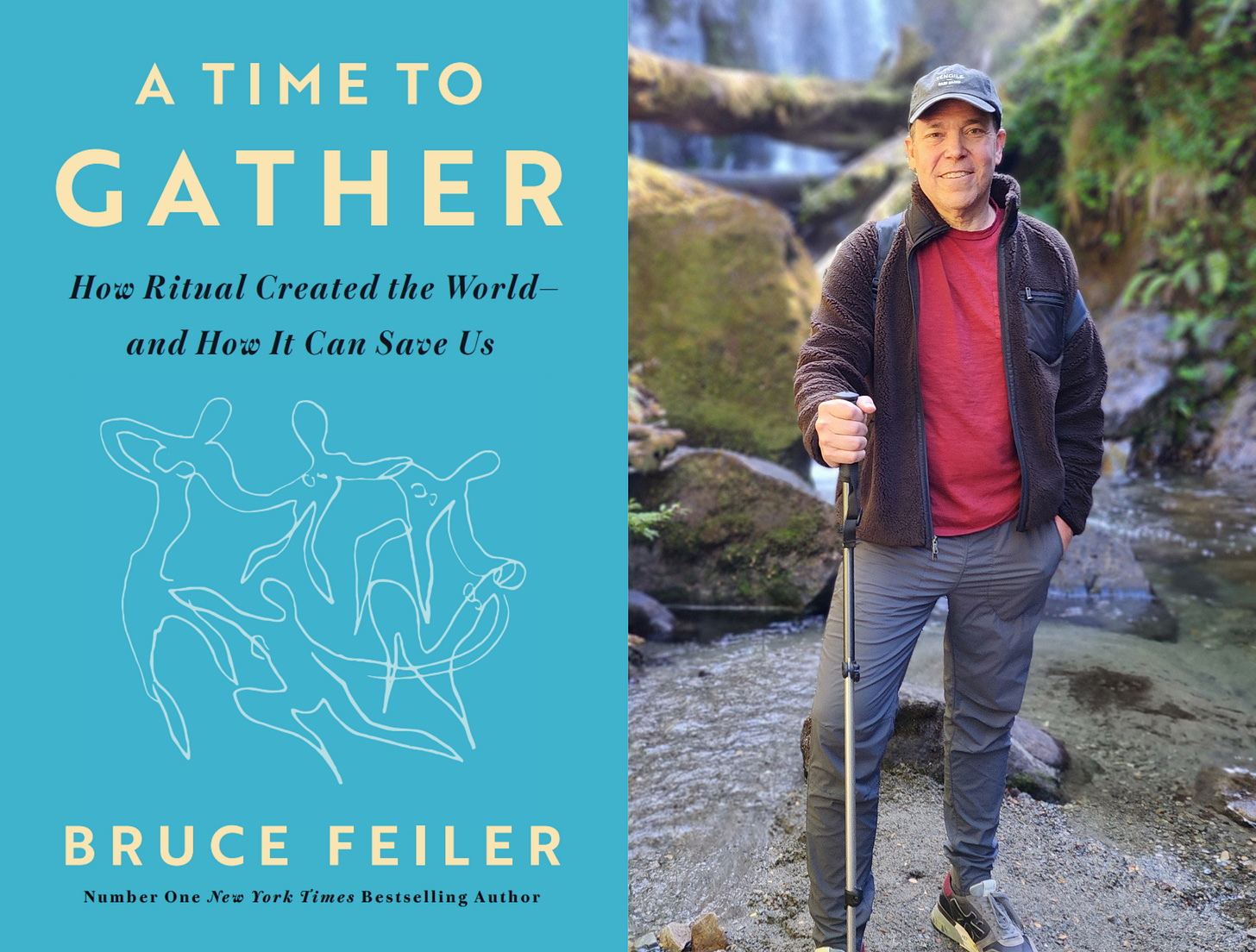
Order from Your Favorite Bookseller
Meanwhile, help us grow our community by subscribing, sharing, and commenting below.
And you might enjoy reading these posts:
Announcing my new book, A TIME TO GATHER: How Ritual Created the World—and How It Can Save Us
Forget Resolutions: Why We All Need a Year of Ritual
The Simple Question that Could Reshape Your Life
Or, you can contact me directly.
Comments
Nothing yet. Say the first thing.
Sign in to join the conversation.