
There is a simple question Americans should ask whenever a president claims or exercises extraordinary power:
Would you willingly give this same power to the president you distrust most? Not merely a president you disagree with. The president whose judgment you question, whose politics you oppose, whose character you distrust, and whose election you worked hardest to prevent.
Would you want that president deciding which political opponents deserve investigation?
Would you want that president using the Department of Justice against people who had angered him?
Would you want that president using federal contracts, regulatory authority, security clearances, government funding, or access to government institutions against organizations he regarded as hostile?
Would you want that president determining which law firms had represented the wrong people, which universities promoted the wrong ideas, which journalists had been too critical, or which career government employees had demonstrated insufficient loyalty?
If the answer is no, then we should be extraordinarily reluctant to tolerate those powers merely because the president exercising them is someone chosen by a slim majority of voters.
That is one of the most important tests of constitutional government. A constitutional principle is not really a principle if we do not apply it uniformly to all presidents, regardless of whether we like them or not.
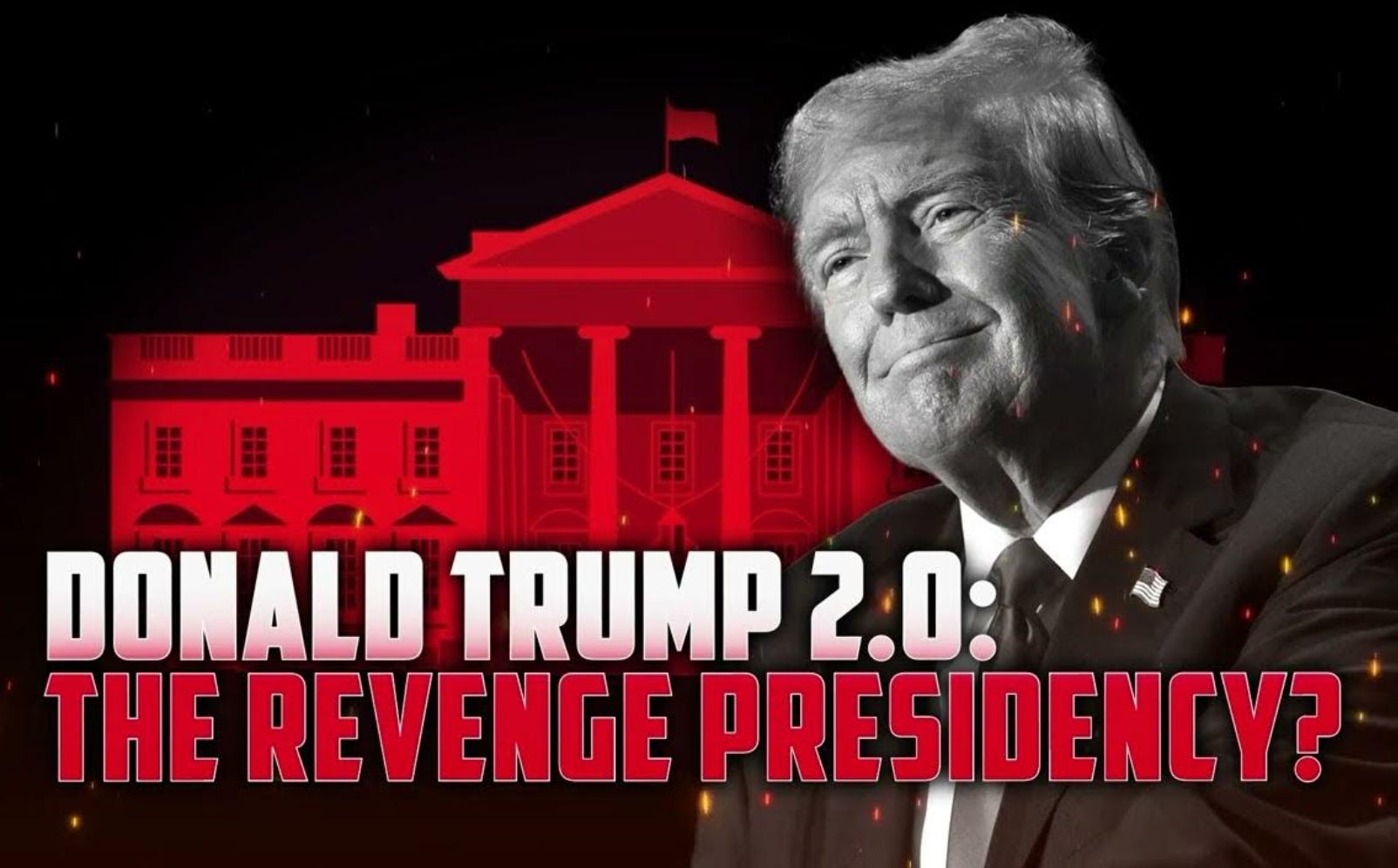
That is why Donald Trump’s continuing fixation upon retribution against perceived opponents should concern Americans across the political spectrum. A presidential term substantially focused upon settling grievances does not serve America, its citizens, or even the president himself. It diminishes all three.
And the scale deserves attention.
On November 26, 2025, Reuters published an extensive investigation documenting at least 470 people, organizations, and institutions it classified as targets of retribution during the first ten months of Trump’s second presidency—an average of more than one per day. Reuters said the targets included federal employees and prosecutors, universities, law firms, media organizations, and others. Its investigation drew on hundreds of government actions and public statements and included outreach to many of those identified.[1]
Importantly, November 2025 was not the end of the story.
Reuters continued reporting afterward on government actions involving people and institutions viewed as Trump adversaries. In December 2025, it examined the treatment of prosecutors who had worked on January 6 cases.[2] In March 2026, Reuters reported on a growing legal practice representing people facing politically charged investigations by the Trump Justice Department.[3] In June, Reuters reported on an investigation involving California Governor Gavin Newsom and his wife and placed it within the larger controversy over investigations of perceived Trump opponents.[4] In July, it reported litigation surrounding an investigation involving former CIA Director John Brennan.[5] And as recently as August 18, 2026, Reuters reported continuing litigation over executive orders directed at major law firms, four of which had successfully challenged those orders in federal court.[6]
That does not mean every investigation or government action involving a Trump opponent is necessarily illegitimate. Allegations must be judged individually, according to facts and law.
But it establishes something important: The Reuters count of 470 was a November 2025 benchmark, not the end of the pattern Reuters was documenting.
And that brings us back to the question that should guide our thinking:
Would you willingly give this power to the president you distrust most?
Justice and revenge can sometimes look superficially similar. Both may involve investigations. Both may produce punishment. Both may involve people who have genuinely done something wrong. But they begin with very different questions.
Justice asks:
What happened?
What evidence exists?
What law applies?
Can the allegation be proved through a fair process?
Would we apply the same standard to someone on our own side?
Revenge begins somewhere else:
Who hurt me?
Who embarrassed me?
Who opposed me?
Who must pay?
That distinction becomes especially dangerous when the person asking those questions possesses the enormous powers of the American presidency.
The Department of Justice is not the president’s personal law firm.
The FBI is not his private investigative agency.
Federal regulators are not his enforcement squad.
Government contracts are not his money.
Federal grants are not personal rewards.
Security clearances are not presidential favors.
And the presidency itself is not personal property.
Those powers belong to the American people and are temporarily entrusted to one person for public purposes.
That is the essential distinction.
The Reuters investigation matters because it attempted to measure something that could otherwise be dismissed as a series of unrelated political controversies.
Reuters reviewed official records, government actions, and public statements and concluded that by November 26, 2025, at least 470 individuals, organizations, and institutions had been targeted for what Reuters characterized as retribution since Trump returned to office.[1]
That number should be used carefully. It is a Reuters accounting, not an official government statistic. Inclusion in that accounting does not by itself prove that every individual government action was unlawful or unconstitutional. Some actions may involve legitimate policy changes, personnel decisions, investigations, or enforcement disputes.
The Trump administration rejects the characterization that it is conducting an illegitimate campaign of vengeance. White House spokesman Harrison Fields told Reuters that Trump was carrying out the mandate voters gave him and described the administration’s actions as accountability rather than retribution.[1]
That argument deserves to be considered. But it does not answer the constitutional question. The proper test is not merely whether an administration can articulate a justification. The proper test is whether government power is being exercised according to neutral rules that we would willingly permit an opposing president to use.
November 26, 2025, therefore provides a useful snapshot. It does not provide an endpoint.
Only weeks later, Reuters reported on former federal prosecutors who had worked on January 6 cases and subsequently experienced firings, investigations, or other government scrutiny. Reuters reported that at least 46 of roughly 200 prosecutors who had worked on those cases had resigned or been fired since Trump’s return to office.[2]
By March 2026, Reuters reported that attorney Abbe Lowell had developed a law practice representing several people facing investigations or indictments by the Trump Justice Department, including individuals regarded as Trump adversaries. Reuters situated that development within Trump’s broader push to investigate perceived opponents.[3]
In June 2026, Reuters reported California Governor Gavin Newsom’s allegation that the Justice Department was conducting a politically motivated investigation involving him and his wife. Reuters placed that controversy in the context of other investigations involving perceived Trump adversaries, while appropriately reporting Newsom’s claim as an allegation rather than an established fact.[4]
In July, former CIA Director John Brennan sought a court order requiring the Justice Department to preserve records relating to investigations involving him. Reuters reported that Brennan argued those records could be relevant to a future claim of politically motivated prosecution, while the Justice Department rejected the characterization of its actions as a campaign of retribution.[5]
And on August 18, 2026, Reuters reported continuing litigation involving Trump administration executive orders directed at major law firms. Four firms had successfully challenged such orders in federal court, while the administration continued to defend its authority and appeal adverse rulings.[6]
Again, the point is not that every one of these actions has been conclusively established as unlawful retaliation. The point is narrower and better supported:
The controversy Reuters documented in November 2025 demonstrably continued afterward. That makes the larger democratic question unavoidable.
Suppose we temporarily remove Donald Trump’s name from the discussion.
Imagine a future Democratic president. Imagine that president repeatedly denounces conservative journalists. Federal agencies begin investigating conservative media organizations. Government contracts held by corporations whose executives supported Republicans suddenly receive unusual scrutiny. Conservative universities worry that federal research money might depend upon changing their policies. Law firms representing Republican politicians discover that government contracts or security clearances could be jeopardized. Federal prosecutors who investigated the Democratic president are fired, investigated, or threatened with professional consequences. The president publicly demands investigations of Republican governors, senators, donors, former officials, activists, and lawyers.
Would Republicans be satisfied with the explanation: “The president is simply holding wrongdoers accountable”?
Surely many would not. And they should not.
But Democrats should apply exactly the same principle when someone they support occupies the presidency. That is the entire point of constitutional restraint.
We do not establish constitutional rules for presidents we voted for. We establish them for all presidents, whether we voted for them or not.
Presidential authority is extraordinary precisely because it is entrusted for public purposes.
The executive branch prosecutes federal crimes. It administers enormous regulatory authority. It awards contracts. It distributes grants. It possesses vast intelligence capabilities. It controls classified information. It oversees agencies touching nearly every part of American economic and civic life.
The constitutional danger arises when those public powers become entangled with a president’s private grievances.
A president may despise someone who has committed a crime. That does not immunize the person.
But presidential dislike does not constitute evidence either. Evidence must come first. Law must come first. Professional investigation must come first. Due process must come first.
And prosecutors must possess enough independence that Americans can reasonably believe criminal cases arise from evidence rather than presidential anger. Otherwise even legitimate prosecutions become suspect.
Suppose a political opponent actually commits a serious federal crime.
Investigators gather convincing evidence. Prosecutors obtain an indictment. The defendant receives a fair trial. A jury convicts.
In a healthy justice system, citizens should be able to examine that process and conclude that justice was done. But what happens after years in which presidents publicly demand that particular enemies be investigated?
Millions of Americans may assume the prosecution is political even when it is legitimate. That is one of the less obvious dangers of weaponizing, or appearing to weaponize, justice.
Eventually real justice loses credibility because citizens can no longer confidently distinguish prosecution from persecution.
That harms the accused. But it also harms prosecutors. It harms judges. It harms juries. It harms the Department of Justice. It harms the president.
And ultimately it harms the rule of law.
Presidents oversee the executive branch.
Elections have consequences.
Presidents are entitled to select attorneys general and establish lawful enforcement priorities. But American governments developed norms to separate individual criminal prosecutions from presidential political demands.
Consider the alternative. One president arrives with a list. Investigate these former officials. Investigate these journalists. Investigate these donors. Investigate these lawyers. Investigate these governors. Investigate these organizations.
Then the next president arrives carrying another list containing the people responsible for the previous investigations. Then another president arrives. And another list follows. Eventually justice ceases to be justice.
It becomes an inherited cycle of retaliation. There is only one durable alternative. There can be no presidential enemies list. There can only be evidence, law, professional investigation, prosecutorial judgment, due process, and independent courts.
Would you give a president you distrust the authority to treat judges who repeatedly rule against him as enemies? Probably not.
Judges sometimes make poor decisions. Their reasoning can be criticized. Their rulings can be appealed. They can be reversed.
But ruling against a president is not disloyalty. It is part of the constitutional design.
Presidents exercise power.
Congress exercises power.
Courts exercise power.
And sometimes each tells another branch: No.
That friction is not evidence that our constitutional system is broken. It is evidence that no one possesses all the power.
Would you want a president you distrust punishing law firms because they represented people the president dislikes?
Again, probably not. Yet this principle becomes more difficult when the lawyer represents someone we ourselves dislike. That is when constitutional commitments actually matter.
Lawyers are not their clients. Representing an unpopular individual does not constitute endorsement of that person’s politics. Challenging presidential authority in court is not disloyalty to America.
Indeed, constitutional protections are meaningless unless lawyers remain willing to challenge government power. If attorneys begin wondering whether representing the wrong client could bring punishment from Washington, the chilling effect extends far beyond elite law firms.
Eventually ordinary citizens may find fewer lawyers willing to confront the federal government on their behalf.
Would conservatives want a Democratic president deciding that conservative television networks deserve government scrutiny because their coverage is hostile?
Would liberals want a Republican president doing the same to liberal publications? Neither should.
Presidents are free to criticize journalists. Journalists are free to criticize presidents.
News organizations make mistakes. They can be corrected. They can be criticized. They can be sued where the law permits. They can be boycotted or ignored.
But government criticism differs from governmental coercion because the government has powers ordinary critics do not.
The First Amendment is especially important when journalists publish material presidents hate.
Would we want government scientists changing findings because they feared angering a president?
Would we want intelligence analysts tailoring reports to presidential preferences? Would we want prosecutors avoiding politically sensitive cases? Would we want economists manipulating numbers? Would we want inspectors general suppressing findings?
Of course not.
Political appointees appropriately implement the president’s lawful agenda. But career professionals perform another essential role. They preserve knowledge, competence, continuity, and candor across administrations.
Every president needs people willing to say: “Mr. President, the evidence does not support that conclusion.”
Or: “Mr. President, the law does not permit that.”
A government filled only with people willing to say yes becomes increasingly incapable of recognizing its own mistakes. That is dangerous regardless of who the president is.
Another consequence of retaliatory government is hard to count.
People change their behavior.
A scientist hesitates.
A prosecutor reconsiders.
A corporate executive remains silent.
A university administrator calculates the risk to federal funding.
An attorney declines a controversial client.
A journalist softens a story.
A civil servant keeps an inconvenient conclusion to himself.
Government does not need to punish everyone to produce this effect.
It needs only to punish enough people for everyone else to notice. That is why a number such as 470 matters beyond the people and institutions Reuters counted.
Each publicly visible target can communicate something to hundreds or thousands of others:
Be careful.
Stay quiet.
Do not anger the people who control the government.
That is not the culture of a confident democracy.
A presidency consumed by grievance does not merely damage institutions. It diminishes the president himself.
The presidency offers an extraordinary opportunity.
A president can mobilize Americans to solve difficult problems.
A president can reconcile political divisions.
A president can build.
A president can inspire.
A president can strengthen alliances.
A president can confront emerging technologies.
A president can improve infrastructure.
A president can address affordability, housing, health care, energy reliability, education, immigration, national security, and fiscal responsibility.
However, Presidential time is finite. Political capital is finite. Public attention is finite. Every day spent revisiting yesterday’s enemies is a day not devoted to tomorrow’s problems.
A president preoccupied with who wronged him inevitably spends less time considering who needs him. That is not strength. It is captivity to grievance.
Most Americans do not awaken thinking about Washington’s personal feuds.
They are thinking about:
Groceries.
Housing.
Health insurance.
Prescription drugs.
Electric bills.
Jobs.
Childcare.
Education.
Retirement.
Their children’s future.
Those are the problems Americans employ presidents to address.
Imagine instead directing the enormous attention of the presidency toward those challenges.
Imagine a president saying:
Some people treated me unfairly.
Some investigations were wrong.
Some journalists misrepresented me.
Some political opponents behaved badly.
But I am President of the United States now.
I have more important work to do.
That would not demonstrate weakness. It would demonstrate magnanimity. And magnanimity is one of the characteristics that can transform political victory into presidential leadership.
Donald Trump will eventually leave office. Every president does. But the precedents established during presidencies remain.
Every expansion of presidential authority creates a precedent.
Every weakening of institutional independence creates a precedent.
Every successful intimidation establishes an example.
Every tolerated retaliation enlarges the boundaries of what the next president may attempt.
That is why Republicans should care deeply about these questions.
The powers tolerated under a Republican president may someday be exercised by a Democratic president.
And Democrats must remember precisely the same principle when they next control the White House.
Our constitutional commitments cannot depend upon election results.
Perhaps we therefore need a simple rule of democratic citizenship.
Whenever a president claims a significant power, ask:
Would I willingly give this power to the president I distrust most?
When a president demands an investigation of an opponent, ask it.
When a president threatens a news organization, ask it.
When a president pressures a university, ask it.
When a president targets a law firm, ask it.
When career officials are punished for perceived disloyalty, ask it.
When a president seeks greater control over prosecutors, ask it.
When Congress considers expanding executive authority, ask it.
And when someone from our own political party occupies the White House: Especially ask it then.
Because constitutional government is not tested when we restrain people we oppose. It is tested when we are willing to restrain people we support.
None of this means abandoning accountability. Quite the opposite.
Corruption should be investigated.
Fraud should be prosecuted.
Government misconduct should be exposed.
Officials who violate the law should face consequences.
Political opponents should receive no immunity simply because an investigation might be controversial.
But genuine accountability has recognizable characteristics.
There is evidence.
There is a law.
There is a professional investigation.
There is due process.
There are independent courts.
And there is one standard regardless of political affiliation.
If Democrats violate the law, investigate Democrats.
If Republicans violate the law, investigate Republicans.
If presidential allies violate the law, investigate presidential allies.
And if presidential opponents have not violated the law, leave them alone.
That is equal justice under law.
The most important question raised by Donald Trump’s use of presidential power is ultimately larger than Donald Trump.
It is about us.
What kind of presidency are We the People willing to create?
It is tempting to judge governmental authority according to whether we trust the person currently exercising it. That is precisely the wrong test.
Presidents change. Power remains.
The authority we permit a president we favor to exercise becomes available to the president we fear.
So when government acts against a political opponent, we should not begin by asking whether we like the target.
We should ask whether there is evidence.
We should ask what law was violated.
We should ask whether due process has been respected.
We should ask whether professional institutions reached the decision independently.
We should ask whether the same rule would be applied to the president’s allies.
And finally we should ask the question that should become instinctive in a constitutional democracy:
Would you willingly give this same power to the president you distrust most?
If the answer is no, then our responsibility as citizens becomes clear.
We must defend independent courts.
We must defend politically neutral law enforcement.
We must defend lawyers willing to challenge government.
We must defend a free press.
We must defend professional civil servants willing to tell presidents inconvenient truths.
We must demand meaningful congressional oversight regardless of which party controls the White House.
And we must insist that accusations of wrongdoing be resolved through evidence, law, due process, and independent institutions—not presidential grievance.
But there is an even more personal civic responsibility.
We must refuse to demand powers for our own side that we would condemn if exercised by the other.
That may be one of the most important disciplines of democratic citizenship.
The presidency is not a weapon awarded to the winner of an election.
It is a public trust temporarily entrusted by We the People to one citizen.
Justice asks what the evidence proves and what the law requires.
Revenge asks who must pay.
Our responsibility is to know the difference.
And whenever we find ourselves tempted to excuse government power because we trust the person wielding it, there is one question capable of bringing us back to first principles:
Would you willingly give this same power to the president you distrust most?
If we would not, we should not give it to anyone.
[1] Reuters, November 26, 2025. Trump’s campaign of retribution: At least 470 targets and counting. Reuters investigation documenting at least 470 individuals, organizations, and institutions that Reuters classified as targets of retribution during the first ten months of Trump’s second administration. The investigation also reports the administration’s response disputing the characterization of retribution.
Reuters investigation: Trump’s campaign of retribution
[2] Reuters, December 17, 2025. They prosecuted Capitol rioters. Now the rioters and DOJ are after them. Reuters examination of consequences faced by prosecutors who worked on January 6 cases following Trump’s return to office, including its finding concerning prosecutors who had resigned or been fired.
Reuters investigation of January 6 prosecutors
[3] Reuters, March 16, 2026. Reuters report on attorney Abbe Lowell’s expanding practice representing individuals facing Trump administration investigations and prosecutions, providing additional evidence that controversies involving investigations of perceived political opponents continued after Reuters’ November 2025 accounting.
Reuters report on legal representation of Trump targets
[4] Reuters, June 15, 2026. Reuters report on California Governor Gavin Newsom’s allegation that the Trump administration directed a Justice Department investigation involving him and his wife. Reuters situated the dispute within the broader pattern of investigations involving perceived Trump opponents while distinguishing allegations of political motivation from established facts.
Reuters report on Newsom investigation allegation
[5] Reuters, July 1, 2026. Reuters report on former CIA Director John Brennan’s effort to require preservation of Justice Department records concerning investigations involving him and his contention that the records could bear upon a future claim of politically motivated prosecution.
Reuters report on Brennan and DOJ records
[6] Reuters, August 18, 2026. Reuters report concerning continuing litigation over Trump administration executive orders involving major law firms. Reuters reported that four firms had successfully challenged orders against them in federal court and described the administration’s continuing legal defense of its actions.
Reuters report on continuing law-firm litigation
Comments
Nothing yet. Say the first thing.
Sign in to join the conversation.