
A small town west of Montreal just gave trees legal standing. Terrasse-Vaudreuil, population 2,000, became the first municipality in Canada to sign the Universal Declaration of the Rights of the Tree, a council resolution granting local trees “the right to life, to natural growth, to integrity and to regeneration.” The mayor credits a documentary that convinced residents that trees communicate through their root systems. In practical terms, it means the town now has to review its bylaws and replace protected trees before any can be cut down.
That’s the minimum basic military training Russian pupils in grades six through eleven now receive every school year, under the compulsory “Fundamentals of Safety and Defence of the Homeland” course. Starting in September, Moscow plans to roughly double the time devoted to military content in that course. A separate pilot programme will add up to 64 hours a year for students aged 14 to 18 across ten regions, covering drone operation, combat first aid and firearms handling.
What It Is: Global sea surface temperatures reached a record high of 20.98°C in June, according to the EU’s Copernicus Climate Change Service, beating the previous records set in 2023 and 2024. Marine heatwaves now cover 82% of the world’s oceans. Copernicus director Carlo Buontempo said current conditions “could indicate the beginning of a new phase, leading, once more, to uncharted territory.”
Why It Matters: The UK just had its hottest June day ever recorded, too: 37.7°C in Norfolk, beating a mark that had stood since 1957, plus an overnight temperature record in England that had stood since 1976. That 1976 comparison is doing a lot of work in the public conversation right now, and it’s worth being precise about why it’s misleading. The 1976 heatwave was a single, freakish, once-in-a-generation event. What’s happening now is that ocean and land temperature records are falling almost every year, sometimes more than once a year. A one-off extreme and a pattern of recurring extremes are different phenomena, even when the thermometer reading looks similar.
The Big Picture: This is happening while one of the world’s largest historical emitters pulls in the opposite direction. The Trump administration has proposed cutting NOAA’s (National Oceanic and Atmospheric Administration) budget by 27% and eliminating nearly all of its climate research labs, alongside a 52% cut to the EPA’s budget. Those are the agencies that track and study events exactly like this one. The current US administration is in full-blown climate change denialism mode, and NOAA’s climate labs are among the primary sources scientists use to see events like this coming before they arrive.
What It Is: Spain’s extraordinary regularisation programme, open to undocumented migrants who could prove five consecutive months of residence before January 1, closed its application window on June 30 with 1,174,978 submissions. That’s more than double the roughly 500,000 the government had originally forecast.
Why It Matters: Prime Minister Pedro Sánchez has framed the scheme as “an act of justice and a necessity”: people already living and working in Spain should do so on equal footing and pay into the system. The economic case is concrete. Each regularised migrant is estimated to contribute around €4,000 a year in taxes and social security once brought into the formal economy, and Spain’s own forecasting office projects that a 30% cut to migration by 2075 would shrink GDP by 22% and the population by 15 million.
The Big Picture: Spain is running against the grain of nearly every other Western government right now. While its neighbours tighten borders under pressure from the far right, Madrid is betting that formalising undocumented workers strengthens the economy more than excluding them relieves political pressure. It’s a very bold experiment, and Spain’s 2005 regularisation of 570,000 migrants is the closest precedent: that round produced higher tax revenue and better labour outcomes. Spain’s far-right VOX party is already citing the 1.2 million figure as evidence of what it calls a demographic and electoral transformation, which gives some sense of how contested the outcome will be either way.
What It Is: Defence Minister Israel Katz announced Israel is developing an offensive laser capability designed to operate in space, part of a stated goal of becoming one of the world’s top three military space powers. “No country has the ability to mount attacks in space,” Katz said. “We must be the leading country in the world with this capability.”
Why It Matters: Public attention to military technology remains largely focused on drones, missiles, and autonomous systems. Space is a live battleground already. China destroyed one of its own satellites in a 2007 weapons test; roughly 3,000 pieces of debris from that single test are still tracked as collision risks today. Russia repeated the exercise on one of its own satellites in 2021, generating over 1,500 trackable fragments and forcing the International Space Station crew to shelter in place multiple times.
The Big Picture: No real regulatory body governs any of this. The 1967 Outer Space Treaty bans weapons of mass destruction in orbit and nothing else, has no verification mechanism, and predates the entire concept of anti-satellite weapons. China and Russia have each proposed their own UN agreements on space weapons, and both proposals happen to exclude the exact capabilities each country is building. What exists in practice functions closer to a law-of-the-jungle arrangement than a governed domain. GPS, the EU’s Galileo network, weather forecasting, and financial systems all rely on satellites, and a single destroyed satellite can scatter debris that can disable nearby satellites. While we on Earth don’t seem to care much about what’s happening above us, if something goes ridiculously wrong with satellites above, we’ll surely face severe consequences in our day-to-day lives pretty quickly.
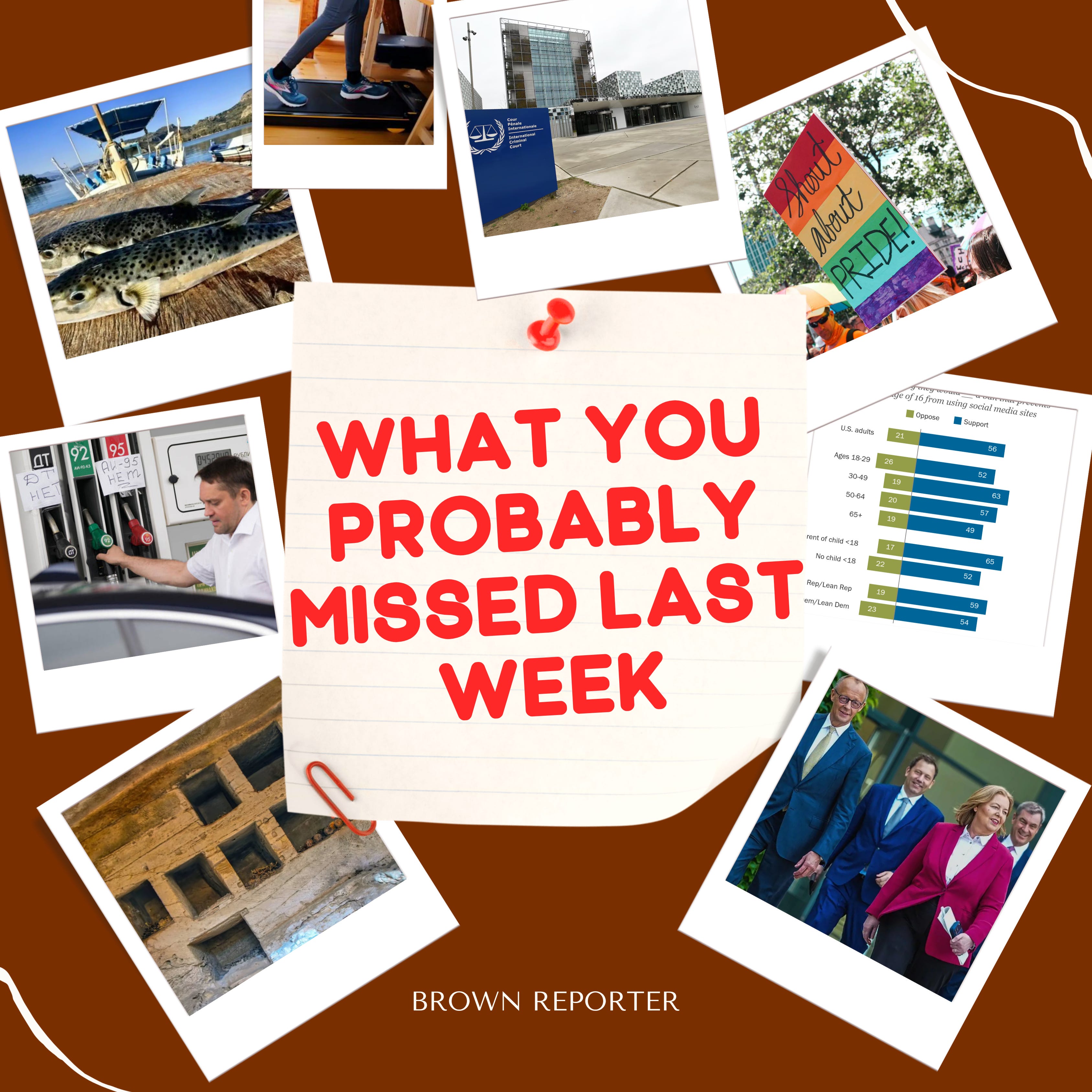
Germany: Chancellor Friedrich Merz is ending phone-called-in sick leave, requiring workers to produce a doctor’s note from the first day of illness rather than after three days, as part of a broader push to curb corporate absences and revive the economy.
Egypt: Archaeologists uncovered a remarkably intact fourth-century residential city at the Dakhla Oasis, complete with a basilica, watchtowers, bronze coins bearing Byzantine emperors, and 200 pottery fragments recording ancient commercial transactions.
United States: A new Pew Research survey finds that 56% of adults support banning under-16s from social media, with bipartisan agreement, and parents are the most supportive group of all.
Kazakhstan: Facing a domestic fuel shortage of its own, Kazakhstan has agreed to send Russia 50,000 metric tons of gasoline as Ukrainian strikes on refineries squeeze Moscow’s fuel supply.
United Kingdom: The NHS is piloting a rewards scheme that turns 20 to 30 minutes of daily walking into a monthly “virtual marathon,” with vouchers and discounts planned once the initial digital-rewards phase ends.
Turkey: An Istanbul court ordered a block on nine LGBTI+ dating apps, extending a pattern that already includes a renewed ban on Hornet and a Grindr block dating back to 2013.
Niger: Along with Mali and Burkina Faso, Niger has formally withdrawn from the ICC, calling the court “an instrument of neo-colonialist repression.”
Greece: The government is now paying fishermen up to €5.33 per kilogram to catch invasive, toxic pufferfish that have migrated into the Mediterranean as its waters warm.
India’s infant mortality rate has dropped to a record low of 24 deaths per 1,000 live births, down from 30 just five years ago. The improvement tracks closely with a rise in medically attended births, from 83% to 95% over the same period, and some lower-income states, including Bihar, have seen reductions of nearly 50%. It’s the kind of statistic that rarely makes headlines because progress this steady doesn’t have a dramatic single moment attached to it. It just quietly saves lives, year after year.
Should other Western countries follow Spain’s approach to undocumented migrants?
“We are as gods and might as well get good at it.”
— Stewart Brand
Thank you so much for reading my curated news stories! If you'd like to support my work, a coffee goes a long way or share this article with a friend. Either way, thank you for being part of this. Your support means a lot x
Enjoying this newsletter? The biggest compliment you can give is to share it with your friends.
Thanks for reading. You’re officially the smartest person in the room. Talk to you soon :)
No posts
Comments
Nothing yet. Say the first thing.
Sign in to join the conversation.