
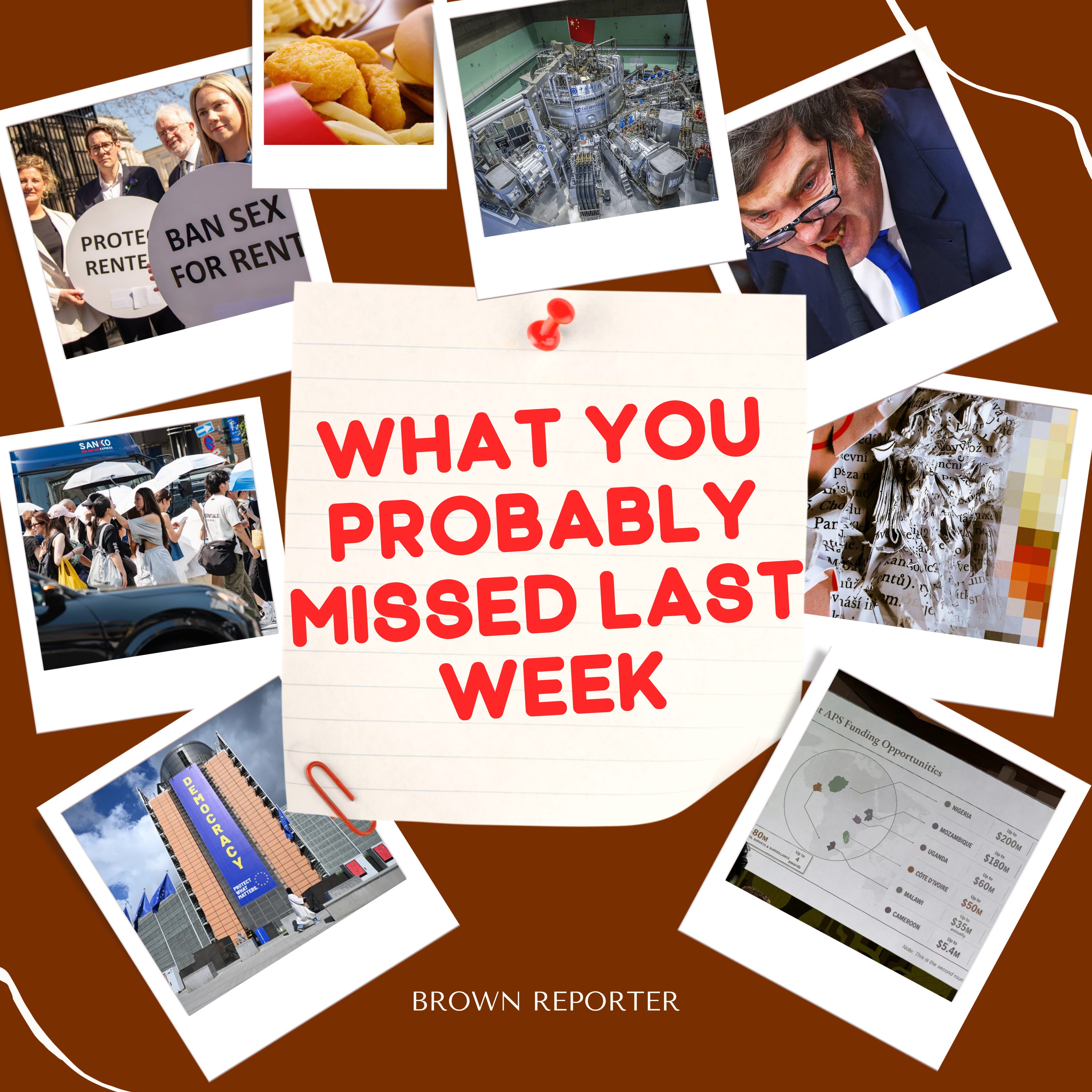
Picture the scene: the US State Department presenting a map of Africa at a global AIDS conference in Rio, with not a single label pointing to the right country. Nigeria landed in the Sahara. Mozambique moved to the Horn of Africa. Cameroon disappeared from the map entirely. A Reuters check of the image found an OpenAI watermark buried in the file, meaning the map guiding a US government presentation had been generated by a chatbot and never checked by a human before it went on screen. The department later called it “an unfortunate error” and said a staffer had swapped slides in a hurry.
That’s how many fewer people faced hunger worldwide between 2022 and 2025, according to the UN’s State of Food Security and Nutrition report released this month. The share of the world’s population going hungry dropped to 7.8% in 2025, the third straight year of improvement. Africa still carries the heaviest burden, with more than half its population facing moderate or severe food insecurity, and the UN warns that conflict, climate shocks, and shrinking aid budgets could stall the trend.
What It Is: Book dealers across the US and Europe are reporting a surge in bulk orders for rare, out-of-print, and specialist titles. Many run through ISBNdb, a book-data service that says it can source up to a million books at once while keeping the buyer’s identity private. Anthropic has reportedly used a hydraulic cutting machine to remove the spines from thousands of books before digitising each page; once scanned, the physical copies are destroyed.
Why It Matters: Since ChatGPT went mainstream in 2022, a growing share of what is published online, including books on Amazon and posts on LinkedIn and Reddit, has been written at least in part by AI. Training a new model on that material means training AI on its own output—a feedback loop researchers call model collapse, in which each generation of machine-written text drifts further from how people actually write. Books printed before the chatbot era are valued for exactly this reason: they are text written entirely by humans, with no algorithmic fingerprints. That is why editions from before 2020 command a premium among buyers who do not want their names attached to the order.
The Big Picture: A US court ruled last year that digitising legally purchased books to train an AI model qualifies as fair use, settling the legal question but leaving the ethical one open. Destroying the originals after scanning does something a plain purchase does not: it takes the book out of circulation for good, so no competitor, library, or researcher can pull the same clean training data from that copy again. ISBNdb has reportedly told clients that “the optics problem is real,” warning that “AI company destroys two million books” is not a headline anyone wants their name on.
What It Is: President Javier Milei has amended Argentina’s migration law by decree, giving the government the power to deny entry to or expel foreign nationals who “promote messages of hatred” against Argentina or its national symbols, whether spoken or written. The decree does not name a specific incident, but its timing coincides with a wave of online abuse targeting Argentina around the 2026 World Cup, including a banner referencing the Malvinas that triggered a FIFA investigation.
Why It Matters: The decree does not define what counts as hate speech, who decides, or how it will be enforced, giving immigration officials broad discretion. It also conflicts with Argentina’s constitution, which explicitly encourages immigration and guarantees foreigners the same civil rights as citizens. Milei has spent years building an international brand as a free-speech absolutist. A decree that bars people from the country over speech critical of it sits uneasily with that image.
The Big Picture: Argentina isn’t the only government doing this. The US has revoked more than 100,000 visas since Trump returned to office, denied entry to a French scientist over messages critical of the administration found on his phone, and banned several European researchers who work to counter online disinformation. Governments that talk loudest about free speech are often the first to punish foreigners for exercising it.
What It Is: The European Commission has reiterated that all ICC member states are legally obliged to execute the court’s outstanding arrest warrants, after Israeli Prime Minister Benjamin Netanyahu’s plane again crossed the airspace of Greece, Italy, and France on its way to Washington. All three are parties to the Rome Statute, yet none closed its airspace or moved to detain him. The ICC issued warrants for Netanyahu and former defence minister Yoav Gallant in November 2024 over alleged war crimes and crimes against humanity in Gaza.
Why It Matters: Hungary allowed Netanyahu to visit in April 2025 without arresting him, prompting the ICC to open proceedings against Budapest for failing to do so. Prime Minister Viktor Orbán then announced that Hungary would leave the court. Germany has separately signalled it will not enforce the warrant either if Netanyahu visits. The Commission keeps restating the rule; whether any member state actually applies it is another question.
The Big Picture: This fits into a broader fight over the ICC’s future. The Trump administration has launched a campaign to dismantle the court, sanctioning its officials and pressuring allied states to leave. Venezuela and Chad have already begun withdrawing, following Burkina Faso, Mali, and Niger. With European countries openly ignoring the arrest warrant for Bibi, it raises questions about whether the ICC is being treated as a legitimate institution at all. When it issues warrants against non-allies of the West, it is upheld as a defender of international law; when it applies the same standard to allies, it is dismissed as a corrupt body that should be dismantled.
South Korea: The city of Yangsan hit 42.5°C on 2 August, the hottest temperature recorded in South Korea since records began, beating a mark set just two days earlier.
New Zealand: English is set to become New Zealand’s third official language, joining Te Reo Māori and NZ Sign Language, after a bill from Justice Minister Paul Goldsmith passed its final reading.
China: Beijing has completed a 582-tonne superconducting magnet, the largest ever built, designed to help confine plasma at over 100 million°C inside its next-generation fusion reactor, a step toward the country’s goal of fusion power by 2030.
Myanmar: The military-backed parliament has passed a law introducing the death penalty for scam-centre operators whose forced-labour operations result in a victim’s death, part of a wider crackdown on the country’s cyber-fraud industry.
Montenegro: Parliament has approved two days of paid menstrual leave per month for women diagnosed with painful conditions such as endometriosis, making it only the second country in Europe, after Spain, to write the right into law.
Japan: The population fell below 120 million for the first time in 42 years, dropping by 917,000 in a single year as births hit a record low of 670,000, while deaths reached 1.59 million.
Global health: The WHO says ultra-processed food giants including Coca-Cola, PepsiCo, and Mondelēz have filed 235 lawsuits against health policies since 2010, and even when they lose, which is three-quarters of the time, the cases delay regulation by an average of two and a half years.
Ireland has made “sex for rent” a criminal offence, closing a loophole that let landlords advertise free or discounted accommodation in exchange for sexual activity. The move followed a 2021 investigation that uncovered dozens of such ads, as well as interviews with women, including international students, who had been offered rent-free rooms with strings attached. It is a narrow but concrete fix to a housing crisis that has left renters with less power to negotiate.
“Whoever controls the past controls the future. Whoever controls the present controls the past.” — George Orwell, 1984
Thank you so much for reading my curated news stories! I write these because I love sharing them with you, and knowing you show up every week means more than you know. I want to keep doing it properly, and if you'd like to help keep it going, I've just turned on paid subscriptions. For a limited time, annual plans are 25% off. It's a small thing that makes a real difference on my end. And if a subscription isn't for you right now, sharing this with a friend helps just as much. Thank you for being part of this. Your support means a lot x
Enjoying this newsletter? The biggest compliment you can give is to share it with your friends.
Thanks for reading. You’re officially the smartest person in the room. Talk to you soon :)
No posts
Comments
Nothing yet. Say the first thing.
Sign in to join the conversation.