
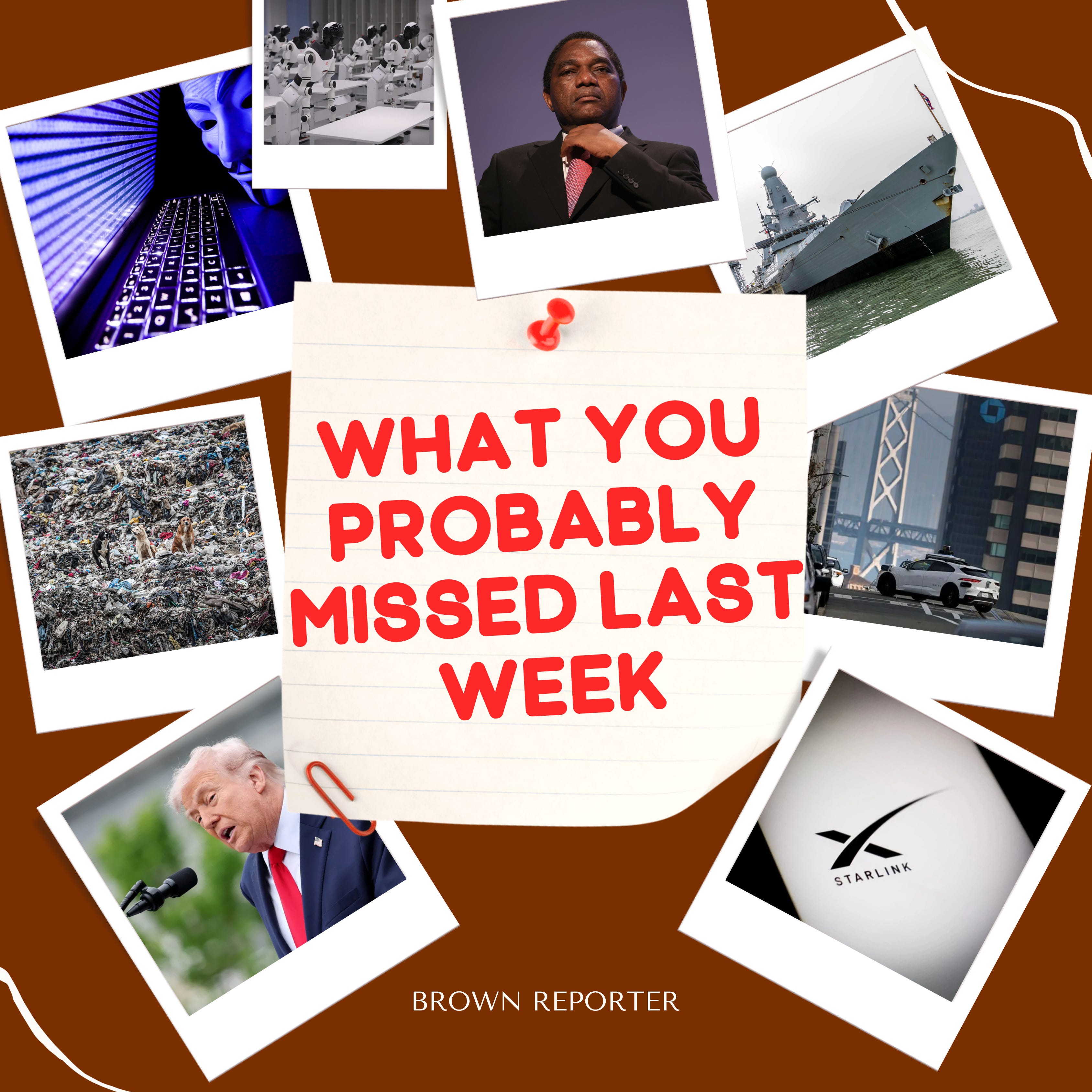
South Africa pulled its draft National AI Policy after journalists found out it was written by AI, and written badly. At least 6 of the document’s 67 academic citations were hallucinated: fake papers attributed to real journals that don’t exist. The government had only just published the policy in the official Government Gazette for public comment in April 2026. The minister called it an “unacceptable lapse.” The country must now restart the entire consultation process with no timeline for a replacement draft. The irony is almost too perfect: a government couldn’t trust the technology it was trying to regulate to help write the regulations.
📊 Number of the Day
810,000 tonnes
That’s how much plastic waste Germany exported in 2025, making it the world’s biggest exporter of plastic waste. Most of it went to Turkey, Malaysia, and Indonesia. These are countries that often lack the infrastructure to process it safely, turning Germany’s recycling problem into somebody else’s health and environmental crisis. To be fair, Germany has cut its plastic waste exports by 51% over the past decade. That sounds like progress until you realise it’s still the top exporter in the world by a wide margin. The phenomenon has been called “waste colonialism”: rich nations solving their disposal problem by making it someone else’s.
Thanks for reading! Subscribe for free to receive new posts and support my work.
🛢️ The UAE Has Left the Building
What It Is: The UAE formally exited OPEC and OPEC+ on May 1, 2026, ending a 59-year membership. The stated reason: to pursue “national interests” and an unshackled production target of 5 million barrels per day by 2027, free from cartel quotas.
Why It Matters: The UAE was OPEC’s second-most influential member after Saudi Arabia and one of the very few nations with genuine spare capacity to move global oil prices. Its departure meaningfully weakens the cartel’s ability to manage supply and stabilise markets. Qatar left in 2019, Ecuador and Gabon have done so before, and some are returning later. But this departure feels different. The real issue is geopolitical. Production quotas have little to do with it. The UAE is, in effect, choosing alignment with the US and Israel over solidarity with its Gulf neighbours at a moment of acute regional tension.
The Big Picture: The timing matters. The exit follows a US-Israel-Iran conflict in which Iran, a fellow OPEC member, launched missiles and drones directly at the UAE. There’s also a deepening rift with Saudi Arabia over Yemen and broader regional strategy. But the full weight of this decision won’t be clear until the Strait of Hormuz reopens: roughly 20% of the world’s oil passes through those waters, and how the UAE positions itself when that chokepoint is in play again will define the real stakes of today’s exit. OPEC is fracturing at a bad time for global energy stability, and this is probably just the start.
💸 America’s Tab Just Hit 100%
What It Is: As of March 31, 2026, US debt held by the public reached $31.27 trillion, slightly exceeding GDP at $31.22 trillion. That pushed the debt-to-GDP ratio above 100% for the first time since 1946. The Congressional Budget Office projects it will reach 120% by 2036. It is also worth noting that the figure cited here refers only to debt held by the public; the total gross national debt, including intragovernmental obligations, has already surpassed $39 trillion.
Why It Matters: The last time the US reached this milestone, it had just financed the largest military mobilisation in human history. Today’s version has no such crisis behind it. It’s the compounding result of decades of fiscal inaction from both parties. The picture keeps getting harder to manage: the ongoing conflict with Iran has added new military spending pressure that won’t ease soon. DOGE promised to slash federal expenditure and generated a lot of noise, but ran out of political steam within six months, producing headlines rather than real savings. Congress has shown no appetite for the politically painful combination of cuts and revenue increases that would actually change the trajectory.
The Big Picture: What keeps the US from the kind of debt crisis that would swallow any other country is the dollar’s role as the world’s reserve currency. There’s no credible alternative. Nations need dollars to trade oil, settle debts, and hold reserves. That structural demand lets America borrow at rates no other country with this debt load could access. It’s an enormous advantage, possibly irreplaceable. It also has limits. High debt restricts a government’s ability to respond to future recessions, pandemics, or military escalations. At 120% of GDP, those limits become very real. The dollar’s privileged position buys time, but that’s all it does.
🤖 China Draws a Line Between AI and the Pink Slip
What It Is: Courts in Hangzhou and Beijing ruled in two separate cases that Chinese companies cannot dismiss employees solely to replace them with AI. Judges classified AI adoption as a “controllable business strategy,” which doesn’t justify termination under China’s Labour Contract Law. The key case involved a QA (Quality Assurance) supervisor who was offered a 40% pay cut and a demotion when his job was automated in 2025.
Why It Matters: 78,000 tech workers globally have been laid off in early 2026, with nearly half of those layoffs attributed to AI. These rulings, the first of their kind, create real legal protections for workers facing displacement due to automation. That protection doesn’t exist in US or EU employment law, where broad “business reasons” are generally enough to justify dismissal. For workers watching their roles quietly automated around them, this is the first legal framework that actually pushes back.
The Big Picture: China is doing two things at once: pursuing AI aggressively at a national level while using the courts to soften the immediate impact on workers, at least for now. Whether that’s economically sustainable in the long term is a real debate. But the more important question is whether other countries follow. As AI-driven displacement accelerates, pressure will build on Western governments to answer the same question Chinese courts just answered: Is “the algorithm wants your job” a legally sufficient reason to lose it? The frameworks don’t exist yet in most places.
🌐 Around the Globe
🛰️ Russia: Moscow signed a decree banning the import of all foreign satellite communication terminals, including Starlink, for 6 months, citing national security.
🦟 Global Health: The WHO granted prequalification to Coartem Baby, the first antimalarial drug specifically designed for newborns and infants weighing 2-5 kg.
🚗 California: Starting July 1, 2026, California police can issue “notices of noncompliance” directly to autonomous vehicle companies when their robotaxis break traffic laws, rather than just filing reports with regulators.
🇵🇪 Peru: Peru’s Specialised Prosecutor for Human Trafficking has opened an investigation after approximately 600 citizens were lured to Russia with promises of security guard jobs paying $2,000-$3,000/month, only to be forced into frontline combat in Ukraine.
🇿🇲 Zambia: RightsCon 2026, the world’s largest human rights and technology conference, was cancelled days before its scheduled opening in Lusaka, reportedly after China pressured Zambia to exclude Taiwanese civil society participants.
🚢 Europe: Britain announced plans to build a unified naval force with nine European nations, including Denmark, Norway, Finland, Sweden, and the Baltic states, designed to go “into immediate combat if necessary.”
🇬🇷 Greece: Greece announced a Digital Identity Verification Act requiring social media platforms to link all accounts to verified real identities, with fines of up to €20 million or 4% of global revenue for non-compliance. Users can still use public pseudonyms, but every account must be traceable to a real person.
🇧🇭 Bahrain: Bahrain revoked the citizenship of 69 people for “sympathising with” Iran’s missile strikes, the first mass citizenship revocation since 2019.
📱 Good News of the Week
South Korea just became the first country in the world to guarantee that no one gets completely cut off from the internet when their data runs out. Starting late July 2026, all mobile subscribers across the country’s three major carriers, SK Telecom, KT, and LG Uplus, will automatically switch to a basic 400 Kbps connection once their monthly allowance is exhausted, at no extra charge. The government has formally declared internet access a “basic telecommunications right.” Around 7.17 million South Koreans will benefit immediately, saving the group an estimated $219 million a year in top-up charges. 400 Kbps isn’t fast enough for streaming, but it works for maps, messaging, and emergency calls. That’s exactly what you need in those moments.
Thanks for reading! Subscribe for free to receive new posts and support my work.
🧠 Brain Food
✨ Quote of the Day
“Nations have no permanent friends or allies, they only have permanent interests.”
— Lord Palmerston
This newsletter exists because of readers like you who want the news without any agenda. If it's been useful, share it with someone who needs a break from the doom loop, or if you'd like to support the work, a coffee goes a long way. Either way, thank you for being part of this. x
🤝 Share the Knowledge
Enjoying this newsletter? The biggest compliment you can give is to share it with your friends.
Thanks for reading. You’re officially the smartest person in the room. Talk to you soon :)
Comments
Nothing yet. Say the first thing.
Sign in to join the conversation.