
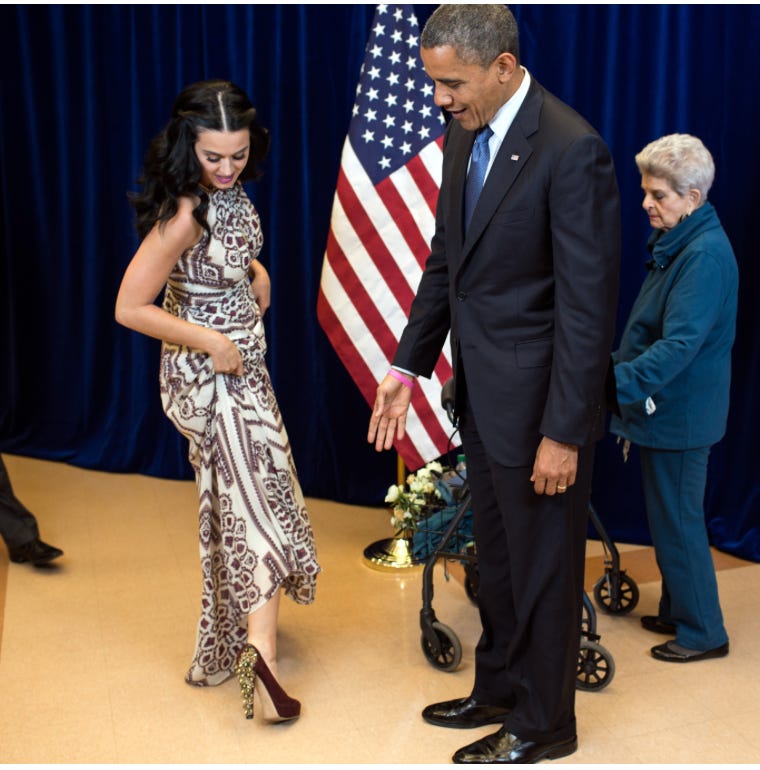
“Does anyone else feel like we are inching slowly back towards Obama-era cultural vibes or is it my imagination?” wrote someone on social media last week.
It’s a little unclear what that person meant. But there’s one area where that prediction may come to pass: We’re on the cusp of a Recession Pop nostalgia moment. And it couldn’t arrive any sooner.
What we now call Recession Pop didn’t have a name at the time. It now refers to that tsunami of brash, indomitable pop—and the largely women artists who fronted it—that was unavoidable during Barack Obama’s first term and part of his second. It was 2008 to 2012. It was Lady Gaga and Katy Perry and Rihanna and Kesha and Adele and more.
It was the robust, often saucy bangers they and their co-writers and producers pounded out, even after another: “Rolling in the Deep,” “Bad Romance,” “Tik Tok,” “Last Friday Night (TGIF),” “We Found Love,” “Paparazzi,” “Telephone,” “Teenage Dream,” “Diamonds,” “Call Me Maybe.” For a generation suddenly facing an uncertain future after the Great Recession of 2008, what came to be known as Recession Pop served as a form of escapism and a coping mechanism.
Even during peak poptimism, albums by those artists rarely made it onto year-end best-of lists. But the period easily ranks with classic pop eras like the Brill Building era, the British Invasion of the Sixties, the Seventies disco boom and the boy band and Britney Spears period that preceded it by roughly a decade. That era set the table for the current, all-conquering world of women in pop: For the current generation, Gaga and Adele are as foundational as blues musicians were to the Rolling Stones and other Sixties British rockers.
The signs of a revival started building last year, when Gaga’s overwhelming Mayhem Ball tour pulled in more than $100 million in ticket sales in North America alone. Even more unexpected, given her recent dearth of hits, Perry raked in $134 million last year with her Lifetimes Tour. After shunning her trademark sound for an increasingly dull “adult pop” phase, Kesha revisited the dance floor with Period. Rihanna sightings near recording studios started the salivating for what could be first album since Anti, released an astounding ten years ago.
The Recession Pop lookbacks continued this year with the warm reception accorded The Devil Wears Prada 2, the sequel to a beloved movie that slightly predated the era. It even came equipped with a new Gaga song to boot, Prada or otherwise. Now scroll down the list of albums in this week’s Billboard’s Top 200 chart. Alongside current releases by Morgan Wallen, Olivia Rodrigo, Noah Kahan, Drake and Ella Langley are Gaga’s The Fame, Katy Perry’s Teenage Dream and two albums (Anti and Good Girl Gone Bad) by Rihanna.
Yes, in 2026.
Thanks for reading The DBrief! This post is public so feel free to share it.
Why now?
The easy answer is the typical nostalgia cycle, which generally starts 20 years later. As hard as it may be to fathom, we’re approaching the two-decade mark (2028) for Perry’s “I Kissed a Girl,” Gaga’s “Just Dance” and Rihanna’s “Disturbia.”
Every generation has its nostalgia moment, and the Millennials and Gen Z who grew up with these songs remember the first time they heard Adele roar into the chorus of “Rolling in the Deep” or saw Perry emerge onstage in her pinwheel dress. (They also bought a massive number of copies of Jennette McCurdy’s memoir, since iCarly is fondly recalled, too.)
Then there’s the music. I recently made a playlist of prime Recession Pop and was once more transported by the distinctive voices (with or without AutoTune), unstoppable hooks and big-audio-dynamate craft heard in nearly all of them. After all these years, it was impossible to resist Perry’s insouciant “Last Friday Night (TGIF),” Rihanna’s hypnotic “We Found Love,” the diva classicism of Adele’s “Chasing Pavements” and Rihanna’s “Stay,” the churning emotional and vocal firepower in Adele’s “Rumour Has It” and “Rolling in the Deep,” the voices-imitating-busy-signals in “Telephone.” The music is still irrefutably vibrant.
But people may also yearn to revisit that era for reasons that go beyond music.
As that social media poster alluded to, Recession Pop and first-term Obama were inextricably linked. The connections are weirdly uncanny. In the first month of 2008, Obama won Iowa’s Democratic caucuses, confounding everyone, just as Adele’s first single announced the arrival of a feisty new diva. Gaga’s first major hit, “Just Dance,” hit no. 1 the week Obama was inaugurated for his first term.
Elena Kagan was sworn in as an associate Justice of the Supreme Court just as Perry’s Teenage Dream dropped and started its five-hits conquest. Gaga’s Born This Way was released just as Obama announced the killing of Osama Bin Laden. The Supreme Court upheld Obama’s Affordable Care Act just as Carly Rae Jepsen’s “Call Me Maybe” ascended to no. 1, where it remained nine straight weeks. Karma? Coincidence? Or both?
For roughly 48 months, a new, more forward-looking administration, led by the country’s first Black president, sought to overcome a devastating recession and make gains for gay rights, gay marriage, and health care. Arising in tandem was a sonically and sexually open-minded soundtrack for what felt like a new morning in America.
Recession Pop was absolutely party music, but it could also be culturally progressive. It was one thing to have a new president who wanted to address progressive social issues. It was another to have Lady Gaga release a gay-rights theme song (”Born This Way”) and explore a lesbian relationship in “Americano” or tap into bisexuality in “Poker Face.”
Or for Perry, despite her all-American cheesecake image, to push the envelope on bisexual thrills with “I Kissed a Girl,” or for Rihanna to sing about grappling with a woman in love with her in “Te Amo.” Kesha’s “W R Who We R” was a propulsive techno pop song; it was also inspired by the alarming rise in suicides of gay people in the 2000s.
Gaga took heat for her decision to play concerts in Arizona when other pop artists pulled out of the state to protest its anti-abortion law. But that was a rare misstep in the bond between pop and politics between 2008 and 2012. As their songs dominated the airwaves and concert halls, Gaga and Perry campaigned for Obama; Beyoncé and Jay-Z helped raise money for him. Shepard Fairey’s iconic “Hope” posters for Obama could also have shown the faces of the queens of Recession Pop.
Those years weren’t without their struggles, frustrations, setbacks and despair. The era was haunted by school shootings, the rise of the Tea Party, and Obama’s missteps in dealing with Congress and Republican resistance to him.
And just as Obama and Recession Pop did a pas de deux, so did both their dances begin to wind down at the same time. The year 2013 saw the start of Obama’s less exhilarating second term, the release of Gaga’s problematic Artpop album and the first glimmers of Kesha’s lawsuit against her co-producer, Lukasz Gottwald, aka Dr. Luke. Adele and Kesha (who was contending with an eating disorder) wouldn’t release new albums for several more years.
The government shutdown of 2013, accompanied by Donald Trump’s incessant needling of Obama on Twitter, would set the stage for his own presidential run. Given the attacks on LGTQ and civil rights that followed, the fall of Recession Pop, so connected with those more forward-thinking times, feels especially symbolic.
From Gaga’s visually overwhelming Mayhem Ball shows to Obama eulogizing Jesse Jackson this spring, flashbacks to that era keep reminding us of what was then and what’s been lost since. And maybe plenty of us wish we were back there now. The music (even with its share of European producers) now feels like the soundtrack to America’s last grand party, and to the country’s last stand as a political and cultural force. If and when Recession Pop returns, we’ll be bopping and mourning at the same time.
No posts
Comments
Nothing yet. Say the first thing.
Sign in to join the conversation.