
Now that Taylor Swift has reengaged with the country world, the next logical questions is: Will the ukulele return?
That’s only a half-joke, of course. Joining a long list of ’60s-and-on pop musicians who became fascinated with that instrument, Swift became something of a uke stan during the waning days of her country years. Back in 2010, “Ours,” a bonus track for Speak Now, integrated a ukulele (played by Bryan Sutton), and she herself began playing the instrument onstage during the tour behind that album.
The ukulele, which has its origins in Portugal (not Hawaii as per legend), is no stranger to post-rock pop. Tiny Tim introduced it to the counterculture crowd nearly 60 years ago, and later uke aficionados included Pete Townshend (who strummed one on the Who’s “Blue Red and Grey”) and George Harrison. Talking about his father’s intense devotion to the instrument (to the point of even going to conventions honoring uke master George Formby), Dhani Harrison once told me, “He spent a lot of time in the tropics, and that was his ‘troppo’ outlet. But it was also a tie back to British wartime entertainment. The ukulele was the common thread between the two different points of his life. He carried one everywhere. He never put them down. He carried four with him and would give them to people or leave them at people’s houses. Just in case he needed one.”
Around the time Speak Now was released, the ukulele strummed itself into our consciousness yet again: Train’s “Hey, Soul Sister” made it part of the Recession Pop moment, Eddie Vedder released an album based around that instrument, Portishead featured one on “Deep Water,” and uke maestro Jake Shimabukuro pushed the instrument to new limits with covers of Beatles, Queen, New Order and Leonard Cohen songs.
Given all that activity, Rolling Stone assigned me a story of the unlikely ukulele comeback, and in April 2011, Swift took time out from rehearsals for the next leg of the Speak Now tour to talk about her engagement with the instrument. Only a portion of the interview appeared in that story, so here’s the rest. As with everything in her career, she clearly took the assignment very seriously.
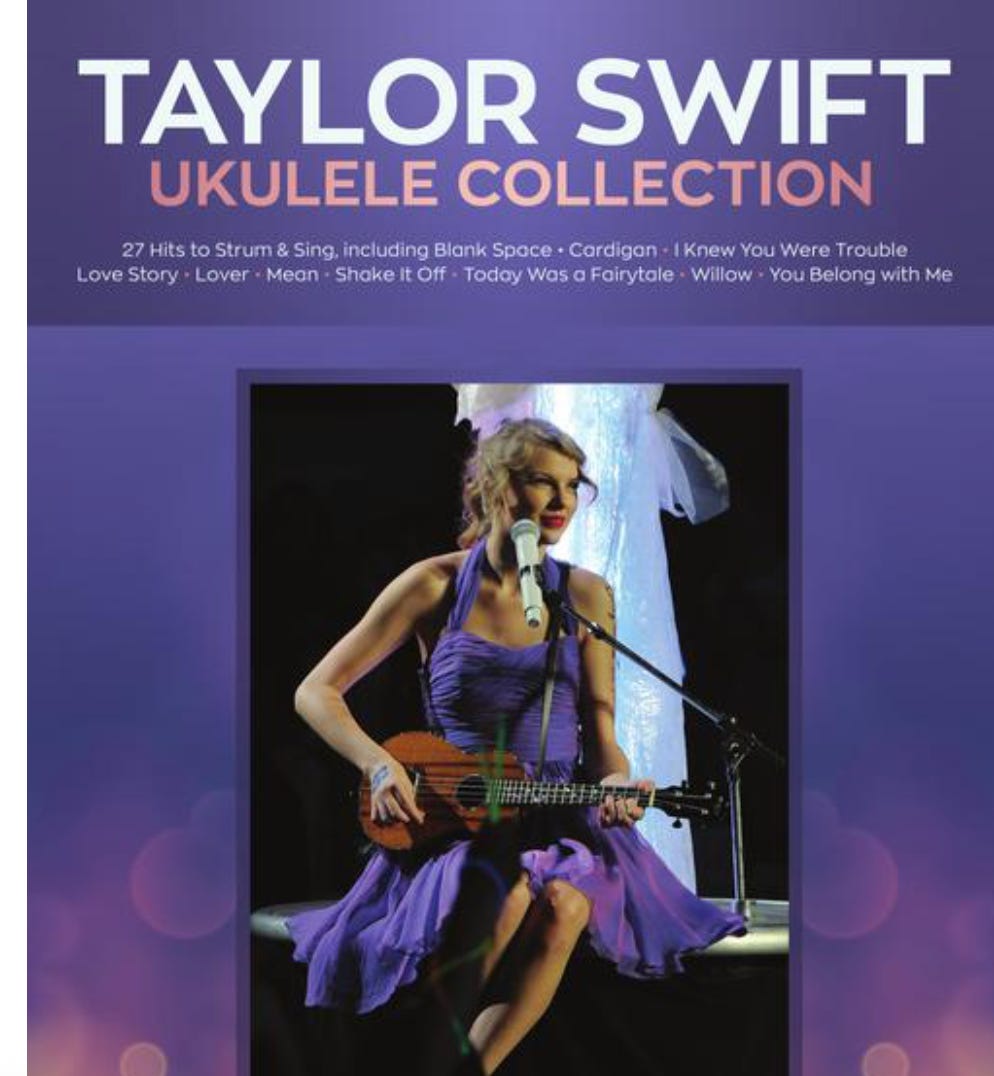
When did you first become interested in playing this instrument?
I first wanted to play ukulele when I was on vacation in Hawaii when I was 18. I had taken my entire band and crew on a vacation there to celebrate all the work we’d done that year. We’re all staying on the big island, in Kona. I was sitting there at the hotel restaurant outside, right by the beach, and there was this band playing and this ukulele player was playing this gorgeous instrument, made of koa. It had a pickup in it. I’d never seen a uke like that.
Afterward I went up to him and said, “You play so beautifully. It’s gorgeous listening to you.” We got to talking and I asked him about it and he said his father had made it and it had been in in his family for years. We talked more and more and I told him I’d love to learn to play ukulele. I ended up getting his number and calling him later and asking if he had any other ukuleles like that in his collection and he said no, it was the only one like that. But he said, “You’ll get it seen in front of more pepole and bring people more to this instrument, so I’d consider selling it to you.”
I went to his house the next day, with his wife and kids playing around. He let me play it and taught me a few chords and told me stories about the ukulele in general and his family history. And he ended up selling it to me!
Did he know who you were?
I don’t remember. I had one album out. I think he came to know that I was in country music and that I was on tour. But it was all because he wanted more people to know about it. I kind of promised him I’d play it live, so I did it that for the entire year. And this year I picked it up again and played it on the world tour. I like to do different versions of songs because I’ve played them over four million times [laughs]. “Fearless” is one of those songs I wanted to try a different version and I thought it could be pretty on the ukulele. I add in a few hooks from other songs, like “Hey, Soul Sister” and “I’m Yours” by Jason Mraz. Those are other songs that are beautiful on that instrument.
How aware of ukuleles were you before that trip to Hawaii?
I’d heard of them and see them played. It’s something you know about. But until I really delved into what it sounded like on my songs and how it felt to sit around and play it—I wasn’t familiar with it until I discovered all that.
What appeals to you about the sound and tone of a ukulele?
It sounds kind of happy and sort of heavenly. It’s an instrument that would probably be played there. It’s just got a light beautiful sound but it’s also really intriguing, when you hear it used right.
How hard was it to learn how to play one?
It has different chords than a guitar, but I didn’t find it hard to learn. It’s so fun to learn it and it’s so pretty. It forces you to learn it because it’s such a cool instrument. I learned to play in my own time, going through chord books and YouTube videos. It’s funny. I can learn my own songs pretty easily by going on YouTube and watching a tutorial on the ukulele.
What feedback have you received from fans after they’ve seen you play it onstage?
I get questions about every instrument we use in the show, but the ukulele I’ve gotten a lot of questions about. People don’t usually see it in live performance. It’s really cool because to add that element to your show, using an instrument people aren’t familiar with. It’s a fun moment for me in the show.
What does the instrument bring out in “Fearless”?
One of my favorite things about that is that I’m introducing the song and I say something with the word “fearless” and it tips the crowd off to what I’m going to play. Then I start paying it with a different beat than on the record. It’s more of an islandy, Train beat. So it’s a different take and as soon as I go into the first chord, they know they’re hearing something different from what they’re hearing. It’s a fun combination.
Is there still a pickup in it?
Yeah. You can plug it in. I use it wirelessly. I use it in the middle of the crowd, too. That’s a fun way.
Does it go out of tune more than a guitar?
You need it tune constantly. It’s not hard because you can tune it by ear, easily. [Sings notes]
Would you consider playing it in the studio?
I take songs on a case-by-case basis. So if there’s a song that screams out for ukulele, I’ll put it on there. It can bring so many different dimensions to a song—it can make it sound child-like or hopeful or happy.
What surprised you most about playing a uke?
The biggest surprise is that you can play acoustically and fill an arena with sound. It’s such a tiny instrument. That really speaks volumes about it. People love the sound so much that it can keep their attention.
Does it have its own gear case on the road?
It has its own case, yeah.
How much did you pay for yours?
I’m not telling you! [Laughs]
They go for anywhere between $40 and $2,000. Did yours fall within that range?
I’m not telling you! [Laughs again]
No posts
Comments
Nothing yet. Say the first thing.
Sign in to join the conversation.