
For the first in what will be a recurring post, here are a few things I’ve been listening to over the last month. If some of these seem a little late, chalk it up to my preference to spend as much time with a new album as possible. You never know how music will settle after you’ve lived with it for a spell.
Rhiannon Giddens, “Carolina Rain”: Life is a mystery, as Madonna once sang. Last month, Giddens released the first of two previews of her forthcoming album, Hope Is the Thing with Feathers. That song was “Carolina Rain,” a contented reflection on the joys and comfort of a long-term relationship. Although it feels like the type of folk-gospel standard people would have heard in a revival tent a hundred years back, it was actually cowritten by Giddens and Americana multi-instrumentalist Dirk Powell.
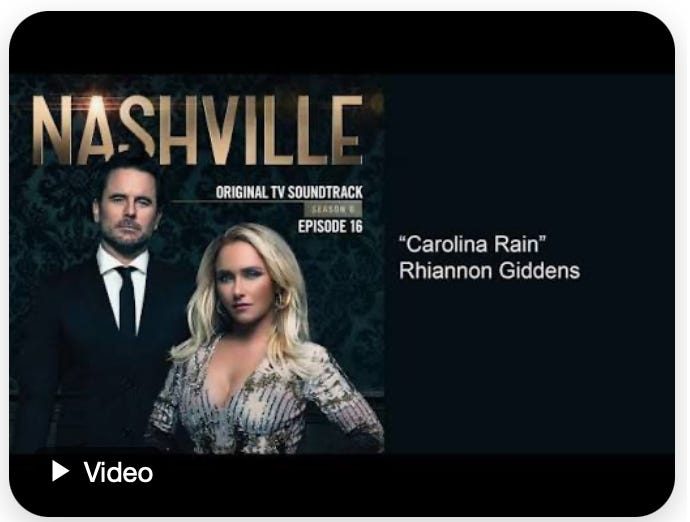
The song is familiar in other ways. An earlier recording of “Carolina Rain” was featured in the very last episode of Nashville, the late, lamented dramatic series about aspiring and well-worn fictional country stars. Nashville may have been the only TV series to nail parts of the music business. (Remember when Rayna was convinced to go more rock & roll? Or when the late JD Souther played a veteran bizzer?)
Giddens had a role on the show, as did the late Hayden Panettiere. Giddens’ redo of her own song adheres closely to the gently headstrong version heard in Nashville, and the timing couldn’t be spookier. Giddens certainly didn’t intend it this way, but “Carolina Rain” now feels like a tribute to her late, troubled costar.
Charli xcx, Music, Fashion, Film: Charli’s eighth isn’t a concept album per se, but it may as well be. Life in the social-media age is the recurring theme: one’s public vs. private identity, what to do “when the camera’s on,” our relentlessly consumerist world. It’s all very meta, but “2007” may be one of the first millennial nostalgia song. It’s “American Pie” for the generation mourning the simpler days of two decades ago. (As I wrote a few weeks ago, Recession Pop nostalgia is all but inevitable.)
Given those lyrics, Music, Fashion, Film could have been insufferable. But the record’s blend of subterranean sonic splatter and pop zest (“Yeah” and “Wink Wink” among them) is an unpredictable and multi-layered marvel. She’s right to complain that this isn’t a “rock” album. But nor does it sound encased in the precious aural bubblewrap heard on too many current pop-indie acts, male and female alike.
At times I wish Charli’s voice were a little less pretty, a little more Courtney Love or Tina Turner. But her delivery, which veers from insouciant to earnest to new-wave deadpan, is its own version of modern rock. A detour from her last few records, Music, Fashion, Film is one of those records you want to keep revisiting to plumb its cheeky depths.
The Strokes, “Going Shopping”: I still have fond memories of seeing these guys at New York’s Mercury Lounge during a 2000 residency there. And they really were thrilling, a welcome respite from rap-metal, nu-metal and Jimmy Eat World and their incoming descendants.
Which means, too, that the Strokes have now been around as long as the Stones were by the time of Steel Wheels. In those 25 or so years, the Stones wandered into all types of musical terrain: some magnificent, some not. The Strokes have moved their own needle a bit, but not all that much. And their overdue new album, Reality Awaits, is the embodiment of how frustrating they can be.
Julian Casablancas’ disaffected delivery awaits you, along with bits of AutoTune, confounding lyrics and songs that rev up promisingly and then take their feet off the gas pedal. And yet a few of its songs have a mattress-spring bounce to them, and “Going Shopping” is among the sharpest. (Like Charli, they’re taking the mall for a spin.) For a few minutes, you forget about the baffling tune that mildly disses their pop competition, from the Weeknd to Harry Styles.
The Grateful Dead, “Don’t Mess Up a Good Thing”: This year’s batch of archival Dead releases includes one of the earliest band recordings. It’s about time, too. On Fillmore Auditorium, San Francisco, CA, July 3, 1966 (first released as part of a massive box a decade back but now available on its own), we’re hurled back to the time when Pigpen, his voice and his musical taste were an indelible part of the Dead universe.
The Dead in 1966 still sound formative and tentative at times. But this Pig-lead version of the Fontella Bass-Bobby McClure hit from the previous year is worth a revisit. The Dead’s take isn’t the rollicking gospel pop heard on Gregg Allman’s Laid Back version. It’s ornerier and scragglier, and it reminds you of what they lost when Pigpen’s role and health began receding.
Lido Pimienta, Caribenya: I belatedly discovered Pimienta, the Colombia-born musical sorceress now based in Toronto, at New York’s Summerstage festival in 2024. Her voice, stage presence and cumbia-rooted musical mantras were equally spell-binding.
That vibe extends to her fifth record. The second half of its title refers to Enya, whose enveloping sound casts a shadow over the album. But the way Pimento tugs at her native forms—slipping in electro pulses, hypnotic chants—is very much her own. Even when the lyrics turn lacerating or bitter, the music swoops in to transport her and us.
Linda Ronstadt, “Lose Again”: The news of Ronstadt’s 80th birthday last month, combined with the 50th anniversary of Hasten Down the Wind, sent me back to that often overlooked album. Ditching the way both Heart Like a Wheel and Prisoner in Disguise relied on the same songwriters, Hasten Down the Wind presented Ronstadt as an interpreter of largely contemporary material by the likes of still-unproven writers like Karla Bonoff, Warren Zevon and Ronstadt herself, along with the more seasoned Tracy Nelson and Ry Cooder. She rarely duplicated that approach on subsequent albums, which was a shame; Hasten Down the Wind was the road not taken.
Before we retire the “sad girl pop” cliché once and for all, let’s at least acknowledge that Bonoff was a pioneer of the form before it had a name. Ronstadt included three of her songs on the album, and “Lose Again” still slays. In the lyric, Bonoff admits she’s partly to blame for the way she’s pulled back into a toxic relationship: “I’ve made up my mind I would leave today/But you’re keepin’ me goin’, I know it’s insane.”
Yet there’s nothing wispy or breathy about the way Ronstadt builds her heartbreak verse by verse. Or in the way the arrangement itself swells from lone piano to full-band bashing. When Ronstadt ramps up the word “love” in the concluding “love you and lose again,” she’s leaving us—and him—with a roar, not a whimper.
(This edition of “The DBrief” is dedicated to the memory of my friend Jim Hunter, a brilliant and astute pop critic and thinker who left us too soon. I’ll miss our conversations and debates, Jim. I know you loved that era of Ronstadt, too.)
No posts
Comments
Nothing yet. Say the first thing.
Sign in to join the conversation.