
It’s hard to imagine arriving on the other side of AI scandals in publishing. Will this all feel quaint someday, the way we might look at photographers who must felt similarly violated when digital cameras came on the scene? Or can publishing find a way to hold the line when it comes to machine-generated books?
It seems simple, the notion that we might have an industry-wide consensus, that there might be policies, or rules, or best practices, or regulations. But no, there’s none of that. Instead, publishers are choosing outrage and canceling as a strategy, and we all know how effective that is.
The latest AI scandal on everyone’s tongue centers a book called The Future of Truth: How AI Reshapes Reality, by Steven Rosenbaum. What should have been a publicity score for the author and his publisher, BenBella Books, has instead cascaded into a national shame fest not dissimilar from the March 2026 fallout surrounding Shy Girl, the novel Hachette pulled from publication following accusations that the author used generative AI.
Here’s what’s happened so far:
On May 14, publication week for The Future of Truth, Wired posted this excerpt from the book: Gen Z Is Pioneering a New Understanding of Truth. If you click on this link now, you’ll find a note from Wired’s leadership reading that its “editorial leadership has determined that [the excerpt] does not meet our editorial standards. It has been removed.” But nothing can ever be removed from the Internet, folks, so you can read the excerpt in full here.
On May 19, The Times revealed in an exclusive that Rosenbaum, whose entire book centers how artificial intelligence is threatening and reshaping the concept of truth itself, had confessed that quotes in his book were either misattributed or completely hallucinated by AI.
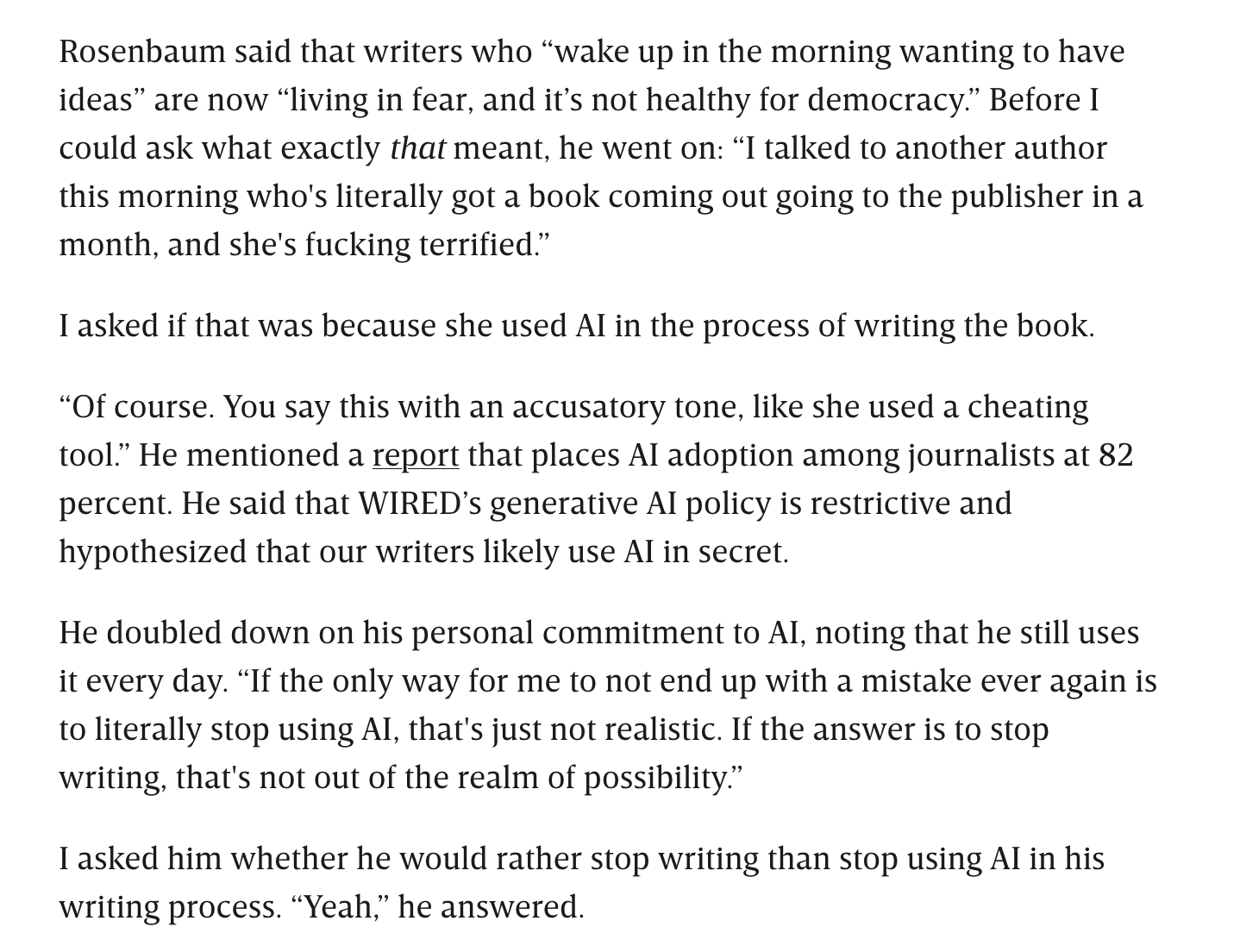
On May 29, Wired did a follow-up in the form of an interview: “We Asked the Future of Truth Author to Explain How He Used AI. It Didn’t Go Well.” It’s behind a paywall, but here’s the part that’s trending:
I read the pile-on that followed, and it’s hard not to feel some satisfaction at it. But the very same week that all of this was happening, I got an email from a former author asking me what our upcoming publishing schedule is, and whether we might consider her next book.
I would have been excited to welcome this author back to She Writes Press, but in her subsequent email she informed me that she’d used AI to write her book. She framed it to me this way:
I must disclose that I used Claude AI to be my ghostwriter and editor to some degree, and the project is still my voice and my stories and my ideas including the framework.
I respect this person a lot, so my heart sunk in on itself as I read these words. Of course, we cannot and will not publish a book with Claude as a ghostwriter, but immediately my head started to swim with what will happen next. Will she just go and find another publisher? Will she stop disclosing that she’s used AI in this capacity because of my reaction? Will this ruin our professional relationship?
When I let her know it was a no-go, but not without letting her know (kindly) how I feel about AI as a ghostwriter, she responded that she respects my position as a publisher. Notably, she continued:
As a writer, from my perspective, it feels much more authentic and genuine than my first attempt at writing, and I am amazed at how well it maintained my voice. And the readers who are reading it experience nothing except my voice.
Do I find this disheartening? I do. But increasingly I’m finding that the line between what belongs to AI and what belongs to a given writer is blurring. Questions come up for me about how divided we’ll become, and how long publishers will continue to hold the line when they’ll be saving so much time and money allowing AI to do more and more for us. I’ve found that people’s ethical stances tend to buckle under financial pressure, and publishing is feeling a lot like the proverbial frog in the boiling pot right now.
On May 28, in the wake of the fallout over The Future of Truth, New York magazine put out an article called “Nonfiction Book Publishers Aren’t Remotely Ready for AI.”
It’s behind a paywall and worth reading, but here are the two intractable problems it identifies about publishing:
#1. Publishers don’t fact check
The gist of it is this:
But fact-checking is expensive: Hiring an outside checker can cost between $7,000 to $10,000 per book, or even more depending on its length, which might not be feasible for an author with a modest advance.
Worse, it seems publishers have no idea what to do about this glaring vulnerability.
#2. Full transparency about AI usage poses more problems than we might imagine.
It’s complicated. And don’t I feel it! Transparency isn’t enough, and we’re not encouraging more transparency when shame is the primary tactic. Detection tools are unreliable, and they pit publishers against their authors.
As of the writing of this piece, I believe that Rosenbaum is fixing the inaccuracies in The Future of Publishing for a next edition, and that the book is not being canceled. But things move fast from one day to the next, and publishers respond to public pressure when it comes to cancellation.
Book publishing’s strategy against AI thus far has been absolutism. The industry has decided that our best response to the tsunami coming our way is to post a sign at the beach that says No Waves. There’s no nuance here, no acknowledging how much support (and dare I say joy) people are finding as they interact with AI to create.
Creative industries are scared, and I feel that, too, but we are also rendering ourselves irrelevant by not taking a lead on establishing guidelines. There’s a huge difference between using AI as a thought partner and cutting and pasting lines of text, verbatim, and passing those lines off as your own. But if we’re equally outraged by all of it, we’re alienating would-be authors and missing our moment to do what publishing has always done best‚ which is to lead, to set standards, and to be an arbiter of what work gets published. I don’t have the answers, but I know I’m not alone in hoping we’ll continue to negotiate, and to find a shared language that doesn’t completely alienate publishers from their would-be authors.
Thanks for sharing with an author or writer in your life . . . ⤵
No posts
Comments
Nothing yet. Say the first thing.
Sign in to join the conversation.