
A note on who I am: I’m an investigative journalist who’s spent a decade reporting on the collision of technology and democracy including exposing the Facebook/Cambridge Analytica scandal for the Guardian and the New York Times. I’m now a co-founder of The Nerve, set up a year ago by five women journalists from the Guardian and Observer. This is my personal newsletter.
Some years ago, I co-wrote a commissioned pilot for a TV series that centred around a bunch of unlikely female spies. It was based on a real story about how parliament’s intelligence committee told MI5 they needed to get with the programme and stop recruiting from public schools and Oxbridge and put ads on places like Mumsnet.
It didn’t get picked up for broadcast but my friend, Louise Crowe, and I had a blast writing it and this morning, I found myself thinking, as I often have, about our tagline for the show: “There’s no-one more invisible than a middle aged woman.”
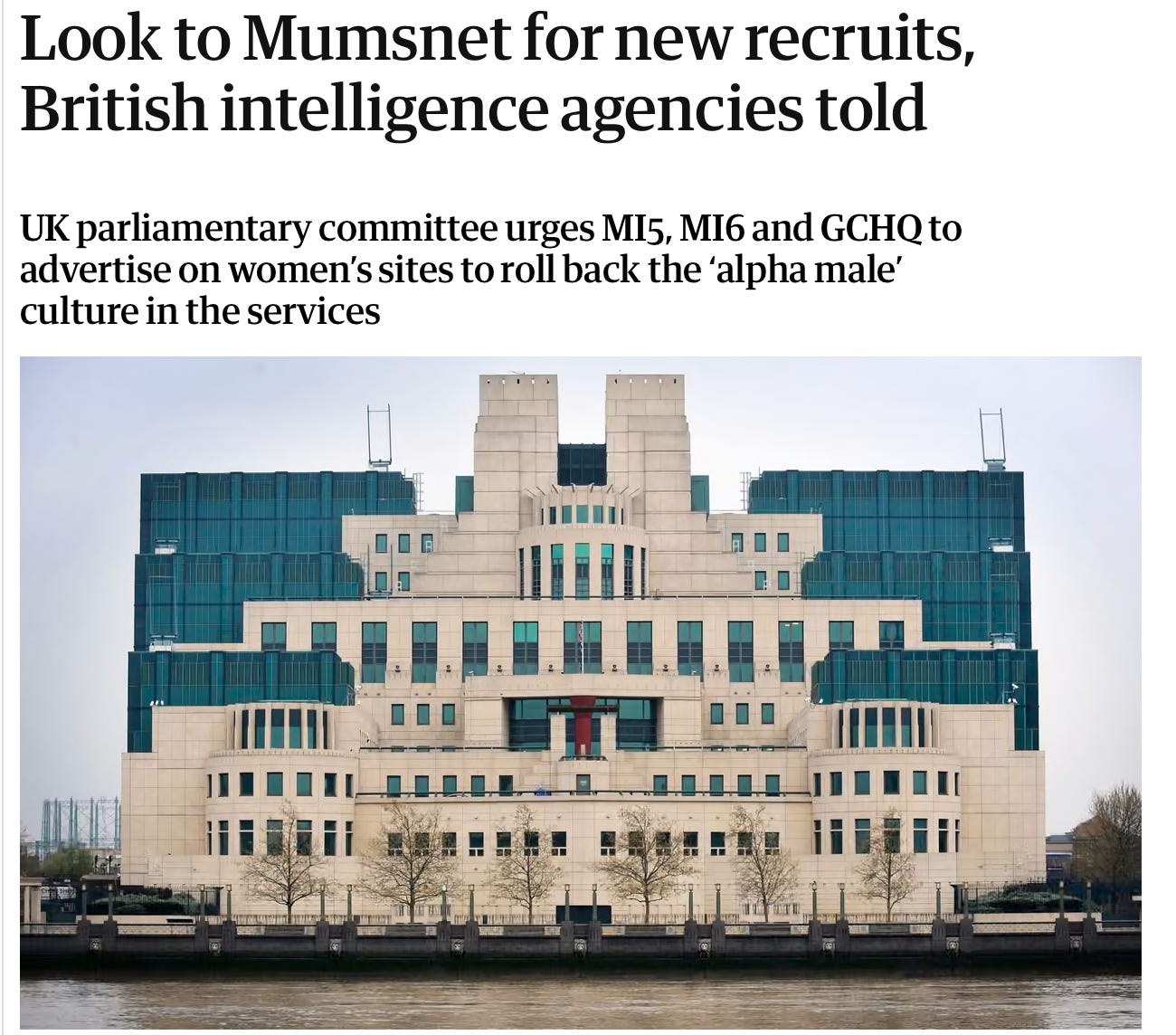
I wrote it before I turned myself into an investigative journalist, before I’d begun meeting spies or ex-spies and before my life began to resemble an actual episode from the series. But I was more right than I knew. Invisibility is a handy quality for both spies and journalists. It’s perhaps my only superpower. I’m not actually invisible but as a middle-aged female journalist, I might as well be. Being serially underestimated is how I got all my best stories. I like to chat. I’m not an arse. And, if I don’t look like an ambitious young man hungry for his next scoop, it’s because I’m not.
In Britain, it’s meant that I exist in a strange shadow world. For a decade, as well as reporting out my stories in the Guardian and Observer, I’ve been a power user of social media. It’s where I’ve gathered evidence, found allies and storytold what was happening in real time. My tweets and Bluesky posts and now Substack newsletter get huge traction and while Twitter may not be the force it once was, my tweets routinely go viral.
But I’m also invisible. In America, I’ve regularly appeared on some of the US’s biggest shows - Jon Stewart! - but as far as the mainstream UK media landscape is concerned, I don’t actually exist. That suits me in many ways. I don’t want to play the media game, and, as the ex-editor of the Sun, kindly pointed out on Friday, I don’t hunt with the pack.
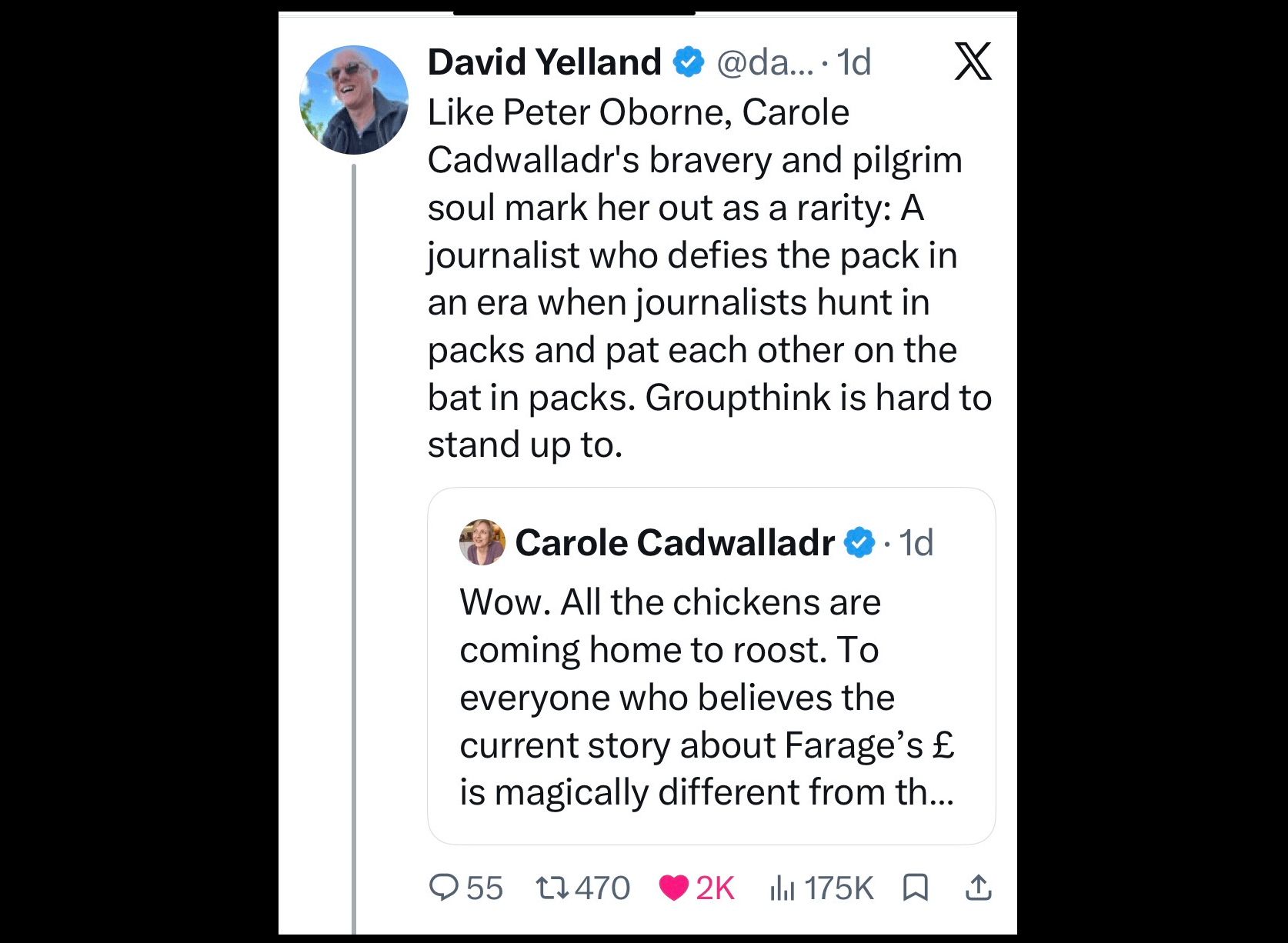
(Thank you, David, it takes a non-pack follower to know one.)
But it does lead to some wtf moments. The man who sued me in the High Court is back in the news.
Emily Lawford at the New Statesman revealed on Friday that Arron Banks had paid for private intelligence agents to spy on a Sunday Times journalist who’s been investigating Nigel Farage’s finances. A spate of articles followed over the weekend including one in the Rupert Murdoch-owned Sunday Times on the threat to free speech this rightly poses. But what unites them all (apart from a Substack by the ex-editor of the Financial Times, Lionel Barber) is that all these articles treated Banks - the funder of Nigel Farage’s Brexit campaign - as if he was a brand new character to appear on the national stage not someone who has actively sought to silence and intimidate not just journalists but government officials too.
Quite apart from what spending years and hundreds of thousands of pounds trying to bankrupt me and end my career, he also spied on journalists, spied on the UK’s official data regulator, threatened parliament’s intelligence and security committee, the Information Commission, Netflix and the Electoral Commission after it referred him to the police.
He reported me to the police too, an incident considered so serious by the Guardian’s lawyer that I was given a full briefing on what I should do in the event of an arrest.
But there’s nobody as invisible as a middle-aged woman. I woke up to this message from a friend.
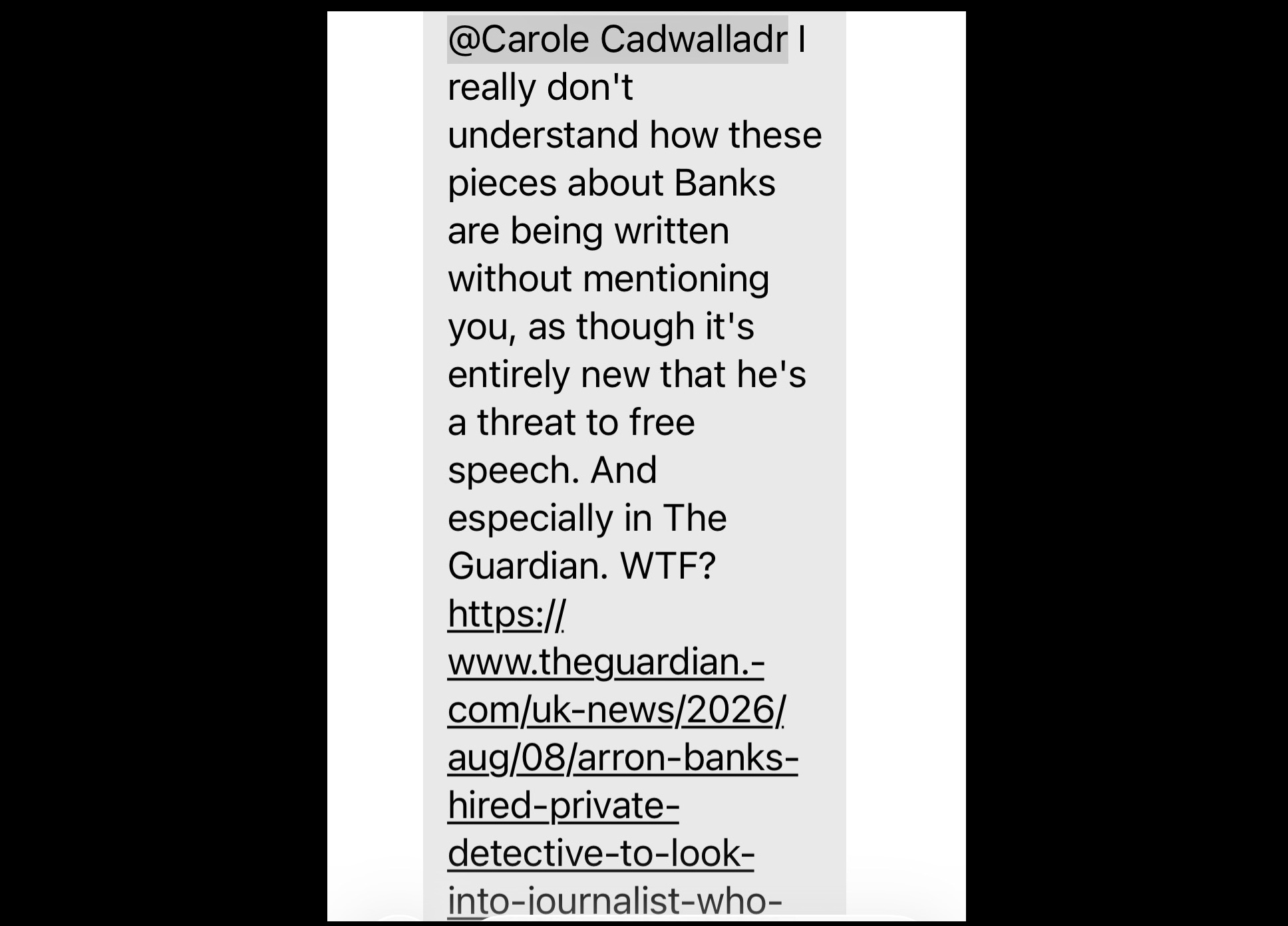
The problem with this wilful denial goes way beyond me. It’s not me who’s being gaslit here, it’s the Great British public. Anyone who’s followed any part of this story knows about Banks. They know, too, that the questions about Farage’s funding haven’t come out of nowhere.
And they know that these questions have been ignored by our overwhelmingly right-wing print media and, as a consequence of that, the BBC. What’s so dislocating is that we’re all living in at least two parallel information spheres simultaneously.
There’s the news that a man or woman in a suit will read from a script on a network broadcast news programme, a format that hasn’t changed in half a century. And then there’s all the other news that you can see with your eyes and ears on every other platform you visit, YouTube, Instagram, Facebook, Twitter, Bluesky, Threads, LinkedIn, Substack.
The fact is that social media is mainstream media now. A larger percentage of people now get their news from social media than they do from legacy outlets, according to latest Reuters Institute report. And - as we saw with Gaza - minimising or denying something that people know to be true creates blowback: an ongoing erosion of trust.
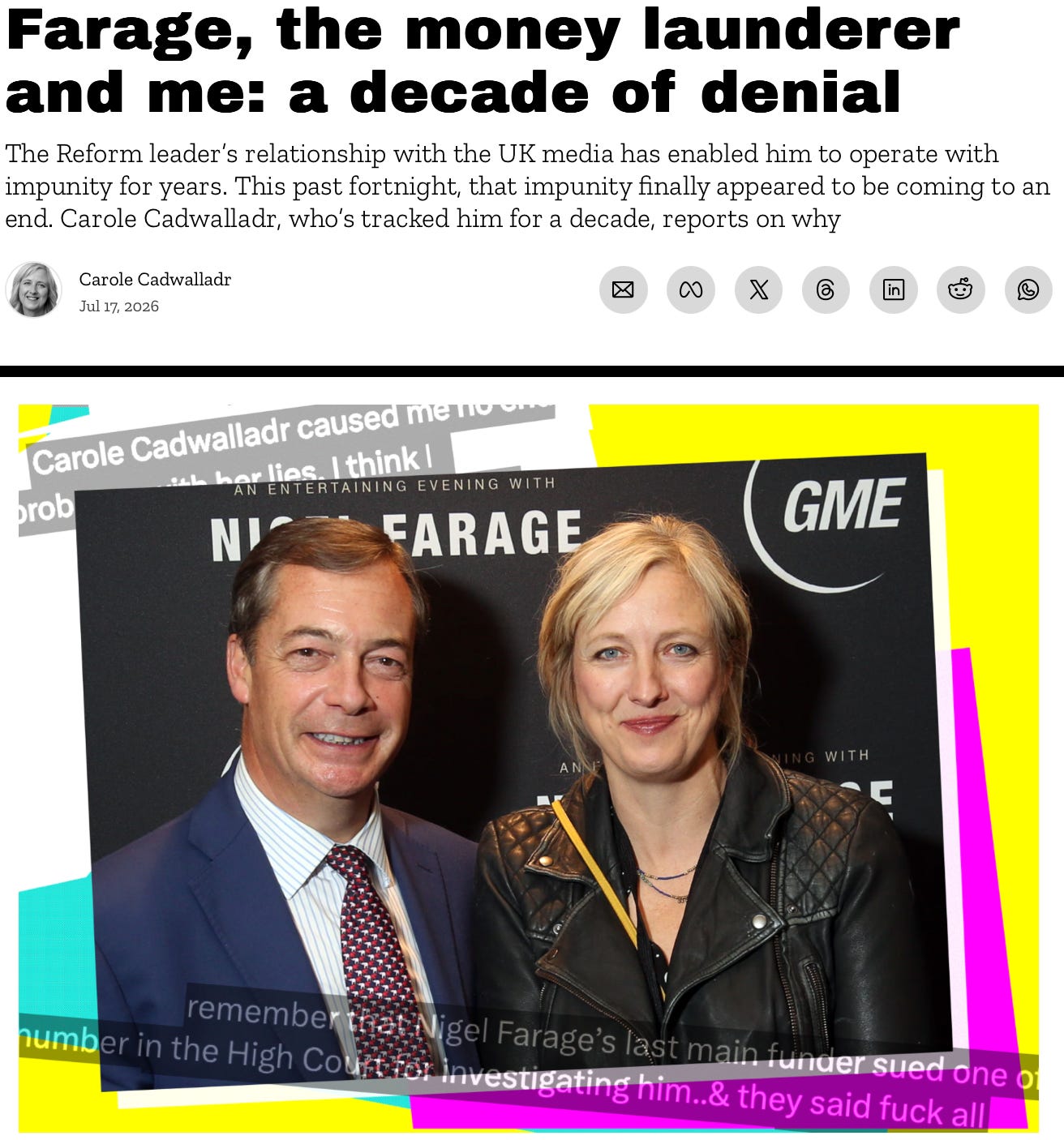
This wilful denial of the long, dark hinterland of this story isn’t doing a disservice to me, it’s doing a disservice to the facts, to readers, to anyone with eyes and ears. Two weeks ago, I wrote a long piece for the Nerve about the UK media’s “decade of denial” about who Nigel Farage is and - most especially - where his money comes from, but it only scratched the surface.
But now Arron Banks is back. He’s re-inserted himself into the story and it creates a massive headache for the pack. They’re going to continue to pretend this has nothing to do with Brexit? Really? That the questions about Farage’s finances have sprung from terra incognita? Well, they can. But no-one will believe them.
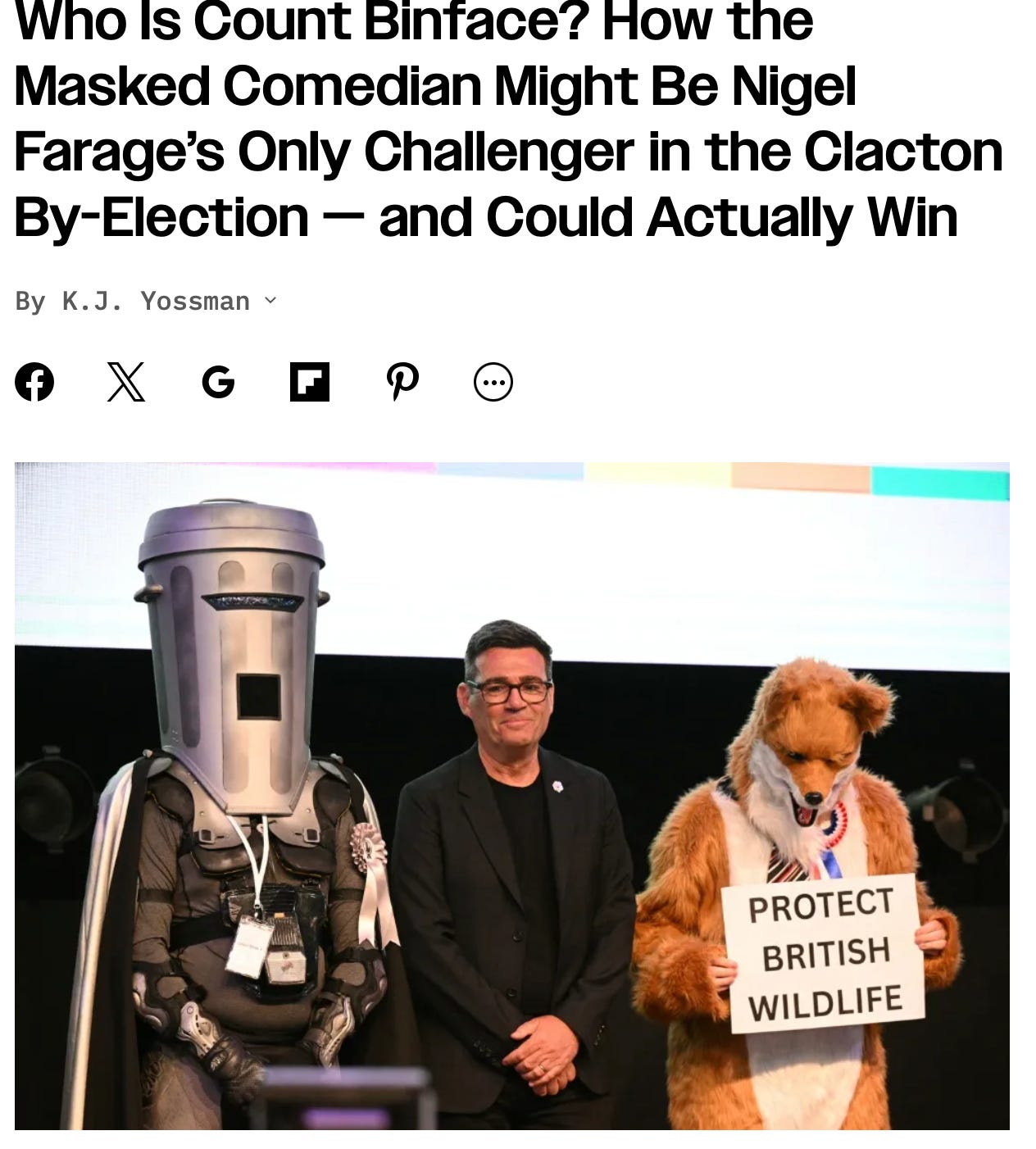
The way that this story is playing out is just one more fascinating data point about the dysfunction of a small island where the man at the centre of it all is engaged in an election that didn’t need to happen where his main opponent is a bin.*
*Trashcan for the Americans. But one from a galaxy far away.
I began with a fictional spy caper and, given this is a rather woolly storytelling newsletter today, I’ll end with a true crime recommendation.
For months, Netflix has been insistently suggesting that I should watch “Should I Marry a Murderer?” And, while it’s not inaccurate to say that I do sometimes fall down the algorithmic pathway best described as trashy true crime, I’d already decided this was a trashy true crime title too far and scrolled on.
There’s a rule of thumb which says that if a headline is a question, the answer is usually “no". And so with true crime Netflix shows. Should you marry a murderer? No, hen. Also this was a British true crime show (Scottish, actually, hence “hen” which translates as “dear” or perhaps “babe”). And British true crime is so much less lurid as the American variety where living next door to Mormon serial killing cult leader seems to be par for the course. That happens less often in Surrey.
Anyway, a week or so ago in need of some brain numbing, I succumbed, watched all three episodes and - in an unexpected plot twist - found myself over-identifying with the main character. No, I didn’t nearly marry a murderer. Though I do have a very colourful tale of a near-brush with a serial killer. (I once hitched a lift with Fred West*.)
(*He killed female hitchhikers, if you’re wondering, but only after chaining them up in his basement and torturing them with his wife, Rosemary. )
But the over-identification is because the main character - a seemingly smart and sensible pathologist called Caroline Muirhead - is seen cracking up over the three episodes after she shops her fiancé to the police. He proposes to her and shortly afterwards confesses that he killed a cyclist and then buried the body. She does the right thing and goes to the police who eventually manage to charge him and make him stand trial.
But on the day Muirhead was meant to be in court giving evidence against him, she ends up in a Highland loch smashed off her face on some combination of wine, vodka and class As and then steals a tractor. The last we see of her is on the run in the stolen tractor, a police helicopter circling overhead. She’s later arrested for contempt of court and spends two days in prison.
Go, Caroline! As acts of self-sabotage go, I couldn’t help but envy her. It was splashy and dramatic and she filmed the whole thing. She simply couldn’t face going into court and giving evidence, felt that she’d been completely let down by the authorities, and cracked under the strain.
She had tried to do the right thing - reporting her boyfriend to the police and leading detectives to the body - and the police had arrested him and his brother. But then they let them go. Worse, detectives on two separate occasions revealed her role in shopping them to the authorities.
She reasoned - I think correctly - that she and her family were in danger. The police refused to provide any protection. And for months, the killers remained free and at large as the police searched for the body. Muirhead ends up going back to the boyfriend though continues to gather evidence including covertly taping their conversations.
In short, she tried to do the right thing and was hung out to dry by the authorities. Blowing herself up and undergoing what appears to be a psychotic break struck me as a completely rational response to the circumstances.
When the police commissioner is asked why they didn’t provide any support or protection for her, he responds by saying she was a highly educated doctor and should have known how to access support through official channels. He adds that she hadn’t even been with her boyfriend that long.
It’s a fascinating study in misogyny. Her evidence put two murderers behind bars and returned the body of a beloved father to his family. But her invisibility to the authorities, the very body that was meant to protect her, is what screwed with her head. She’s taken herself off social media, did no publicity for the series, and has made unsuccessful attempts to hold the police to account for her actions.
My crack-up was quieter than Caroline Muirhead’s and I regret that. I took myself off social media, out of the public eye and had my breakdown in private. I didn’t have Muirhead’s sense of drama and I knew I wouldn’t end up in prison, just bankrupt and homeless, but I was also desperate and it also made me sick.
And a Netflix trashy true crime show about a Scottish murder is the closest I’ve come to having my experience reflected back at me. Muirhead was angrier with the police than she was with the murderer. I understood that too. The Guardian’s failure to support me as it ran ads about speaking truth to power is what screwed with my head. The world is upside down when Rupert Murdoch’s Sunday Times has proved itself to be a better defender of journalistic values than Britain’s famously progressive news organisation but it is what it is.
But there’s no Netflix ending. The only person put on trial was me. The invisibility continues and that’s not my problem any more - I’ve walked through fire and I no longer care - it’s everyone else who is at risk. Everyone on this small dysfunctional island in the North Atlantic where we’re spending our summer watching the possible next prime minister thrashing it out in a seaside resort against a man with a bin on his head while his political ally puts spies onto the journalists investigating him. This is the true crime drama we deserve, an absurd, ridiculous pantomime that’s actually a morality tale for our time.
Comments
Nothing yet. Say the first thing.
Sign in to join the conversation.