
A grand deception with confusion was thrust upon the people of the United States through the 2020 election. Reality crashed hard into us as we learned of our lack of collective knowledge and education to quickly remedy that crisis. We were then halted by the General Grievance Doctrine which grants immunity to elected officials. What happens if those alleged representatives are corrupted by conspiring forces?
Without knowledge, oversight and the opportunity to hold elected officials accountable for their actions, We The People are the unwitting servants of an aristocracy protected by pretorians. A DEEP STATE. With their strangle hold on power reaching down and eroding states rights (even the people’s courts) . Confusing understanding of elections is an act of usurping citizen rights. Election laws and equipment have become so complicated that the vast majority of voters are unaware how votes are counted. We aim in the Election Laws series to provide educational opportunity for citizens to understand their rights, as well as how those rights have been eroded. President Donald John Trump told us the truth two days after the elections.
“It is, in fact, a part of the function of education to help us escape, not from our own time — for we are bound by that — but from the intellectual and emotional limitations of our time.” — T.S. Eliot
Over the last almost 250 years, society has endured remarkably fast social and technological changes. Being converted through PsyWar into greed driven consumers distracted from the necessary actions of self government that ensures freedom. The average American lost understanding of what their rights are, thus consumed in a system of control. Without knowledge and an unquenchable FIRE for self education our freedoms can be (and were) stolen from us. The forgetfulness combined with the lack of meaningful education has led to the overthrowing of the Republic (U.S. Constitution, Article IV, Section 4).
Over time, the officials placed into elected positions chose to sacrifice the people for money, greed, and opposing allegiances. Courts were designed to be there for the people for the redress of grievances - especially against government officials misusing their power. The population suffers with the degree of maladministration committed by our public officials. As discussed previously, courts have expanded protections for government officials through the employment of the generalized grievance doctrine and sovereign or governmental (qualified) immunity doctrine: shielding government officials from punishment or liability for unlawful and abusive actions they take when carrying out their duties. In that discussion, the focus centered on the generalized grievance doctrine.
A wave of petitions have been filed all across the United States, yet citizens have been deprived of their right to hear their grievances aired. As the replies from the courts were received, it was clear that immunity doctrine is a blockade set against We The People. President Trump sought to rectify this vote delusion from election rigging by Deep State pawns in the state of Georgia and has published the evidence.
Prior to the inauguration, President Trump as Commander in Chief questioned the results. The Deep State responded by leaking the phone call between President Trump and the Georgia Secretary of State Brad Raffensperger. Mocking bird media propagated a false and misleading narrative. After hearings and growing amounts of evidence of the failure to conduct a legitimate election are exposed in this state, a remedy has yet to be achieved.

Power of The Pen
In the aftermath of the 2020 election a group of citizens who were listeners of the live streams of Tore Maras moved from being spectators, into participants. They organized into smaller groups based on their location. Previously unknown neighbors with a passion for the cause of freedom and liberty in their nation. Gathering in green dragon taverns to address the dissolution of voting rights. A remarkable occurrence of a 50 state organization of citizens that file lawsuits pro se (without paid legal council). In vigorous passion countless hours were sown together to uncover issues and lawsuits were filed. Bringing to fruition the vision of a Civilized Revolution fought with the power of the pen conceptualized by Tore Maras.
In a current consolidated case sitting before the Supreme Court of the United States (SCOTUS), the conversation shifts to the immunity doctrine in its petition for Writ of Certiorari from the Supreme Court for the state of Georgia: Lovell, et.al. v. Raffensperger, Georgia Secretary of State, et al., and Lori Tullos and Virginia McFaddin v. Raffensperger, Georgia Secretary of State, et al., No. S23A0887, S23A1151:
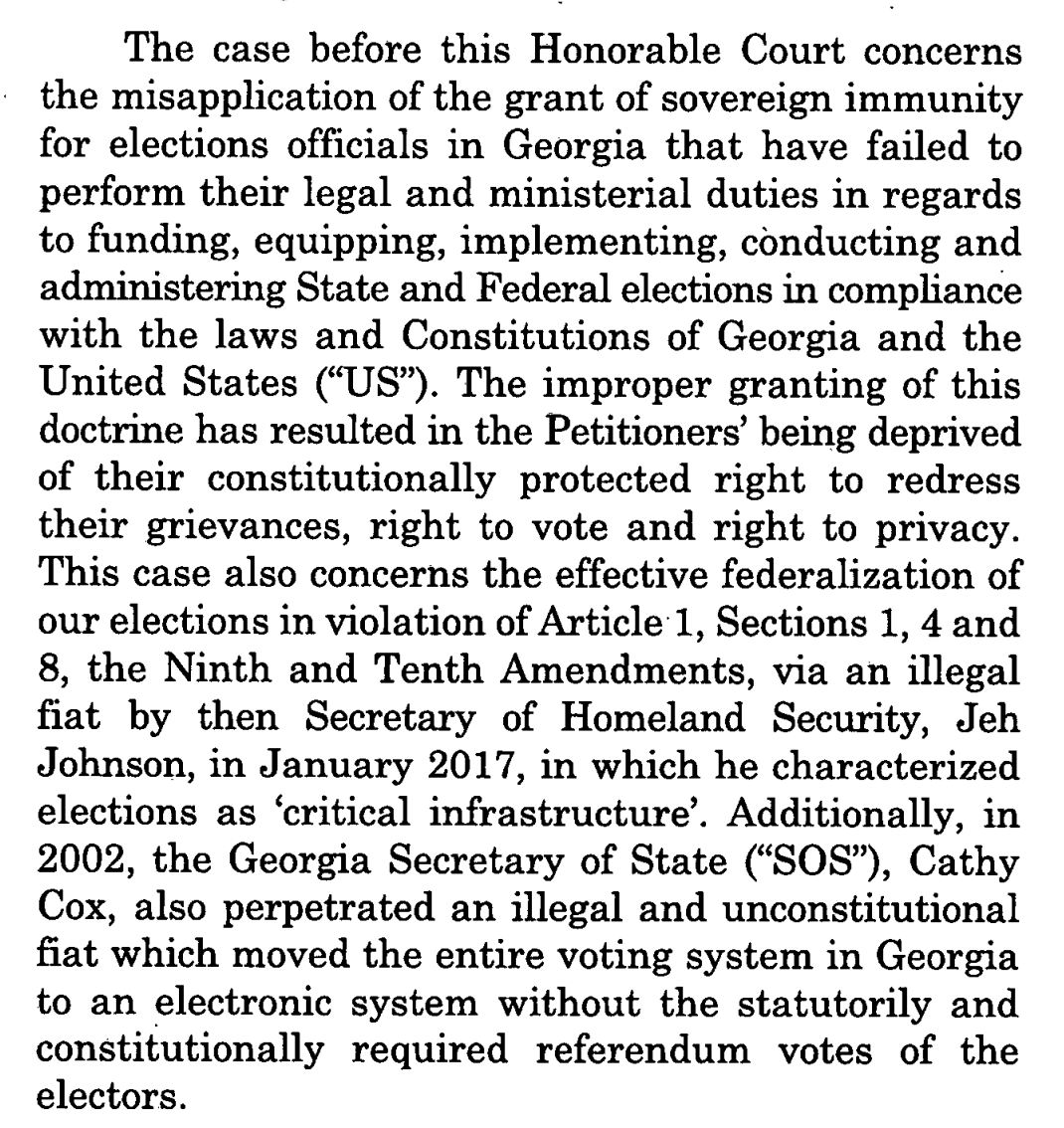
This petition proves any citizen can organize and work together with their fellow countrymen to craft a necessary lawsuit. This kind of opportunity for rebuttal terrifies the power structure that deprived freedoms from an uneducated and inactive citizenry. But the times are changing.
Election Laws
During this postmodern era, it is often contended that the Eleventh Amendment confers immunity to governmental officials, which does not align with the spirit of the time in which the Amendment originated. In his article, The Eleventh Amendment and the Reading of Precise Constitutional Texts, 113 Yale L.J. (2004), John F. Manning argues the original public meaning of the Eleventh amendment was limited to its precise terms based on the legal background against which the Amendment was adopted (1743) and states' assertion that the text of Article III should be qualified by an unenumerated immunity from suit is inconsistent with the fundamental principles of republicanism which the Constitution rests.
In a very early court case, Fletcher v. Peck (1810), Chief Justice Marshall affirms that the Court's reading of the Constitution was correct in Chisholm v. Georgia (1793) as the court interpreted that “immunity was flatly incompatible with the premises of our republican form of government”.
The constitution, as passed, gave the courts of the United States jurisdiction in suits brought against individual States. A state, then, which violated its own contract was suable in the courts of the United States for that violation…This feature is no longer found in the constitution; but it aids in the construction of those clauses with which it was originally associated. ‘in favor of presuming an intention to except a case, not excepted by the words of the constitution. (Contracts Clause).’
Lawmakers would have us believe that immunity derived from the time of kings. However, in The Crime Victim in the Prosecutorial Process, HARV. J.L. & PUB. PoL'Y 357, 358 (1986), author Juan Cardenas demonstrates the discrepancy in such an interpretation, "The right of any crime victim to initiate and conduct criminal proceedings was the paradigm of prosecution in England all the way up to the middle of the Nineteenth Century."; Philip B. Kurland & D.W.M. Waters, Public Prosecutions in England, 1854-79: An Essay in English Legislative History, 1959 DUKE L.J. 493, 497-99 (discussing the long-unsuccessful movement, dating back to the late eighteenth century, that led up to the 1879 statute). Even the 1879 statute did not "establish a system of public prosecution similar to the one that exists in the United States." Woolhandler, Ann and Nelson, Caleb (2004). Does History Defeat Standing Doctrine? Michigan Law Review. vol. 102, iss. 4, pg. 698.
However, governmental officials of every level have made concentrated effort to shift interpretation away from the motives and intent of the Framers and Constitution, and the people of America have lost their foothold as the authority behind government, as well as access to our grand juries (United States v. Williams (1992)) reinforcing the need for grand jury independence) and to free and fair access to our courts. In referencing sovereign immunity, “Apparently the first to use the phrase was Edwin M. Borchard, Government Liability in Tort, 34 YALE L. J. 1, 4 (1924). In the intervening years, he has been quoted by many, including Judge Traynor in Muskopf v. Corning Hospital District (1961). The opinion of the Court in Owen v. City of Independence (1980), stated:
Although it has never been understood how the doctrine of sovereign immunity came to be adopted in the American democracy, it apparently stems from the personal immunity of the English Monarch as expressed in the maxim, ‘The King can do no wrong.’ It has been suggested, however, that the meaning traditionally ascribed to this phrase is an ironic perversion of its original intent: ‘The maxim merely meant that the King was not privileged to do wrong. If his acts were against the law, they were injuriae (wrongs). Bracton, while ambiguous in his several statements as to the relation between the King and the law, did not intend to convey the idea that he was incapable of committing a legal wrong.’ Randall, Susan (2002).” Sovereign Immunity and the Uses of History. Nebraska Law Review. vol. 81, iss. 1, art. 2, pg. 4.
In the same vein, many Americans believe officials are not privileged to do wrong as they have taken a binding oath to uphold and defend the U.S. Constitution, which does not grant them the authority to waive their duty with sovereign immunity in the face of repugnant behavior. In support of the Fourteenth Amendment and civil rights, Congress enacted Title 42 United States Code (U.S.C.) § 1983, which purportedly provides a private cause of action against those who, under color of law, deprive a citizen of the United States of 'any rights, privileges, or immunities secured by the Constitution and laws.'" Goodman v. Harris Cnty. (2009).
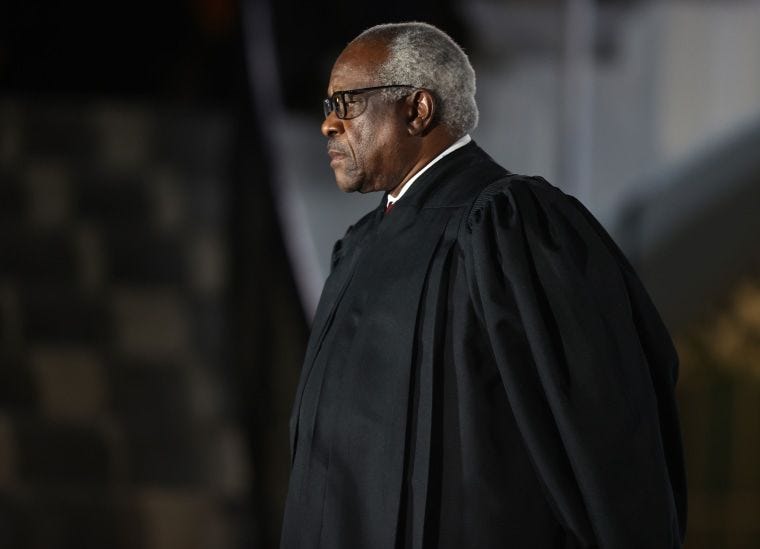
Justice Thomas explains in his concurring opinion of McDonald v. City of Chicago, (2010), “The Privileges or Immunities Clause of the Fourteenth Amendment declares that ‘[n]o State . . . shall abridge the privileges or immunities of citizens of the United States.’ In interpreting this language, it is important to recall that constitutional provisions are ‘written to be understood by the voters.’ Heller, 554 U. S., at ___ (slip op., at 3) (quoting United States v. Sprague, 282 U. S. 716, 731 (1931)). Thus, the objective of this inquiry is to discern what ‘ordinary citizens’ at the time of ratification would have understood the Privileges or Immunities Clause to mean.” Thomas continues into a lengthy exposition of the original language behind “Privileges and Immunities” for both Article 1, Section 2 of the U.S. Constitution and the Fourteenth Amendment:
At the time of Reconstruction, the terms “privileges and immunities” had an established meaning as synonyms for “rights.” The two words, standing alone or paired together, were used interchangeably with the words “rights,” “liberties,” and “freedoms,” and had been since the time of Blackstone. See 1 W. Blackstone, Commentaries *129 (describing the “rights and liberties” of Englishmen as “private immunities” and “civil privileges”)...See, e.g., Magil v. Brown, 16 F. Cas. 408,428 (No. 8,952)(CC ED Pa. 1833)(Baldwin, J.) (“The words ‘privileges and immunities’ relate to the rights of persons, place or property; a privilege is a peculiar right, a private law, conceded to particular persons or places”).
The recently filed Writ of Certiorari to SCOTUS, Lovell, et.al. v. Raffensperger, asks the Court a remarkable eight questions pertaining to official misconduct, maladministration of elections, and deprivation of voting rights:
1. Whether the granting of the defense of sovereign or official immunity for employees or officials that are acting outside of the authority of their office, unlawfully, or in contravention to the Georgia or U.S. Constitutions is in violation of rights protected by the First, Ninth and Fourteenth Amendments of the U.S. Constitution and Article I, Section I, Paragraphs I, II, VII, IX and XXVIII of the GA Constitution?
2. Whether an action is brought within a Federal or State Court, does the protection of sovereign or official immunity apply when officers and/or employees of a State are participating in conduct that is ultra vires or in violation of Federal and State laws and Constitutions? Based on this answer, if the State Courts are responsible for adjudicating conduct that is in violation of Federal laws and the rights protected by the U.S. Constitution, should the State Courts be applying the rules of Ex parte Young prior to granting sovereign or official immunity to the errant officials?
3. Whether the Court erred in its failure to apply proper analysis, and by not giving proper consideration to the arguments of the Action, in their determination that the case at bar was against the State versus an Action against the Defendants, as officers who were negligent in performing, or failing to perform, their ministerial duties or functions, acting out side of the authority of their offices, unlawfully, and/or unconstitutionally?
4. Whether the Court erred when it failed to consider the constitutional, textual language of Article I, Section II, Paragraph IX(d) itself, and within its appropriate historical context?
5. Whether the Court’s question regarding the position or character of the Defendants is relevant?
6. Whether the Court erred when it failed to consider the ruling of Federal District Judge Amy Totenberg, Northern District Georgia, in which she declared the ballots produced by the current Georgia voting system are unconstitutional and non-compliant with Georgia election law in October 2020?
7. Whether the voting systems in Georgia were illegally and unconstitutionally implemented and installed pursuant to State and Federal laws and Constitutions?
8. Whether the Secretary of the Department of Homeland Security had the authority to effectively federalize our elections by designating them ‘Critical Infrastructure’?
The case itself is still in the preliminary stages, and the Respondents in the case chose to waive their right to respond to the petition. Two Amicus Briefs were filed in support of the petitioners to date.
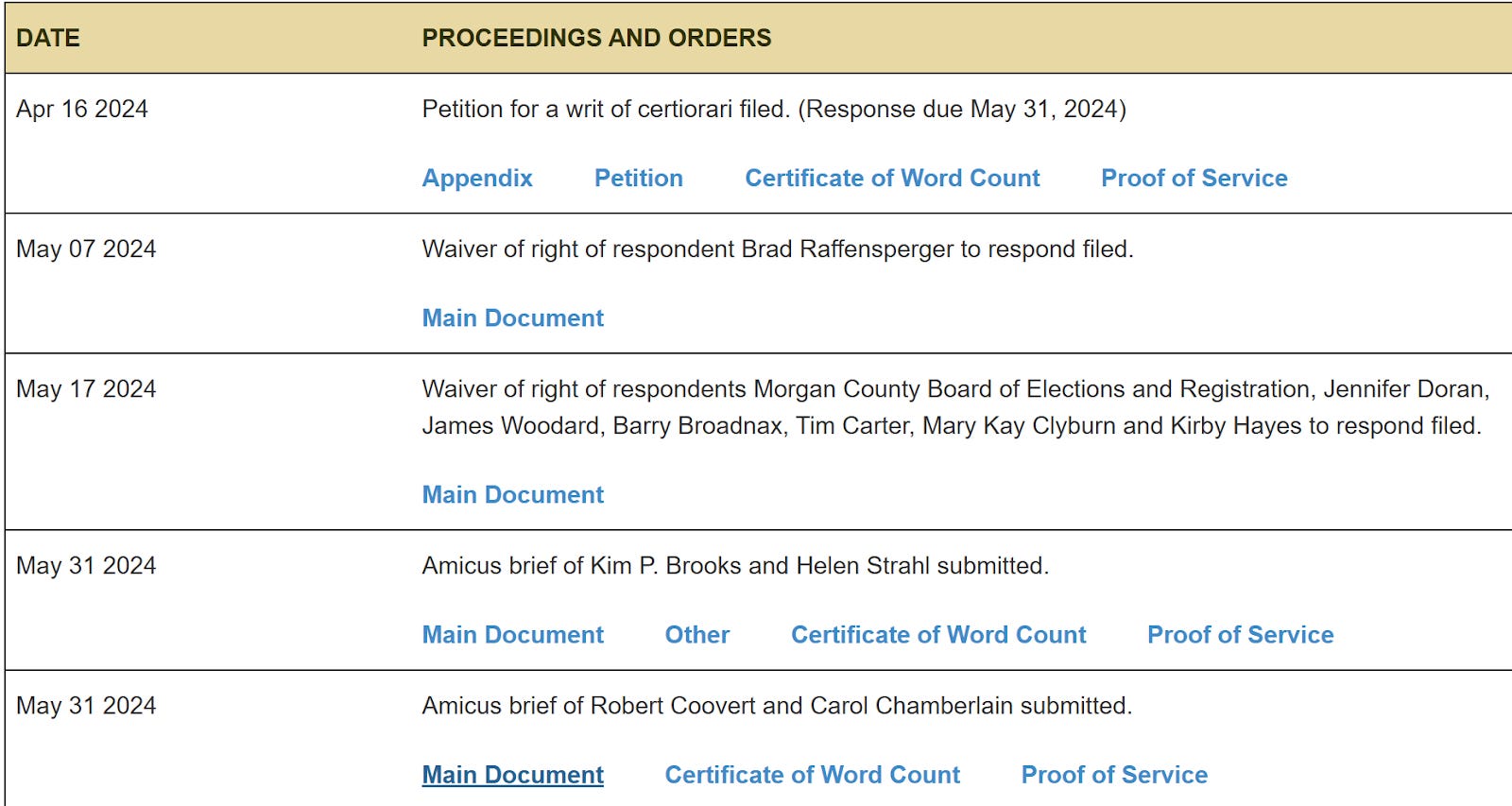
The first Amici argues:
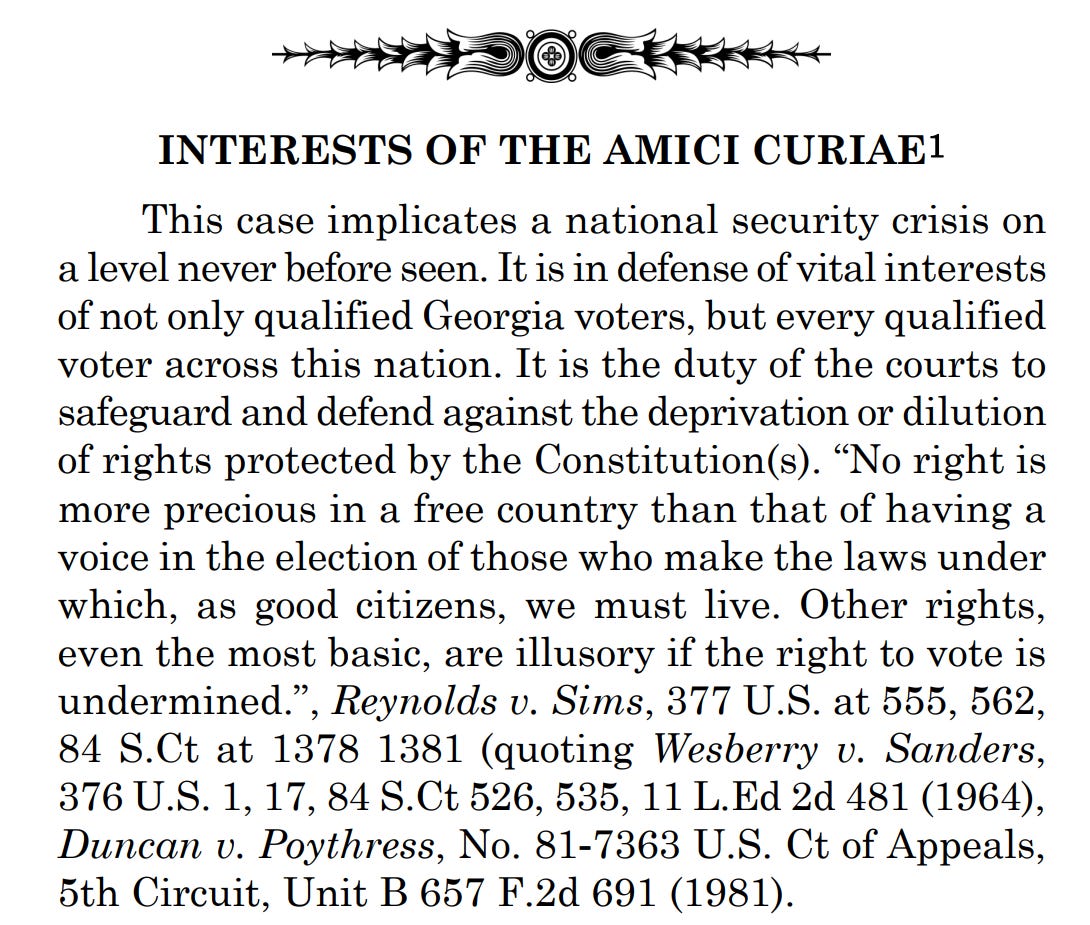
The brief asserts Respondents committed fraud on the people through synthetic identity theft, using false government documents, and manipulating registrants entered into the voter database. It also claims fraudulent manipulation of all dates in the voter database used to run elections and perform list maintenance on the voter database, absentee ballots during an election, and votes during and after an election with improper registration data and list maintenance. Because of the allegations of fraud, the Amici asks SCOTUS to grant the petition and cites Hammerschmidt v. United States (1924), Chief Justice Taft’s definition of “defraud”:
To conspire to defraud the United States means primarily to cheat the Government out of property or money, but it also means to interfere with or obstruct one of its lawful governmental functions by deceit, craft, or trickery, or at least by means that are dishonest. It is not necessary that the Government shall be subjected to property or pecuniary loss by the fraud, but only that its legitimate official action and purpose shall be defeated by misrepresentation, chicane, or the overreaching of those charged with carrying out the governmental intention.
The second Amici attests to the fact that the ballots used in elections contain a nonhuman readable barcode, and the “voting machines” used in Georgia have not been 3 certified according to the Official Code of Georgia Annotated § 21-2-300 et seq. in which paragraph c(a)(2) states that elections “shall be conducted” on aforesaid “certified” equipment “unless otherwise authorized by law.” Additional deficiencies that are described in the Amicus Brief include:
1. The Dominion voting machines used in the Georgia 2020 General Election to scan barcode ballots are still in service after a non-existent audit.
2. Maladministration and deception by many who manage Georgia elections continue to disenfranchise voters.
3. Election law decisions made by lawmakers in Georgia and Washington, DC, may have been influenced by a spurious Georgia audit report.
4. The Dominion voting machines used in Georgia have not been certified as required by Georgia law.
The brief utilizes Governor Kemp’s 2020 press release in its request to SCOTUS to grant the petitioners’ Writ of Certiorari:
Free and fair elections are the foundation of our American government. Any allegations of intentional fraud or violations of election law must be taken seriously and investigated. We trust that our Secretary of State will ensure that the law is followed as written and that Georgia’s election result includes all legally-cast ballots and only legally-cast ballots. We will continue to follow this situation to ensure a fair and transparent process.”
“Without intervention, the continued maladministration, deception, lack of transparency, and disregard for Georgia and U.S. laws and Constitutions will continue to disenfranchise Georgia voters.” If there is fraud and maladministration for elections in one state, it impacts the country as a whole. It remains the tantamount duty of all Americans to educate themselves of their rights granted to them by the Framers of the Constitution in order to hold their representatives accountable for their misdeeds.
Self Government
Citizens are hopeful SCOTUS will grant the petition to rebuke the election malfeasance officials have engaged in across the country. A proper application of stare decisis of the immunity doctrine as appropriated by Justice Alito in Dobbs v. Jackson Women's Health, 19-1392 (Nov. 1, 2021) would, once again, return accountability to our elected officials who violate the Constitution. U.S. CONST. art. VI. Even if governmental officials were intended by Constitutional design to be afforded immunity, as if America were founded on the principles of sovereign monarchy, the kings of the United States have abdicated their thrones.

“Education is a better safeguard of liberty than a standing army.”
— Edward Everett
In reconciling what deprived voting rights we see a lack of knowledge and understanding. A widespread education endeavor must now be undertaken. Spreading the idea of action and participation in self government is an essential change for the citizens of the United States to restore and safeguard freedom onward. Publishing in ways that can be understood, while collaborative efforts to compel the systems of government currently in place to honor the rule of law and revere the integrity of rights granted to each soul. FREEDOM! We pray to our Creator in the heavens to hear our cry for help.
IMMUNITY for the modern American Tyrants must END! A petition has passed through the doors of SCOTUS. Lovell v. Raffensperger and the Tore Maras community prove that any citizen at any time can file a lawsuit against their government and elected officials. Seeds of Liberty have been planted through the work of ordinary citizens who became educated and acquired the knowledge to petition the courts themselves. Generations to come will be the inheritors of this new birth of freedom on the road to our 250th Anniversary as the United States of America. The Deep State can not stop 120 million Americans UNITED in cause and purpose under the leadership of President Donald Trump. Together we will achieve victory. #America250
Comments
Nothing yet. Say the first thing.
Sign in to join the conversation.