
Welcome to Self-Publishing for the Broke Author, where I’m updating my 2018 book of the same title and posting the revised chapters as I go, along with additional tips and guidance to help you produce, publish and sell books like a pro, all without going broke in the process. Subscribe for free to get it all delivered to your inbox.
I’m still working on revisions for the book’s next chapter, but this week I want to jump ahead and focus a bit on smart marketing tactics, because I know many of you reading this already have books on the market, and I don’t want any of us to remain broke.
If you have books on Amazon, or plan to sell your books on Amazon, this post is for you, although the principles carry over to pretty much every online bookseller.
One often overlooked fact is that your Amazon book page will do a lot of the work of selling your book — as long as you nail these three major elements.
These elements are all “above the fold,” i.e., they’re the first things a shopper sees when they land on your book page without needing to scroll down. If done right, these three things will convince your browser to scroll down to learn more, or better yet, not even bother and go straight to clicking that Buy Now button instead.
It may seem obvious once we get to what these elements are, and yet, so many indie authors fail miserably at nailing these elements (myself included; it can take a lot of trial and error before you get them right).
I’m talking about:
Your cover
Your book blurb
Your sample
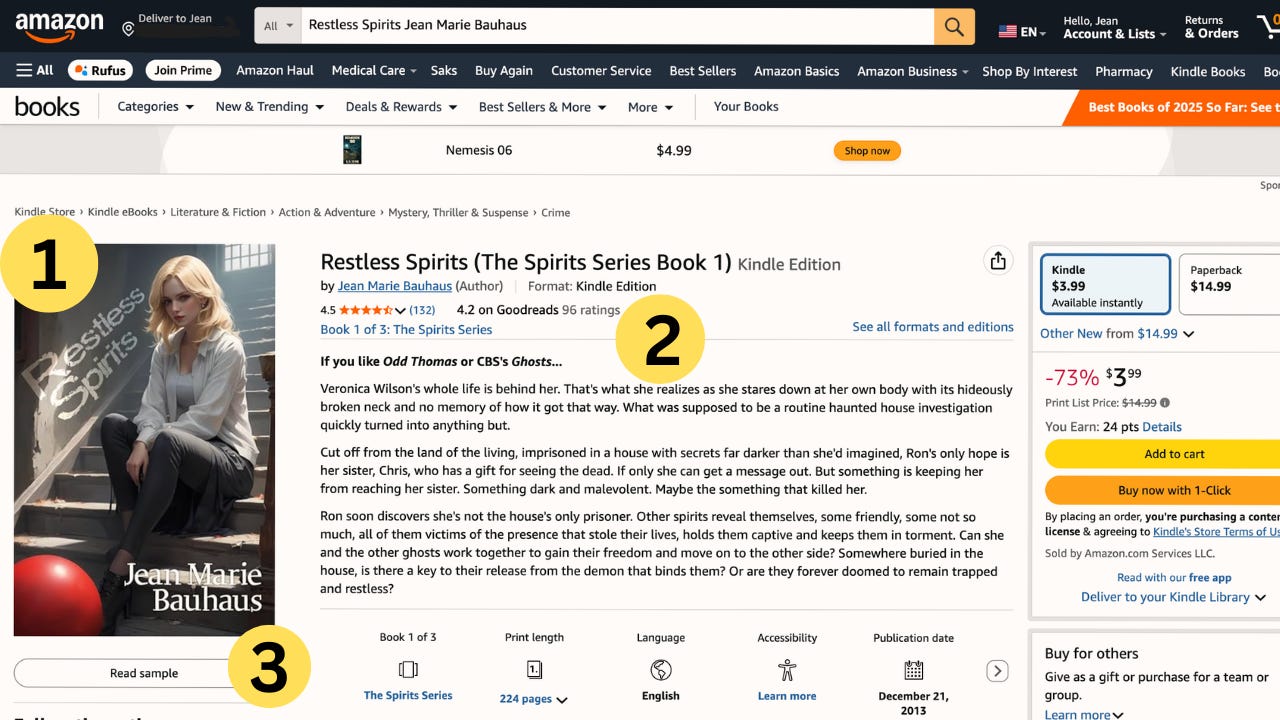
People absolutely judge books by their covers. When a potential book buyer searches or browses through Amazon’s listings in a particular genre that includes your book, your cover is the hook that reels them into your book page.
Your cover needs to do a few things: it needs to communicate your book’s primary genre, as well as the overall mood or tone, and give the reader a sense of what to expect. It needs to stand out, but not so much that it fails at the first thing. And it needs to be able to stand up alongside professional covers from Big Publishing.
That means it needs to look polished and professional, not like it was designed in MS Paint or like it’s just a title and author named slapped onto a stock image with no thought given to typography or design.
If your cover fails at any of these things, potential readers are likely to scroll right past it. The more closely you can come to nailing all of these things, the more likely they are to click on it.
In Chapter Three of Broke Author I’ll be going over options for designing your cover without spending a lot — or any, depending on how hands-on you’re willing to get — of money. In the meantime, study the bestselling books in your genre, focusing on newer releases. Look closely at what those covers are doing, and do that — but different. Not so different that you fail to meet genre expectations, but different enough to stand out.
And do yourself a favor and check out The Book Designer blog and website. Search the blog for past issues of the Book Cover Design Awards and read Joel’s feedback on both the winners and the losers. It’s a free master class in effective cover design.
Once someone clicks your cover and lands on your page, your book blurb — also known as the About copy — is what will convince them to either check out the sample and scroll down and read the reviews or, best case scenario, go straight to that Buy button.
Your About copy does most of the heavy lifting. If you’ve nailed your cover and your book page is getting traffic (something you can track by using Amazon affiliate links) but it’s not converting to sales, chances are your blurb is falling down on the job. It’s worth redoing it and revising it until you get it right.
Don’t mistake your book blurb here for a synopsis of your book. The job of this copy is not to introduce the reader to every major character or explain the entire plot.
Its job is to tell the reader just enough to help them decide if this is a story they’d probably enjoy and to leave them curious enough to want to know more. It’s a tease and a lure. It should seduce the reader into wanting to go all the way.
That went somewhere I didn’t expect it to, but hey, it’s an apt metaphor.
Amazon cuts off blurbs after a certain length and puts the rest behind a “Read More” link. So keep it short and sweet, and aim to hook your reader with the first sentence. If it needs to be longer, make it compelling enough to make the reader want to click that “Read More” link. And make it scannable, with short paragraphs, each of which push the reader to want to know more.
The best thing to do is to write several versions and test them out. Show them to your beta readers to find out which blurbs resonate with them the most, but also test them out on your actual sales page. If one doesn’t seem to be working after a week or two, switch to the next, and keep trying until you land on one that works.
Again, study what the bestsellers in your genre are doing, and emulate them to the best of your ability. Here’s a great article on how to write an effective blurb, with examples.
This element is harder to get right than it may seem at first, but it’s absolutely essential to do so.
So your book shopper clicked on your cover and read your blurb. They’re intrigued, but not yet convinced to buy. Even if you’ve nailed your blurb, reasons beyond your control might make your potential reader cautious. Perhaps they have a limited book budget, or they have limited time for reading. Whatever it is, they want to be sure your book is well written and is going to deliver the experience they’re looking for.
From here, they’re probably going to do one of two things: either scroll down to read reviews, or (especially if you don’t yet have many — or any — reviews yet) they’ll click to read the sample.
Whether they read it on the desktop website or send it to their Kindle app, Amazon will let a shopper read the first 10 percent of your book for free. You need to make sure that 10 percent can close the deal.
One way is to maximize the real estate, especially in your ebooks, by moving the “front matter” — your dedication, “Other books by” page, even your copyright page — to the back of the book (once upon a time, it was common practice for indie authors to also place the Table of Contents in the back, but Amazon started requiring the TOC to be up front).
Of course, the other way is to make sure your books first 10 pages or so — more or less, depending on the overall length of the book — are well written as well as well edited and polished to a high shine.
Hook the reader in the first paragraph, and compel them to keep going and turning the page. Download your book’s sample to see where it ends, and if necessary, revise it to make sure it ends on a compelling part that would make the reader want to keep going.
A reader who takes the trouble to read the sample is already half-convinced to buy your book. Your sample needs to close that gap and eliminate their reservations.
These aren’t the only aspects of your Amazon book page you’ll want to pay attention to, and we’ll cover additional elements in a future post. But these are the three most essential, the ones that will do the majority of the work to hook the reader, reel them in and convince them to hit that Buy button.
There’s no guarantee that these things will propel your book onto the bestseller charts, and if your book is actually terrible, they’re not going to help much. But if your book is objectively good enough that you’re scratching your head wondering why it’s not selling, start by examining these elements to see if there’s room for improvement (and there probably is).
Taking the time and effort to get each of them right will go a long way toward getting that needle moving on your sales dashboard.
This month, I’m giving away personalized help to two lucky subscribers — the winners’ choice of a rewrite of your book’s about blurb or a critique and edit of your book’s first five pages. To enter, all you have to do is make sure you’re subscribed to this Substack and drop a comment below to let me know you wish to enter. I’ll randomly select two winners at the end of the month.
The fine print — the winners agree to report back to me on whether the revisions helped their sales and allow me to use their book as a case study for a future post. That’s it!
Thanks for reading! If you’re in need of a budget-friendly editor, look no further. I offer editing and proofreading services at affordable rates and I’m happy to do partial critiques and edits and work with you at a pace that suits your available budget.
If you enjoyed this free post or found it helpful, a like, comment, restack or share will go a long way towards boosting its visibility for others to find, as well as keeping the author motivated. And if you’re not actually broke, you could also consider buying me a coffee.
And don’t forget to check out my fiction stack!
No posts
Comments
Nothing yet. Say the first thing.
Sign in to join the conversation.