
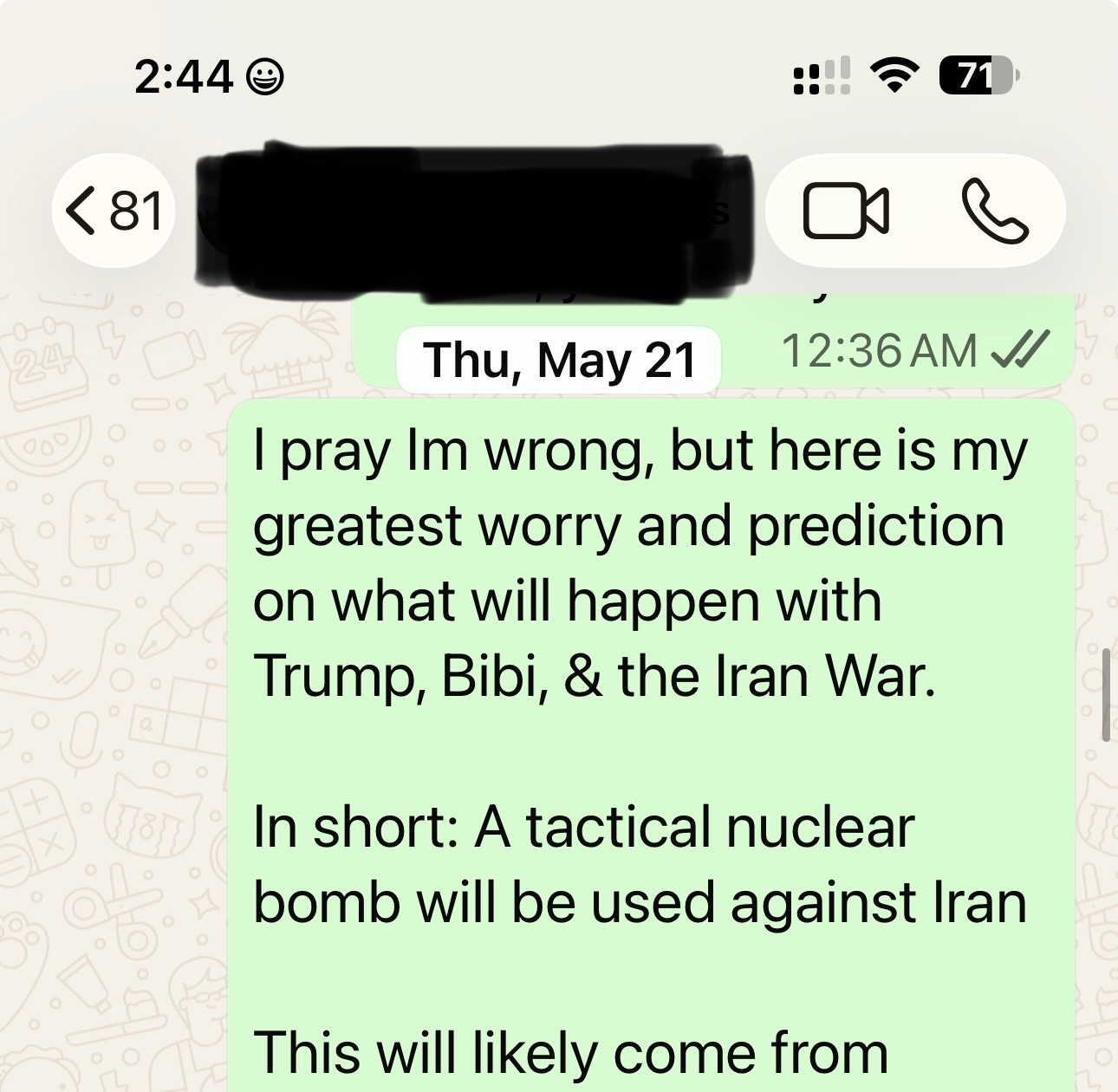
The Israel-US war on Iran is moving into an unprecedentedly dark and dangerous phase: the use of a tactical nuclear weapon against Iran.
The route is increasingly direct. Conventional air campaigns have failed to achieve their central objectives. Diplomacy has been undermined and ceasefires have collapsed. A ground operation offers no credible way to eliminate Iran’s dispersed missiles, drones and coastal capabilities or permanently reopen the Strait of Hormuz. Meanwhile, the damage to global energy supplies is mounting, Gulf infrastructure is increasingly exposed and the political cost of failure is rising sharply for Donald Trump and Benjamin Netanyahu.
At the end of this sequence, the United States or Israel may present a limited nuclear strike as the only remaining option: the only weapon capable of destroying Iran’s deepest underground nuclear facilities, forcing Tehran to reopen the strait and ending the war before the economic and humanitarian consequences become intolerable.
I began warning colleagues and friends about this pathway in May. I hoped then, and still hope now, that an off-ramp would emerge before the sequence reached its final stages. Instead, more of its constituent parts have fallen into place.
The escalation pathway is now unfolding:
Diplomatic negotiations are obstructed or deliberately sabotaged.
An initial bombing campaign fails to achieve its principal military and political objectives.
A ceasefire is negotiated but quickly collapses or is undermined.
A renewed air campaign also fails to force Iranian capitulation or reopen the Strait of Hormuz.
Limited ground operations are considered or attempted. If attempted, they fail—or prove so costly, ineffective and politically dangerous that they are abandoned.
Iran retains the ability to fire Shahed drones, ballistic missiles and anti-ship weapons from positions deep inland, while continuing to obstruct Hormuz.
Iran escalates its attacks on Gulf ports, power stations, energy facilities and desalination plants.
The disruption spreads to the Red Sea and Suez Canal through the Houthis, placing further pressure on global shipping and energy markets.
Trump and Bibi conclude that conventional force cannot deliver victory and that they no longer have time to pursue slower methods.
A tactical nuclear strike is presented as the only remaining way to destroy Iran’s deeply buried nuclear infrastructure and force a rapid end to the war.
This is the basic logic: conventional weapons keep failing, the costs of the war keep rising and the leaders responsible cannot accept defeat.
At that point, unconventional weapons begin to look attractive precisely because they have not yet been tried.
Either the United States or Israel could carry out the first strike.
Israel could use a weapon from its undeclared nuclear arsenal with tacit American approval, operational assistance or partial public support from Trump.
The United States could also act directly if Trump became politically vulnerable and publicly humiliated by his inability to achieve his stated objectives through conventional force.
Whether the weapon ultimately comes from Israel or the United States is less important than the mechanism that leads to its use.
Each failed military operation narrows the range of options Trump and Netanyahu believe they still possess. Each escalation raises the political cost of accepting an inconclusive outcome. Each public promise of victory makes retreat more humiliating. Each failed conventional attack makes an unconventional one appear more necessary.
Neither man needs to have begun the war intending to use nuclear weapons. They can arrive at that decision gradually, after concluding that every other method has failed.
Both would also face intense personal pressure.
Trump would be approaching the midterm elections with the global economy weakened by the closure of Hormuz and rapidly rising energy prices. Netanyahu would face his own political and legal pressures. For both men, an outright military failure could threaten not only their strategic objectives but their careers and, potentially, their personal freedom.
They would therefore be looking for a rapid and dramatic option that could reverse the course of the war.
In theory, Trump could first put American forces on the ground.
A major invasion would be politically toxic in the United States and militarily disastrous. Americans remember Iraq, Afghanistan and the wider failures of the forever wars. A large ground campaign would produce substantial casualties and could begin another conflict with no credible endpoint.
A smaller operation against Bandar Abbas or one of the Iranian-controlled islands would not solve the central military problem.
Iran does not control the Strait of Hormuz through a single port, island or coastal installation. It can launch Shahed drones, ballistic missiles, cruise missiles and anti-ship weapons from dispersed positions deep inside the country. Surveillance and targeting systems can be moved or concealed. Mines can be laid covertly. Mobile launchers can be repositioned faster than they can be found and destroyed.
American forces could capture an island and still fail to reopen the strait.
They could seize Bandar Abbas and still face missile and drone attacks launched from hundreds of kilometres inland.
A limited ground operation could therefore inflict significant casualties without removing the capabilities that allow Iran to control Hormuz.
If Trump attempted such an operation, he would quickly find himself searching for another method.
He would remember the speed and apparent decisiveness of the operation against Venezuela and look for an option that appeared similarly rapid and final. A tactical nuclear strike could be presented as a means of avoiding both a prolonged ground war and an outright American defeat.
Trump and Netanyahu could eventually argue that Iran already possesses two capabilities with effects comparable to nuclear coercion, even without having completed a nuclear weapon.
The Gulf states depend heavily on desalination plants, electricity generation and tightly integrated water-distribution systems.
Iran can attack these systems using Shahed drones, cruise missiles and ballistic missiles.
If desalination and power infrastructure were systematically destroyed, bottled water flown in by aircraft would not be sufficient or sustainable for millions of people. Air-conditioning and refrigeration systems would begin to fail. Hospitals, transport networks and basic municipal services would come under severe pressure. Millions of expatriates would attempt to leave.
Dubai, Abu Dhabi, Doha, Bahrain, Kuwait City and other Gulf population centres could face acute and potentially existential water shortages within days rather than weeks.
Iran has already demonstrated its willingness to strike ports, power facilities and desalination infrastructure. Its leadership may also have concluded that previous restraint produced few strategic benefits.
That increases the risk that Iran will overplay its hand.
It may escalate attacks against the electricity and water systems of neighbouring Gulf states, believing that only the imposition of intolerable costs will force an end to the war.
Iran could simultaneously mobilise the Houthis to intensify attacks in the Red Sea and obstruct the Suez Canal. Saudi Arabia’s remaining east–west energy infrastructure could be targeted. Qatar’s liquefied-natural-gas facilities connected to the South Pars field could face drone and ballistic-missile attacks.
The result would be an emergency extending far beyond the immediate targets.
Iran can also close or severely disrupt one of the world’s most important maritime energy routes.
Conventional weapons can punish Iran, destroy fixed infrastructure and impose enormous costs. They cannot necessarily reopen the Strait of Hormuz or permanently eliminate the dispersed missile, drone, mine, surveillance and targeting capabilities through which Iran controls it.
Iran may also overplay its hand by charging tolls or imposing political conditions on neighbouring states and other countries seeking to transit the strait.
That would weaken sympathy for Iran among governments that might otherwise oppose further American or Israeli escalation.
Trump and Netanyahu would then make a simple argument:
Iran can choke the global economy through Hormuz and choke its Gulf neighbours by destroying their water and electricity systems.
They would describe these as nuclear-level capabilities. Iran, they would argue, can already place millions of civilians at risk and send the global economy into recession without possessing a completed bomb.
From there, they would claim that nuclear means had become a justified response to nuclear-scale coercion.
A tactical nuclear strike would not be announced without preparation.
The idea would first be floated through ambiguous statements, jokes, selective leaks and speculation about an overwhelming weapon capable of reaching targets that conventional bombs cannot destroy.
Trump’s latest language may be the beginning of this phase.
He said that the United States was going to hit Iran “very hard in a way they can’t stop,” adding: “I can talk about that, you know, because they can’t do anything to stop this one.”
The statement does not identify the weapon or operation. It invites everyone else to speculate.
What can Iran not stop? What can Trump discuss openly without compromising the attack? What capability has not yet been used?
Over the following weeks, the answer will be floated more explicitly.
The press will ask whether Trump is referring to a tactical nuclear weapon. Former officials and military analysts will debate whether conventional bunker-busting bombs can destroy Iran’s remaining underground nuclear infrastructure. Think tanks will publish assessments of the military, legal and humanitarian consequences. Republican politicians will be asked whether they would support a limited nuclear strike.
There will be a continuous stream of “will he or won’t he?” reporting.
That debate will help normalise the idea.
A tactical nuclear strike will move from the category of an unthinkable act into the category of a military option whose risks and benefits can be debated on television.
Attention will centre on reports that Iran’s remaining stock of uranium enriched to 60 per cent—what Trump calls the “nuclear dust”—is stored deep inside Pickaxe Mountain near Natanz.
Conventional bunker-busting weapons may collapse entrances and damage shallower tunnels. They may not reach the deepest chambers or destroy the material itself. Entrances can be excavated. Tunnels can be repaired. The uranium may remain intact.
The argument will therefore be that conventional weapons can delay Iran’s access to the material but cannot eliminate it.
From there, the proposed conclusion will be presented as technical rather than political:
The uranium is buried too deeply. The conventional weapons have failed. Only a low-yield nuclear weapon can reach and destroy it.
Advocates will call it “fighting fire with fire”: using a nuclear weapon to destroy the material from which Iran might eventually produce one.
They will describe the target as a military facility in a sparsely populated area. They will claim that no civilians—or very few civilians—would be killed. They will insist that the strike is small, tactical, limited and contained.
Trump will make the argument in his own language.
He will say it is only a tiny little bomb. He will say that the media are overreacting and deliberately frightening people. He will emphasise that it is much smaller than the weapons used against Japan and that it would be detonated against a mountain in the desert rather than a city.
He will say that the war could be over immediately.
He will say that Iran cannot stop the attack, that the weapon will destroy the “nuclear dust” hidden beneath the mountain and that American troops will not have to fight and die in a ground invasion.
He will say that critics are confusing a small tactical strike with a large strategic nuclear war.
The purpose will be to strip the word “nuclear” of its meaning.
The strike will be presented as an unusually powerful bunker-busting operation rather than the first use of a nuclear weapon in war since 1945.
The distinction is false. But after weeks of jokes, interviews, technical analysis and political speculation, it may become persuasive enough to make the strike possible.
The initial nuclear strike would most likely be directed against a military or nuclear installation in a relatively unpopulated area rather than a city.
The strongest candidate is the Pickaxe Mountain facility near Natanz, where approximately 460 kilograms of uranium enriched to 60 per cent is believed to have been stored.
The facility is deeper and harder to destroy than Fordow. Uranium held inside its tunnel complex may be beyond the reach of even the largest conventional bunker-busting weapons previously used against Iran.
This would give Trump and Netanyahu what they could present as a uniquely defensible nuclear use case: a low-yield weapon used to destroy highly enriched uranium buried beneath a mountain and inaccessible to conventional weapons.
They would describe the strike as limited, contained and counter-proliferation in nature—not as the beginning of nuclear warfare.
The strike could serve two purposes at once:
destroy a deeply buried nuclear facility; and
demonstrate enough force to compel Iran to reopen the Strait of Hormuz and halt attacks against Gulf infrastructure.
That combination makes Pickaxe Mountain especially dangerous.
It provides both an operational justification and a political narrative.
The central flaw in this reasoning is that a tactical nuclear strike may not deter the Islamic Revolutionary Guard Corps.
It may harden Iranian resolve.
Iran’s leadership would see the attack as the clearest possible demonstration of nuclear double standards. It would present the strike domestically as proof that Iran had been right to pursue a nuclear deterrent of its own.
Iran could respond with unrestricted attacks against Dubai, Abu Dhabi, Doha, Kuwait and Bahrain.
A strike against the Burj Khalifa—or another globally recognisable civilian landmark—would be broadcast around the world and immediately transform the political character of the conflict.
Iran could launch a sustained assault against Gulf energy, electricity and desalination infrastructure.
The Houthis could attempt to close the Red Sea and obstruct the Suez Canal. Saudi pipelines and Qatar’s liquefied-natural-gas facilities could be attacked. Jordan, Israel and American forces across the region could face heavy strikes at a moment when interceptor stocks were already severely depleted.
The Islamic Revolutionary Guard Corps could also activate intelligence or operational networks outside the region.
The result would be a regional disaster.
But after the first nuclear strike, neither Israel nor the United States would feel able to retreat.
Iranian retaliation would be presented as evidence that the initial strike had been necessary—not that it had failed.
The United States or Israel might then argue that they had no choice but to use nuclear weapons again, this time against a city or more heavily populated area.
They could claim that the situation was analogous to Japan during the Second World War: millions of civilians in the Gulf were endangered by the loss of water and electricity; the global economy depended on a rapid conclusion; and further nuclear strikes would supposedly save more lives than they destroyed.
This is how a supposedly limited first use could become the beginning of a wider nuclear campaign.
The use of a nuclear weapon against Iran would break the nuclear taboo for the first time in war since 1945.
The consequences would extend far beyond Iran, Israel and the Gulf.
Other nuclear powers would begin treating nuclear use as permissible under sufficiently extreme circumstances. The distinction between strategic and tactical nuclear weapons would become easier to manipulate politically. Governments would argue that low-yield weapons used against military targets did not constitute nuclear war in the traditional sense.
Medium-sized states would draw their own conclusions.
Many would decide that international agreements, conventional military strength and security partnerships were no longer sufficient to guarantee their sovereignty. They would conclude that only an independent nuclear deterrent could prevent them from becoming the next Iran.
The result would be a dangerous new wave of nuclear proliferation in an already unstable and increasingly unconstrained multipolar system.
Future regional wars would carry a greater risk of nuclear escalation. Nuclear-armed states would face stronger incentives to use their weapons before an adversary could destroy them. Non-nuclear states facing powerful enemies would have a stronger reason to acquire weapons of their own.
The world would become much less safe.
The escalation chain is already in motion:
Conventional military failure. The closure of the Strait of Hormuz. Attacks on Gulf water and energy infrastructure. Economic panic. Political humiliation. The search for a rapid and decisive solution.
Together, those pressures could lead Trump and Netanyahu to conclude that a tactical nuclear strike is their only remaining option. It is not.
An off-ramp must be found before the idea is normalised, justified and carried out.
If a face-saving off ramp is found, it will likely come through the. Tucker-Vance wing of the GOP. Tucker is now seen as the leader of the America First movement after what the Republican base now sees as Trump’s abdication, treason, and corruption. Tucker’s influence within the. GOP is unparalleled, particularly with those who are politically active and young or middle-aged Republicans who represent the future of the party. It is only a small percentage of cable news-watching elderly Republicans who meaningfully differ from Tucker’s approach on Iran. The audience for fringe figures like Mark Levin, Ben Shapiro, Randy Fine, Ted Cruz, Rudy Giuliani, Mike Huckabee is already tiny and contracting every day.
Tucker has replaced Trump. He is the only Republican with as much name recognition, media savviness, and platform reach to meaningfully challenge Trump. While Vance did not speak out, reports are that Tucker has significant sway over Vance who is already trying to distance himself from Trump and the Iran War before 2028. If anyone gets through to Trump, it will be this faction in the party.
Comments
Nothing yet. Say the first thing.
Sign in to join the conversation.