
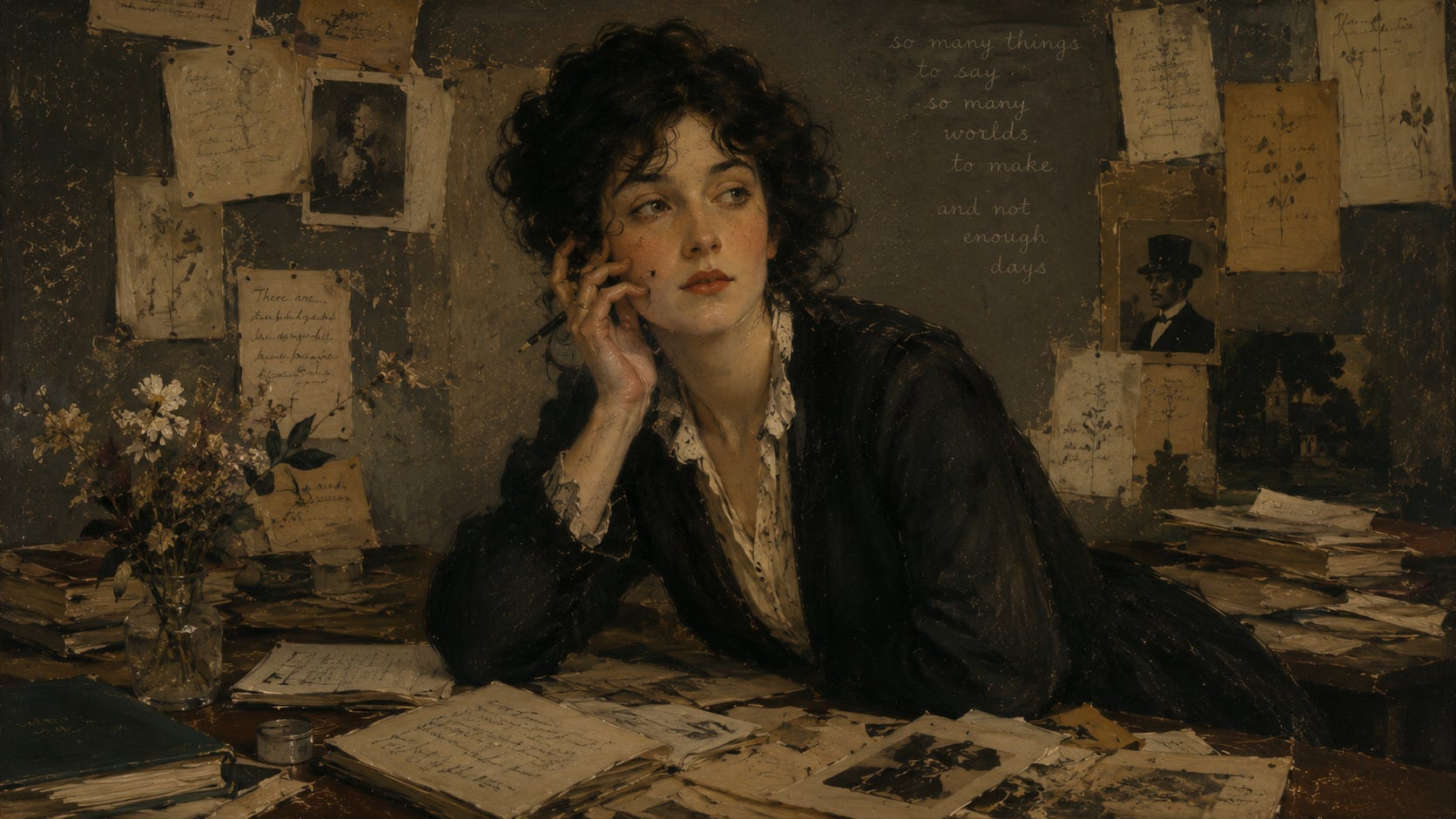
This is the first of two. Part one is about how my mind works, while part two, which I’m finding harder to articulate, is about how it affects everybody else in the room…
Creative misery. Too many ideas. Poor me. I know how daft and pretentious it sounds. Writer has too many things she wants to write. Woman who makes things cannot stop thinking of things to make. Yeah. Call in the violins.
But know that abundance has its own cruelty.
Because having ideas and being able to bring ideas into the world are two entirely different things. And somewhere in the muddle of my AuDHD brain, I’ve got almost endless capacity for the first and a far less dependable capacity for the second, and it’s an awful place to be.
Make no mistake about it, I hate it here.
I have spent twenty years being praised for my chaotic, sometimes even shambolic productivity by people who have no idea what it actually costs, and who remain privately convinced that I’m getting away with something. So I want to take the lid off the muddlefest and show you the workings, because I think a great many women are rooting through the same muddle and calling themselves lazy. Or worse, stupid.
Skippety is the charming word. The one I say at parties.
But SLIPPERY is probably the more accurate one?
Because it isn’t only that my attention hops from one bright thing to the next like a woman crossing a river on stones, which sounds lovely and purposeful and speaks of she who knows what she is doing. No, it’s not just the attention issue, it’s that things won’t stay held? I put a thought down for one second, one actual second, to answer a message or find my glasses or take a sip of water, and when I come back the thought has gone, not gone somewhere, just gone, and I’m left in the middle of my own head with my hands out like a woman who has dropped a bowl and is still, absurdly, in the position of holding it. A woman frantically rooting through the debris of her mind, because there is no peace there. None at all.
And then it all comes at once, because that’s how it arrives, never in a queue: the post I’m supposed to be finishing and the woman whose name is written in the front of that book and whether I’ve thawed anything and the fact that the phrase counting house is beautiful and nobody uses it and could that be a title, and underneath that the low hum of the seventeen unfinished things, and underneath that, my mum saying something in a doorway once upon a time, cigarette in hand and underneath that the sudden absolute certainty that I should reorganise the entire shop, all of it, today, from scratch, into seasons, and wouldn’t that be better, and shouldn’t I just quickly see, and there goes the morning, there goes the essay, there goes the woman in the front of the book who I won’t think about about for four months until she surfaces at eleven at night like something worrying rising in a canal.
This is what I mean by slippery.
Not butterfly.
Not sparkly.
Eel. (Stupid, lazy eel).
And then, sometimes, it lands.
You need to know how good feels, because we can be so busy talking responsibly about neurodivergence that we forget to admit the ecstasy. And the ecstacy is why I donn’t want it medicated out of me.
I am in love with hyperfocus.
Not fond of. Not grateful for.
In love. The stupid kind. The kind that ignores its friends. The kind I am head over heels in now and that may or may not pass again into the silence underneath it.
Eel.
Because when it comes, the noise stops. All of it. The eel goes still. Every scattered piece of me faces the same direction at the same time, and for once I’m not dragging myself towards the work like a woman pulling a heavy case uphill. I’m being pulled. I don’t need timers or lists or stern little talks in the mirror, and the hours go by in what feels like about nine minutes, and I look up and it’s dark and I’ve built forty pages of something that would take other people three months, and I feel clean and vast and unmistakably myself.
Skills worthy of the CV I have never had:
Excellent communication skills. Works well independently. Hyperfocus.
What it actually means for me is that my brain occasionally chooses something and informs me that this is what we’re doing now. Not what I planned to do. Not necessarily what needs doing.
This.
I’m not being disciplined. I’m being carried.
That’s the difference between rowing and being swept.
It’s also why I can build something enormous on a Sunday and fail to answer three emails on the Monday.
The ability didn’t disappear. The power did.
And awareness of that distinction makes all the differnce, because for most of my life it was read as a character reference. Look what she can do when she wants to. As though the Sunday proved the Monday was a choice.
As though I want to be eel.
This then, is the distinction that changed things for me.
Wanting something and enjoying having done it are not, in my experience, the same thing. I have an enormous capacity for wanting. Which means anticipation is where I live.
The idea at eleven at night, unwritten, unformed, still made entirely of light, is intoxicating. It will almost always be better than the finished thing, because the finished thing has edges and the idea has none. The promise is enormous. Delivery is strangely quiet. A thud of absolute nothing. A death of sorts I have come to despise.
So the shape of my working life makes a horrible kind of sense.
Beginnings: paid in all consuming curiosity.
Middles: not paid. Terrible.
Endings: the money never arrives, and I stand there like a woman who has done a full week’s work and been handed an envelope with a card in it. And no pound coin stuck inside with sellotape.
(the pleasure I get from winning the bet, is to lose)
And then the wanting, which is fine, which has had a marvellous time, turns to me and says brightly: shall we start something else? And back on the merry-go round I get.
Once I understood this about myself, once I realised that if wanting is unreliable as a guide to what matters, then it cannot be the thing I steer by, I had no choice but to come to the understanding that wanting is a magnificent engine and dreadful compass, and I’ve spent my formative life trying to use it as both.
I muddled these together for years, and separating them has helped me understand my own working life.
Hyperfocus is a surge.
It arrives, it lasts hours, it can’t be summoned, and in my case it will attach itself to absolutely anything. I’ve hyperfocused on a chapter of a novel and I’ve hyperfocused on finding one particular shade of green. The surge doesn’t care about the subject. It only cares that something switched on.
Obsession, or special interest, is the wiring.
It’s in the walls. It’s live whether or not anything’s lit. It survives boredom, house moves, illness, three businesses and one entire personality change, and on the days I can’t focus at all it’s still there, sitting in the corner like a beloved peculiar.
Hyperfocus without obsession is enormous power going nowhere. You burn eleven hours and end up with a beautifully organised drawer and no career. A relationship without passion.
Obsession without hyperfocus is love without opportunity. You carry the thing for a decade and never create anything useful. Nothing that wholly expresses the meaning of the thing consuming you. A stalker of a thing.
But when the surge meets wiring, that’s the work. The fire. That’s every good thing I’ve ever made. And it happens perhaps just six times a year. And the rest is just all manner of nothing.
Six.
I’ve built twenty- one years on six days a year and a stupid, foolish, irrational sense of stubbornness, and I feel shame and pride and anger and joy: because it took so little to create so much and I would be so much more than I am if only hyperfocus would marry obsession and stop playing this relentless game of cat and mouse.
The one practical thing I’ve found, is the Big List. Ideas I might, just might, no pressure now, do, or write or fashion into being should I manage to get hyperfocus and obsession down the aisle.
Not tasks, and nothing with a deadline attached, because you’ll see later what happens to anything with a deadline attached. Just things that might matter if I got to them.
Because the surge will come, I have enough faith at least in that, it will come whether or not I’m ready, and when it comes I have about ninety seconds of choosing before it decides for me. If there’s a lit runway, it lands on the runway. If there isn’t, it lands in the airing cupboard, and I lose a whole magnificent day to scenting towels with lavender.
(this is how it goes)
the idea comes in wearing all its lights on and says come on
and i say yes because i am not a woman who says no to a lit thing
and we run we run we run
and somewhere near the middle the lights go off one by one
and i’m holding a thing in the dark that i built and cannot see and no longer care about and want to imagine never happened and i don’t care, i don’t care
stupid, lazy eel
Nobody warns you about this part. The withering isn’t giving up. Giving up is a decision, and decisions have dignity, and you can be talked out of a decision.
This is not that. I cannot be talked out of abandoning something my entire body is violently now opposed to.
This is going back on the Wednesday to something that on the Monday had you awake at half past four with your heart going, and finding it has gone grey. Not wrong. Not bad. Grey. Somebody has bleached the colour out. You read your own notes, the ones in that scrawl you only use when you’re excited, with the underlining and exclamation marks and the little flowery box drawn round the good bit, and you feel nothing. You may as well be reading somebody else’s love letters. There’s the evidence of a passion. There’s the handwriting of a woman having the time of her life. And you can’t reach her, you can’t disagree with her, you can’t get it back, and the worst of it is you can’t even mourn properly because nothing has died, it just isn’t lit any more, and a thing that isn’t lit any more ceases to exist.
Then the second wave, which is worse. You did it again. You promised people. You told him. You told readers. You bought the domain. You made the folder and the folder has a lovely name and inside it there are eleven documents and one of them is nearly finished and you will never open it again.
What kind of woman does this, over and over, and how many folders is it now, and how do you have the nerve to sell anybody anything about intentional living when there’s a graveyard on your desktop?
Two things about that, in this order.
I no longer believe it’s a character flaw. I know this pattern too well now. I know how differently my attention behaves when something is new and lit and how difficult it can be to reach the same work when it isn’t.
You aren’t lazy and you aren’t a liar and you didn’t mean a word of it dishonestly. You meant all of it, at the time.
That’s what makes it so bewildering to everybody, including you.
And: some of those folders should be opened anyway. Not all. Most are compost and always were. But there’s a small number, and they’re grey not because they’re finished with you but because you reached the middle, and the middle is unpaid.
Which means the middle has to be done unpaid, by an ordinary woman, on ordinary days, without the lights on.
Waiting for them to come back on isn’t a strategy. Sometimes you have got to summon everything you have got to get up (and it’s harder than it might seem to those capable of living in a straight line) and flick the switch quite independent of your own head.
Adaptations have to be made and ableist opinion set aside. And that too is harder than it seems.
Special interests aren’t simply subjects I enjoy. They are territories mapped in my mind.
I want to discover them. Know what lives there. I want the obscure book and the forgotten woman and the footnote everybody else skipped. I want the history behind the history. I want to collect. I want to connect.
And then, inevitably, I want to make something from it. I want to write its way into my truth.
Homes. Women. Housekeeping. Old magazines. Midlife. Forgotten writers. Why a room feels wrong. Why a sentence feels right. Why women keep things and why women throw things away.
I can see connections between all of these things.
That’s the joy.
I can see connections between all of these things.
And that’s also the problem.
Because there’s no obvious place to stop. Every rabbit hole contains another rabbit hole. Every book has a bibliography. Every woman has a history and every history touches another history.
Keats had a phrase for the quality he thought a great mind needed: the ability to sit inside uncertainty without an irritable reaching after fact.
I’m the irritable reacher.
My brain does not naturally say thank you, that’s sufficient.
My brain says:
Oh my God. Look!
Let me show you rather than tell you, because telling you is a lie about how it works in here.
I bought a book for two pounds and somebody, one Doris Cecil, had written her name in the front. Just a name and a year, in ink, in the careful hand of a woman who wanted it known.
And I sat on the edge of the bed and thought: she claimed it. In a house where possibly very little was hers, she took a pen to the one thing that was.
Which made me think about how much of what women have written down was written in the margins of things belonging to somebody else. Flyleaves. Recipe cards. The backs of envelopes. The inside covers of account books.
Which made me think that household accounts are autobiography if you read them slowly enough. What she bought. What she stopped buying. The month everything got cheaper. The year there’s suddenly an extra name.
Which made me think about how many women have gone into the ground without a single person asking them one question about what they knew.
Which brought me back to her, to Doris Cecil, whose book I own for two pounds, and who I will never know anything else about, and who I think about most weeks.
Which made me realise that this is what my work actually is. Not homes. Not housekeeping.
Women, and what they kept, and why, and the fact that the keeping was a kind of writing that nobody read.
Which is a better description of what I do than anything I’ve managed in twenty years of trying.
Do you see?
That was a wander. That was me going off. That’s precisely the behaviour I’ve spent my working life apologising for and trying to manage with systems. I despise systems. And they hate me.
And yet, this bothersome, erratic wild dance of a head eventually produced this sentence, and I’m repeating it again here, because I want to stash it in my heed and keep it for always and forever…
“Women, and what they kept, and why, and the fact that the keeping was a kind of writing that nobody read.”
I wouldn’t have got to that sentence directly. There’s no route, so I have to go all round the houses. I’ve tried sitting down and asking myself what my work is really about, in a nice notebook, with a candle lit, like one of those floaty homemakers on Instagram, and I get bland little abstractions that could belong to anybody. The good stuff only ever arrives sideways, at the end of a chain of eight things that had no business being connected.
The wandering isn’t a failure of the process: it IS the process?
Which is why I’ve stopped calling the good days the productive ones. The productive days are the ones where I did what I said I’d do. The good days are the ones where I went off, and came back with something I couldn’t have gone looking for. A prize of sorts!
They break differently, and knowing which is which is useful.
Hyperfocus is broken by noise. A doorbell. The phone. A perfectly reasonable question in a perfectly reasonable voice from a perfectly reasonable person I want to punch. The realisation that I have to leave the house at two. Not the leaving at two: the knowing about the two. The surge cannot survive a future appointment. An afternoon with one small thing in the middle of it isn’t an afternoon, it’s two useless stumps.
It’s also broken from the inside, which nobody talks about, and which is harder to be gracious about because there’s no one to blame. Hunger, eventually. Needing to go to the loo, though I will have been ignoring that for a good few hours and rotting my bladder in the process. A bad night three days ago arriving late to make me feel sick or sorry or miserableƒ. The bit of the work that requires a decision I don’t want to make. And will never make and if you try to make me I will scream and scream and scream until I’m sthick. The moment the interesting problem is solved and only the tidying is left.
(And then there’s the cost of coming back. A two-minute interruption doesn’t cost two minutes. It costs the two minutes plus however long it takes to get back in, which could be anywhere between twenty minutes and never, and which nobody can see from the outside, and which sounds to everybody else like an enormous fuss about two minutes. And makes me sound precious and ridiculous to myself and that’s because I am and while I feel as if my neurodivergence is something I should protect, I also have to see beyond the beauty I find in it, to the more ludicrous elements of the impact it has on me).
Obsession, on the other hand, is broken by almost nothing. It waits. It’s what’s still there after four months of admin. Interruption barely touches it, because it isn’t a state to be broken, it’s the wiring in the walls.
It’s broken by one thing only. By being made compulsory.
Here’s the civil war, and it took me until around about last week to see it clearly: the same head helplessly in love with hyperfocus contains a ludicrous brain that will flatly refuse demands. Any demand. Including, the ones I issue myself.
I experience demand avoidance as something much more physical and immediate than deciding I don’t want to do something. It’s an automatic no. Something in me reads the word must and puts up a wall before I’ve finished the sentence. Trying harder rarely gets me over it. Mostly it just makes the wall higher?
Here’s what happens - The idea comes. The lights go on. I’m in love. I’d do it for free. I’d do it instead of eating cheese.
And then I make one small mistake: I tell someone. Or I put it on the calendar. Or I say to myself, in a kindly voice, right, I’ll finish this by Friday. No pressure, you hear me, no pressure at all Sweetheart.
And in that instant the thing I loved becomes a thing I owe. And debt scares me. And my whole brain says: no. Not I’d rather not. Or I’m tired. A flat No. A preposterous sense of absolutely NOT. The shutters coming down, and there I am sitting in front of work I was ecstatic about eleven hours ago feeling something close to physical revulsion, unable to explain to anybody, least of all myself, why I now cannot fling the laptop open upon work I loved yesterday.
Do you understand what a bind that is?
The only thing that reliably kills my joy in the work is committing to it. God I hate it.
Love and the refusal live in the same head and use the same door and I’ve been called inconsistent by people being generous and flaky by people who weren’t, when what was actually happening felt more like a small savage nation defending its borders against a tyrant it had correctly identified as me.
There’s no cure, so I exhaust myself creating smuggling routes: I don’t announce. I say possibly, and I’m toying with, and there might be a thing. I lie to myself in a language I find plausible. And I keep the beloved work off the list, always, because the list is a demand and the demand contaminates whatever it touches. It never goes next to descale kettle. Because computer say no to descaling the kettle. EVER.
So I approach at an angle, pretending to be interested in something adjacent, like a woman edging up to a nervous animal, hand out, while very obviously looking at the sky.
It’s ridiculous.
But it turns out you CAN kid a kidder and it works about seventy per cent of the time, which is more than any system ever managed for me?
So what do you do with a mind like this, assuming you’d rather not be at war with yourself for the rest of your life?
Very little, is the answer, and most of it depends on a change of belief rather than a change of behaviour? Because interest is not instruction. And excitement is not obligation.
A new idea doesn’t automatically deserve a new project, and a special interest can be allowed to feed the work without becoming the work. But when something lights up my brain it feels important. And I get crazy greedy for it all, more, now, again. And then this is it m’lady!! The intensity seems to prove something. Look how alive you feel. Surely this must be THE thing?
But intensity is information, not orders, and I just can’t seem to get my head around that, because yes, sometimes a rabbit hole is JUST a rabbit hole and I could simply seek the pleasure in it without turning it in a project, couldn’t I? And sometimes the obsession will pass, leaving three useful paragraphs and a peculiar amount of knowledge about a woman born in Mill Road Hospital. And it’s not failure as such. It’s just how my mind gathers material and I think I have to stop beating myself up about it?
And something less flattering while I’m here. Because some of the wanting may not be appetite at all. Sometimes I wonder whether it is a sophisticated way of never being finished, because a finished thing can be looked at, and judged, and found to be exactly as much of me as I was able to give. An unfinished thing gets to remain potentially magnificent. Or declared appalling or worse meh. I dread the meh. Surely we all dread the meh?
Perhaps that’s why starting the next one can be easier than standing still beside the last one. Running away from it is too enticing because it avoids other people and I am scared of other people?
I used to describe all this as a warehouse, and it was the wrong word entirely. Too cold. Too high. All that concrete and nobody’s ever made a cup of tea in it.
It’s a shop. With splendid rosehip tea on tap.
A brocante, obviously, with the bell over the door and the smell of old paper and beeswax, and rooms going back much further than the rather gorgeous, decaying bow-fronted Georgian frontage would suggest (and yes, if you are from Liverpool you know the exact shop I mean). There are books piled to the ceiling and strange drawers full of somebody else’s buttons and scraps of ribbon and ideas from when you were about thirteen and sentences I haven’t found a home for yet, and rooms up the back stairs I haven’t been into in years.
I love it in there. That’s the thing I need you to understand. It isn’t a burden and it never was. What I got wrong was thinking that everything in a shop is stock for sale or wool for knitting my way to a different life.
Some of it is furniture. Shelves to hold the dreams. The counter, the chair by the window, the lamp you’d never part with, the thing on the shelf behind the till that three customers a year ask about and the answer is always no.
Some of it is out the back, waiting, because it isn’t ready and might never be. Some of it is there because it makes the light nicer.
And some of it, a very small amount, is in the window this week.
That’s the whole discipline, and it took me twenty years. Not what shall I make of all this. Just: what’s in the window, what’s furniture, what’s out the back, and what’s simply mine to squint at and adore.
You see the shopkeeper who sells the chair she sits in has misunderstood the business.
A skippety mind ravenous for beginnings and much less interested in endings. A surge that can’t be summoned and wiring that never goes off. A withering nobody warned me about. A refusal that fires hardest at the things I love most.
And I could stop here, and maybe you would feel seen too and I’d feel briefly and genuinely useful. But it would be a lie by omission. Because everything I’ve described is written as though the only person paying is me. My mornings. My exhaustion. My folders. My magnificent unfinished business. As if the whole thing happened in a locked room with nobody outside it.
There are people outside it.
There always has been.
And that’s the part I’ve been avoiding for eleven years: it isn’t just about me. The skippety eel develops tentacles and wraps her neurodivergence around other people and whether I like it or not, I have to own that…
Not lazy. Or stupid. But still someone with responsibility?
So part two, next week: the man at the end of the sofa, the small boy in the garden, and what it means to be homesick for your own mind.
Comments
Nothing yet. Say the first thing.
Sign in to join the conversation.