
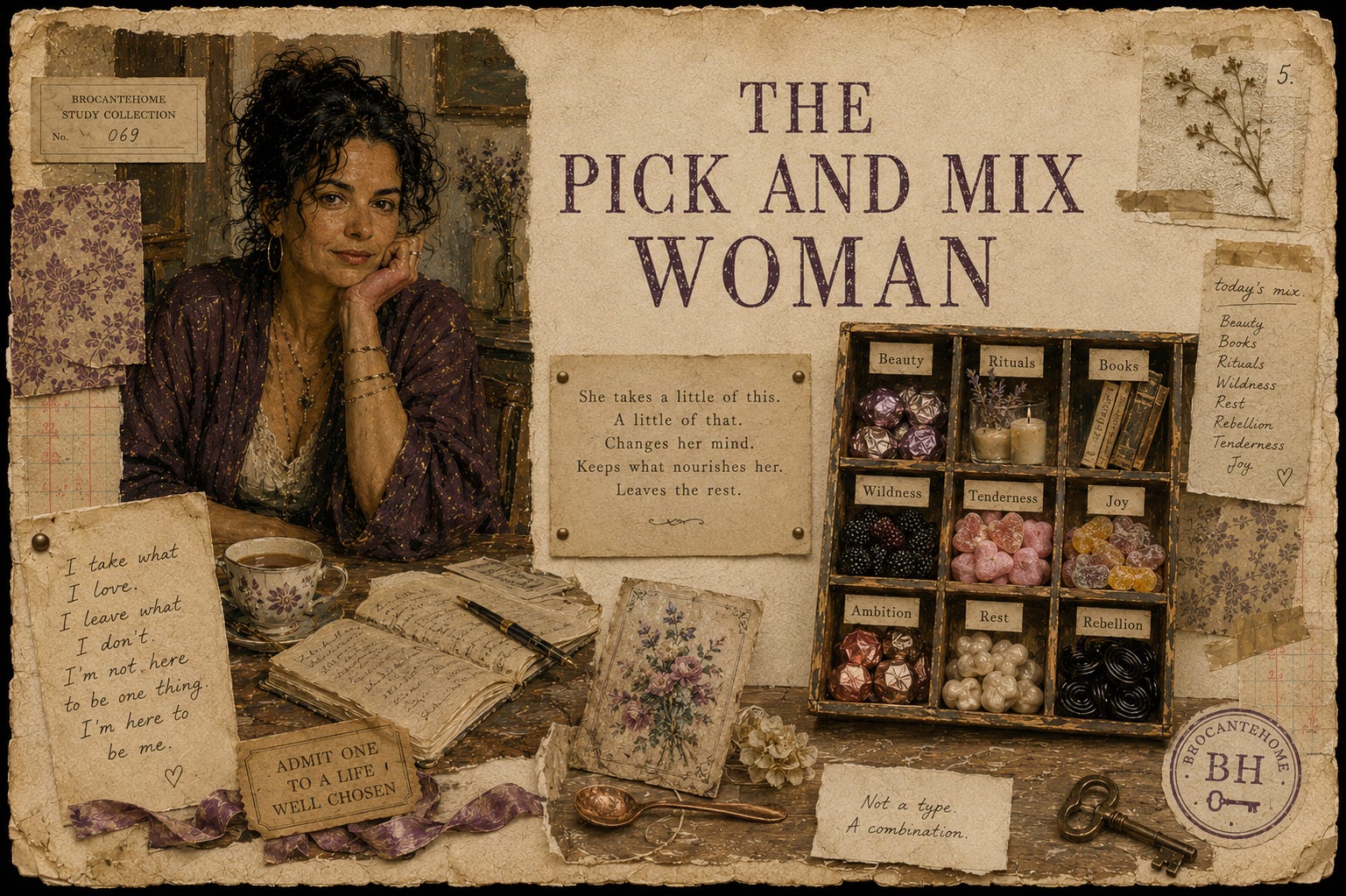
I am large, I contain multitudes. Walt Whitman
A foolish consistency is the hobgoblin of little minds. Ralph Waldo Emerson
I’ve been an artist. I’ve been a writer. I was, for one sincere stretch, a transcendental meditator, and I still dabble in twenty minutes here and there repeating a gibberish word to myself because it works. And for a short while I was a hairdresser’s receptionist and I’m not sure they would give me a reference for that.
I’ve played games. I’ve been bohemian. I’ve been mad, in the way a woman is permitted to be mad for a year or so provided she does it without much fuss and keeps up with the laundry. I’ve been Mother Earth, wholesome and frizzy-haired, fond of hummus and lentils. Telling friends off for being over-reliant on kitchen paper towels and announcing myself consideribly purer than thou. I’ve been a pouting seductress, which took much humiliation and a line in pink bras, doused in essential oils, or doused in Obsession, followed by a brief period when I wore both at once and surely knocked anyone who came near me, clean out.
I once went out dressed to the nines, and stood at the bar, and looked down to find both arms covered to the elbow in paint the colour of that day’s work. I didn’t wash it off. I’ve never quite washed it off.
Woman, with paint. Hang me in a gallery.
I’m neurodivergent, which I understood about myself a great deal later than everybody else would have liked, for isn’t it true people like to be able to neatly box us off… but no, not possible, because I contain facets and I contain facades, and I can’t fathom which is which, and suddenly find myself thinking that maybe if you can’t either then maybe that’s a YOU problem? There’s madness in the mix and there’s intelligence in it, and there’s trauma and there’s fright, and every last bit of that has gone into making whoever it is that types this.
A homemaker and a feminist (bite me). A mother and a terrible friend. I’m so sorry. I don’t do it on purpose. Not religious: spiritual. My own brand of spirituality, the kind I’ve made up and cobbled together from the universe and astrology and witchiness and Buddhism and crystals and every Sunday of my childhood spent sneaking into the congregation at St. Judes because my Nana was chronically late for everything, and because it all makes sense to me and it is mine and I can’t and probably won’t explain it.
And speaking of spirituality, I don’t know whether my spiritual home is a cottage, a manor house, or a skip. Because I want it all and I want to squeeze the whole lot on to a 68ft narrowboat, please and thank-you kindly?
I could go on, because there’s the woman inside me who once did the school run in yesterday’s mascara with a coat over her nightie, and the one who ate nothing but cheese for a whole day, and the one who cried in a garden centre car park over something so small I’ve lost it completely, and the one who stood at a window somewhere far away and thought, oh, I could be somebody else here, and wasn’t, and so I came home, and put the shopping away.
There’s no ONE me. There are billions of little bits of all the women I’ve been stealing from for fifty-four years, and I can’t stop the stealing and I’m never giving any of it back. Arrest me, why don’t you?
All of which begins, as these things do, at a sweet counter in Woollies.
The scoop was silver and and nobody ever used it. You used your fingers. Or the little tongs if the woman with scary make-up was watching.
Nobody asked you to explain your selection. Nobody said, I notice you’ve taken three flumps and a fried egg, shall we talk about it? You put in what you wanted. You avoided the coconut mushrooms because the coconut mushrooms were an act of aggression.[^1] And then you handed the bag over to be weighed, and the woman in the tabard didn’t look at what was inside it, because why on earth would she, and you walked out onto a wet high street with your own assembled brand of all that is sweetness and light shoved into your pocket.
Most of us have endured an extraordinary amount of time being invited to become somebody. Not ourselves, exactly. Somebody. A recognisable somebody. A type. Boxed off and tied with a bow!
The sensible woman. The creative woman. The SWEARY one. The woman who has her life together. The woman who has opted out and let. herself. go. The woman who doesn’t need anybody. The woman with three identical white shirts hanging like proof she is hygenic, neat and probably minty fresh. The woman who rises at dawn and drinks grass. The woman who has rejected all that nonsense and lives entirely on Serrano ham and Fab lolly-ices.
There’s always, somewhere, a blueprint. Yep, even for the ham lady.
Choose a label (look for the “cores”: norm core, cluttercore, faerycore, fishermancore - no really FISHERMANCORE) and you’re apparently expected to choose the accompanying beliefs, clothes, books, breakfast, bathroom, attitude towards money and preferred method of storing beans. We’re surrounded by complete packages. Everything arrives as a set. Milk jug, sugar bowl et al.
But one of the quiet pleasures of getting older, I’ve found, is working out that you’re under absolutely no obligation to buy it all in one neat package. You can be a fisherman faery if you want to. Or you can say phooey to the lot of it and do Alisoncore or Dianecore if you’d rather.
You can have the lipstick and kick the patriarchy into next week.
You can have the old wooden table without wanting the old social order that once gathered around it.
You can believe fiercely in women earning their own money and still want somebody to bring you tea when the day has been vile.
You can read feminist theory in bed underneath a ridiculous floral eiderdown, because why wouldn’t you?
You can reject the notion that housework is women’s work and still get an almost embarrassing satisfaction out of polishing a sideboard until it looks wet.
You can despise beauty standards and still stand in Boots at half past four on a Thursday wondering whether you might, after all, be the sort of woman who needs plum-coloured eyeliner. (Answer: probably. It is kinder to ageing eyes than my beloved black kohl).
You can want solitude and company inside the same hour. You can have spent twenty years rejecting something and suddenly decide you rather like it. The sky doesn’t fall in. Your membership card to womanhood isn’t revoked. Nobody worth knowing appears at the door with a clipboard.
And yet you’re braced for the clipboard. Look at you. Still braced.
Yes. Alright. She’s here now, the one who lives down the side of the page. She’s been there for years. Sarcastic and a little bitter. Try and ignore her if you can?
Personality quizzes. Aesthetic categories. Archetypes. Style identities. Attachment styles. Love languages. Hormone types. Body shapes. Colour seasons. Work personalities. Erotic blueprints. Housekeeping styles. Which of the four autumn palettes are you. Which goddess governs your money. What your handwriting says about your capacity for intimacy. Which fictional village would suit your nervous system. What kind of tired you are. Whether you’re a lark, an owl or a third bird recently invented by a podcast. Your decluttering personality. Your grief style. Your rest archetype. Your gut biome’s preferred cuisine. Whether you’re a fig woman or a pomegranate woman, no really, tell them which, their bank balance depends on it. Choose! They want you to choose!
The algorithms are mad fond of all this. They want to know who you are because once they do, they can show you more of yourself, or rather more of what women like you are supposed to like. Watch one woman buttering her own sourdough in a long white dress and your phone becomes convinced you’re days away from a smallholding. Show an interest in strength training and you’ll be pursued around the interwebs by women carrying enormous bottles of water.
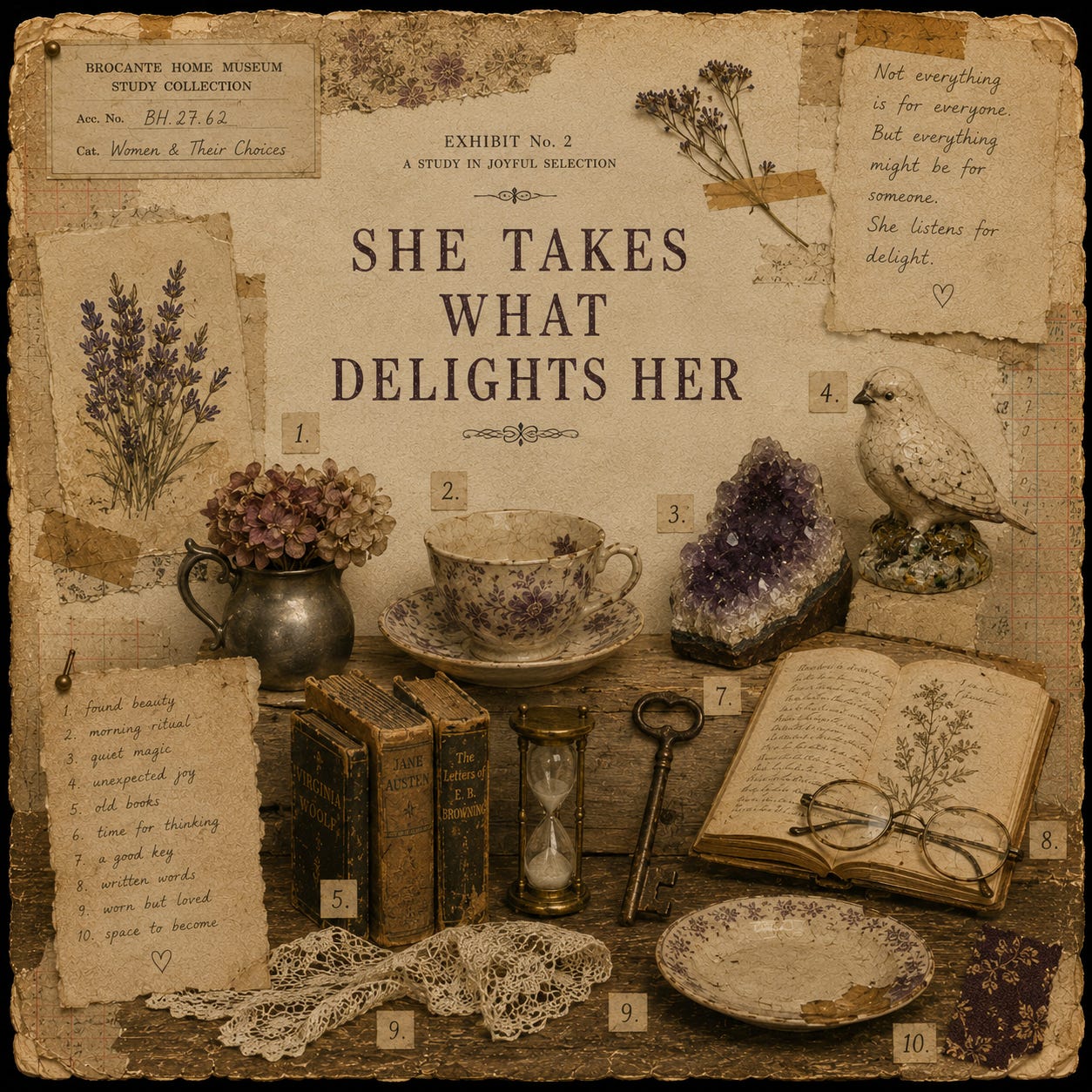
The categories are occasionally useful. They give shape to something previously unnamed, and there’s in recognition, the click of ooooh, that’s a thing, other women have it too. I’m in a gang!
But the label/gang/scary woman in charge soon starts issuing instructions.
You choose an aesthetic, an idea, a way of living, and then, without ever deciding to, you begin editing yourself so that you belong to it. (Because we tell ourselves BELONGING is EVERYTHING and we don’t know it means absolutely nothing until we are almost too old to care). We imagine we pick identities because they express who we are. And then, almost imperceptibly, we start interrogating ourselves in ways that protect this imagined, adopted identity.
Would a serious woman care this much about cushions?
Would a feminist want somebody to open the door for her?
Would a creative woman be this interested in cleaning?
Would a woman committed to slow living be allowed to adore the madness of Manchester?
Would the spiritually evolved woman still want revenge?^2. Because HELL I want revenge!!
Women contain rooms nobody puts on Pinterest, don’t you know?
There’s a room in you with the curtains shut and the light on in the afternoon, and nobody has ever once asked about it.
I wonder if we’ve confused authenticity with consistency?
Authenticity is one of those words rubbed cheap by handling. Be authentic! Live authentically! Find your authentic self, as though somewhere beneath the accumulation of everything that’s happened to you there’s a pristine woman waiting to be uncovered. Here I am, she says, arms crossed, I was buried underneath the ironing!
I’ve stopped believing in her.
I know I’ve been ranting about finding her for years, but she’s not the shape I thought she was. She’s either an idea, ie. not something attainable: a fantasy - OR there may be no one true self waiting underneath at all, because maybe a self just keeps being made, not invented falsely but assembled honestly, the way you’d build a room over fifteen years rather than order one from ikea?
And something else… the authentic self might not represent a collection of things a woman has chosen. It might be the woman actually doing the choosing. Because surely it is odd to imagine that we are anything but authentic in the first place?
Yes. That makes more sense doesn’t it? Because the chooser can change her mind. The chooser develops appetites she didn’t possess at twenty-three. She can abandon entire selves. She can return to things she once dismissed, loudly and slightly merrily at a dinner party. She can discover her mum was right about some things and gloriously wrong about others. She can find pleasure where she once saw only oppression, and call out oppression where she once saw romance.
And we mustn’t call it inconsistency, when we should be calling it consciousness.
Women have always been offered models of correct womanhood. The costume changes, but the inspection remains and it is brutal.
The good wife. The superwoman. The domestic goddess. The girlboss. The tradwife. The woman ageing defiantly. The woman who has absolutely no intention of ageing at all and has the hairline scars to prove it.
Every generation believes it has escaped the previous model and then, double quick, manufactures another. There’s always a right way to be free. (Even liberation arrives carrying instructions). Isn’t that appalling? Not on your own terms, Darling. Don’t go rogue, now will you Sweetheart?
You must want the CORRECT freedoms. Reject the correct traditions. Be sufficiently independent without becoming cold, sufficiently desirable without appearing vain, sufficiently maternal without misplacing yourself entirely, sufficiently ambitious without letting ambition deform you into something with an obnoxious jaw. Modern womanhood presents itself as a buffet, and then somebody follows you around commenting on your plate.
You’ve made that joke before.
So shoot me.
Two things said out loud, together.
This then, is why I’ve become interested in women who are difficult to categorise.
Women whose houses are full of contradictory evidence. Women who keep serious books beside giddy ones, or dirty ones and don’t shelve them apologetically. Women who care deeply about politics and wallpaper. Women who can spend a morning thinking about mortality and an afternoon looking for precisely the right shade of moss.
Women who aren’t interested in demonstrating that their pleasures are morally useful.
I fancy myself as Carrie Bradshaw and I fancy myself as Miss Marple, and I think they would have got on rather well, given a decent bottle of plonk and a body in the library. I want a long rainbow scarf of the Doctor Who variety. I’d wear it with a tutu if I had the legs, and there’s a real chance I’ll try it anyway, because the legs are only going to get worse and the scarf is my spirit animal.
(That last part matters more than the rest of it because we’ve developed a habit of requiring women to justify pleasure. If she likes baking, it’s got to be therapeutic. If she likes clothes, it must be self-expression, art even, not for the vacuous sake of it. If she loves housekeeping, it must be mindfulness. If she buys flowers, they must be an act of self-care, as though we are only allowed beauty on prescription).
Sometimes a woman wants ranunculus because she wants ranunculus. True dat.
I resent it all, but the ludicrous expectations around domesticity seriously stick in my throat, because the domestic world is packed with ideological traps. A woman says she loves her home and within minutes someone is poking at her politics Does she think women belong there? What’s she hiding? Is she performing, ye gads, playing HOUSE? Is she succumbing to nostalgia, that great charge, always delivered as though nostalgia were a controlled substance?
Or is SHE the controlled substance managed into obscurity by a man tightening reins around her and only yanking her back into life when his appetite needs satisfying.
Maybe. Or maybe she likes being at home, and that’s the end of it?
Maybe she just likes washing that gingham tablecloth and smoothing it back over the table. Or finds the small arrangements of daily life satisfying in a way she’d struggle to justify to Betty Friedan, while still believing that every adult in the house should be doing a fair share of the bloody work.
Careful.
Both are true. I know because both are true in me. I’m interested in housekeeping as creative discipline and I believe there’s real meaning in paying attention to the place where our ordinary
Say the other half.
where our ordinary life happens.
AND
I don’t believe a woman owes anybody a clean house.
There. Nothing exploded did it? Boom!!!!
The Pick and Mix Woman isn’t simply eclectic. That’s too simple in the reckoning. She’s suspicious of total and absolute systems. She’ll take a practice from somewhere without swallowing the doctrine wrapped around it, because women are so often told that enjoying one aspect of a tradition means endorsing the whole of it.
But human culture has only ever advanced by salvage. We inherit and we discard. We adapt, we rescue, and we steal shamelessly from the blessed dead.
Why should womanhood be different?
I’ve learned little bits of everything but nothing in me has ever wanted the whole course. It only wants the bit that shines. Aromatherapy. Yoga. Tantra. Breath work. Nutrition. How to stick on a false eyelash without blinding myself. Books, please. Scooby Doo now.
This is intellectual pick and mix, and I like the thought of a woman rummaging through ideas the way she’d rummage round the flea-market. Picking something up. Turning it over. Checking whether it’s still useful. Looking for cracks, and then looking at the cracks more closely, because sometimes the crack is the reason to buy it. Taking it home if she pleases. Leaving it there if she doesn’t. Not revering it because it’s old, and not rejecting it for being dilapidated either.
We’ve become slightly frightened of contaminated ideas haven’t we? If something comes from a tradition whose politics we dislike, we decide we’ve got to chuck the baby out with the bathwater. But women have always made lives out of imperfect inheritance. Tis the history of us. We’ve always taken recipes from women whose marriages we’d never have tolerated. We’ve inherited sewing baskets alongside warnings. Jewellery alongside silence. Good sense sitting right next to appalling prejudice, in the same drawer, in the same handwriting.
A life can contain both gratitude and refusal. We know that. Surely we know that.
And a woman can contain the people she came from whether she agreed to it or not. I am my mum. I am our Barbie. I am a lady called Tuesday and another called Mrs Brown who lived next door and wore her hair in a currant bun, and who I don’t believe I ever had a conversation with about anything more searching than whether I’d had a nice day at school. Something of her got in anyway. The cottage in her 1950’s semi-detached maybe? That’s the thing nobody warns you about inheritance. You acquire it like osmosis.
A rough guide to what’s actually on offer, for those of us approaching with a paper bag and no fixed plan for sweet satisfaction.
The wellness jar. Rest, walking, attention to the body, food that makes you feel properly alive. Also panic, purity, endless self-surveillance and a barely disguised terror of getting fat or old. Take the top layer. Leave the rest.
The domestic jar. Ritual. Care. Hospitality. Making something out of very little. Seasonal attention. The pleasure of keeping things well. Right at the bottom, obedience, gone slightly sticky. Take the ritual. Bin the rest.
The glamour jar. Almost entirely delight, with a hard centre of comparison. Suck slowly. Try not to choke on it.
The religion jar. Ritual again, and the words people reach for when somebody dies, and a great many rules about women. You know which parts you’re taking. Everybody does.
The feminism jar. Language that saves us. Also arguments, fractures, whole generations of women disagreeing loudly about what freedom ought to look like. Good. A politics that couldn’t survive women disagreeing with each other would be a very flimsy politics indeed.
The capitalism jar. Forms of ambition we may honestly enjoy, sold to us bundled with the exhaustion. Nobody has yet worked out how to buy the one without the other. Report back if you manage it.
The Nana jar. Knowledge dismissed for being domestic and therefore assumed to be small. Enormously undervalued. Fill your bag.
The jar with no label, at the back, that the shop has stopped ordering in and can’t tell you the name of. That’s the one I want.
The coconut thing. No.
When I was younger, identity felt declarative.
I am this/I’m not that. I believe this/God NO, I would NEVER do that. Are you actually mental?
Never is one of youth’s favourite words. It goes beautifully with everything, and we mustn’t sneer at it, because younger women need tough edges to survive the necessary work that is separating themselves from parents, peers and teachers expectations, the version of yourself other people have already started writing on your behalf. Definition is necessary. Mine/not mine/yes/no.
But middle age is dragging an archive. Pages already curling. Yellowing like her teeth.
There are so many former selves by then. The girl who thought she was Pollyanna. The young woman performing a version of adulthood she’d seen somewhere. Boss-girl, shop-owner, shoulder pads, clipboard. Mother Earth. The woman who survived something and will NEVER discuss it. The woman who wanted something badly and got it. (Damnit). The woman who wanted something badly and didn’t. (Thank-God).
It gets harder and harder to believe in a single pure self, and all of a sudden it doesn’t seem to matter anymore. At fifty-four I’ve got no interest in identifying the REAL ME. I’d rather wander through the archive with the bag open, discarding bits of me here there and everywhere, and snaffling only those parts of who I have been that strike me as something I can take into my next lifetime…
Ah yes. Her! I liked the earrings. Terrible, dreadful, boyfriend. (Keep the earrings).
And there. That woman. She worried too hard, but she knew how to get things done. Take the competence, leave the anxiety.
That version of me was funnier. I’ll have some of that.
This one was frightened almost all of the time. Fragile. Be gentle with her. Wrap her up in cotton wool now and carry her home gently, please.
This one mistook being lusted after for being loved. Put that down, and put it down properly, not in a way that means going back for it in five years.
This one had gumption I’d forgotten about. In the bag it goes!
And then towards the back there’s a shelf of women I can’t do anything with at all, the one who apologised to a counsellor for feelig too much, the one who laughed at a joke a dull man told about wanting to park his bike between her breasts, while his pious wife sat and looked on as if those very breasts were asking for it, the one who said she didn’t mind, and said it so often and so convincingly that for a while she didn’t, and the one who let too many friendships go without a word because picking up the phone had become a thing too large to lift, and I can’t take anything from them, and I can’t throw them out either, and they stay where they are with the dust settling on them and their hands folded and I love them and I hate them.
Becoming yourself is partly an act of retrieval, I think? Not just becoming new. Recovering, reconsidering, choosing again, going back for something you left on a shelf twenty years ago because a man you no longer remember said it was silly.
Going back to fetch yourself off the shelf he put YOU on. Shame on him.
The internet doesn’t much like this kind of woman. She’s difficult to sell to.
Identity converts desire into equipment. Once we know what sort of woman you are, we know what you’re required to own in order to prove it, and the dress and the powders and the blonde highlights arrive in the post like a starter kit. There’s pleasure in that game. I’ve played it with both hands.[^3]
Oh yes, make no mistake, the Pick and Mix Woman is commercially inconvenient because she won’t buy the whole aesthetic. She wants your candlestick, not your worldview. She likes the dress and has no intention of moving to Provence. She takes the perfume and declines the kind of reinvention programme you can pay for on Klarna, because it costs more than her mortgage and she might be gullible, but she is’t actually STUPID, age has at least given her that.
So she buys one thing and then escapes back inside her own head. Because it’s nice there and she can hang something avant-garde on the William Morris wallpaper and refuse to dress in anything other than a lace nightie and a tatty mohair cardigan.
She can wear a crown while she boils the milk for coffee if she wants and that right there is soveriegnty.
Here’s the other reason I like her. She makes room for appetite, and women are taught to distrust appetite almost from the beginning.
Not only appetite for food. Appetite for attention. Money. Sex. Beauty. Solitude. Power. Rest. The ridiculous. We’re taught moderation before we’ve discovered what we want, which is an efficient way of ensuring we never quite come to know who we are as women on our own terms and I hope you think that’s as appallig as I do?
The Pick and Mix Woman asks a different question. Not what should I like. Or what would make me admirable, or what is gram worthy, or what have my bestest friends agreed constitutes good taste, because we live somewhere nice and nice has rules, nice women don’t break.
Because a great many women can tell you exactly what their family prefers long before they can tell you what they prefer themselves. Ask a woman which restaurant everybody likes and she knows. What time everyone needs to leave. Who hates onions. Which child will only eat the sauce if it’s kept separate and served in the correct small dish. What her partner considers too expensive. What her mum considers vulgar.
But ask her what she wants and find yourself blinking into the awkward pause.
I’ve sat inside that silence myself, in a restaurant, holding a menu, unable to locate my own preference, and I remember thinking with something like anxiety, that I’d mislaid something and didn’t know when, or even really what? And I have turned to men sitting next to me and said what do you think I will like? And let them choose for me, because honestly, my brain was just too exhausted to pick for myself.
What to do about it? The exhaustion, the not knowing? Teach yourself to hear the faint yes.
So here’s mine, and I know it’s no help at all really, but I think it useful to be be able to set my multitudes in stone: I want to live in France and be a Parisienne, thin and unimpressed, neck kissed by a Gitane mouth, and I want to live in Ireland and hide in a hovel deep in the forest and become the stuff of small village legend, and I want to swish my way through Thailand, in a cheesecloth skirt with the dust coming up warm through my sandals, and I want to stay in bed, and I want to live in Chelsea and pretend I was made there and I want to live on a boat with the water knocking all night against the hull and everything I own inside one damp cupboard, or else move lock, stock and barrel into the wild abundance of a National Trust property and refuse to be shifted while I make a life out of foraged jam[^4] and Liberty print dresses and a great deal of unnecessary jelly in rabbity moulds, and I want all of it, and I want it soon, before my knees go. But be quick, because the right one is already shrieking.
Every one of those wants is real. Not one of them cancels the others out. This is what I mean about being confined and confused by the muddle of it, because I contain multitudes I haven’t begun to understand, and some days I’d give a great deal to be a woman who wanted one house.
You’d last a fortnight.
I’d last a fortnight.
That. More of that. Not that. Never again. I thought I liked this and it turns out I don’t. I used to hate this and now I get it.
There’s danger here.
Because we mustn’t turn the Pick and Mix Woman into yet another aspirational woman. God forbid. She shouldn’t become a woman who has curated herself into a cliche, standing at the counter with a beautifully designed checklist, choosing her contradictions with impeccable taste. That would defeat the whole point, and it would also, within about eighteen months, be commercialised into a heap meaningless nothing.
She gets things wrong. She confuses desire with aspiration. She buys into things. Ludicrous, ridiculous things. She changes her mind. Some days she wants to hand the whole lot back and ask for a refund and a lie down. Other days she wants to start a riot. Or a movement. In a tutu.
And she isn’t equally free to choose, because none of us are. We live inside money, bodies, histories, caring responsibilities, class, culture, race, health, geography and luck. Some women stand at counters that run the whole length of the shop. Some are handed three grim jars and told to be grateful and that’s not politics, its
VIOLENCE
and we have to stand up for those women who are fighting so bloody hard for choice beyond entrapment.
So she doesn’t deny circumstance. She looks for agency inside it.
For some agency is enormous. But for other it amounts to nothing more than choosing which teacup to take her morning tea in while the rest of her life burns, and we mustn’t sneer at that either, ever, because an extraordinary number of women have survived by making tiny choices inside lives that didn’t offer them enough large ones. Finn’s Nana rearranges her tiny front room roughly every six weeks. And I finally understand why.
No. Still no. I mean, seriously what the hell?
Feminism gave us the language to ask who benefits from the rules. But feminism itself contains disagreement, fracture, whole generations of women arguing about what freedom ought to look like.
Good. Isn’t that how it should be? A politics that couldn’t survive women disagreeing with each other would be a very flimsy politics indeed. And tearing it aprt and putting it back together in our own likeness is surely what we have long been fighting for?
So what I want now is feminism roomy enough to hold women making choices I wouldn’t make. One that can tell the difference between coercion and preference, and can ask hard questions about why women want what they want without requiring every answer to be politically spotless. Or religiously immaculate.
Because sometimes we ARE shaped by patriarchy. Of course we are. And sometimes we just like the skirt. Mostly the two are tangled past separating, and there’s no laboratory anywhere in which a woman can discover what she’d have wanted if nobody had ever influenced her. We absorb approval and disapproval before we learn to speak for ourselves.
That doesn’t make desire fake. It makes desire worth being curious about.
Which is a different thing from interrogation. Why do I like this? How interesting. Not: prove that you’re allowed to.
I’ve been trying to find the line between the two since I was nineteen and I will probably still be rooting around in the dirt of it all when I’m ninety.
One of the liberties I increasingly want for us is the freedom to say: I haven’t decided what this means yet.
I’m so tired of absolutes.
We’re living in an age that demands instant positions. Everything must be interpreted, categorised, declared, and preferably declared within the hour. You can’t just have an experience. You’re expected to explain your experience while it’s still happening to you. Or hand the whole shebang over to ChatGPT and let her hand your entire self back neatly labelled.
Don’t. Let the whole idea that is you remain unfinished.
I think I believe this, except for that bit. I can see why she feels that way. I don’t know. I haven’t read enough. I changed my mind.
Those sentences have become strangely radical, the last one especially. We treat changing one’s mind as weakness, when it may be the clearest available evidence that a mind is still running wild and active.
What sort of adult arrives at fifty holding precisely the opinions she held at twenty? Imagine it. Terrifying.
I hope seventy-year-old me looks back at something I believe passionately today and says, Alison, baby girl, what on earth were you thinking? There should be development. There should be embarrassment. There should be abandoned certainties lying around the place like old hairstyles. And I know this to be true because I’ve been blogging for over twenty years and there are is a whole host of Alison’s lurking in those pages and not all of them are who I would choose to be now.
Which is why the language of pick and mix appeals to me so much more than the language of reinvention. Reinvention has become an industry of its own. New year, new you. New decade, new chapter, become her. Erm, No?? I don’t want to become her. I’m not sure I trust her? She’s almost certainly waking at a quarter past five, owns matching luggage and a Smthyson passport cover in panama green don’t you know?
There’s something violent in the fantasy of continually replacing oneself, as though each new version requires the previous woman to be quietly dismissed. I’d rather accumulate. Take what still works, repair what can be repaired, leave a few things frankly shabby, add something nobody saw coming.
Keep the evidence.
I like women who show evidence. A life should leave marks on the woman who’s been living it.
Show your work?
Two hooks, one loose. A pink bobble hat I’ve worn twice. Keys to a house I don’t live in. A tin that says biscuits and holds batteries, most of them dead. Reading glasses. Reading glasses. Reading glasses. A postcard of a painting I stood in front of for half an hour and can’t now remember the name of. A dish of foreign coins. Somebody’s glove. A carrier bag of carrier bags. Three ticket stubs. A conker from an autumn I couldn’t date for you now. A pot of hand cream gone solid at the neck. My Mum’s loopy writing on the back of an envelope, and on it, a shopping list, and on the list, cream.
Because brocante was never about matching.
It’s about recognition. That peculiar little pull towards an object a hundred other people have walked straight past. The tarnished frame, the scrap of fabric, the almost beautiful thing. The smell of a stall in the rain, which is damp cardboard and cold metal and a perfume bottle gone bitter in the years since she died.
Which is why the skip stays on my list of possible spiritual homes. Nobody curates a skip. Somebody has died or moved or finally lost patience, and the whole of a life goes in together, the occasional table riding on top of the ruined mattress, and you stand at the edge of it in the rain working out what’s worth wet hands. And how it would look draped in fairy-lights.
You gather objects that were never intended to live together, and then over time they begin to look inevitable. And they could only belong to you. Sarahcore! That’s taste. Not conformity, but relationship. The objects change each other simply by being placed side by side. A solemn painting loosens beside something daft. A polished table makes a chipped bowl look deliberate. A room acquires character because nothing in it arrived as a set.
We allow rooms this freedom. But we won’t allow it in ourselves, or heavens, in other women who we can be almost repulsively judgey about, if something about them doesn’t make sense to us.
Nobody walks into a beloved, complicated house and says: I’m terribly sorry, but your aesthetic appears ideologically inconsistent. The velvet chair conflicts with the modern lamp. The floral curtains contradict the abstract painting. You have failed to establish a coherent personal brand.
No. We stand in the doorway and we say: it feels like her.
That’s what I want for women. Not coherence. Recognition. The sensation of looking around a life and thinking, yes, this feels like me, even though I couldn’t give you a neat explanation of why. And that, yes, that is her.
And perhaps there’s a stage beyond even that, where she stops worrying about whether any of it represents her at all. Where a woman no longer converts every object and habit and pleasure into identity. I wear this because I like it. I cook this because it tastes good. I stay home because I’m tired. I go out because I suddenly want to. I’m not assembling evidence for the prosecution.
Selves get lighter when we stop asking every small choice to carry them.
Leave the other women alone.
Think how much energy we spend making ourselves understandable.
We explain. We dilute. We put little footnotes around our appetites. I know this sounds silly, but | I know it isn’t very feminist, but. | I’m probably too old for. | I know I said I’d never.|
Who exactly is the explanation for?
Maybe there comes a point when we can drop the defence altogether.
Yes, I like that. No, I don’t. Yes, those two opinions feel the same to me. Yes, I have contradicted myself and you can’t stop me. No, I won’t be submitting revised documentation.
Revised documentation. Listen to yourself!
Because a woman doesn’t owe the world philosophical coherence. That sentence still feels almost naughty to write, since coherence is so highly prized. Coherent arguments. Coherent politics. Coherent identity, with a suitable tasteful colour palette if you don’t mind?
But a human being isn’t an argument.
We are appetite, memory, hormones, history, imagination, fear, conditioning, rebellion and half a biscuit found at the bottom of our bag. We’re porous. We change. We contradict ourselves because life keeps contradicting us.
And there’s something astonishing in refusing to become predictable even to yourself. I want the possibility of surprise. Don’t you? I want to keep finding out that I’ve turned into a woman who loves something my younger self would have tutted at. Gardening. Opera. Tinned sardines straight out of the arty little tin. No, not sardines, weird boney bits, weird slimy bits. Sleep taken shamelessly at three in the afternoon with the light coming through the curtains orange. Bed at nine. Up until two with something scandalous, bourbon, sex, dancing. All three at once please?
We talk about self-knowledge as though the goal were to know ourselves completely, and what a dreadful prospect that is.
I hope there are whole territories in me I’ve never visited
I hope I can still astonish myself at seventy.
Annie Dillard wrote that how we spend our days is, of course, how we spend our lives,[^5] and I’d only add that how we choose is how we spend our days.
The Pick and Mix Woman leaves space in the bag for more of who she is becoming. Her muchier, experimental self.
So here she is, in a shop that shut years ago. Wet shoulders. Paper bag. Paint to the elbow, because there’s always paint somewhere on her by four in the afternoon.
She takes the thing she’s wanted since she was nine.
She takes the thing she swore off in her thirties for reasons that have since evaporated. Maybe gluten? Or liars?
She takes two of something completely inappropriate. nice.
She takes something because it’s the colour of toxic waste and for no other reason she’s prepared to give.
She stands there a full twenty minutes because she can’t decide whether she still likes cola bottles. She decides she does. Chucks six in a bag.
She leaves the coconut. Obvs.
Then she folds the top of the bag over, and she pays a woman with pink splodgy blusher who retired a long time ago, and might already be dead and then she walks out into the wet with the whole strange muddle of it all knocking about together, and
nobody weighs her.
Nothing to add.
[^1]: Coconut mushroom, so: somebody must have loved them, because they kept making them, and that somebody was almost certainly a woman born before the war who also liked coltsfoot rock. I don’t have to like a thing to notice it was loved.
[^3]: I’ve changed my mind about this paragraph since I wrote it, and I’m leaving it in because I’d rather you saw the join.
[^4]: I have made foraged jam twice. The first batch never set, so I poured it over ice cream, called it coulis.
[^5]: I’ve had that line pinned up in every house I’ve had.
🌸 The Brocante Way
Housekeeping As Creative Discipline
·
Aug 6
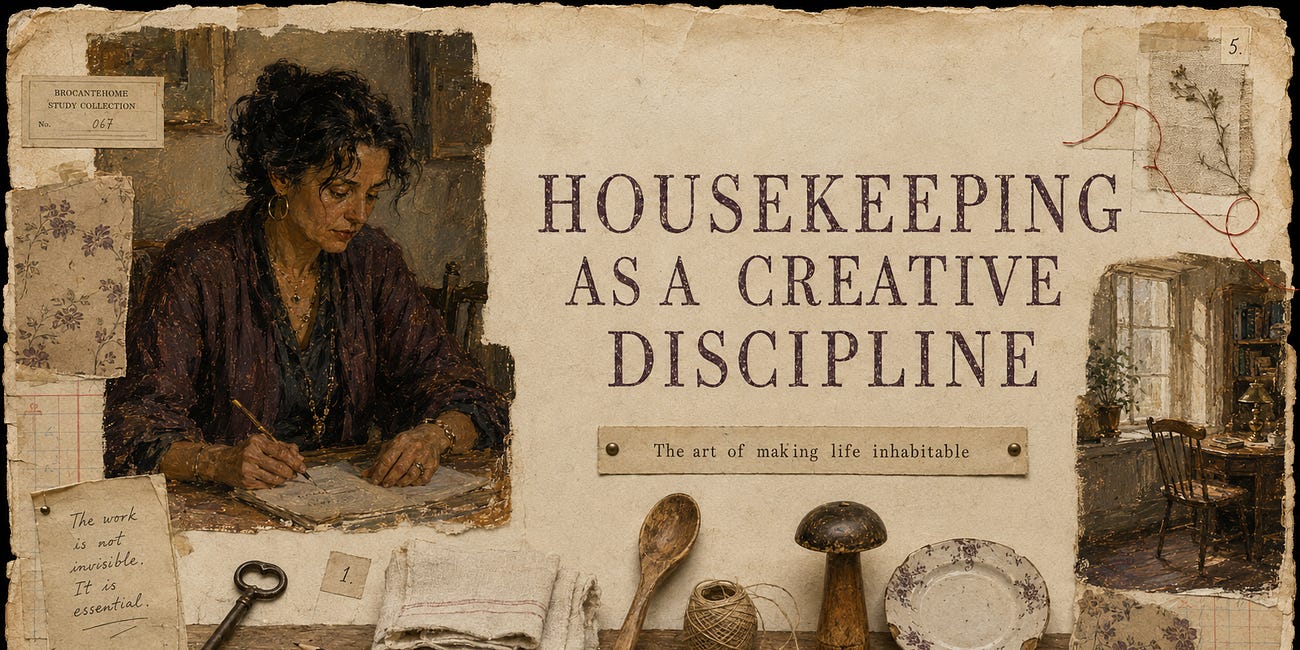
I’ve been standing at this metaphorical sink for twenty-one years now. Not continuously. Even I sit down. But there have been weeks, whole seasons, when it’s felt very much as if I have: as if somewhere around 2005 I plunged my hands into the washing-up water and simply never took them out again, while behind me a child grew, relationships came and went, four dogs auditioned for the role of Captain Chaos, and a woman I only half recognise wrote several million words about the whole carry-on.
Comments
Nothing yet. Say the first thing.
Sign in to join the conversation.