
I’ve been standing at this metaphorical sink for twenty-one years now. Not continuously. Even I sit down. But there have been weeks, whole seasons, when it’s felt very much as if I have: as if somewhere around 2005 I plunged my hands into the washing-up water and simply never took them out again, while behind me a child grew, relationships came and went, four dogs auditioned for the role of Captain Chaos, and a woman I only half recognise wrote several million words about the whole carry-on.
And still, every single time I come back to this sink, there’s a teaspoon in the plughole. One teaspoon. Always one. Placed there, I can only assume, by domestic poltergeist
Twenty-one years at the sink. You’d think they’d give you a carriage clock.
Twenty-one years ago, on a cold November afternoon when Fin was one and I was still living inside a version of domestic life that seemed solid enough to name, I made a small home on the internet and called it BrocanteHome. And because I needed language for what I was doing there, because housekeeping on its own sounded grey and dutiful and faintly cross, and homemaking arrived carrying a tray of buns and a husband whose shirts she ironed voluntarily (and, worse, gladly), I put two words together and called it vintage housekeeping.
I didn’t mean pinnies. I didn’t mean simpering. I meant burglary.
I meant creeping into the great lumber room of the past with a torch between my teeth and taking everything worth taking: lavender among the pillowcases, books by the bed, puttery treats and emergency cake, the consoling click of a well-stocked pantry, the whole gorgeous apparatus of domestic pleasure. And leaving the corsets, the drudgery and the marital obedience in a heap on the floor for the moths.
I meant life, love and vintage housekeeping.
And then the phrase wriggled out of my hands and legged it down the road without a backward glance.
It travelled across blogs and Pinterest boards and book descriptions. Women called themselves vintage housekeepers. Shops used the words. Writers used the words. My own books trotted them out into the world, and by the time The Spring House was published it could be sold as part of a twelve-year tradition of vintage housekeeping I’d apparently founded, which gave me such a funny turn I had to sit down with a custard cream. The phrase became internet furniture. People sat on it, put their feet up on it, spilled tea on it, without ever knowing who’d first dragged it home from the kerb and covered it in faded velvet.
Did I mind? Sometimes I minded so much I had to go and lie face down on the bed about it. Women are forever being told that influence should be payment enough. That we ought to feel flattered when our language is borrowed, watered down and sold back to us in a nicer font at three times the price.
But there was wonder in it too. I’d named a thing and the name had made room for other women. That matters more than the credit or financial success does. (But do ask me again on a bad day, won’t you?)
And now, twenty-one years later, here I am at the same metaphorical sink with my hands in entirely different water, ready to name something again.
Not a trend. Or aesthetic. Not another pleasing phrase destined for a tea towel, or aything that ends in “core”.
No. This time I want to name an entire discipline.
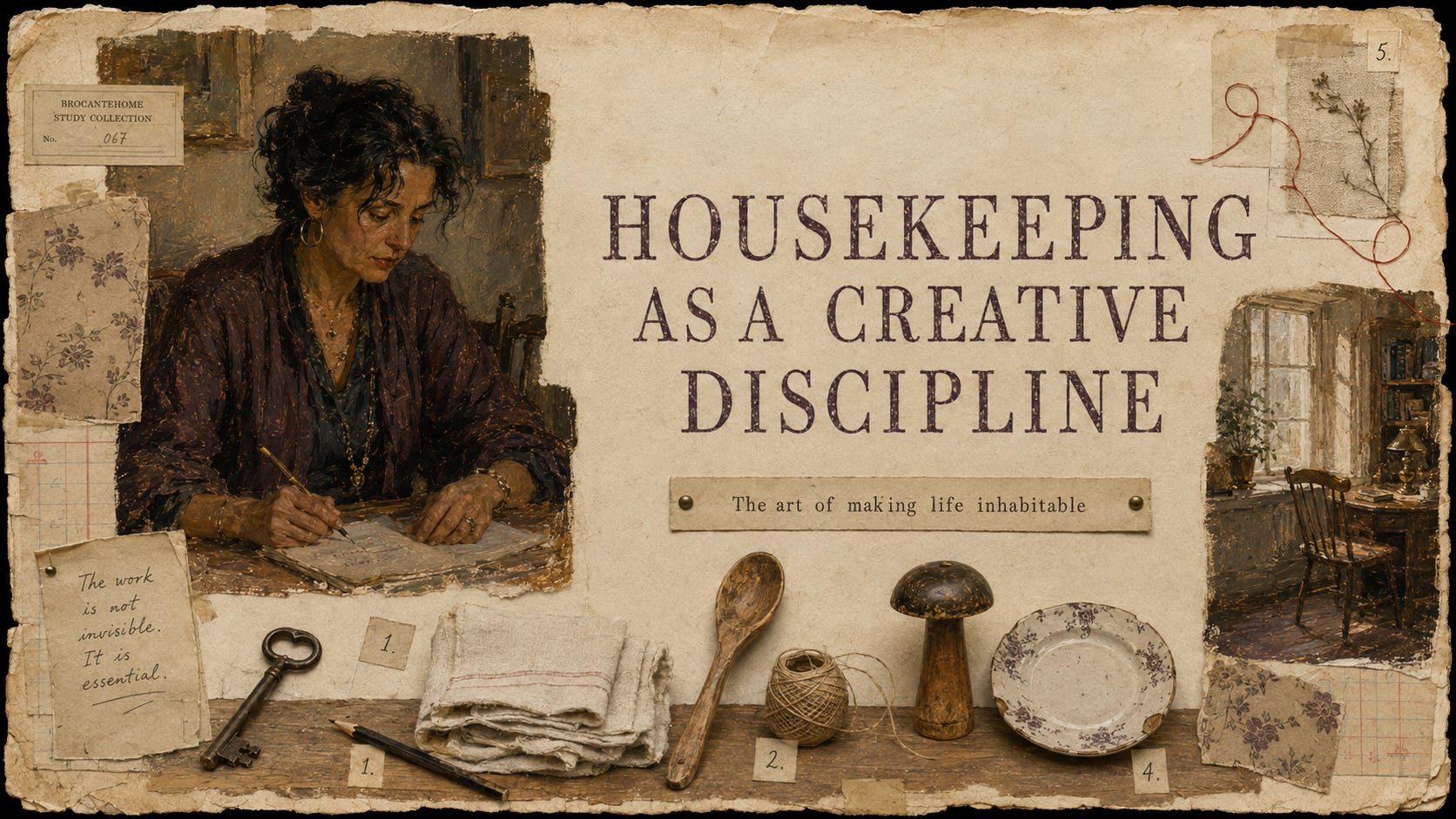
Housekeeping as creative discipline. The art of making a life worth inhabiting.
There it is. Put down the duster. Read the sentence again.
Housekeeping is the creative discipline of making a life worth inhabiting.
Not merely clean or organised into submission. This isn’t about decoration, or rooms destined for The World of Interiors.
Inhabitable: a life we can walk into and recognise as our own. Even at three in the morning. Even in the bad weeks. Even when the bin needs taking out and it’s raining sideways and there’s a cheese in the fridge strong and tempting enough to have us doing Nigella impressions at two in the morning.
And suddenly, oh suddenly, the doors fly open and every room in the house starts shouting at once. And for the first time in twenty-one years, I can hear what they’re all saying.
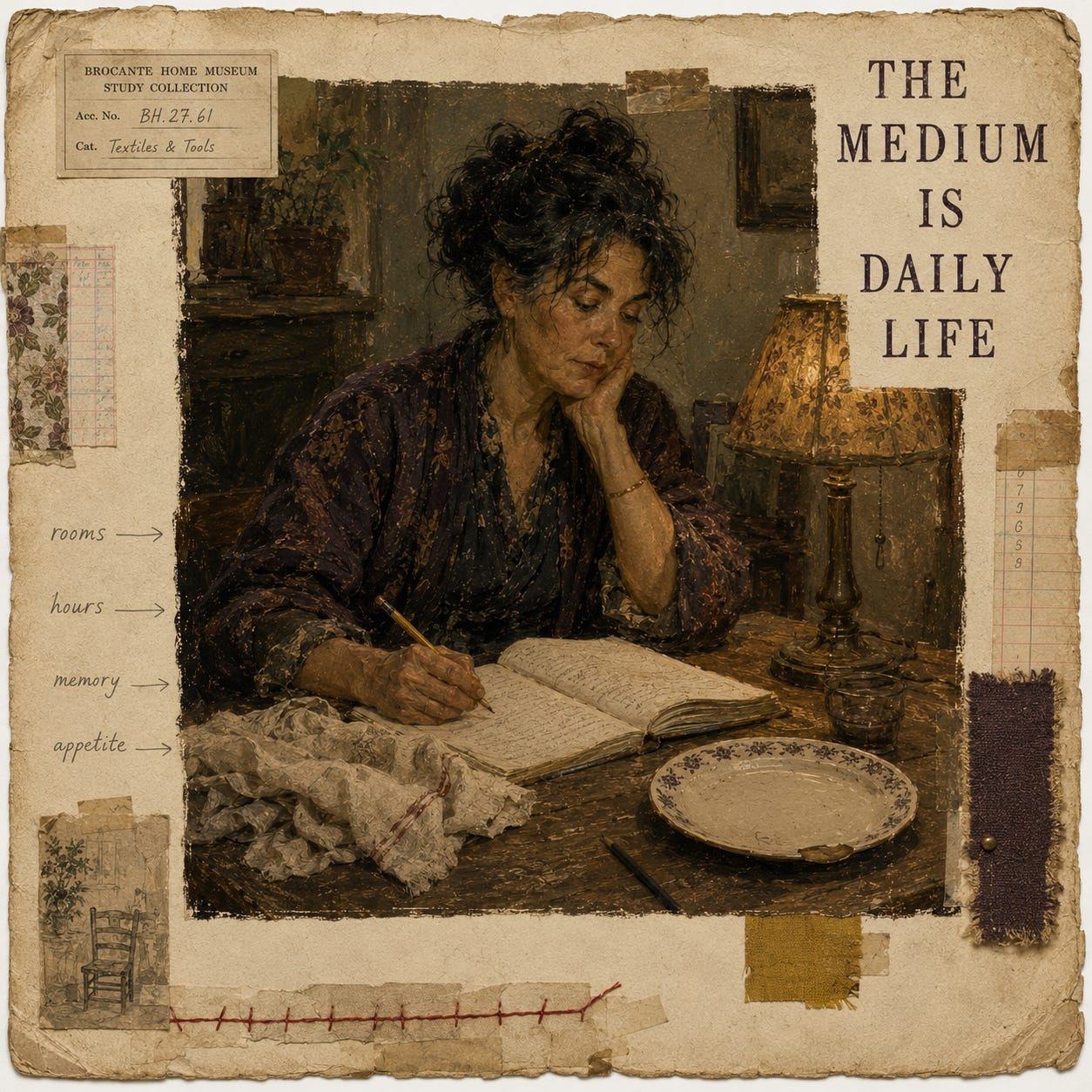
Every creative discipline has a medium.
The writer works with language. The painter works with pigment and light. The gardener works with soil, weather, growth and death. (Mostly death, if we’re honest). The musician works with sound and the charged silence around it. The cook works with appetite and transformation. The dressmaker works with cloth and the inconvenient, magnificent fact of the human body.
The housekeeper works with daily life.
Her materials are rooms and hours. Light at four in the afternoon, which is a different substance entirely from light at ten in the morning, and she knows the difference in her wrists. Money. Mud. Towels. Memory. Other people’s shoes, which breed by the front door in the night. The objects we inherit and can’t look at and can’t part with. The things we buy at midnight because for eleven giddy minutes we genuinely believe a fluted glass storage jar will turn us into a calmer woman with a marriage we arre committed to in both heart and head.
She works with flour and fatigue. With family mythology and floorboards. With grief and Sellotape. With neurodivergence, leftovers, lust, lists, and the mysterious smell under the sink that nobody else can smell, and everybody else is lying, and one day it will be found, and it will probably turn out to be related to the Blacksticks Blue.
She works with what’s there. What’s actually there. Not what the magazine insists SHOULD be there.
And this matters, because creativity has been sold to us as the act of producing something new. A novel. A painting. A ceramic lemon squeezer shaped like Frida Kahlo, forgive us all. We worship the moment of invention and look away, pointedly, fingers in ears, from everything that keeps the invented thing alive. We applaud the opening night and completely ignore the woman who unlocks the theatre the next morning, sweeps up the programmes, wipes the sticky off the seats and replaces the toilet roll. Without whom there’s no second night. No run. No theatre. Just a locked building slowly filling with spilled popcorn.
We’ve confused creativity with novelty.
Centuries of philosophy and this is where we landed. Honestly.
Housekeeping offers another model entirely, and it’s been offering it, patiently, at volume, for all of human history. Preservation can be creative. Repetition can hold imagination the way a bowl holds broth. Repair can be authorship. Setting a room back in order after life has happened in it isn’t evidence that nothing was achieved. It’s evidence the room was lived in. Gloriously. Probably with tequila and a woman screeching I WIll Survive at the top of her lungs.
A song isn’t pointless because it ends.
A meal isn’t a failed sculpture because somebody eats it.
A clean floor isn’t a foolish investment because a spaniel is at this very moment dragging half the canal across it.
Transience is part of the form. Ask any baker. Ask any florist. Ask anybody who’s ever iced a birthday cake for a five-year-old and watched three hours of work demolished in nine minutes flat, and been glad.
Glad in her bones.
A creative activity becomes a discipline through return. Through going back. Through turning up again, weary. and determined, and beginning.
The pianist plays her scales. The dancer goes back to the barre. The writer writes another sentence after yesterday’s marvellous sentence flatly refused to write today’s for her. The diva.
Housekeeping has always contained this discipline, but repetition has been used as a stick to beat it with. You’ll only have to do it again tomorrow, they say. Triumphantly. As if they’ve caught the whole enterprise out. As if this reveals the stupidity of washing a cup, rather than the cathedral-sized fact that life continues to require cups. That we’re still here. Still thirsty. Still handing each other hot drinks across kitchens as an act of love.
Yes, it’ll need doing again tomorrow.
That’s tomorrow’s work. Do mind your own business, and take your domestic resentment elsewhere. Repetition is zen and you me darling are not.
There’s no such thing as a finished house. There are only houses between events. Before breakfast. After the bath. During the flu. Five minutes before everybody arrives. And three days after Christmas, in that strange loose week when nobody knows what day it is, the cheese has reached a stage best described as assertive, and we’re eating chutney with everything.
Housekeeping is the rhythm of return. We come back to the bed, the table, the body, the budget, the neglected corner, the promise we made to ourselves in the dark and hoped nobody heard. And because we aren’t machines, because the day is never quite the same and neither, thank heavens, are we, every single return requires judgement. Fresh judgement. Judgement with the price still on it.
Which is where discipline parts company with routine. They were never really friends anyway. Routine repeats an action. Discipline deepens a relationship.
You can make a bed for fifty years and still discover, aged fifty-four, that what you actually needed all along wasn’t tighter hospital corners but softer sheets, fewer pillows, a hot-water bottle waiting under the eiderdown like a small buried sun, and full unconditional permission to climb back in at two in the afternoon with Barbara Comyns and a violet creme and no intention whatsoever of explaining yourself.
Discipline isn’t punishment. Yes. Cross that idea out.
Discipline means making yourself do what a better woman would do.
No. Fetch the ink again.
Discipline is devotion practised often enough to grow clever.
Sometimes devotion looks like polishing silver until you can see your own raised eyebrow in it. Sometimes it looks like ordering chips because everybody’s exhausted and tonight love stinks of vinegar and comes wrapped in paper. Sometimes it’s filling the freezer against the future. Sometimes it’s admitting the elaborate freezer system has become aburial ground for unidentified slabs of meat, and grabbing a bin-bag to get rid of the lot.
The disciplined housekeeper doesn’t ask, what would the perfect woman do?
She asks, what does this life require now?
Then she wanders into another room to fetch something to write with.
Forgets why she’s there.
Finds an old photograph.
Cries a bit.
Ties a ribbon around a pile of letters for reasons she couldn’t defend in court.
Has a small argument with a drawer.
And eventually remembers that the pen was in her hand all along. Where it had been the entire time. Warm from her grip.
This too is practice. Congrats. You made it into the advanced class.
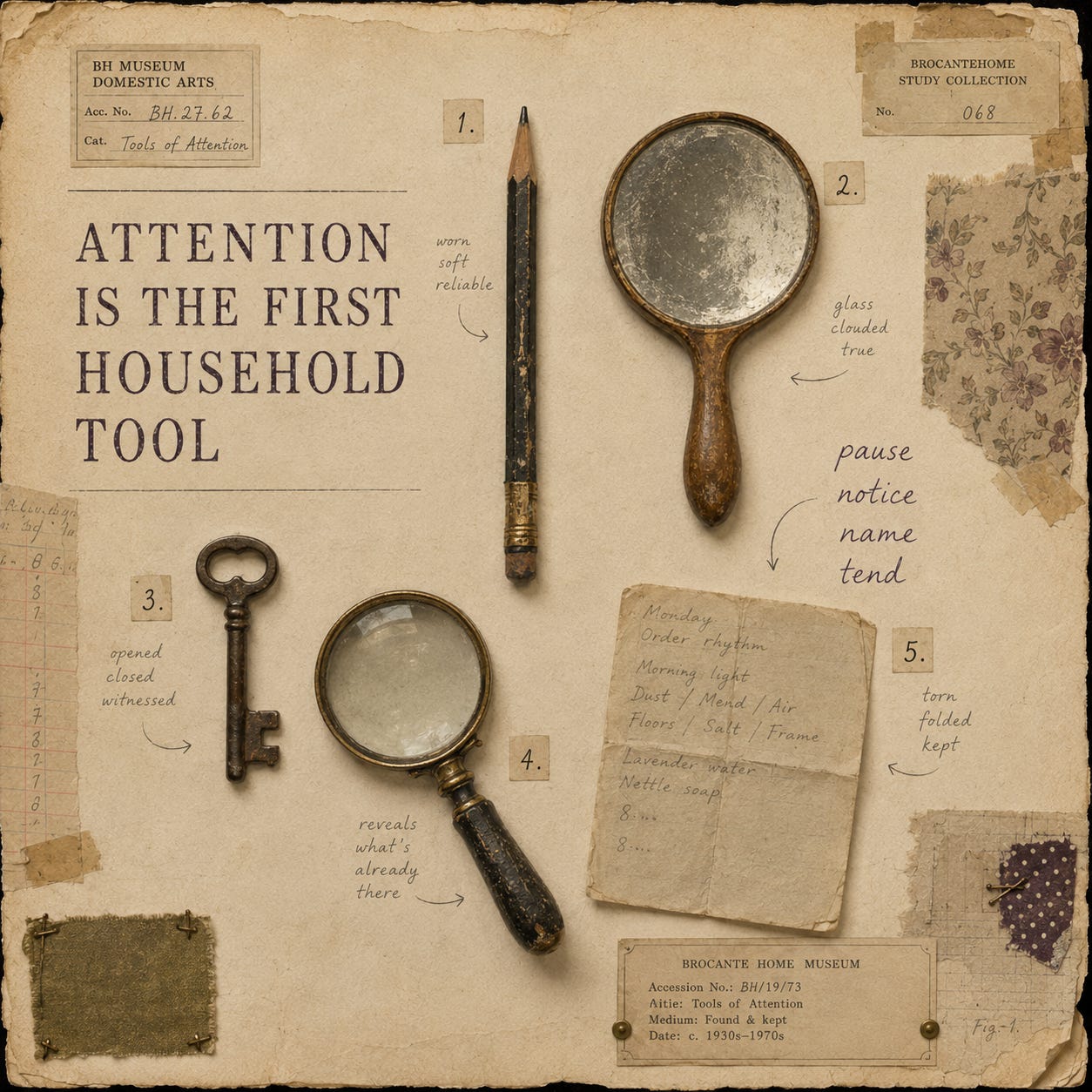
Before any creative person can make anything, she has to learn to notice. Not just glance. Notice.
The painter notices the blue hiding inside a shadow. The novelist hears the lie curled up inside the way somebody says fine. The gardener sees that one corner of the border is sulking and has been since June.
And the housekeeper, that unsung field naturalist of the domestic interior, notices E V E R Y T H I N G.
She notices that everyone has stopped sitting at the table and drifted off to eat in separate rooms like a family of hermits. That the bedroom is making her sad, and has been for months, quietly, the way a dripping tap makes you mad. That the hallway has become a physical record of every decision she’s postponed since March, an archaeological dig of good intentions, with a bag for the charity shop near the bottom that’s been “just going” for a year. That she keeps buying food for a fantasy self who marinates things midweek and owns a fish kettle, while her actual self stands stooped, eating toast over the sink like a heron in a dressing gown.
She notices the good towels have never been used. Not once. They’re being saved. For whom? For what visitation?
She notices there’s nowhere, in her entire house, to put her own bag.
She notices she’s holding her breath in her own kitchen. And has been, possibly, for years.
This is why housekeeping can’t be reduced to cleaning. Cleaning can be prescribed, delegated, bought. Attention can’t. No universal checklist on this green earth can tell you what a room means in the life being lived inside it. The same pile of books might be clutter in one house, a working library in another, and in mine, a load-bearing wall that also functions as a bedside table and, in emergencies, a step.
So the creative housekeeper begins with observation rather than accusation. Curiosity before the courtroom.
Pause. Notice. Name. Tend.
What’s happening here? What keeps happening here? What has this room quietly become while I wasn’t looking? Is this disorder or abundance? Grief or poor storage? A body without enough energy, or a family without enough time?
Because we’ve been trained, (oh how thoroughly we’ve been trained), to read every domestic difficulty as a personal failure. Particularly if the person failing is a woman. The drawer sticks because you lack discipline. The laundry’s behind because you haven’t optimised your morning, whatever that means, presumably it involves five a.m. and a smoothie the colour of pond. The house is cluttered because you’re emotionally defective and require a skip, a label-maker and a very expensive course taught by a woman whose countertops have never once, in their entire marble lives, met a charging cable.
But creative practice is curious before it’s cruel. It treats problems as information. The way a detective treats a footprint.
Perhaps the mess means there’s simply too much to maintain, and the answer is less, not more effort. Perhaps the room you consciously avoid has outlived its old purpose and is standing empty like a stage between plays. Maybe the chaotic mornings mean the household rhythm was designed for people with entirely different brains. Possibly for people who don’t exist at all??
And perhaps, perhaps, the neglected self means a woman has spent so long making life inhabitable for everybody else that she’s vanished clean off her own floor plan. And nobody’s noticed. Least of all her.
There. That last one.
Write it in the margin. Draw furious little stars around it.
To call housekeeping a creative discipline is to hand the housekeeper authorship. It’s about time somebody did. Here. Take it.
Not ownership in the estate-agent sense, mind. Plenty of women live in houses they don’t own, in rooms they can’t paint, with money that won’t stretch to the wallpaper they love and lie awake thinking about anyway. Some live in temporary accommodation. Some in houses arranged entirely around disability or care. Some among other people’s possessions, like polite ghosts. Some WITH ghosts. So creative discipline has to begin with actual materials, actual rooms, actual budgets, or it’s nothing but fantasy with a shopping list stapled to it.
Authorship means relationship, choice and interpretation. It means reading the house and then, crucially, talking back.
Because a house is never neutral. Walk through any front door and you can read the place like a novel: who sits where, what gets hidden when the doorbell goes, who has privacy and who has a corner of the kitchen table, whose work matters, what kind of life is expected to unfold there, and who wrote those expectations down, and when, and whether anybody’s checked them since the seventies.
A dining room can become an office. A box room can become a sanctuary with a lock on the door and a biscuit tin nobody else knows about. A kitchen can hold nourishment, exhaustion, conflict, inheritance, loneliness and burnt onions.
To keep house creatively is to read those meanings and then revise them. Ruthlessly. Tenderly. And by your own hand.
It’s to say: this room no longer serves the woman I’ve become, and I’ve become her, so the room neeeds to catch up, thank-you kindly.
This cupboard contains a fantasy that’s costing me actual money.
This tradition is lovely and shall remain. Protected. Funded. Beloved.
This tradition is unpaid theatre performed annually for relatives who criticise the potatoes, and it’s hereby abolished by royal decree. Effective immediately.
This chair belongs by the window because I do.
This then, is composition, but composition in motion. We place objects, establish rhythms, alter atmospheres, edit possessions, prepare for what’s coming. Then somebody gets flu or leaves home or comes home or enters menopause or buys an air fryer the size of a small wardrobe, and the whole composition has to change. And change again. Forever. Amen.
The house is NEVER the finished artwork.
The work is the evolving relationship between a woman and the life she keeps.
Because housekeeping isn’t only a creative discipline. It’s a political one, and anybody who tells you otherwise has never once wondered where clean socks come from.
You can’t speak seriously about domestic life without speaking about women’s labour. You can’t admire the gleaming table while politely declining to ask who cleared it, who remembered the milk, who noticed the child’s shoes were too small before the child did, who booked the appointment and the follow-up and the appointment to discuss the follow-up, who changed the sheets after the fever, who keeps every birthday in the family lodged in her head like shrapnel, and who lies awake at half past two conducting tomorrow like a frantic invisible orchestra that never, ever tunes up.
Here in the UK, women are still doing nearly an hour more unpaid work every day than men. That’s the Office for National Statistics saying so, not me being dramatic, though heaven knows I’m capable of both. A whole hour a day. Every day. For a lifetime. Do the sums and then go and stand quietly in the garden for a bit. And worldwide, women do roughly three quarters of all the unpaid care work there is. These aren’t antique grievances hauled out of a trunk smelling of mothballs. They’re current measurements. This morning’s facts.
The world is propped up by work it has carefully, deliberately, expensively trained itself not to see.
It calls that work natural when women do it and skilled when a man can invoice for it. It calls the woman at home lucky. It calls the woman cleaning another woman’s home unskilled, as if there were nothing to know. It calls the mother not working. To her face. At parties. It calls the carer economically inactive, which is a phrase I’d like taken outside and dealt with. It calls the utterly exhausted woman bad at self-care, and then it sells her a scented candle and tells her she’s empowered.
I’m tired of this language. Tired right down through my slippers and into the floorboards.
I’m tired of an economy that behaves as though workers arrive each morning spontaneously fed, clothed, soothed, raised and emotionally repaired by woodland creatures. By elves. Or Mary Poppins. By some unpaid backstage crew it has never once thought to name, though it would notice within the hour if they downed tools. Oh, hell yes, it would notice.
A man spends six hours perfecting sourdough and he’s an artisan. He gets a stall at the market and a profile in the weekend supplement. A woman feeds a family every day for twenty years, through fussy phases and grief and gluten discoveries and the year somebody would only eat beige, and she gets asked what she does.
And I’m tired, so tired, of the false choice between the idealised homemaker and the liberated woman. As if there were only the two costumes and we must pick one and be buried in it. As if liberation must be performed by hating aprons. As if loving home means handing in your power at the door like an umbrella.
I want the apron and the bank account. I want sanctuary and sovereignty. I want women free to love domestic life without being trapped inside it, free to reject domestic labour without being shamed for it, free to share it without having to issue instructions like a woman managing a particularly reluctant intern who claims not to know where the hoover lives. Paid for their paid work. Recognised for their unpaid work. And free, entirely free, to decide which forms of care belong in the lives they’re making.
Other women got here long before me, and I want their names in what is fast becoming a rant (sorry!).
In 1972, Selma James stood up at the Women’s Liberation conference in Manchester and demanded Wages for Housework, and I like to imagine the room going very quiet and then getting crazy loud. Housework, the movement insisted, wasn’t some innate female impulse floating up from our ovaries like scented steam. It was labour. And invisibility was the trick. The oldest trick in a very old book. Silvia Federici opened her famous pamphlet with the line that still stops me at the sink: “They say it is love. We say it is unwaged work.”
Say that one out loud. Roar it.
The women who built that movement, women of colour, disabled women, queer women, sex workers, single mothers, pushed the argument far beyond the tidy nuclear household and out into the whole world. The kitchen, it turned out, had a door that opened straight into the entire economy. It always had. Somebody had just hung a calendar over it.
So let this warning hang above the stove where the sampler used to:
Creative housekeeping must never become decorative propaganda for women’s servitude.
It mustn’t sprinkle rose petals over exploitation. It mustn’t ask an exhausted woman to regard scrubbing the lavatory as sacred feminine magic while everybody else watches television in the room she also cleaned. It mustn’t convert structural inequality into yet another personal development project with a workbook and a hashtag. Buy a better planner! Wake at five! Decant your despair into matching jars and label them in violet ink.
No. Even I got that one wrong, and I’m truly not to big to admit it.
If housekeeping is a creative discipline, then the housekeeper holds creative authority. All of it. Authority to set the standard. Authority to distribute the work, actually distribute it, not delegate-and-then-redo-it-at-midnight. Authority to refuse it altogether. Authority to decide a task doesn’t justify the life-hours it swallows. Authority to make something beautiful for the pure animal pleasure of it, and equal authority to serve fish fingers on paper plates when beauty would be a burden, and to feel, while doing so, absolutely magnificent.
Feminism doesn’t require us to despise the domestic. It requires us to ask who’s free inside it.
Keep asking. Ask it at dinner. Ask it until somebody passes you the answer along with the salt.
In 1969, an artist called Mierle Laderman Ukeles became a mother and discovered that the art world could imagine the heroic male genius, splattered and important, far more easily than it could imagine an artist changing nappies. The art world, in other words, had a very small imagination and a very large opinion of itself.
So she sat down, furious and brilliant, and wrote a manifesto declaring washing, cleaning, cooking, renewing and preserving to be the substance of an art practice. Not the interruption of one. The substance. Later she went out and shook hands with thousands of New York sanitation workers, every single one, and called it art. Because it was.
I am an artist. I am a woman. I am a wife. I am a mother (random order). I do a hell of a lot of washing, cleaning, cooking, renewing, supporting, preserving, etc. Also, (up to now separately) I “do” Art. Now, I will simply do these maintenance everyday things, and flush them up to consciousness, exhibit them, as Art. I will live in the museum as I customarily do at home with my husband and my baby (right, or if you don’t want me around at night I would come in every day) for the duration of the exhibition, and do all these things as public Art activities: I will sweep and wax the floors, dust everything, wash the walls (i.e. “floor paintings, dust works, soapsculpture, wall-paintings”), cook, invite people to eat, clean up, put away, change light bulbs. I might save and make agglomerations and dispositions of all functional refuse. The exhibition area might look “empty” of art, but it will be maintained in full public view. My working will be the work.
(Read that, and tell me it doesn’t make you want to cry. And cheer. And cry again.)
Her great question still lands like a dropped saucepan in a silent house:
“After the revolution, who’s going to pick up the garbage on Monday morning?”
The revolution loves a banner. Monday morning loves a bin bag. Somebody has to hold both.
Development, the creative act itself, gets to be exciting: invention, progress, the ribbon, the scissors, the photograph. But maintenance is the work of keeping people, objects and entire cities alive after the ribbon’s been cut and the dignitaries have gone home to houses somebody else keeps. Our culture rewards the first and hides the second, and Ukeles hauled the hidden work into the gallery lights and refused, arms folded, the insult that she saw as treating necessity as the enemy of creativity.
I’d have her manifesto read aloud in schools.
BrocanteHome belongs in this conversation, though it turns up carrying something smaller and warmer.
I’m not proposing that every emptied dishwasher be exhibited at the Tate. Though if the Tate would like to discuss funding, I’m available on alternate Thursdays and my rates are reasonable.
I’m proposing that the intelligence spent keeping daily life going has creative value. Real value. The kind you could weigh! That the home is one of the great unacknowledged studios of the world, where human beings practise composition, preservation, improvisation, ritual and care, daily, for decades, unpaid and largely unphotographed.
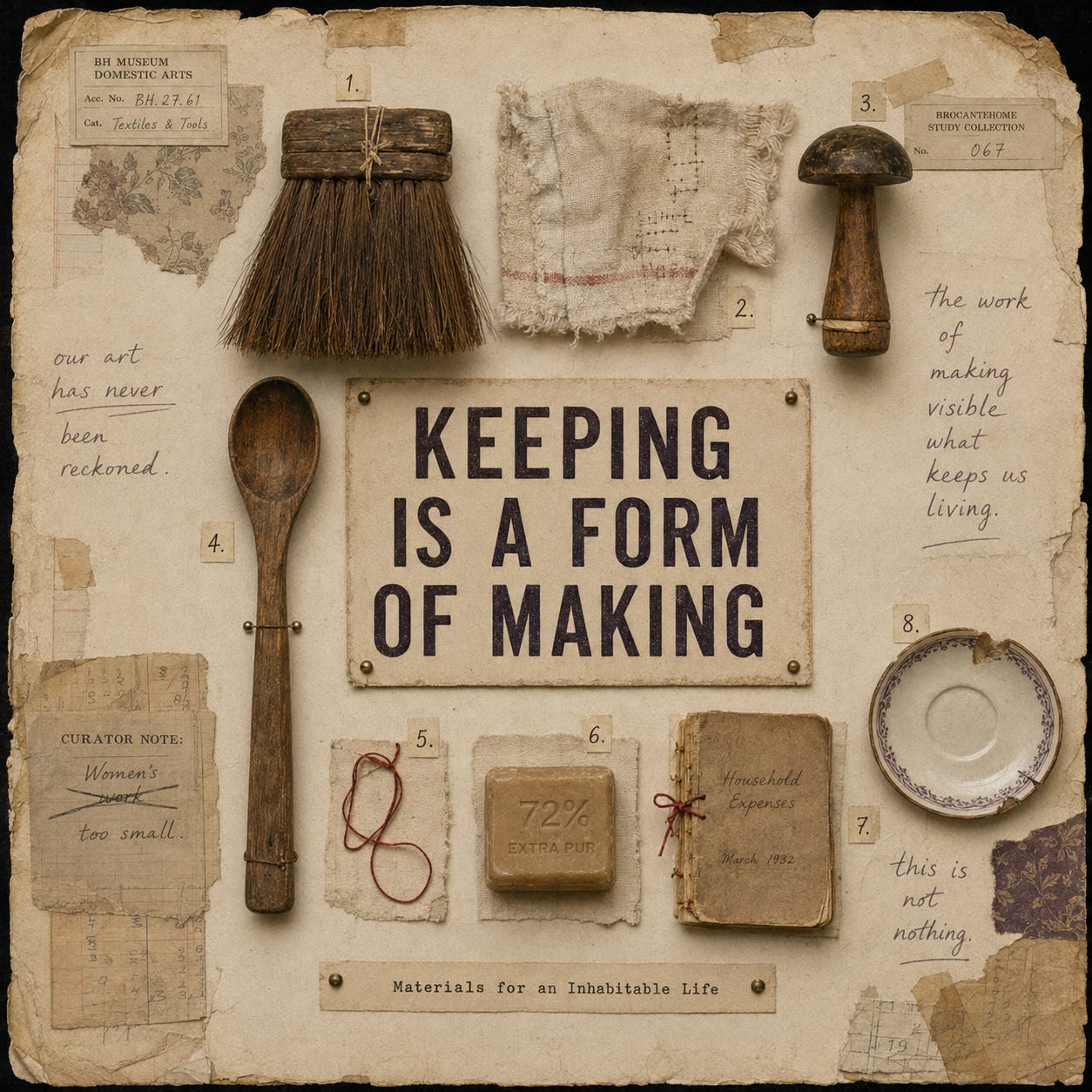
I’m proposing that (house) keeping is a form of making.
Lean in, because the distinction matters. Making is culturally glamorous. Keeping is quiet. Making produces the object; keeping preserves the conditions in which objects and people endure. Making gets the photograph. Keeping dusts the frame, remembers why the photograph matters, knows who everybody in it was, and wraps it in a tea towel when the family moves. And unwraps it first in the new house. Before the kettle. Before anything.
The world desperately needs new things. It also desperately needs people willing to care for what already exists, and it should say so out loud. With flowers on a Friday, if you please?
Our homes know this. The planet knows this. And our bodies certainly know it, particularly at fifty-four, when they’ve started ringig increasingly specific alarm bells.
Ursula K. Le Guin. I come back to her in my work a lot because she spoke for all of us.
Once she suggested that the first human tool might not have been a weapon at all. Perhaps civilisation didn’t begin with a spear thrust heroically into the world by a man who then expected dinner. Perhaps it began with a container. Something for gathering. Carrying. Bringing things home. She called it “the tool that brings energy home”, and I wrote it down and turned it over and over.
Because women have always known the significance of a bag. We’ve been trying to tell you why what we carry, and more pertinently, how we carry it matters.
A bag, a basket, an apron pocket, a drawer full of string too short to use and too long to throw away, a biscuit tin containing buttons and one mysterious key, and a commonplace book containing everything else. Domestic culture is stuffed to the gunwales with containers, because keeping requires somewhere for the kept things to go. We gather fragments. We carry knowledge. We preserve what might be needed later, and we’re right about it roughly once a decade, and that once justifies everything. We understand the civilisation-saving importance of a small plastic bag full of other small plastic bags, even if aesthetically we’d prefer a French market basket and morally we’re trying very hard to stop acquiring the bags in the first place. And failing. And forgiving ourselves. And acquiring more, because somebody stop us.
The BrocanteHome commonplace book is a carrier bag for a woman’s mind.
Into it go recipes, quotations, complaints, sketches, overheard sentences, paint colours, medical questions, menus, desires, evidence, grudges lovingly pressed like flowers, women we want to remember, and the name of the book we absolutely must read, which we then fail forever to identify because we wrote only “blue one?? woman on train perhaps murder.”
This gathering isn’t clutter, whatever anybody says while looking over your shoulder.
It’s studio practice.
Artists keep sketchbooks. Gardeners keep records. Scientists keep field notes, and nobody asks the scientists to apologise. And women have kept household books for centuries: accounts, remedies, recipes, births, deaths, weather, the whole deep knowledge of a place and a family written down between interruptions. In snatched minutes. In pencil. At tables that needed wiping.
The mind at the kitchen table is still a mind. I want to write that again: The mind at the kitchen table is still a mind.
The notes made between interruptions are still thought. A woman’s record of daily life isn’t trivial just because daily life was assigned to women without consultation and then marked down for being feminine.
Quite the reverse. The reverse with bells on.
The everyday is where history takes its coat off and shows you what it’s really been wearing all along. And it isn’t always pretty. But it’s always the truth ad the truth, even in a society made complex by. smoke and mirrors, still matters.
Feminism, though, has excellent reasons to be suspicious of the home, and we’re going to sit with every one of them. No fidgeting.
For many women home has been a workplace without wages. A site of violence. A place of confinement dressed up as a haven. Privacy conceals cruelty as easily as it protects intimacy, and the net curtain works both ways. And the sentimental home, the one on the biscuit tin, has so often been built on somebody else’s labour: the servant, the enslaved woman, the cleaner, the badly paid migrant worker, the daughter expected to care because she was the daughter, the poorer woman quietly absorbing the work that lets a richer woman “have it all.” Any serious discipline of housekeeping has to look directly at class, race, disability and power. And keep looking. And not flinch. And not change the subject to cushions.
But abandoning the home as a subject doesn’t liberate the people still living and working there. It just leaves them alone in it.
bell hooks wrote about the homeplace Black women made under the daily grinding violence of white supremacy: a place where people could be restored to their own humanity, built with soup and clean sheets and locked doors and love. Home wasn’t outside politics. Making it was political work of the first order. A room can be used to confine you. A room can also be made into somewhere the dominant world doesn’t get to define you. Doesn’t even get in.
Because I need you to know this: home isn’t automatically sanctuary. Sanctuary is made, with hands, and sometimes it can’t be made without money, safety, privacy and other people’s help, and pretending otherwise is cruel. A candle can’t fix damp. A ritual can’t redistribute labour. A pretty notebook can’t treat depression. Lavender water has many virtues, I’ve catalogued them personally, but it has so far proved bitterly disappointing against capitalism. And I say that as a woman with three bottles of it.
And yet and yet and yet…
I won’t surrender the emotional, imaginative power of home just because it’s been misused against us. That’s exactly the sort of surrender they’d enjoy.
I know what it is to need the house to hold me. I know the stabilising weight of one familiar mug when everything else has become unrecognisable. The way your hand goes to it in the cupboard without looking. I know that putting clean sheets on the bed can be both an ordinary task and a declaration, witnessed by nobody, that tonight I will be cared for, even when the person doing the caring is also the person whose mascara is halfway down her face. I know the tenderness of keeping a child’s strange little treasure, a stone, a bent badge, a terrible clay something, long after the child has become a man with a beard. And I know the peculiar resurrection contained in dragging a chair towards the light.
Home isn’t where life ends. Whatever they told our mothers.
It’s where life gets to begin again. Daily, if necessary. Hourly, in the bad patches.
That has always been the radical hope inside BrocanteHome. Hiding in plain sight among the ribbons. I hope you have always been able to see that?
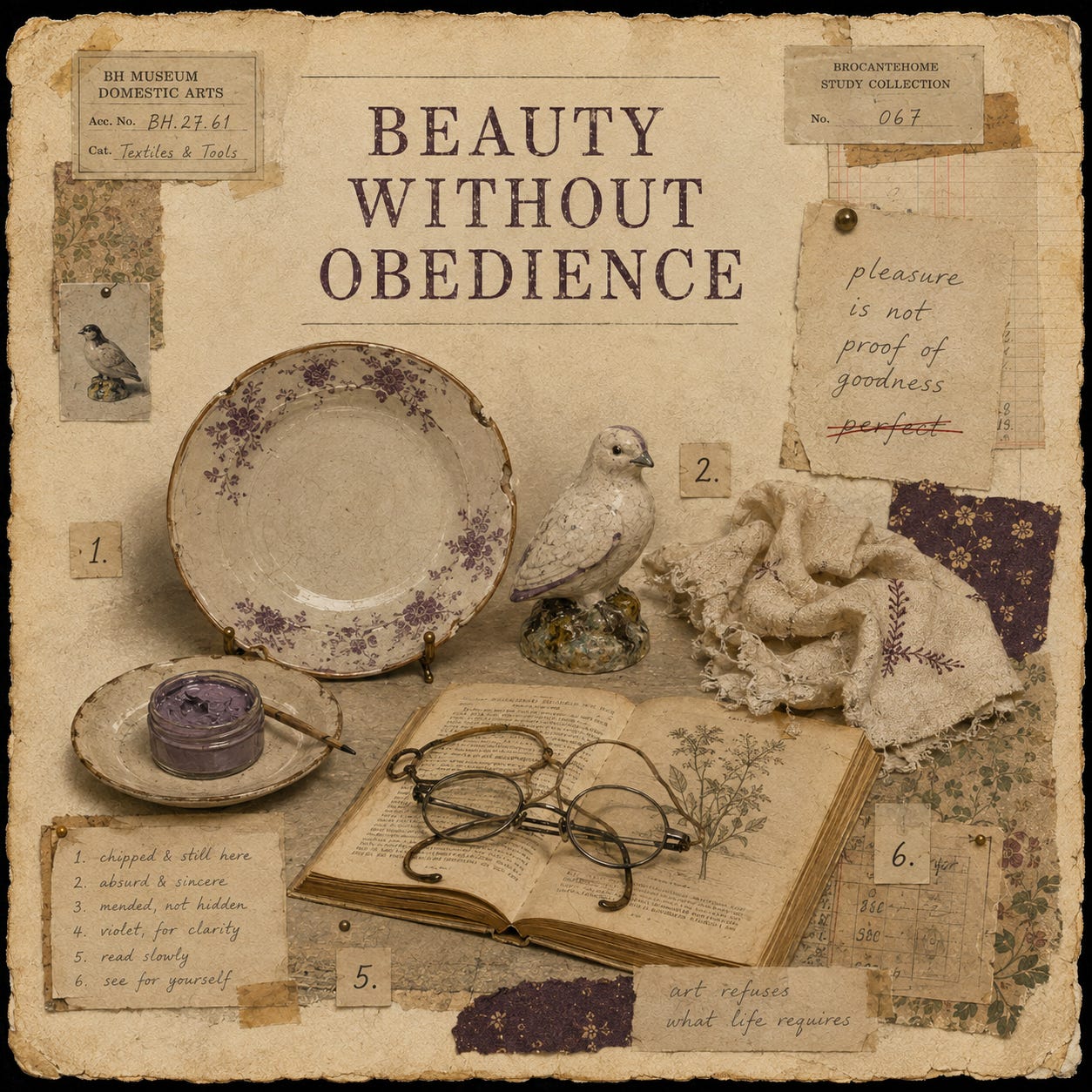
I believe in beauty. I really do.
I like faded florals. Ribbons. Old paper. The glow of a lamp switched on in the middle of the day, which feels like getting away with something. Trays. Tiny bowls that hold nothing and mean everything. Books with deckled edges. Objects whose practical purpose left the building years ago and never wrote, and who are welcome here anyway. This is that kind of house. I believe a violet creme eaten from a saucer can improve an afternoon well beyond anything the available evidence would suggest. I believe a proper cheese, the kind that announces itself from the hall, belongs on a proper board with a proper knife, and that this is not fuss. It is civilisation.
But beauty turns dangerous the moment it’s converted into obedience. Watch for the moment. It’s quick.
The beautifully kept home has too often been entered as evidence of the beautifully disciplined woman. Her morality measured in shine. Her love measured in visible effort. Her worth staged for visitors and then judged in whispers on the doorstep afterwards. And don’t pretend you haven’t heard the whispering. We’ve all heard the whispering. Some of us have done the whispering, and are very sorry.
Creative housekeeping refuses this trial entirely. Case dismissed.
Art isn’t always beautiful, and beauty shouldn’t be a standard we maintain to prove our goodness. It’s a material we use, like flour, like paint, like light. A room might need beauty. But maybe it needs warmth, accessibility, privacy, storage, noise, darkness, laughter, or nothing more elaborate than one surface cleared enough to put down a mug more and knowing which is the entire art.
Good judgement matters more than good taste. Embroider that on something. Hang it crooked.
Ask what the beauty is doing. Working questions. Tradesman’s questions. Does it welcome? Console? Stir something low down? Mark a season? Express a private eccentricity nobody else needs to understand or even see? Or is it just another object to dust, another small daily audit, another reminder that she has once again failed to become the woman who arranges figs?
We’re allowed to edit the figs. We’re allowed to keep the ridiculous china bird.
This is beauty with its corset flung over the banister. Beauty laughing in the pantry with flour on its nose. Beauty that forgot to plump the cushions because the book got good. Beauty with dog hair on its skirt and ink on its fingers and no explanation prepared.
Beauty as nourishment. Never examination.
Every discipline develops a practice, a language and a body of knowledge. Creative housekeeping is no exception.
It doesn’t become serious by having its whimsy surgically removed. It becomes serious when we recognise the intelligence inside the whimsy, the engineering inside the enchantment, and give ourselves ways of growing it.
First, attention: ALWAYS attention. Attention before breakfast.
Then interpretation: What does this house, this room, this repeated maddening irritation tell me about the life actually being lived here? As opposed to the life on the mood board….
Then imagination: What else might be possible, with the materials I actually have, the money I actually have, the energy I actually have?
Then tending: One intervention, small as a stamp. Move the chair. Change the lamp. Cook twice as much and freeze half, and label it this time, we’ve discussed this. Put the medicine beside the kettle. Abolish the ironing, yes, all of it, I’ll sign the paperwork. Ask somebody else to clean the bathroom, and then withstand, white-knuckled if necessary, the thrilling discomfort of not supervising.
Then living with the change long enough to learn from it: Which is longer than a week. I’m sorry. I don’t make the rules. Actually I do round here don’t I, so trust me, it’s longer than a week.
Then revision.
Then writing down what we’ve learned before we forget it: Which we will, by Sunday.
But even as I set this out in a tidy row I want to scribble arrows all over it, because the method isn’t a staircase. It never was. It refuses the upwardly mobile. It’s a kitchen dance. We notice while tending. We imagine while furious. We revise before we’ve begun. We forget what we learned last February and rediscover it in October, underneath a supermarket receipt, and greet it like an old friend, and lose it again by spring.
So perhaps it’s simply this:
pause, notice, name, tend
and again
with more kindness this time.
Technique belongs here too, and don’t let anybody with clean hands tell you otherwise. Stain removal. Soup, both the making and the strategic deployment of. Budgeting. Mending. Lighting, the most underrated art in domestic life. How to air a room. How to welcome a guest. How to feed yourself when appetite has gone peculiar. How to keep a cheese at its correct and lawful distance from the butter. How to recognise the exact moment an object passes beyond reasonable devotion into hostage situation.
Domestic knowledge is real knowledge. Tested harder than most laboratory findings and cited less. Some of it was passed hand to hand between women at sinks and gravesides. Some was written in household manuals with astonishing confidence. Some got lost. Some deserves careful, grateful recovery. And some deserves a ceremonial burning at the bottom of the garden with drinks afterwards and a short speech about how far we’ve come.
We’ll examine all of it. Everything gets weighed.
Vintage housekeeping was never about moving backwards. It never once was.
It was about rummaging intelligently. Elbow deep. Sleeves rolled. Torch between the teeth.
RUMMAGE.
When I look back now, from here, from the twenty-first year, I can see that BrocanteHome has been circling this one discipline the entire time. Like a dog turning round and round and round before it finally, finally lies down with an enormous sigh.
The rituals were studies in meaning.
The routines were studies in return.
The puttery treats were tiny acts of domestic composition. Five-finger exercises for the housekeeping soul.
The seasonal work treated time itself as a household material. Something you could fold, air, and put away sweetened.
The Housekeeper’s Diary recorded the practitioner inside the practice. Frequently mid-crisis. Frequently losing her keys. On too many occasions, almost, losing her mind. Bless her silly heart.
The archives aren’t old content. They’re the collected notebooks of a woman thinking her way through domestic life across two decades of motherhood, loss, reinvention, financial strain, love, neurodivergence and the persistent, unrepentant acquisition of books.
The Commonplace Book is our studio notebook.
The Household Ledger is where imagination sits down, at last, with money, food, time and whatever energy’s actually left in the tin.
The Still Room holds the material knowledge: salt, wax, oil, cloth, herbs, scent, folklore, and the gentle chemistry of tending things that reward tending.
The Edited Woman practises selection. The bravest domestic art. What comes in? What stays? What am I keeping because it serves my life, and what am I maintaining because an imaginary woman in my head, and she has a clipboard, holds very strong views about matching storage?
The Brocante Way becomes the method.
The Library becomes the studio.
And Betty, part housekeeper, part high priestess of sanctuary, part magnificently unbamboozled woman with her spectacles on a chain and her sleeves already rolled, becomes the tutor who looks at you over those spectacles for exactly as long as it takes, and then asks whether this is truly a cleaning problem, sweetheart, or whether you’re trying to dust your way out of dreadful relationship.
She’ll wait. She has all day. She’s seen everything.
It all belongs. It has always belonged. I just hadn’t found the corridor.
I thought I was making a great many separate things, because my ADHD mind runs ahead of me scattering projects like a flower girl at a wedding. But perhaps I’ve been building one thing all along: a body of work about the imaginative keeping of a life.
Not a content empire. I’m the world’s worst influencer. A school of thought.
Not a perfect system. A living discipline. Breathing. Shedding. Occasionally knocking things over.
Not seventeen unrelated Circle spaces, so Alison, step away from the “create new space” button, and put your hands where the community can see them.
One house. Many rooms. And at long last, a corridor between them all.
This is what matters most:
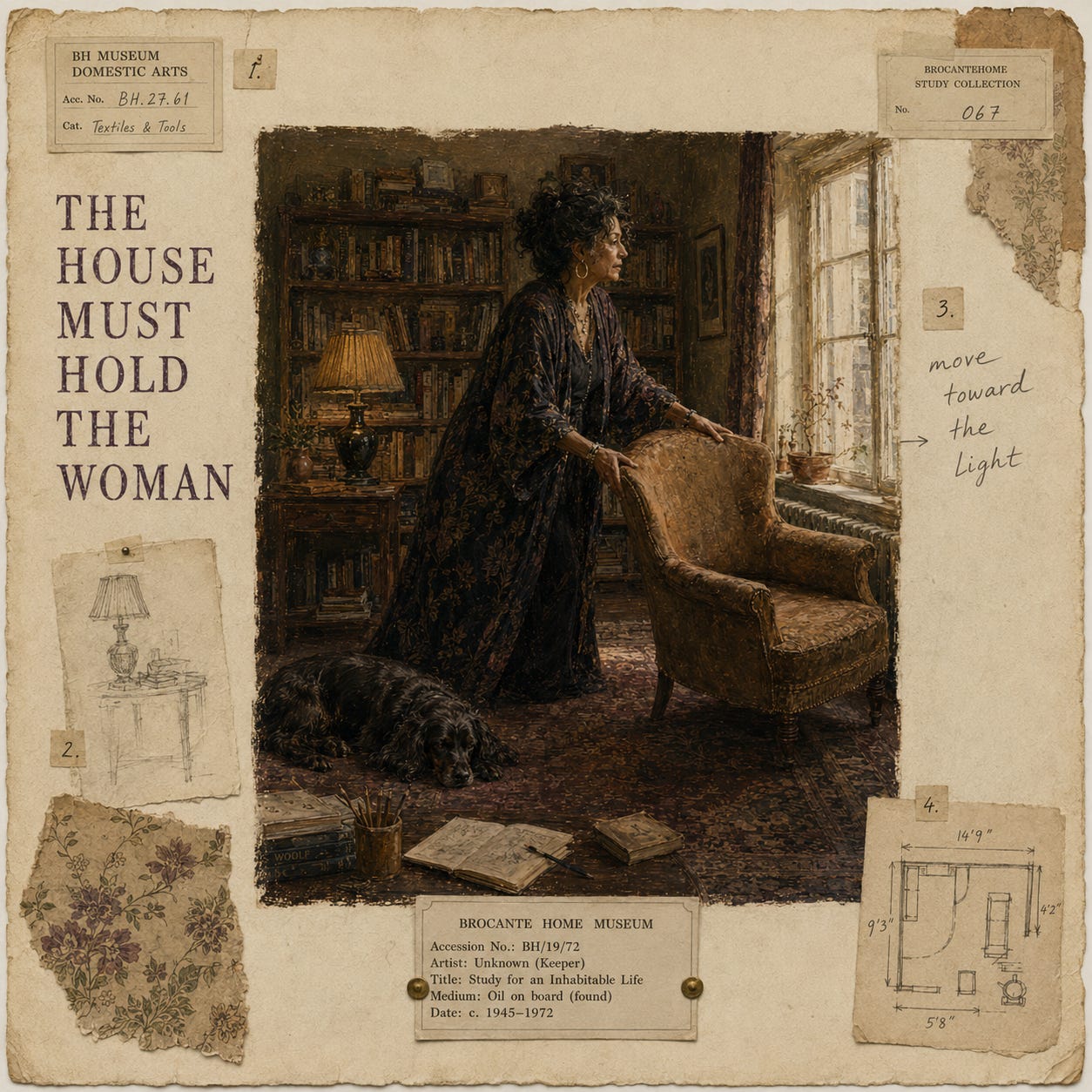
The woman doesn’t exist to maintain the house. The house must be kept in ways that help maintain the woman.
Shall we pop that in capitals and shout it from the rooftops?
THE WOMAN DOESN’T EXIST TO MAINTAIN THE HOUSE. THE HOUSE MUST BE KEPT IN WAYS THAT HELP MAINTAIN THE WOMAN.
If a housekeeping practice repeatedly empties the housekeeper, it goes on trial. If a standard consumes more life than it supports, it’s a bad standard, and out it goes with the recycling. No last words. If a ritual delights only the people watching while exhausting the person performing it, then it’s theatre, and the cast should renegotiate their contracts before the next matinee. Or bring the curtain down entirely.
None of which means we never do tiring or unpleasant things. Care contains effort. Always has. Love frequently involves cleaning something we’d rather not inspect at close range, and doing it anyway, breathing through the mouth.
But the work has to serve a larger intention: nourishment, dignity, welcome, continuity, beauty, rest. We should know what we’re serving and why, and be able to say so out loud without our voices going strange. And the housekeeper herself must be counted among those served. First, on alternate days.
Her body belongs in the household ecology. Not as staff. Her sensory needs matter. Her work needs a room of its own, or at the very least a corner with a decent lamp and a door that shuts. Her rest is not what happens once every other requirement has been met, because as every woman alive knows, every other requirement wil never, ever be met.
And all of this becomes urgent at midlife.
The arrangements that carried us through one life may not carry us through the next. Children grow. Relationships alter. Parents need care. Bodies change their terms and conditions without so much as a consultation period. Hormones rewire the whole household overnight and don’t label the fuse box. The woman who could once clean the entire house in a morning may no longer wish to, and here’s the greater revelation, the one that takes decades: she never owed anybody that morning in the first place. Not one of those mornings. They were hers all along. An entire stolen archive of mornings.
Midlife housekeeping is revision. Glorious, ruthless, line-by-line revision!
We look again at the rooms and roles we inherited. We ask what still fits. Actually fits. Not fits-if-she-breathes-in. We stop maintaining identities whose occupants moved out years ago and left no forwarding address. We make space, real square footage, for intellectual life, pleasure, solitude, friendship, work, eroticism, rest, eccentricity, and whichever self has been knocking from inside the airing cupboard for the past thirty years. Patient as a saint and twice as cross.
Open the door.
She’s furious and she’s magnificent.
Let this be formally recorded, witnessed, stamped, and read aloud at the next available solstice.
The creative housekeeper is not a domestic goddess. I knew it then and I’m doubling down on it now.
Goddesses are decorative, exhausting and rarely shown taking the bins out in the rain with a anorak over their nightie. The domestic goddess is just another impossible woman, focus-grouped into existence to make actual women feel vaguely sticky. She cooks from instinct. She cleans as she goes, whatever that means. She resents nobody, needs nothing, and owns both a waist and a utility room.
We’re finished with her. She can see herself out. She can take the fig-arranging woman with her. They can share a taxi.
The creative housekeeper is a practitioner, and practitioners get to be human and take days off when the muse has taken herself on holiday. She’s allowed to be a beginner at fifty. She’s allowed to develop dazzling strengths and remain gloriously, permanently hopeless at other parts of the work. A great novelist may be unable to draw so much as a convincing cat. A brilliant cook may dress from the floor. A woman may compose rooms of such emotional intelligence that guests feel held the moment they cross the threshold, and still fail to return phone calls or understand a single one of the washing machine symbols. Which were, let’s be honest, designed by somebody who hates us and lives far away.
Discipline doesn’t demand mastery of everything. Only devotion to something. It asks for attention, curiosity and a willingness to revise.
Nor does it belong only to women. Housekeeping is human work. Men, children, friends, lovers, communities and entire institutions all take part in creating or wrecking the conditions of everyday life, and they can jolly well take part on purpose. Feminism isn’t out to crown women the superior natural keepers of everybody. We’ve had quite enough coronation. It’s time to end the arrangement in which women are assigned the work, denied its value, and then blamed, personally, by name, for its failures.
A creative discipline can be shared. Taught. Practised in every kind of household there is, in every configuration love comes in. It lets us negotiate standards out loud, at the table, instead of inheriting them in silence. It turns “helping her” into taking responsibility for the life one also, conveniently, happens to inhabit and eat in and sleep in and shed socks throughout.
The house doesn’t belong to the person who notices the dirt first.
I’m claiming housekeeping as a field of creative intelligence. Out loud. In daylight. With my name on it.
I’m claiming maintenance, atmosphere, preservation, rhythm, domestic memory, material knowledge and ordinary beauty as subjects worthy of serious thought.
I’m claiming the right to be sentimental about a chipped tumbler and political about who washes it. In the same breath.
I’m claiming the kitchen table as a thinking place. One of the great ones.
I’m claiming the commonplace book as an intellectual tool.
I’m claiming the seasonal ritual as an act of attention.
I’m claiming the drawer of string
the emergency supper
the lamp switched on before dusk
the budget rewritten
the sheet changed after grief
the room reclaimed
the standard lowered
the standard raised
the thing mended
the thing finally, blessedly thrown away
the cheese, entire and unrepentant
the door closed
and the woman inside it allowed, at last, to rest.
I’m claiming all of this while refusing, absolutely and forever, to romanticise the burden. I won’t call exploitation sacred. I won’t confuse cleanliness with goodness. I won’t make a religion of exhaustion. And I will not, not while there’s breath in me, hand women a prettier whip. No more of that. No more.
I’m also claiming joy. Loudly. Because joy gets called frivolous whenever women find it somewhere that doesn’t generate sufficient profit for somebody else.
There’s joy in a well-made bed. Joy in knowing how to care for old wood, how it drinks the oil. Joy in a stew, stewing and waiting for tomorrow like money in the bank. In the first fire of autumn. The clean window. The car boot saucer under the pot. The note tucked in a lunchbox and found years later in a coat. The shelf arranged like a private poem nobody else will ever scan.
These things don’t solve the world. They’re among the reasons the world is worth solving.
Creative disciplines are never completed. Nobody finishes writing and receives a certificate confirming there are no more sentences. Nobody completes gardening. There’s always bindweed. Bindweed will attend the overheated death of the universe and still find something to climb.
So there’s no final state called A Properly Kept Life. I’ve looked everywhere for it and it doesn’t exist no matter what social media optics might be saying.
There’s only practice.
So begin with the actual house. The ugly one. The rented one. The unfinished one. The house containing too much, or too little, or people who leave wet towels in a heap as avant-garde comment on shared responsibility. People who apparently, don’t give a damn.
Begin with the actual body. Its energy. Its fear. Its appetite.
Begin with the money there is. Not the money in the fantasy. The money in the tin.
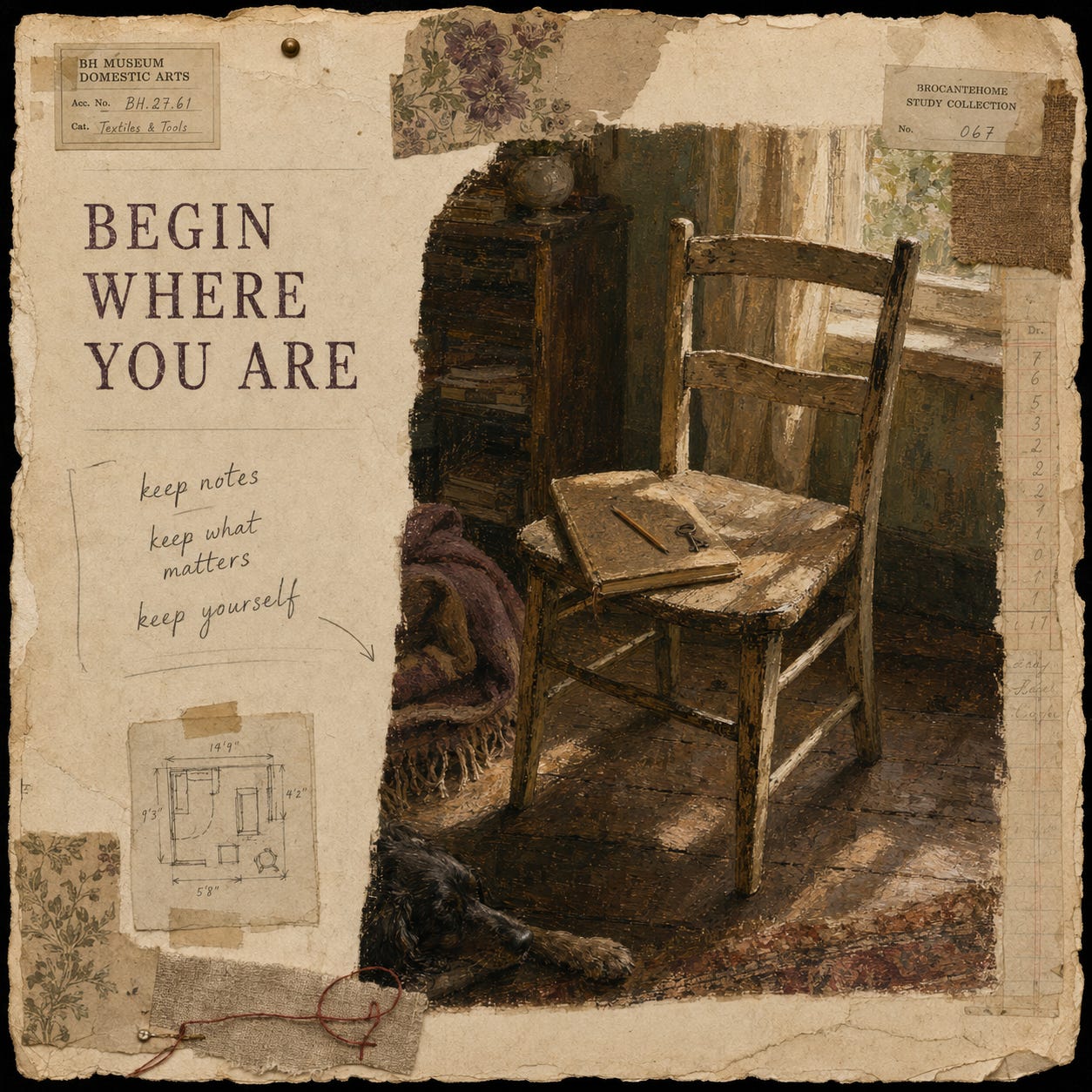
Begin with ten minutes, one corner, one single recurring irritation.
Look without accusation. Or judgement.
Ask what would make this small fragment of life more inhabitable.
Maybe you will move the chair. Or perhaps you will make a list. Maybe you will wash the blanket, cancel the tradition, light the bloody candle, ask for help, eat the violet creme, cut yourself a proper wedge of the good cheese and eat it for breakfast, open the window, close the window again because actually it’s freezing, and begin again.
There’s always beginning again.
Keep notes.
Keep what matters.
Keep yourself.
Twenty-one years ago I coined vintage housekeeping because I needed a way to describe the old knowledge, domestic pleasure and rebellious loveliness I wanted to gather into BrocanteHome. The phrase travelled further than I ever expected. Further than I did, most weeks. And it gave women a name for something they already recognised in themselves and had been waiting, some of them for decades, to hear said out loud.
Today I’m naming the deeper work.
Housekeeping is the creative discipline of making a life worth inhabiting.
Its medium is daily life.
Its practice is attention.
Its method is tending and revision.
Its politics are feminist, because the freedom, labour and authority of the housekeeper matter. Full stop.
Its purpose was never a perfect home.
Its purpose is a life we can enter without abandoning ourselves at the door.
Come in. Settle down. Move the dog if you need the good chair. There’s work to do, and it’s wild and ordinary and smells of lavender, and occasionally of burnt onions, and occasionally, magnificently, of the cheese. All of it the smell of somebody both alive AND living.
There’s a woman here becoming the author of her own life.
And a house being taught, room by room, how to hold her.
Welcome home, Sweetheart.
Comments
Nothing yet. Say the first thing.
Sign in to join the conversation.