
Hi hello, I’m Jess Ryan, founder of Broadway Unlocked. I write about theatre, technology, live broadcast and digital audiences every other Tuesday.
Well, this is not the way I was planning to start this Substack, but I feel called to add to the dialogue around the closing of CATS: The Jellicle Ball and the sustainability of theatre.
This is, obviously, only one person’s perspective, and admittedly mine is so so SO specific but I have to admit I am really struggling with a new day of the same headlines that making theatre is not sustainable financially. I am struggling because these headlines, and the outrage, and the blame throwing between the theatre owners, unions, producers and whomever else is in the line of fire continues to be blasted into the realm of magical thinking. I am frustrated that the people I see around me envisioning big, bold solutions and moving heaven and hell to help alleviate this catastrophic problem are having such a hard time gaining traction - it feels to me, at least today, that as a whole, theatre wants to cry foul but not do anything about it.
I gotta tell you, today I can’t stop feeling angry about the fact that at Broadway Unlocked, we are building the infrastructure for a source of revenue and a counter balancing business model that will help sustain the increasing costs to craft our beloved, imperative and vital in-person experience. And somehow, not a single one of our investors is from the theatre industry. I generally am an “accept things as they are and work with it” kinda gal, but I feel irate about this right now and that’s the truth.
I’m obviously having a day so, I’m going to do what I always do when I get feeling this way, and try to help.
Today’s Substack breaks down what we learned when Broadway Unlocked went from being the home for one live show a year delivered to digital audiences to an average of five live shows a month (plus their limited on-demand periods). In addition to just being generally awesome from the perspective of feeling successful and making a lot of money (never a bad thing), the pipeline of shows was a live, scaled-up feedback loop I never had access to before — and it forever changed my understanding of what people who wanted Broadway Unlocked to exist actually really needed.
Here’s why I think it matters in light of the frustration I and I assume many of you are feeling today:
There’s nothing about digital audiences and our access to theatrical experiences that indicates to me that what we’re building has to be rooted in New York.
There’s every indication, from the latest in our ongoing conversations about the financial burden of theatre and the very real experience documented below, that the world we’re building at Broadway Unlocked is not just feasible - it’s inevitable.
If the industry won’t turn the wheel, we can. I see a future where all of us here on the internet - from academics, to community, regional and international theatre makers, to theatre fans around the world - have the power to support and sustain the work that needs to be done to make access for digital audiences a reality, in all the corners and nooks we make theatre. So today, I hope this helps you understand more about how and why we’re building what we’re building - and if you’re so inclined, inspires new and exciting ideas for your own contributions that move our industry forward.
With that, here’s a few of my most valuable learnings when it comes to building a home for digital audiences:
Despite my focus on building infrastructure for an arm of Broadway on the internet, which largely centers around technology enablement, IP investment capital and marketing, one of the first and most compelling learnings had nothing to do with any of these things, and it’s very much shaped our company’s first principles. I had an epiphany about what it means to “go to the theatre” and what makes it such a special experience.
In losing the ability to plan a night out at the theatre (thanks COVID) - and faced with the reality of having to move thousands of people through digital theatrical experiences - I realized I hadn’t fully considered that going to the theater was about so much more than seeing the show. As we did more and more live digital shows, it became clearer that a night at the theater is also about the dinner with my friend that I have beforehand. And it is about having a quick chat with the person seated next to you with the Kansas City Royals hat. And it’s running into someone you know as you’re joining the 9-mile bathroom line during intermission. And it’s walking out of those doors into the crush of people, and maybe going to the stage door, or going for a drink, or just standing on the sidewalk talking before you go to the subway. All those pieces and parts, in addition to seeing a great show, are what makes theater so special in our hearts.
So, how the heck do you build that into the digital experience? From my vantage point, it’s not 1 for 1 and it’s changed over time. In 2020-21, we built a literal virtual theatre experience. Places to move around inside the platform - a lobby, a stage, a mezzanine, a “bar” where you could randomly run into other people in the venue, a gallery - modeled, by the way, after The Living Room, a Kansas City theatre I’ve referenced here before. As we moved people through the virtual venue, we started crafting chat workflows that created interactive, experiential moments for the audience. We installed venue managers who could see you and make you feel seen, even as you sat by yourself in your living room. We orchestrated interactive moments that hit all audience members collectively, no matter where they were in our digital space.
These were small, intimate elements that, when compounded across a show, add up to an experience that feels less like watching and more like being somewhere.
Things have evolved over the past few years, and today, we find our digital audiences want a slightly pared down version of that experience - we still use chat, a venue manager and interactive elements like polls to connect folks together and give the experience of liveness and connection.
I’ll be interested to see if and how that changes in the coming year. I can theorize til the cows come home, but this experience taught me the only way to really know is to be in dialogue with a live audience.
Adding a livestream and digital audience layer to a theatrical experience is interesting in that if both All Together Now (strategy, creative & production) and Broadway Unlocked (distribution) are engaged, we are tasked with working with almost every department in a theatrical institution - Artistic, as we work on the broadcast creative. Executive as we craft the 30,000 foot strategy of the digital engagement as a means to growth for the org. Development as we implement the fundraising strategy both into the venue and broadcast. Marketing as we work to expand audience access and awareness. Audience Services as we spin up ticketing and analytics.
Show after show, one observation was 100% consistent and I can’t imagine it will surprise you:
Everyone in every org sees the potential in the development of a digital audience base. Almost no one has time for it.
Thank you to the underfunded and overworked American Theatre.
Big learning for us: that’s a problem when we’re dependent on these orgs to kick out hundreds of shows for our live broadcasts so we can compete with Netflix and TikTok by being “always on”.
This realization came to me so late it’s embarrassing. 100+ shows in, it was 2023 and we were in talks with a venue to do all their live broadcasts. After an hour of conversation, the CEO of the venue asks us: “Who does the marketing for this?”
The CEO of the tech platform we were working with at the time said “Not us”. I, the CEO of the creative, strategy and production company at the time said “Not us”. And the in-person venue team said - can you guess? -
“Well, not us.”
And that, folks, is what we call an impasse.
In 2020 and 2021, we snuck by this because everyone had to do digital, so our built in audience coming over was enough. Today, there’s a ton of demand for digital access to long form arts (see my Substack about the data behind this claim) but that base audience can once again decide between hundreds of things to do and watch at any given moment. Marketing (and I’m talking effective, digital-first, fan forward marketing) is essential to the creation and sustainability of this arm of our industry and it cannot fall on the shoulders of the theatremakers in my experience.
Tech platforms assume the product you need is the ticketing and video player software. Broadway Unlocked’s position, based on our experiences, is that it has to come with a support layer to grow your digital audience that isn’t just lip service.
There are a million different ways to do a live broadcast - they all cost differing amounts of money, they all achieve different goals as it pertains to audience experience and revenue. From the kind of run-and-gun stream our production company designs and teaches people how to do so they can run them internally, to monthly cloud based lecture series (we essentially pull video and audio from zoom and repackage into a good looking “set design” if you will) that can live behind a ticketing paywall or at the awareness layer on YouTube, to one day events like Miscast that get captured live, to an actual Broadway show like Between Riverside and Crazy – you’re looking at a mind boggling range of $5k to millions of dollars.
We were able to readily road test all these solution levels during this period I’m writing about today. We got clearer on which of those return on investment for what kind of partner in what kind of circumstance. I think this is one of our biggest superpowers heading into the next phase of Broadway Unlocked - so many companies either leave you to figure it out yourself or force you into the one way they do it. We pride ourselves on understanding as many options as possible, and recommending what is doable (and what will move you forward).
On this note, Jared Harbour said something in his Substack a few days ago that made me laugh and laugh and laugh as I was reading it in the Miami airport (yes, people were looking at me but god did it ring true):
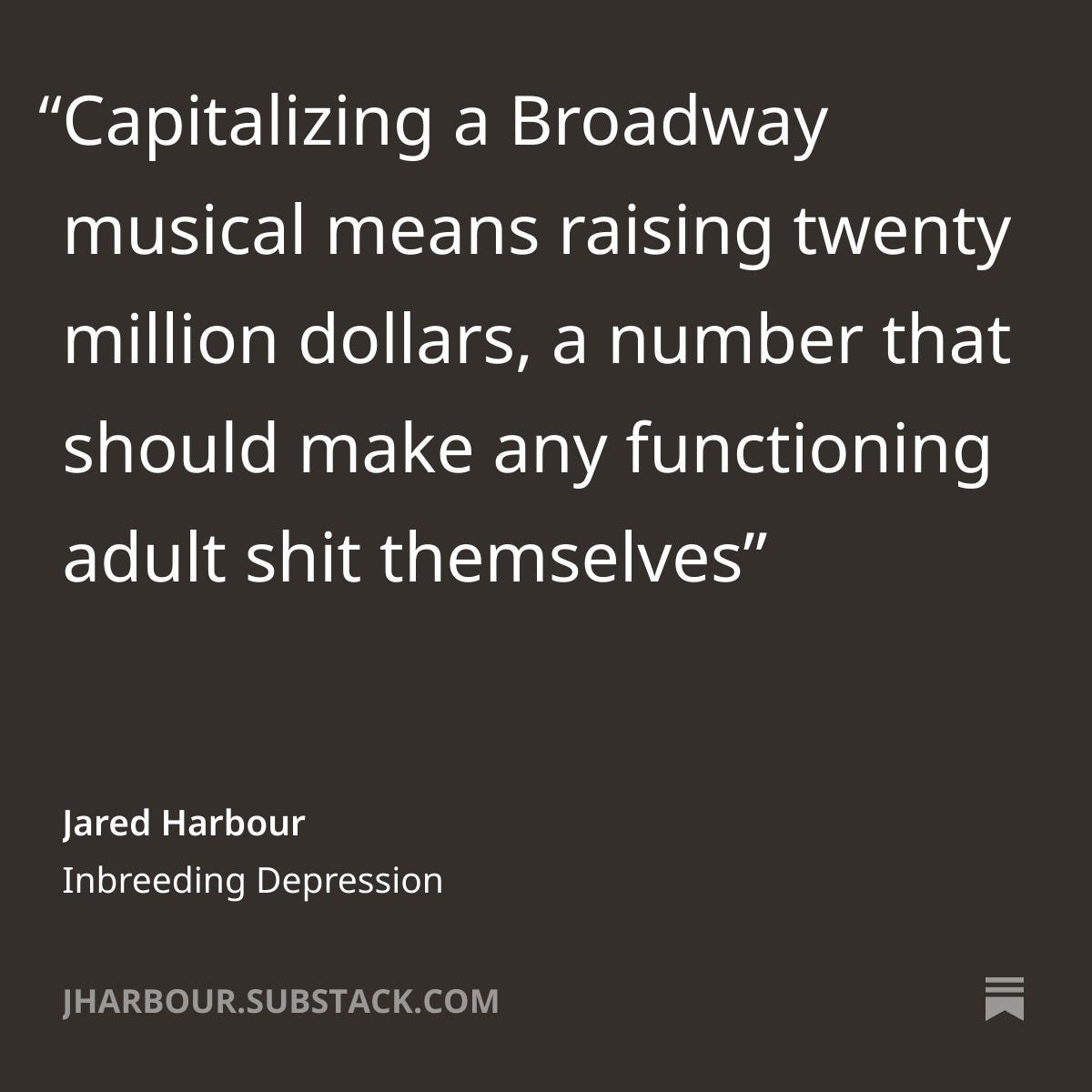
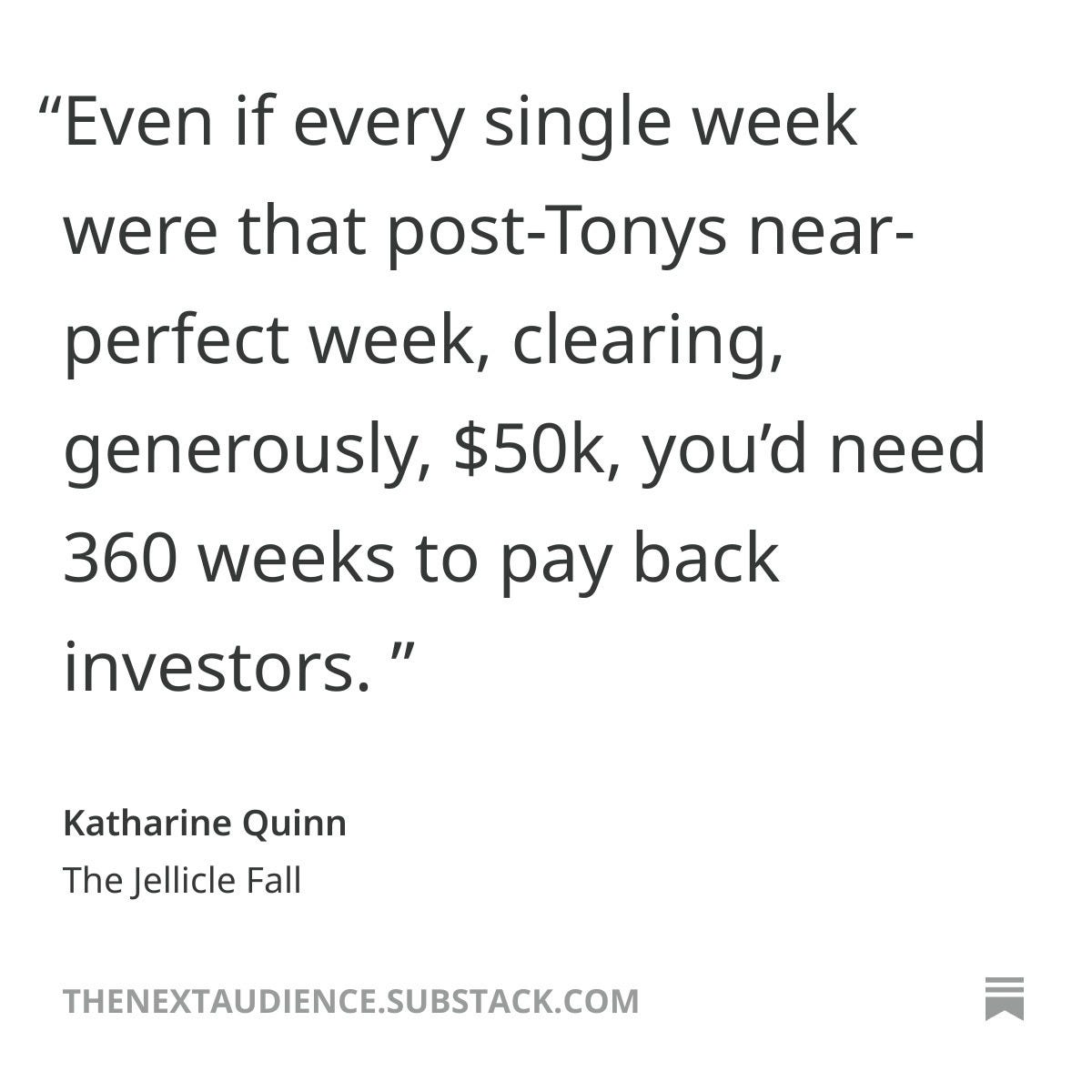
When I tell you the *outrage* we have run into, at the whiff of a suggestion of a $5k, $25k, $60k, even $1.5M live broadcast and digital audience engagement, from people regularly dealing with $25M capitalizations… I must admit, it does kind of blow my mind. Seems rather reasonable to me? Particularly because where a Broadway recoupment chart shows you how many weeks you have to run at what capacity to recoup your initial investment - it can be bleak, ya’ll, note Katharine Quinn’s estimates about CATS: JB this week:
a live broadcast recoupment chart doesn’t ask how many weeks before profit, it asks how many hundreds of percents more money can you make before the night is over:
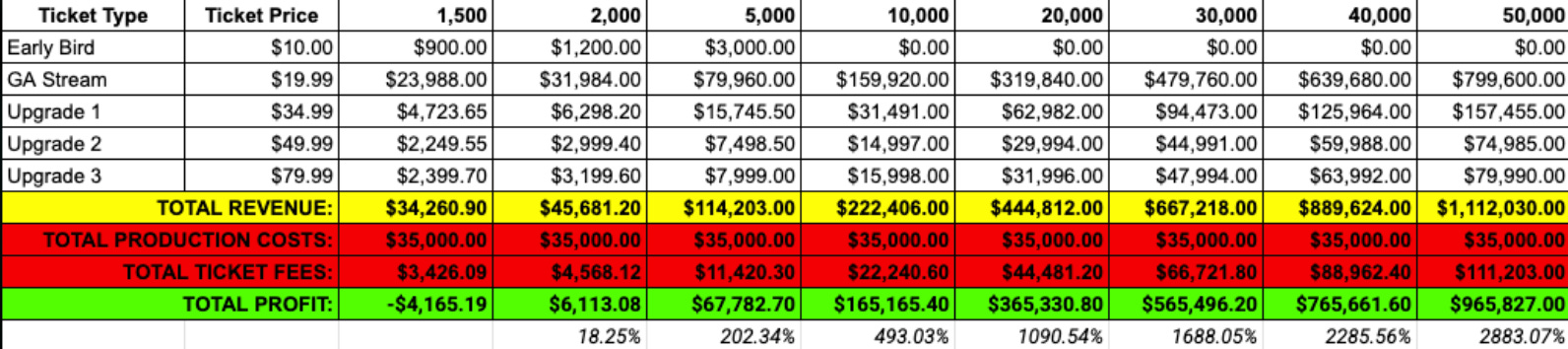
To be clear: the world illustrated in the above model only works in tandem with in-person (see again: counter balancing business model). And to be fair, I again want to say: broadcasting the show is just not enough. To see a financial model like this come to life, you need great creative and production, smart, ongoing marketing, a totally separate audience development plan, strategic platform strategy and, at least in my opinion and experience, it really needs to be treated as an investment.
All of this is infrastructure that is tough for any successful, operating artistic institution to add on to their plate; all of this is infrastructure that makes a ton of sense for our companies.
I really don’t mean to be a broken record about data, but in my experience, combining world class creative with world class data means MORE ART EVERYWHERE. And that’s the goal here, so I’m going to bang my drum again.
The biggest opportunity that comes with consistently engaging digital audiences in live experiences is a constant flow of data. And what we learned doing 5 shows a month is that the data has patterns, sometimes astonishing ones, that help us build bigger and better. Here are just a few we’ve seen:
We started to learn about repeat ticket buyers - and not only did we get the normal demographic-based information you get for in-person, we were getting micro and macro behavioral data insights that helped us design the next experience and the next and the next.
How eager were they to attend (= how early before the show did they log in and how many times before the show did they come in and out to engage with the content we had up)
How long did they stay? (= how to customize our email marketing to them the next time to increase their time spent with us)
Did they participate in chat? (= nearly free live polling at scale, something my agency friends tell me is usually very hard and very expensive to do)
Conversion data started to have repeating themes. We saw:
Year over year similarities in how different ticket prices converted (see the model above - quite literally, we were seeing nearly the same percentage of total audience converting to each of the price points)
Very similar percentages of total social audience (top of funnel) convert ie if you have 3M total followers on social and you’re moderately engaged, we can predict you’ll see x% of those followers convert to ticket buyers for a live event
International audience segments started having patterns that matched global arts market projections
Audience members from countries experiencing high growth or poised for high growth in the arts and culture sector were consistently showing up in our top 10 lists for audience locations. This helps us understand where to target our marketing, what live translation to concentrate on and how to approach simulive and time zones.
At Broadway Unlocked, we are laser focused on enabling a world where we are back to streaming many many shows a month. That’s a world wherein we can put all of the above learnings to work and give ourselves an unfair advantage. It’s also a world that allows us and our audiences to grow together. And in the long run, Broadway (the jumping off point for so much of theatre around the world) isn’t getting cheaper. So, it’s a world that will help improve the odds of success for the stories and culture the theatre is simply the best at creating.
I’m really grateful to our earliest investors for understanding that vision and seeing the signals that we can and will build a viable path to this new arm of Broadway.
And, in closing, I’m equally as grateful for all of you here. After all the noise today, I’m reminded it’s a quiet thing to read Substacks. To expose ourselves to new ideas. To quietly but firmly support change by connecting and contemplating on, of all things, an app for newsletters. But I’m increasingly sure this is where the future is being built. And I’m glad to be building it with you.
Comments
Nothing yet. Say the first thing.
Sign in to join the conversation.