
Hi hello, I’m Jess Ryan, founder of Broadway Unlocked. I write about theatre, technology, live broadcast and digital audiences every other Tuesday.
Boy howdy, did I love this year’s Tonys - did you? For me, there was better set design, more satisfying camera shots, slightly cleaner audio, the bits felt more culturally relevant to me than they have in previous years. And how much did we love hearing Alden Ehrenreich talk about using film and live broadcast to create a financial counterbalance to the extreme costs of the in-person experience (and the resulting astronomical ticket prices)?!
I hosted a party and woke up Sunday morning really craving an interactive ballot experience for my guests that would allow us to track our picks and also see what we liked in relation to each other. So I took the opportunity to take my first whirl at coding with Claude. Anyone else done something like this yet? I honestly was thrilled with the results and so were my guests! My team and I are frequent beta testers for super early technology, so we’re very used to providing feedback on bugs and the user flow gap between what the engineers want and how we actually use it. Which kind of made me born for creating something with this tool.
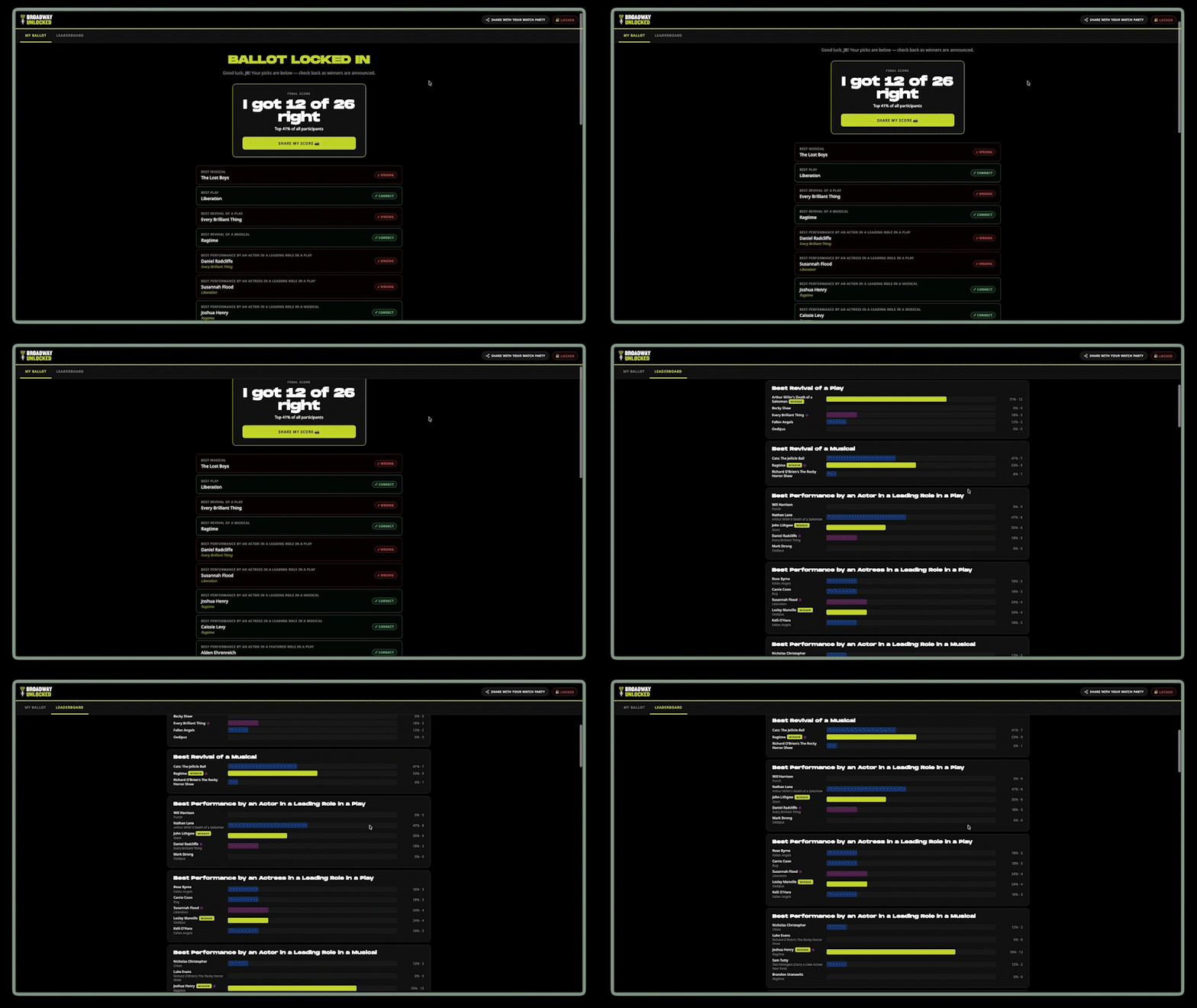
If you’re interested, I used Claude to code, Visual Studio Code to edit the code generated by Claude, Supabase for the tables and databases and Netifly to host. It took me about 3.5 hours to fully build, refine and squash bugs. And it cost me around $20 in extra Claude usage fees and another $10 for hosting. Wild!! I have to be honest with you (and I’m dating myself a little here), it took me back to my Xanga blog days, when I taught myself to read and edit HTML because I wanted to customize what my blog looked like (to tie it all together, my username was Savionfunk, after Savion Glover lol).
I learned a ton - not the least of which was, as a theatre fan, I would love to have a record of how I voted each year and how that stacked up against the industry’s votes. And I think having dynamic leaderboards that connect us all together might be really fun. Who knows what the future holds for this fun app, but for now - you can go check out the leaderboard that included my friends and a few friends parties around the country (special thanks to Anant Das, Nico Juber, Greg Kamp, Andrea Prestinario, Dustin West) – and you can sign up for future updates HERE!
Alright - back to your regularly scheduled programming…
In Part One of my examination of Broadway’s “situationship” to the internet and screens, I focused on tracing the past to see how it informs the present. Today, in Part Two, I want to look at my own direct experiences over the past six years, and see what insights we can glean from them.
As a bit of framing, I spent 2013-2020 deliberately staying out of the way of Broadway — I was building live broadcast concerts with YouTubers who were musical theatre kids first, running down to Rockwood to livestream my writer friends showcases, experimenting with cloud-based liveswitching tools to make TV-style content live on the internet. I felt like bumping up against capital B Broadway directly would create too much friction to keep myself and my business moving forward. Then, as the pandemic hit and All Together Now, my production company, was born, I gradually started to go inside commercial and institutional theatre. What I uncovered was… complex, messy and wildly inspiring.
After six years squarely focused on building theatrical livestreaming experiences inside Broadway, Off-Broadway and regional theatre, there are a couple recurring relationship dynamics I’ve witnessed that keep us in the messy middle of this “situationship”.
Us-Versus-Them: Why is this so common?!
A few years ago, I was hired by a tech company to direct a live broadcast run on Broadway - 8 shows a week for two weeks, live cut and streamed at the same time as the show was happening in New York. While sitting in the orchestra during install, two young riggers above me, not knowing I was below them, started talking. I heard anxious chatter above me and I tuned in just as they said:
“’These tech companies — they come in here and they don’t know anything about theater.’
I am ashamed of how grumpy this makes me seem, but I gotta be honest - my first thought was “Listen kids, I’ve been doing theatre longer than you’ve been alive!
And in my day, I did theatre barefoot, uphill and in the winter!”
Jokes aside, it was a curious assumption to witness. My team and I (all theatre makers, btw) creatively led the project—we created the plan and executed the production, while the tech company paid the bill for that specific broadcast. I saw it as a symbiotic relationship and another step towards innovation, but some of the theatre employees saw us entirely differently. I’ve now seen it multiple times at various levels within the industry - there is an ingrained us-verus-them cultural vibe going on that has very real downstream effects. It’s one of the reasons Broadway Unlocked is built by artists who are entrepreneurs. It puts us in a unique position to combat this relationship dynamic and hopefully build collective action and a more unified way forward.
A Tale of Two Financial Models
This one’s a doozy. I’ve sat in front of dozens of general partners of Broadway shows, as they consider streaming for their show. They’re curious. They have questions. They want to want to do it. So why, 9 times out of 10, don’t they? These conversations revealed to me that the chasm between the theatre and livestream financial models have a lot to do with it.
As a founder of multiple businesses, I appreciate how tough it is to consider starting a new “arm” of your business with an entirely different financial model. The scale and finances of a Broadway show—where you know exactly how many seats you have, what your weekly operating budget is and how many weeks it will take to recoup—is patient, disciplined and legible. That’s quite different from a live broadcast of theatre—where the business model is basically a startup smashed into one night instead of ten years. I compare it to startups because live broadcasts create an environment that rapidly increases revenue at a significantly faster rate than costs, enabling sustainable, high-volume growth after a particular inflection point - the definition of scale.
As I continue to have these conversations, it’s clear to me that the business logic of a physical theater is deeply ingrained. The business logic of digital access is deeply different and much more foreign. And that is just a difficult square to circle, no matter how much we want this dual world to exist.
So, back to the question at hand: Is there a way out of this “situationship”? I find myself going back to the startup analogy. What makes a startup successful? This is certainly simplifying it a bit, but generally:
A great product
Understanding what your customer wants and needs
An environment where constant iteration is possible
A scalable business model
Broadway currently doesn’t have a sufficient environment under which these elements can be implemented and tested. And this leads directly to why I’ve been out on these streets, shouting about my boyfriend, live broadcast – Broadway Unlocked has it all and that’s enough to commit. Over the past six years, we’ve done 140+ shows. We’ve seen 250,000+ digital audience members cross our doors. We’ve evolved our definition and execution of what watching a live show on the internet actually entails, we’ve survived failed ideas and made them better the next time. I know Broadway will get there eventually - mostly because we have to. For me, the question becomes - what can we build that will help it along?

Is there a real relationship to be had here for Broadway and theatre more generally? Yes. Our data and experience proves it - I’ll dig into that in the next one. But maybe a more important question I want to be asking is — how are we cultivating that relationship? And do you think there is a better way than how we’ve been doing it over the past 50 years? I’m particularly interested to hear diverse perspectives on this - Broadway, indie, community international and regional theatre makers alike!
Previously on Broadway Unlocked
Part 1 of this series is a deep dive on the history of our stages on screens.
Check out my most recent Substack to read more.
•••
Next up - June 16th, 2026
I typically do this every other week but I was really jazzed about this topic (and I learned so much going down the rabbit hole ) - it’s a three part series and it’s coming out every week for these three weeks. Here’s a preview of next week.
55+ Is An Opportunity: 88% of those ages 55+ use YouTube on a weekly basis.
Creating Results: What Do Seniors Do Online 2025
I’d say this is the biggest change from when I started this work, and a very big driver for us. This largely results from the pandemic forcing folks to become digitally native, but also, I offer this anecdote: We often take sales calls for new technology tools that we feel could help improve our business and efficiency. Nearly every 20-something startup sales guy I talk to finds out what we do and says - “Oh my god my parents would love that - they loved going to the theatre but just can’t go as much anymore”.
…
Tune in next week for more of the data we’re tracking at Broadway Unlocked.
Comments
Nothing yet. Say the first thing.
Sign in to join the conversation.