
Hi hello, I'm Jess Ryan — director of 140+ live theatrical broadcasts and founder of Broadway Unlocked. I write about theatre, technology, live broadcast and digital audiences every other Tuesday.
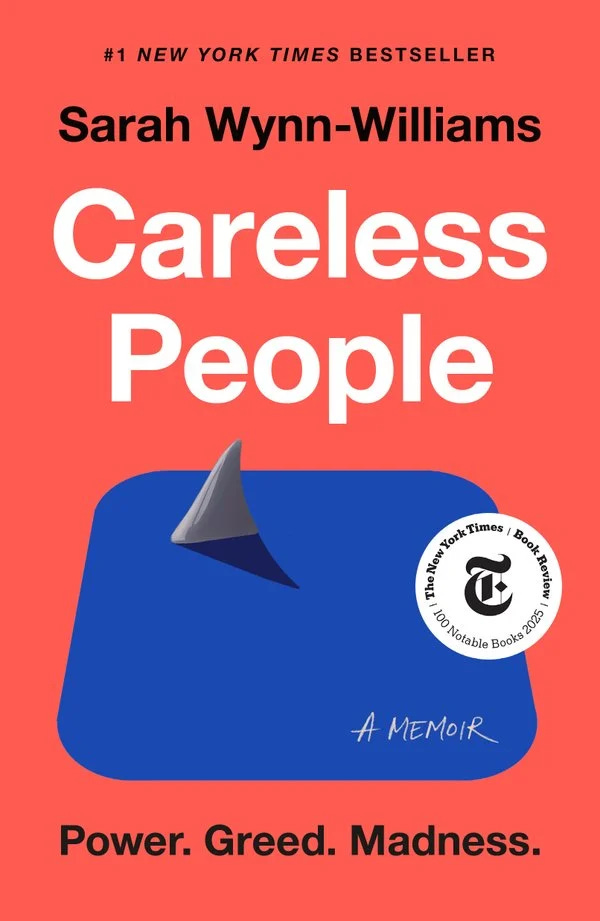
I stayed up all night last night reading Careless People: A Cautionary Tale of Power, Greed and Lost Idealism.
Have you heard of it? It came to my attention when my algo served me a clip of a woman who was sitting on a panel, and as the host described, was not allowed to speak because of legal action from Facebook. My first thought was - what an incredible show of power to sit in front of hundreds of people as a panel participant knowing you can’t say a word. My second was obviously - who is this woman!?
Turns out, Sarah Wynn-Williams is a former Director of Global Policy for FB - she worked there from 2011 til 2017 when she was fired (and gagged as part of her settlement). For a bunch of reasons I’ll let you go research, because of course now you’re as fascinated as I am, she decided to write a whistleblowing book in 2025.
I can now confidently tell you, my god is the whistle blowing in this book. She hits on sexual harassment and assault, employee endangerment abroad, exploitation of teen mental health, maternity leave and HR cover ups, and possibly most devastatingly - the drift from a mission to make the world more open and connected to inconsistent, growth-at-all-costs data policies that served the share price of FB and is associated with the rise of dictatorships around the world.
Now, what does this have to do with Broadway Unlocked, you ask?
I knew when I was signing up to be an impact-driven founder in my space (and a woman at that), I’d have to nail the following to succeed:
Leveraging a long and fruitful career as an actor, director and producer
Identifying world-changing business ideas
Having a deep understanding of the challenges facing founders of these types of businesses
Developing a preternatural ability to make money - because I didn’t take investment capital for my first business or the beta of my second and I’m not sitting on extra money to help subsidize my path
Prioritizing the ability to make business models that, to put it simply, pay people well and still make profits
Building systems that communicate our business out, helping potential customers see the benefit so they come in and delivering our products and solutions to them
Exercising unparalleled grit, determination and patience because everything seems to be 20x harder when you’re a woman in this space
Check, check and (::wipes sweat off brow::) check.
What I didn’t know is noooooo, oh nooooo, that’s not enough. Turns out, the kind of capital I decide to raise (and even more precisely, what kind is available to me) dictates whether or not I’ll be able to realistically achieve the vision I have for live Broadway’s global third arm built for the internet or…if we turn into Facebook decades down the road.
Careless People, and every single terrible downhill slide documented in the book is enabled by a company built on venture investment - if you don’t know, that’s for-profit capital, deployed against companies identified as having the ability to 100x their investment. Most often, a company that fits needs to be able to:
deploy astronomical amounts of cash
grow exceptionally quickly (“move fast and break things” ring any bells?)
have very high margin products
make decisions that must put the financial interests of investors first, over every other stakeholder
be run by people who decide to subscribe to doing business that way.
The internet frequently sells this as the one true way™️ to build a scalable company. A handful of years ago, I set out to discover other paths.
Because I knew the next steps for Broadway Unlocked couldn’t succeed unless every unit of revenue was tied to a unit of impact, I started to teach myself yet another hard thing - the world of finance, investment and corporate governance. It has been ::ahem:: a process:
I started by reading Wealth Supremacy: How the Extractive Economy and the Biased Rules of Capitalism Drive Today’s Crises by Marjorie Kelly (very big thank you to Jim Augustine for gifting me this book at the start of my journey). Let’s just say I have a knack for starting with the hardest stuff first. But it helped me start to understand what I was up against if I was sure that to the best of my ability I wanted to build a business that a) would flourish with investment capital b) was going to benefit all its stakeholders and c) was going to provide “risk adjusted returns” (fancy way to say financial outcomes commensurate with the risk the investment is taking on)
Then I spent the majority of SXSW a few years ago at panels examining various ways to create company structures that protect impact and make money. It was the first time I learned about employee ownership trust owned companies (The Guardian, being the example). I had the privilege to listen to an economist and a journalist arguing that standard economic assumptions—such as prioritizing pure free markets and assuming relentless self-interest - aren’t the only way to go, as founders are sometimes sold (The journalist wrote a very helpful book I read afterward called The Alternative: How to Build a Just Economy.)
Are we having fun yet? We’re not in tap class anymore, Dorothy.
This year, as I started raising my first friends and family round, I began to contextualize what I was building against all these different views of what the responsibility of an American business is. I was increasingly feeling sure that a Public Benefit Corporation was the way to go. Why? There’s a big chasm between growth that breaks a company and growth that doesn’t. Facebook chased growth as an end in itself — engagement at any cost, including, Careless People alleges, exploring how to help the Chinese government surveil its own citizens in exchange for market access. That’s growth completely untethered from mission. Broadway Unlocked’s model is built so growth and mission can’t come untethered: every dollar of revenue has to carry a unit of impact with it, by design. If we can’t grow the audience without growing the good, we don’t grow that way. A PBC goes a decent way toward helping us protect that model as we scale.
Once that was settled, I decided to take Duke University’s Coursera on Impact Investing, so I could more thoroughly understand the incentives and expectations for impact investors - the capital pool looking more and more like the right one for Broadway Unlocked. I can’t recommend this course enough, I learned a ton. Great founders understand the incentives of their investors and create room for them - this course helped me start moving in that direction.
And then, a few months ago, I read Eric Ries’ Incorruptible. While many things were illuminating in the book, he shared a really easily digestible example of shareholder primacy at work that I finally understood in a way I hadn’t before. He tells the story of one of the original founders and the CEO of Whole Foods, John Mackey.
Then came 2008. The financial crises sent Whole Foods’ stock plummeting 90%. In the years that followed, Mackey worked hard to push the stock price higher but held to the company’s premium pricing, defending their 35% gross margins. The stock rebounded spectacularly, recovering the 90% it had lost… Looking back, Mackey would call this his “single biggest regret as the CEO. As he explained, “We missed the best opportunity we ever had in the history of the company to lower our prices… We wouldn’t have created as much short term shareholder value. We’d still be an independent company today, I think, if we’d done that.” With Wall Street clamoring for short term profits and rising same store sales, the right long-term decision felt impossible.
Mackey literally legally couldn’t lower the prices of groceries; his board would have had grounds to fire him.
While it’s not like a PBC is the god given solution to running a business that also contributes to human flourishing, its structure (or something like it) would have given John Mackey legal cover to hold Whole Foods' prices down in 2008, instead of a fiduciary duty pointing him back toward expensive prices and rising stock price. And that conceivably could have saved them from being bought by Amazon.
Incorruptible is by far the simplest of all the books I read, but in many ways, it made so many difficult, obtuse concepts filling my brain much more legible.
And finally on this journey through these books, reading Careless People last night was the contextual and anecdotal glue that brought everything together for me.
Why am I writing about this here, in a Substack that is usually about technology, theatre and live broadcast?
Reading Sarah’s story, I realize I want this record of my journey and of Broadway Unlocked’s journey to include what it’s like to be a mission-driven, female founder balancing equal desire and aptitude to create impact and financial returns at scale
I want other founders, especially in the arts and culture space, to understand the existence of this whole other layer of financial and economic consideration at work. I don’t think most of us know it exists, because it’s so divorced from our day to day as artists and theatre makers.
In my countless investor conversations, I perceive that there is a real bias toward for-profit arts and culture startups, and their invest-ability. I also think this is TOTALLY UNDERSTANDABLE. As I continue down this path, when someone searches to learn more about me, I want this Substack to serve as an exceptionally clear sign that I am unrelenting in making sure that I will do whatever I need to do to make sure Broadway Unlocked is a success for everyone involved.
I and my capital advisors have recently learned that Upstart Co-Lab, the authoritative voice on arts-and-culture impact investing, reviewed 46 media/entertainment funds looking for one that met their investment bar, and found none.
None.
To grow, flourish and scale its impact, Broadway Unlocked needs capital at the same scale as any venture-backed startup — from investors whose incentives look nothing like the ones that broke Facebook. Our investors:
believe a live Broadway on the internet is inevitable (it is)
believe I and my team are the only people in the world who could credibly build this (we are)
understand that while in-person Broadway’s business model depends on scarcity staying scarce; ours depends on reach getting bigger. No scarcity to protect. Just an audience to grow and that makes a healthier theatre for all
see our vision for a company that started in production and ticketing and can and will expand to include IP, licensing, advertising, franchise revenue and even real estate
I’m writing this today because in a weird way, Careless People reminded me these investors aren’t just random wealthy people and big funds. They are you. People you know. People you know who know people who align with our vision.
Every step of the way with Broadway Unlocked has been powered by you, people who are very decidedly not careless. If I’ve learned anything, it’s that this is going to take a village. All that I wrote about today is often hidden, not talked about and definitely not understood in many of our circles. And I figure, if we’re all in this together, you should know about it too.
(but in little paragraphs, instead of big hard books and courses - I took that one for the team 👊🏼).
Thanks for being part of this journey.
Previously on Tech Theatre
Two years into collaborating on a live streamed Ancient Greek Odyssey, here's what an eight-time Broadway vet taught me about theatre at a distance.
My Odyssey with Joseph Medeiros
·
Aug 12
As I read my 946th Subwaystack Take™️ about the new Odyssey film, it hit me that I have something of value to add, and it has nothing to do with Christopher Nolan, whether his women are fully fleshed out or why Agamemnon looks like he’s about to answer the Bat Signal.
Comments
Nothing yet. Say the first thing.
Sign in to join the conversation.