
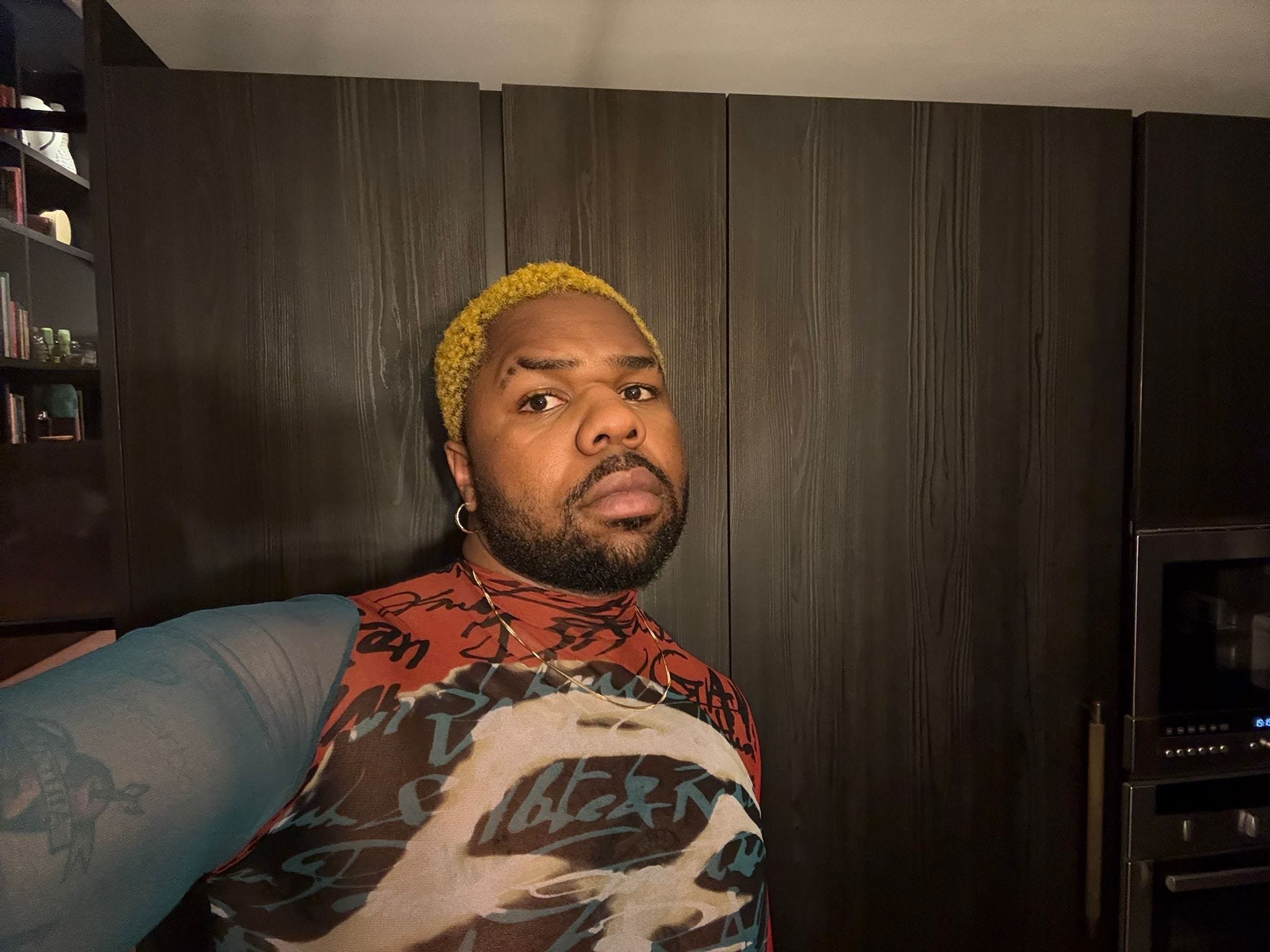
I’ve been a fan of MNEK for a long time, and you probably are too. The London-born singer, songwriter and producer has been working in the industry since he was just 14, having caught the attention of major artists and label execs through the independently created songs he would share on MySpace.
He has come a long way since then, with his name in the credits of hits by Beyoncé, Christina Aguilera, Kylie Minogue, Dua Lipa, Selena Gomez and so many more. You’ve probably spent a lot of time listening to MNEK’s work this year: he executive produced Zara Larsson’s 2025 smash LP Midnight Sun and co-wrote her viral verse on a remix of PinkPantheress’ “Stateside” as well. Their recent work together marks a decade since they both had a major breakthrough, having both cracked the Hot 100 for the first time with the 2015 single “Never Forget You.” From all of MNEK’s work, it’s clear he has his finger on the pulse of what pop fans want to hear — and that’s because he is a pop fan himself.
“I’m a total fanatic of pop stardom,” he tells me over Zoom. The 31-year-old grew up a true Nineties kid, drawn especially to Spice Girls, Mariah Carey, Whitney Houston, George Michael and Michael Jackson. He was raised on MTV and the radio like any other music-loving millennial.
“I listened to these artists as a fan, but then also as a student,” he says. “I don’t negate there being a natural knack for it, but I think anyone who has a gift, they then are able to make that into a talent by working at it.”
Next up, MNEK is finishing his second-ever solo album, eight years after releasing his debut Language. He and I chatted about his early years, pinch me moments, recent work with Zara and how he overcame a spell of shattered confidence to make his new album.
This interview has been condensed and edited.
What did growing up in the late Nineties, early Aughts teach you about what was possible in pop music? It was such an interesting time with a mix of emerging pop stars, legends and wildly different genres exploding at once…
Here in the UK we didn’t have the same genre lines, as far as the very clear grouping of “Black music,” “dance music” or “rock music.” If it was popular it was popular. The variety of musical sounds was really good for me as a growing musician and just a fan of music.
There were cultural things that were more tricky, like it wasn’t as cool to love pop music if you are trying to present as straight or affirming your Blackness. I’ve always loved pop music. I’ve always loved pop music in the style of pop music. Obviously, there’s popular music as just like, songs that do well, but then there’s just the style of a Max Martin or a Darkchild. I grew up with that. That was my food growing up, my musical diet.
Do you remember the first song you made?
I made this song called “Paper and Pen” [when I was eight or nine]. On the nose. Gotta write about what you know. After that, I’d go on to write about a bunch of things I did not know. I was just talking about me and my paper and pen, and we’re writing this song. It was me discovering my relationship with melody, me discovering my relationship with song. There’s something pure about that root of me just wanting to have an outlet.
I’ve always loved pop music in the style of pop music.
And then you started sharing your music on MySpace?
Yeah, I was 14, and I just put these songs on MySpace. I didn’t really have any gauge on the industry. I was just making music, and saw that MySpace was working for a bunch of artists. That was the medium, the same way that you see TikTok as a medium right now. I joined MySpace and Twitter at the same time, and I used MySpace as a way to send my music to people that I was a fan of. This was 2009 so I was sending it to people like Ellie Goulding and Frankmusik and Cocknbullkid and Calvin Harris. I was really into electronic dance pop records.
I sent it to a few people, and it just landed in the industry’s hands. I guess a lot of industry hoopla around me that time was that I was 14, writing and producing these records [on my own]. By June of 2009, I’d signed my first publishing door with EMI Publishing. I begrudgingly remained in school because I’m the product of Nigerian parents who are very much strong on the idea that education does come first. They wanted me to have something to fall back on. But I was always very one track mind about wanting to do music. So first two years of that publishing deal before the end of high school, I was working every weekend, every half time, every summer holiday. Any pocket of time that I could get, even if it was after school, I’d find a session or be in the studio with someone.
What were the early lessons you were getting the first five years in this industry?
It was me learning on the job that it’s so much more than just writing a song and then being done with it. It was writing a song and then being open to tweaking a song, and then being open to bringing in other producers and learning how to collaborate. I got into the industry based off songs I was writing all by myself.
I worked a lot with Brian Higgins from Xenomania and Miranda Cooper. They were a massive part of those first few years of me figuring out the different processes and ways to write a song. One of the things I learned with them was the idea of you could take a piece of my brain and that could become a section of the song. I was learning was how to collaborate and what I bring to the table.
You were coming into the industry as the whole market and landscape was changing guards to the streaming era. Did you feel the effect of that on songwriting as you were beginning your career?
I don’t think any of that clocked into me at any point in this. I’ve always thought about songs in the classic sense. The song is good because I feel good. Is it pertinent to the artists I’m writing it for and or with?
The one time I did feel the difference was “Never Forget You” with Zara. That record came out literally as the UK’s relationship with streaming versus sales changed, like it was pretty much that week where the power of numbers on streaming could affect chart position, or that you can project how a song is going to do via those kind of things. But that was all business stuff. It didn’t have anything with like how the song was constructed or the structure of the song.
Comments
Nothing yet. Say the first thing.
Sign in to join the conversation.