
Dear friends,
A shipment of Centre for British Progress-branded notebooks arrived at our office this week, putting us all into a back-to-school kind of mood. Summer shows little sign of ending yet, but there’s an enticing feeling of a new term about to begin.
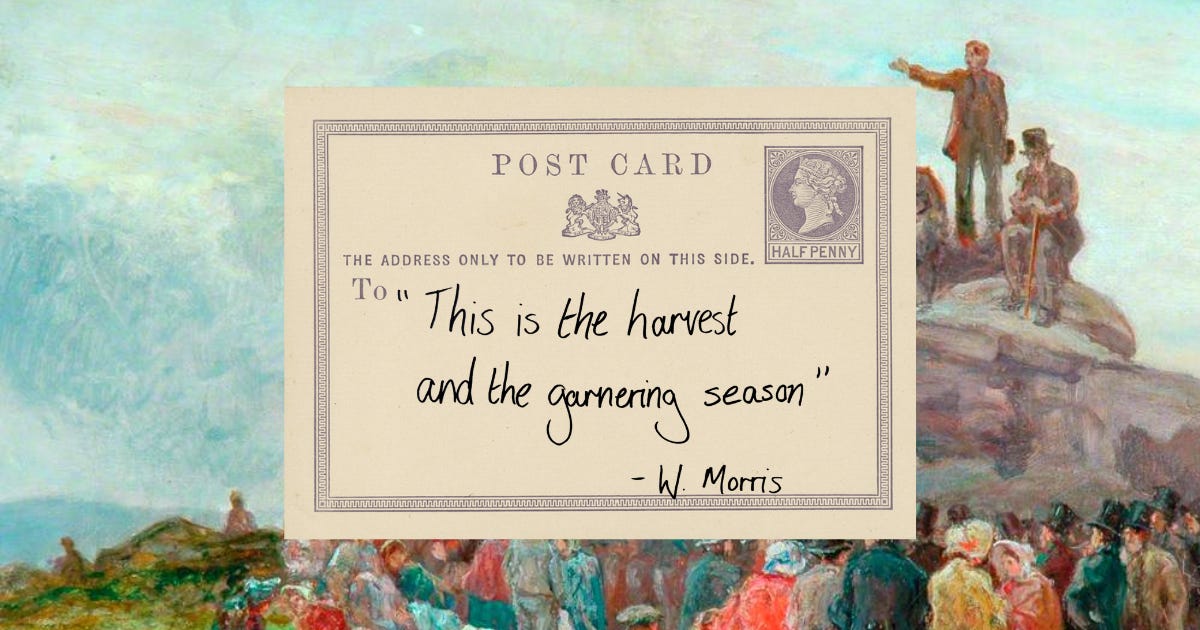
This time of year can also be a little melancholy, but William Morris wrote in its defence in ‘Love is enough’, reminding us of the rewards of late summer. “But this is the harvest and the garnering season,/And the leaf and the blossom in the ripe fruit are blended.”
Literal harvests could be difficult this year – notwithstanding the watermelons growing in Bristol and other surprise side-effects of the heat – but in general we find this to be a good time to take stock of everything the year has brought so far and look forward to a busy few months ahead.
New ideas and publications
Post Haste: England has too many environmental regulators and no one in charge – Guest contributors Sebastian Leape and Professor Baroness Kathy Willis argued that a complex system leads to worse results for the taxpayer and for nature.
Pen Portrait: Daisy Christodoulou on grading exams, touching grass, and lunch at the Oval – Just in time for results day, we spoke to the author and educator about her favourite things, and what people get wrong about her field.
Post Haste: The new AI taskforce should have one mission: leverage – In a guest piece, Callum Coleman and Ed Lawrence set out a proposed agenda for the Prime Minister’s new AI-focused unit, chaired by Lord Vallance.
Policy changes and projects of note
Gatwick win - The London airport will be able to open its second runway after seeing off a legal challenge. It’s expected to enable about 100,000 more flights a year. We’ve previously set out the case for why Britain needs new runway capacity.
Ox-Cam updates – In addition to his appointment on the AI Taskforce, Lord Vallance was also made chair of the Oxford to Cambridge Growth Corridor. We continue to watch the project with keen interest, having made the case for tripling the size of Ox-Cam by 2050.
We recently welcomed three new people! To introduce them, we asked a few questions from our Pen Portrait series
Michael Hill
Michael takes on the role of Head of Energy and Infrastructure. He was previously a civil servant working on transport and energy policy and a Policy Researcher at Britain Remade. He is interested in how cheaper and better infrastructure can power British growth. He studied at the University of Oxford and Yanbian University, China.
Q. How is the world different now compared to when you were a child?
A. In the year I was born we were putting the finishing touches to Sizewell B nuclear power station. It costs half as much as the nuclear plants we are currently building per unit of capacity. While I was at primary school HS1 was being built. It would cost less than a third as much as High Speed 2 is costing now per mile.
Q. Where do you find new ideas?
A. I am not sure energy and infrastructure policy needs that many new ideas! Britain used to be able to build cheaply. Plenty of other developed countries still do. I look to our own past and to the examples of other countries to seek good ideas of how to build our future.
Q. Where’s the best place for a lunch meeting?
A. The Breadline Cafe opposite Charing Cross. Cheese omelette with chips is fantastic. They seem to have got their seats from the same people who supply football stadiums.
Adash Herrenschmidt-Moller
Adash is a Policy Fellow working on questions relating to biosecurity and public health. He has previously worked on improving incentives for the development of new antibiotics in the EU, and researched decision-making in international development. He co-founded Arcadia Impact, an organisation that supports individuals in contributing to AI safety and governance. He studied computer science at King’s College London.
Q. How does change happen?
A. A lot of change has this quality of being more subtle or slower than we care to notice - or than we are able to notice. For example, solar has got so much cheaper but you might not know about that until you see the Our World in Data chart. It happens almost in the background.
Q. Where do you find new ideas?
A. I think I just revel in asking interesting people questions. I’ve never been tired of hearing about people’s work.
Q. What would you serve up for a dinner party?
A. To anyone who will eat it, I serve up Bkeila. I took it from an Ottolenghi recipe, it’s a Tunisian dish. It’s one of my favourite things to introduce people to, because it just doesn’t look good – but it’s delicious.
Tom Barrowcliff
Tom is joining as our new Head of Operations after nearly a decade with the conglomerate Jardine Matheson. His early career spanned East Asia and the Middle East, with roles in corporate finance and business transformation before moving into hotel management. He studied Russian at the University of Oxford and recently International Political Economy at King’s College London, where his dissertation examined sovereignty and technology.
Q. What makes you optimistic about the future?
A. Growth in life expectancy and the expansion of education.
Q. How is the world different now compared to when you were a child?
A. We had more time to our thoughts. Competing for our attention was more difficult: things weren’t always plugged into our ears, stuck to our hands, glued to our face.
Q. What’s the best place for a lunch meeting?
A. I’d suggest breakfast instead, at The Wolseley on Piccadilly
Opportunities and happenings in the ecosystem. Let us know what else should appear here by emailing editor@britishprogress.org
The Sovereign AI Fund is looking for its first operating partner.
Julia will be speaking at the launch of The Great Stagnation: Why Britain Stopped Growing next week.
She’s also interviewing Verity Harding at Policy Live on the 10th of September.
Julia is reading the Robert Service biography of Lenin, from which she has pulled out this quote: “There are not always extraordinary people around to take advantage of an extraordinary political situation.”
Michael recently finished Municipal Dreams, John Boughton’s book about council housing. He enjoyed it greatly but felt it raised lots of questions that the book didn’t really try and answer.
Pedro has Susanna Clarke’s Jonathan Strange & Mr Norrell on his list, but might start with something light like Blood Meridian first.
Alys is taking another stab at The Mandarins by Simone de Beauvoir. Thought-provoking and rich in its depiction of post-War Paris, it’s also occasionally a slog with its 100-page chapters.
What else is on our minds and in our feeds: Where have all the bank robbers gone? | A British pub is polarising the Bay Area | Is London a swimmable city? | North America’s depressing relationships | Chimichurri potatoes
No posts
Comments
Nothing yet. Say the first thing.
Sign in to join the conversation.