
One of the things that interests me is how some Christians judge those who claim to be unbelievers. This is also the case with other religions whereby non-believers are considered to be anyone who does not believe in the teachings of that religion. The question I have is this: Why be a believer? Why not be a KNOWER?
When I write Christianity Without Fear, I am writing about something that is realized through direct experience, through KNOWING. My reflections often take me back to my Christian upbringing in my homeland of Northern Ireland. Never during that time was there an invitation to become one who KNOWS God, even though the Psalmist says, “Be still and KNOW that I AM God.”
Christianity Without Fear is a reader-supported publication. To receive new posts and support my work, consider becoming a free or paid subscriber.
Instead, the emphasis was on belief. We are told, “Let not your heart be troubled: ye believe in God, believe also in me.” When I used to sing in the cathedral choir, we would begin by reciting the creed, which opened with the words, “I believe in God the Father Almighty.” Notice the focus on belief in God.
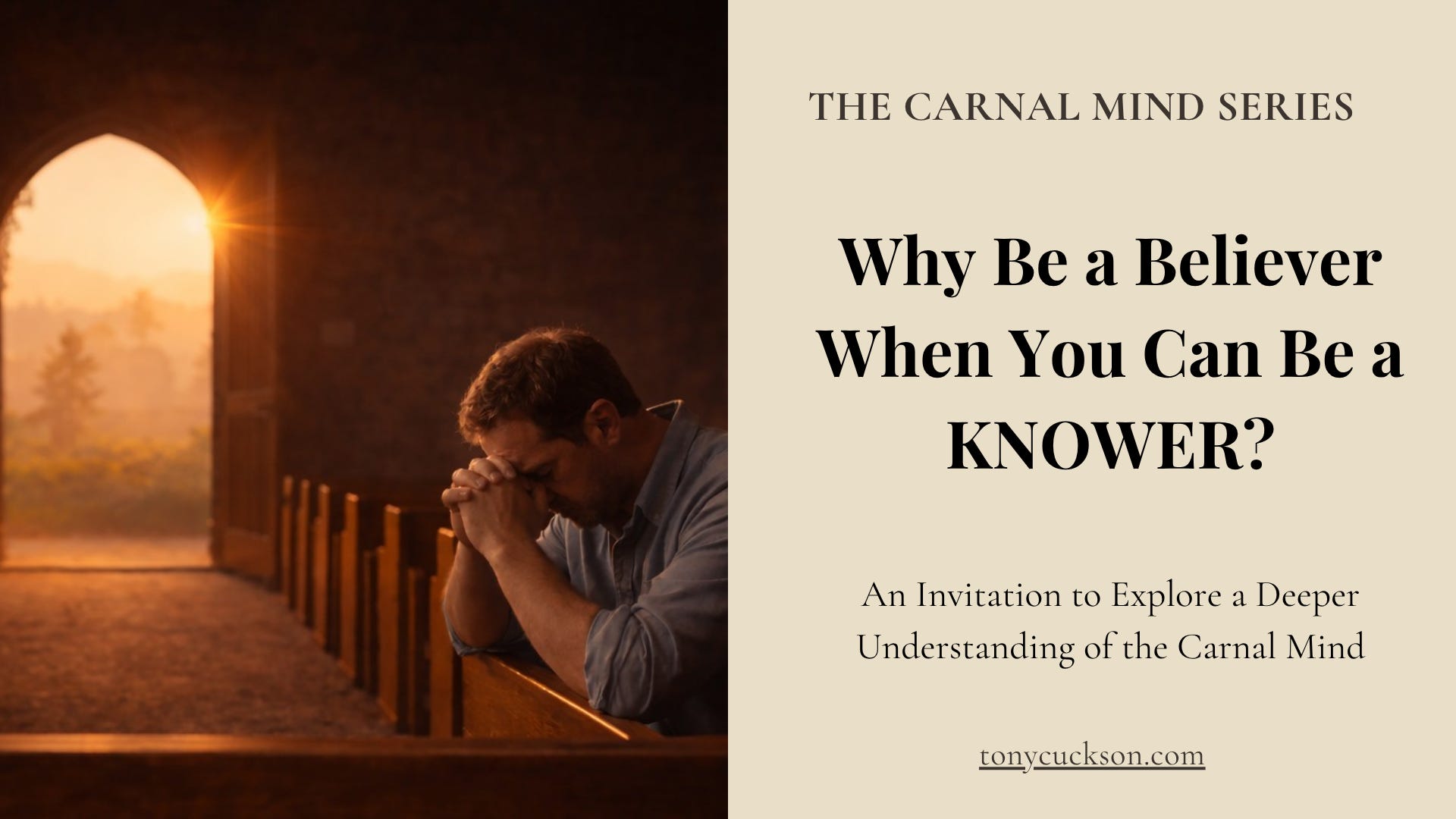
There is, of course, nothing wrong with belief. Belief may well be the beginning of the journey. It may create an openness to possibilities that have not yet been experienced. Yet belief and KNOWING are not the same thing. Belief accepts the possibility of something. KNOWING arises from direct experience. Belief might give comfort, but KNOWING is transformational.
Thus, there becomes a focus on believing in God rather than on KNOWING God. Yet I would argue that the invitation of the Master was always directed towards KNOWING. This is the deeper meaning of abiding. Abiding does not arise from belief alone, although one may begin with the belief that abiding within the state of Oneness pointed to by the word God is possible.
I often return to what I regard as one of the Master’s most important instructions: “Seek ye first the Kingdom of God.” Notice that he does not say, “Believe first in the Kingdom of God.” He speaks of seeking. He then goes on to say that this Kingdom is within you. To the mind of this writer, seeking points towards discovery. It points towards something that is to be experienced and KNOWN rather than merely believed.
In the view of this writer, the challenge for any Christian is therefore the challenge to move beyond belief into the experience of KNOWING. I suspect that for many Christians this is an invitation they will avoid. Their identity as a believer is central to their sense of self. Who they believe themselves to be becomes more important than discovering who they are in reality as an emanation of the one I AM beyond the idea of the separate personal self part of which is their identity as a Christian believer.
Yet this invitation to KNOWING is not something foreign to Christianity. It has always existed within its deepest stream. Throughout Christian history there have been men and women who were not content merely to believe. They sought direct realization of the Divine Presence.
The anonymous author of The Cloud of Unknowing taught that God could not ultimately be grasped by thought but only entered through a surrender beyond thought. Meister Eckhart spoke of the birth of God within the soul. Teresa of Ávila described the soul’s journey into deeper chambers of Divine union. John of the Cross wrote of the dark night through which all attachments are stripped away so that union with God may be realized.
These Christian mystics were not unbelievers. Yet neither were they content to remain merely believers. They were KNOWERS. Their authority arose not from second-hand knowledge but from direct realization. They understood that the deepest truths of the spiritual life cannot be borrowed from another person, no matter how sacred the source. They must be discovered and KNOWN within.
Religious institutions, however, often have a vested interest in maintaining the believer as a believer. Institutions are naturally concerned with preserving doctrines, traditions, and structures. The institutional church has not always been comfortable with those who have become KNOWERS. Throughout history some mystics were viewed with suspicion, quietly sidelined, or in some cases condemned as heretics.
This is understandable. The believer can be instructed regarding what to believe and how to believe it. The KNOWER represents something more difficult to manage. The KNOWER has gone directly to the Source. Their authority arises from direct experience rather than from conformity to accepted ideas. They have touched something beyond words and beyond belief.
Let us be clear about this experience of KNOWING pointed to by the word God. It is not knowledge in the ordinary sense of the word. It is not information accumulated by the intellect. It is not the result of studying more books, attending more services, or becoming more skilled in theology.
To KNOW God requires a death. Not a literal death, but the death of primary identification with the separate personal self. What must die is the attachment to the personality that constantly refers to itself as “I, me and mine.” This is not a popular invitation. Most of us would rather improve the separate self than see through it.
Yet the great spiritual traditions all point towards the same mystery. When attachment to the separate self begins to dissolve, something else becomes available. The believer, as an identity, begins to fall away. What emerges is the Presence pointed towards in the words, “Abide in me and I in you.”
There is a profound paradox here. We imagine that we will become someone who KNOWS God. Yet the deepest realization is that there is no separate person who KNOWS. There is only KNOWING. You are in the Father, and the Father is in you. Notice here that there is no separation. There is no one who is the KNOWER and something that is KNOWN. There is only KNOWING.
This is why KNOWING is beyond belief. It is not that you acquire added information. It is that you undergo transformation. You die into the experience of LIFE. What disappears is not your uniqueness or your humanity but your identification with an idea of yourself that has never existed in the mind of God. What disappears is not your sense of self but your identity as being separate from God which includes your belief that you are separate from God.
The irony is that nothing real is lost. What falls away is only the illusion of separation. What remains is what has always been present. This cannot ultimately be explained in words because words are only pointers. They can indicate a direction, but they cannot replace the journey. Belief may point towards the mountain. KNOWING is standing upon it. And that is why the invitation of the Master is not merely to believe. It is to seek, to abide, and ultimately to KNOW.
Tony Cuckson, Cordressagagh, Ireland
Christianity Without Fear is a reader-supported publication. To receive new posts and support my work, consider becoming a free or paid subscriber.
Comments
Nothing yet. Say the first thing.
Sign in to join the conversation.