
One of my favourite spiritual practices is to begin the day by spending about an hour crafting a reflection on a theme related to Christianity Without Fear. Often I will return to what I have written later in the day, perhaps when the rain suggests the garden can wait. Over the last several weeks I have reshaped my website to dedicate it entirely to this unfolding work. If someone had told me years ago that I would become a writer on Christianity, I would have laughed and thought, “They don’t know me.” It is interesting how something we spend much of our lives resisting eventually reveals itself as what Carl Jung called “the gold in the shadow.”
I write because I love to write. I have been a spiritual seeker, and in some measure a spiritual finder, for much of my life, ever since my mother handed me a book on Yoga in 1967 and it quite literally blew my mind. I remember the exact words that arose within my seventeen-year-old self: “I KNOW this stuff. How come I KNOW this stuff?” This was not Hatha Yoga, which has since become a household name, but Raja Yoga — royal Yoga. At the time I did not realise that the journey of yoga is the journey from the self to the SELF through the self. In Christian language, that could be described as the journey from the I am to the I AM through the I am. Another way of saying it would be the movement from the personal to the transpersonal by way of the personal.
Our false self is the self that wants to exist outside the reach of God’s will and God’s love - Thomas Merton
The Christian journey pointed to in Christianity Without Fear is the journey of union beyond the sense of personal separation. It is the journey of dis-identification with what Thomas Merton called the false self so that the TRUE SELF may be revealed. When written like that, I understand why resistance can arise. Who wants to live without a sense of the personal? For many, the personal identity is all that has ever been known. The question naturally appears: “Who would I be if I wasn’t me?” The quiet answer is that you would be far more than you imagine, but that cannot be known except on the other side of dis-identification with the separate sense of self. For some this unveiling comes in a single revelation. For most of us it unfolds as a slow and disciplined practice.
This dis-identification with the separate sense of the self is what the Master invites when he says, “Deny thyself, take up thy cross and follow me.” You willingly take up the cross that is your separation identity and allow it to be crucified so that what is real may be resurrected and you may live the life more abundant. When it is said that your sins are forgiven, this has little to do with moral accounting. Sin is the felt sense of separation from the Source. When that separation dissolves through dis-identification with the “I, me and myself,” what remains is the truth of who you are beyond your finite human self.
The problem is not that we are sinners who occasionally get it right. The problem is that we do not know who we are. Cynthia Bourgeau
Another reason I began writing Christianity Without Fear was an earlier experience at the graveside of my sister Mary. She was a born-again Christian, and four ministers stood at the graveside to assure the gathered mourners that unless they accepted the Lord Jesus Christ into their hearts they would not see Mary again. The theology was narrow and the insensitivity deeper still. In that moment I found myself thinking, “I could do better than that.” It was not arrogance. It was an honest response to what felt like a distortion of the Master’s teaching. When the invitation began to unfold within me to write about Christianity — the very tradition I had long avoided — I resisted mightily.
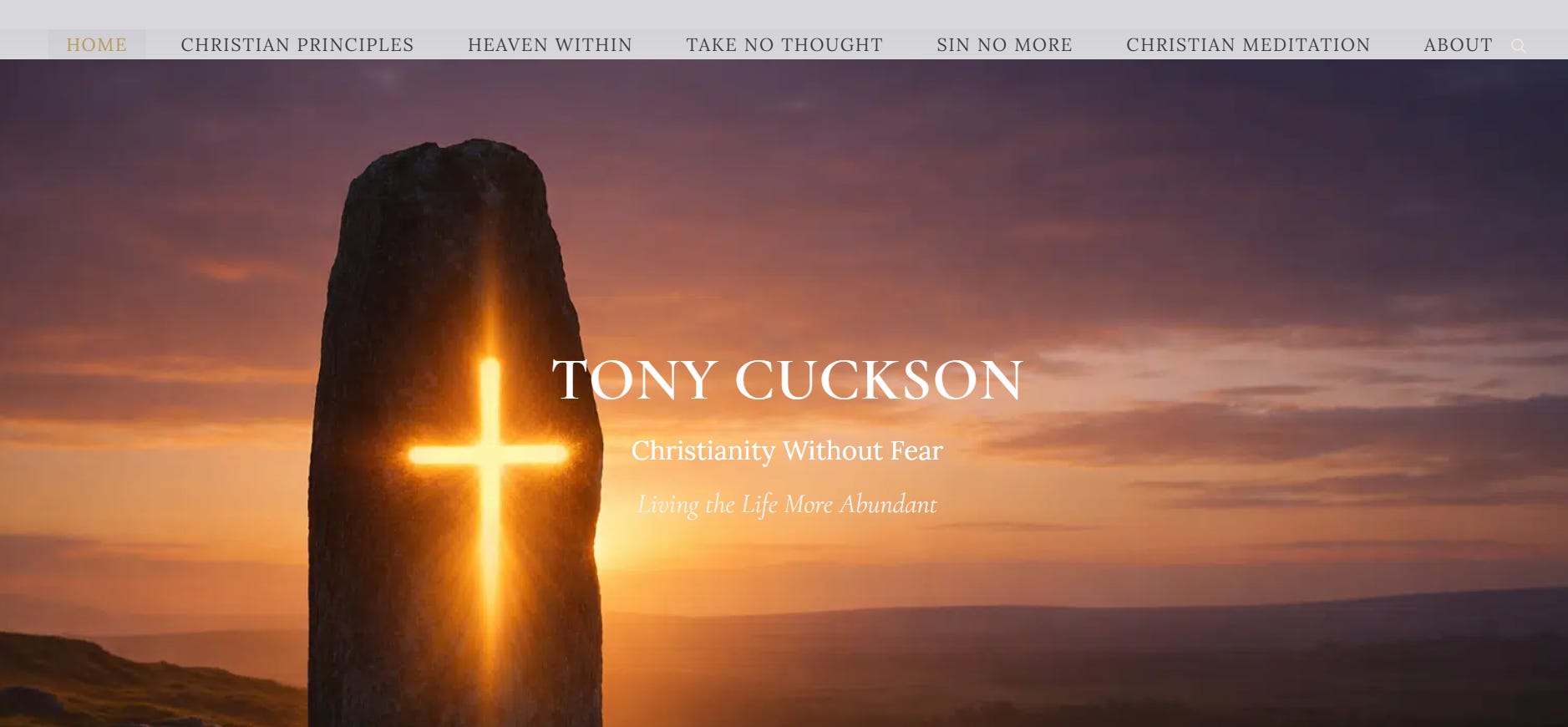
I now write in what I call series of reflections because this I think allows me to gather similar ideas around a specific theme together. Such series of reflections gather under titles such as Christian Principles for Living, Heaven is Within You, Go Sin No More, Take No Thought, and Christian Meditation, with many more already written on the hard sayings of the Master and the real power of prayer. What began as heavy resistance has become a quiet obedience. My hope is simply this: that you might discover for yourself that the teachings of the Master were never about fear, exclusion, or spiritual threat, but about freedom, union, and LIFE more abundant. If these reflections help even one person see that more clearly, then the gold in the shadow has done its work.
Tony Cuckson Cordressagagh Ireland
Comments
Nothing yet. Say the first thing.
Sign in to join the conversation.