
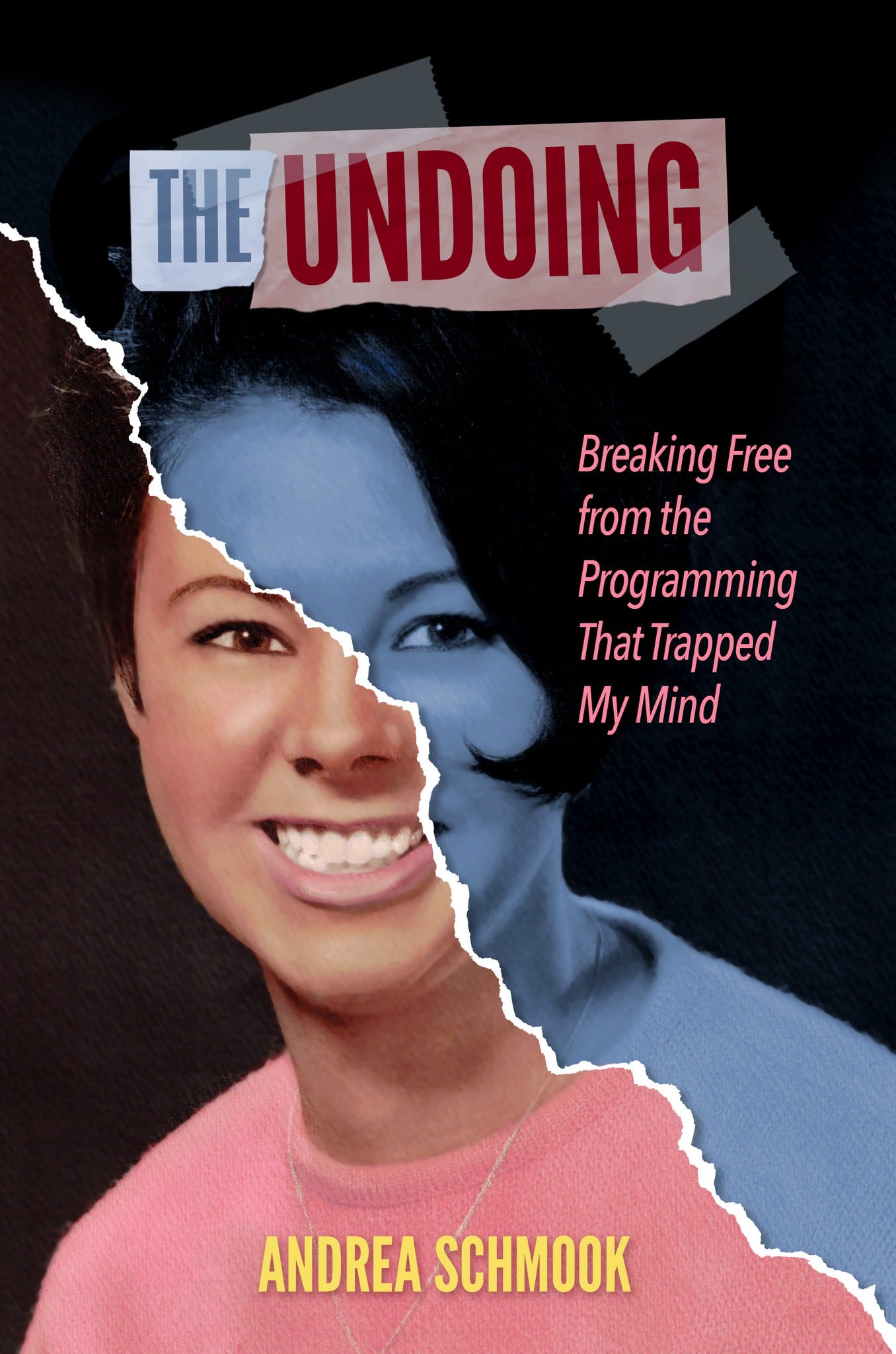
Mom’s book
My mother’s book was published recently, and I had the privilege of being its editor. In doing so, I read it countless times— refining her voice, correcting typos, streamlining the language, cleaning up redundancies, organizing content, double-checking facts, improving clarity— the usual stuff one does when editing. This was my gift to my mother because she needed an editor and I knew I could honor her story like no one else— but what I didn’t expect was the gift her story would be to me.
At first, I was just focused on the copy itself— correcting errors, refining language, etc., not getting too caught up in the narrative because I was raised on most of the stories and lived many of them myself. However, after several reviews of the material, it started to sink in, and suddenly, I not only saw my mother in a new light, but it became obvious what her book’s title was supposed to be— The Undoing: Breaking Free From the Programming That Trapped My Mind. The title was perfect because the word “undoing” demonstrated both her experience with mental illness as well as her ability to liberate herself from the programming that created the mental illness in the first place.
My mom was already a hero in my eyes— raising my brother and me on her own after my father divorced her, sacrificing for us, fighting for us, working hard to feed and shelter us, all while struggling with her own serious mental health issues— but now I realized just how much she’d had to overcome and how strong she really was.
What I saw now was that she came from women who were subjected to horrific abuses by the men in their lives— mental, emotional, physical, and even spiritual. Her father battered her mother and her oldest sister, often leaving my grandmother bruised and unconscious while he’d abandon her and the children, not even knowing if he’d killed her as he made his escape. He controlled the family with an iron fist, demanding his four daughters treat his word as rule of law. They were to stay at home and avoid speaking with or befriending boys, and they weren’t permitted to go away to school and earn degrees because boys would be there just to rape them. Ironically, this was all under the guise of “protecting them” and “keeping them safe,” while he also threatened to break their legs if they disobeyed him. My grandfather’s love for the women in his life meant that my mother was born blind in one eye because her father beat up her mother, kicking her in the stomach while she was pregnant with her.
Another of my grandfather’s greatest hits was to threaten his family with Hell. If his daughters were to marry outside of their own kind—Russian— God was going to punish them. Yet another irony is that DNA analysis proved only trace amounts of Russian in our family heritage. Because of my grandfather’s religious and physical abuse, my mother grew up incredibly sheltered and terrified of her father, of God, and of men.
By the time she was an adult, she had no comprehension of how to interact with the male gender, and had never seen what a healthy relationship with a man was supposed to look like— and she wasn’t the only one. Like their mother, even her next older sister, *Joyce, married a man who physically abused her, so by the time my mom met my father, she didn’t have the skills or the modeling to discern whether or not he was good for her.
He wasn’t.
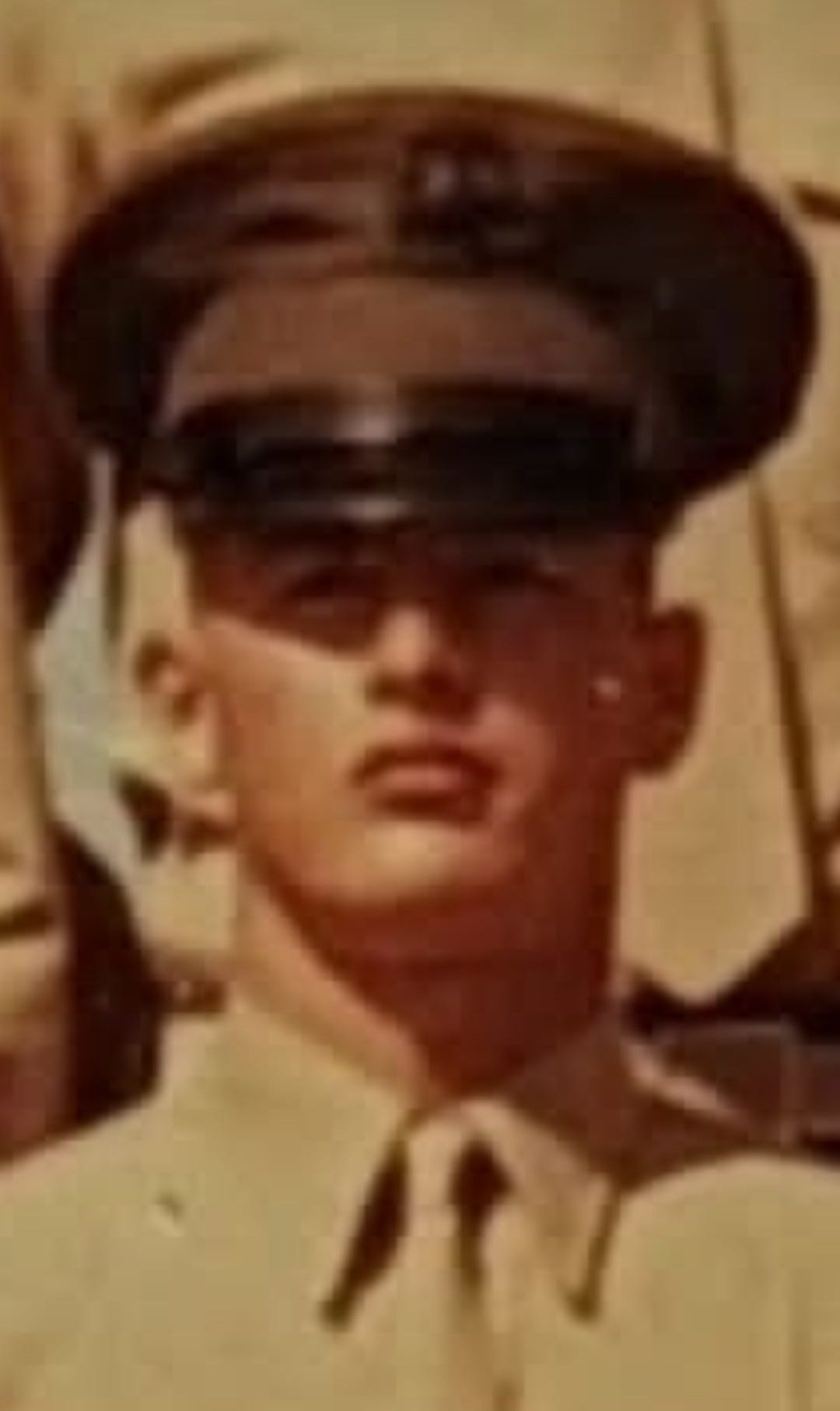
Dad at bootcamp
She was a fully grown woman when she finally moved out of her father’s house, sneaking away with her mother’s blessing and assistance, because he intended to keep her there forever, going so far as to remove the distributor cap from her car so she couldn’t leave. She was young and beautiful when she moved in with her best friend, *Carol, and she was able to experience a little freedom for the first time in her life. My mother discovered that she loved to dance, so she and her friends would go out dancing, go to movies, and drive up and down the strip. She and Carol were in her car when she met my father, a handsome ex-Marine from Montana who’d fought in Vietnam.
When she finally realized my dad was a bad fit for her, it was too late. My grandfather’s programming had found fertile ground in my mother, who was the youngest and most impressionable of the siblings. My mother took his teaching to heart— when you make your bed, you sleep in it. She really believed she was a sinner who was going to Hell just for marrying my Irish/English/Scottish/German father, especially when she was excommunicated from her church because my father had never been baptized and had no interest in letting my mother’s church administer baptism to him. In my mother’s mind, she had committed a mortal sin and God was going to punish her.
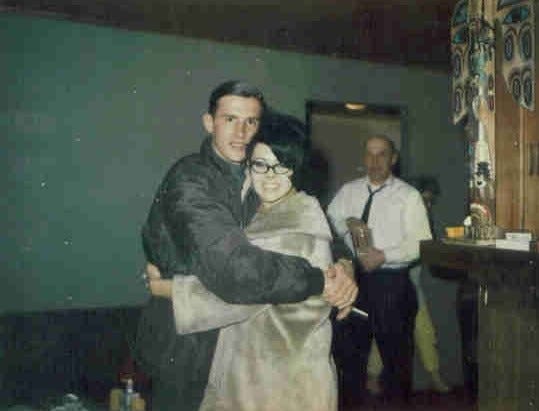
Mom and Dad during happier times (with my much-adored paternal grandparents in the background)
To compound the issue, my father was an emotionally abusive alcoholic, who was every bit as demanding as my grandfather had been. He laid down the law, commanding us all to fall in line or be punished. In my father’s house, he was king and my mother was his slave— only there to serve his needs. Shortly after they were married, he explained to her that marriage was a 90/10 prospect— 90% for the man, and 10% for the woman, saying, “If you’re lucky, you’ll get your 10%.”
She didn’t.
After years of this kind of abuse, my mother finally cracked. One day, when I was nine years old and my brother was six, my mother had a nervous breakdown and ended up in a mental hospital. It wasn’t long thereafter that my father divorced her and kicked us all out of the house. However, it was this undoing that saved her, and this is where my mother discovered her own strength. She went from a childhood where she was sheltered, unskilled, and terrorized, to a marriage where she was disrespected, neglected, and terrorized, to the mental institution where she was forcibly drugged and told she’d never get better, to working full-time and keeping a roof over our heads as a single mom, all while still occasionally having bipolar and schizophrenic episodes.
Not only did my mother support us—she thrived. She realized that all the programming she’d received from her father, from my father, from her church, and her religion was wrong. She began to “uninstall” their programming and instead “install” her own— choosing love over hate, trust over fear, strength over weakness. It took eight years, but my mother finally healed herself, transformed herself into a new person, and recovered her life (becoming completely medication free). And when she did, she began helping others. The governor appointed her to his mental health board, and she was hired as the head of the state consumer affairs office where she developed consumer/peer support services for those who were struggling with mental illness.
Over time, she became a consultant, traveling the country and giving presentations about her story and how she was able to heal and recover her life on her own terms. She returned to the same mental institution that had locked her up— not as a patient, but as someone they called when the professionals needed outside help with patients. Later, she also worked for the same community mental health center where she’d received services herself, and eventually, she founded non-profit organizations, trained psychologists and psychiatrists, worked in the field, and attended national and international conferences, often as a keynote speaker.
My mother is my hero.
For most of my life I wanted to distance myself from her story and from all of the trauma in my family. I just wanted to be “normal”— to be like everyone else— so I averaged myself down, hiding behind the things that were culturally acceptable so I wouldn’t stand out like the awkward, lonely failure I believed I really was. I had an active social life, went out on dates, wore cute clothes, got involved in teenage drinking— you know, “normal stuff.” (be pretty, let the boys think they’re smarter than you, be cool, just try to fit in)I went to college because it was the “normal” thing to do, but by my junior year I really fell apart and left school altogether, making my way to Seattle, where I lived off and on for a few years. I realize now that I really should have gone to Europe instead of college and maybe found a school to attend there— perhaps studying journalism, but probably art. (I always knew I’d be a writer so it didn’t really matter what I studied.)
But I had inherited a lot of my father’s programming about the value of women and a lot of my mother’s mental and emotional dynamics, so I kept breaking in my own way, especially as time went on (depression, anxiety, panic attacks, self-loathing, suicidal ideation). I didn’t even feel like I deserved a “normal life,” so I began to subconsciously avoid those markers that would have proved I was “normal.” I became angry and resentful as I watched things pass me by and I lashed out at people, but mostly, I punished and hated myself. I worked demeaning, low-paying jobs because I had no value.
A year or so before my father passed away in 2021, I finally began to see how damaging the dominant program has been to women within our cultural paradigm, and part of that realization involved seeing how much my father had contributed to it and how much it affected me. Before that, I was pretty much oblivious to it because I was still invested in the program, but when I finally saw the truth, it was my own undoing—
but in the best of ways.
About six months before my father died, I sent a photo of a painting I had done to my stepmother so she and my father could see it. I wouldn’t exactly call it a self-portrait because I wasn’t trying to capture my actual physical appearance. It was folksy, and representational of how I saw myself on the inside— someone who was deeply, deeply spiritual, but not religious. Moments after seeing the photo, my father called. The first words out of his mouth were, “I hate it. It’s a piece of shit.”
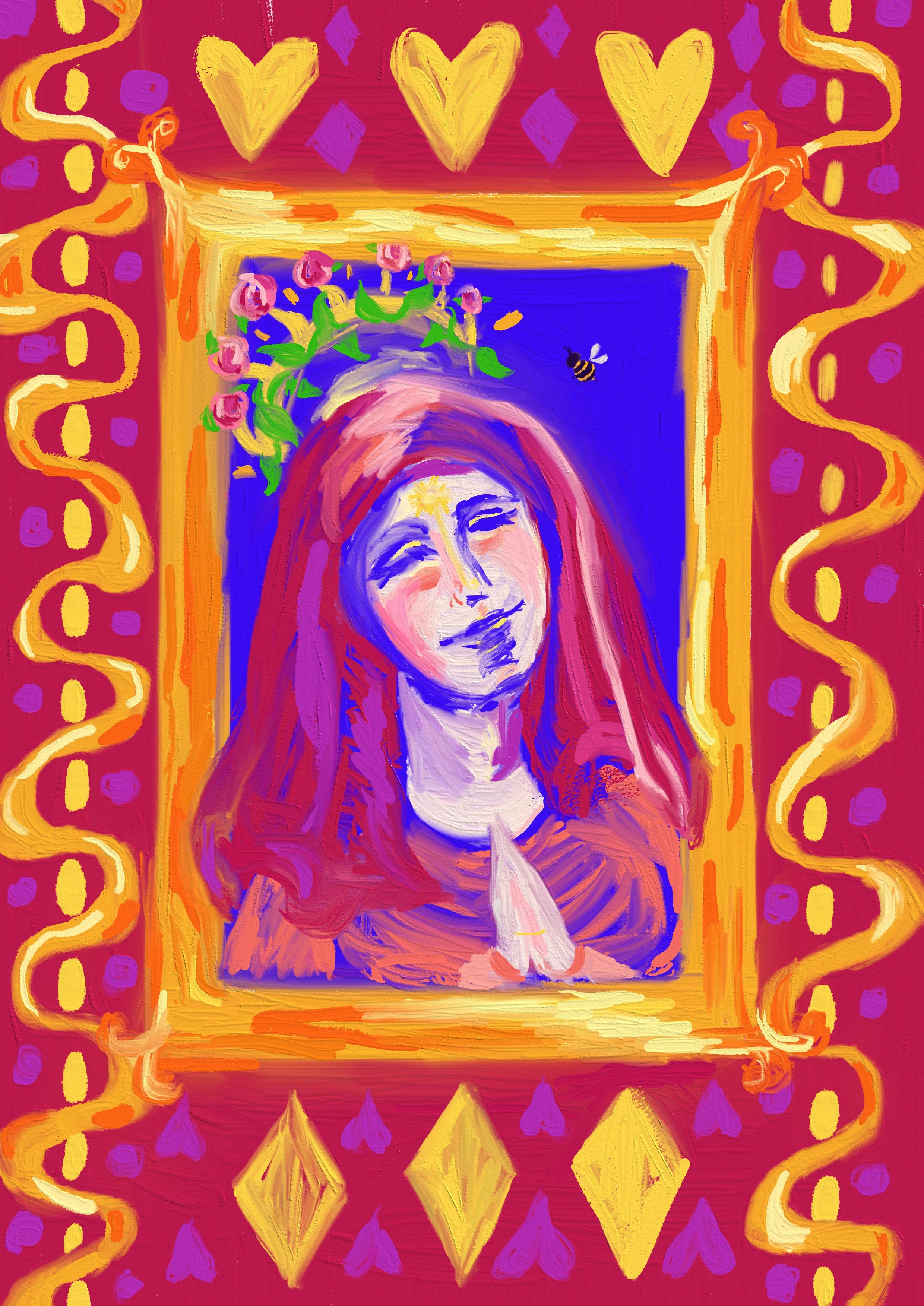
My “piece of shit” painting
But this didn’t crush me the way I expected it to— the way it would have in the past. For the first time in my life I realized that I didn’t care what he thought. I was finally liberated from all of his ugliness and his expectations about who I should be as a female in this world. Now I could be whoever I wanted to be, someone that I valued— a woman who empowered herself to play by her own rules. I saw that I could forge my own identity.
I loved my father, but it was time for me to break free from his programming, and now everywhere I looked I saw how that same program had been running in the world all around me. It’s in our churches, our schools, our government, our entertainment, in our friends, in our romantic relationships, in ourselves.
Magazines, movies, television, social media, and advertising show us what the “ideal woman” is and how we should aspire to be her. The workplace contains and restrains us with lower pay and fewer opportunities; the medical system gives us a pill, tells us we’re delusional, pats us on the head, and sends us on our way without trying to find the source of our suffering; our government only gives us our rights and freedoms under extreme pressure (and is now taking them away again); and our fashion industry requires us to squeeze, pluck, and starve ourselves into ridiculous, exploitative, and often painful clothing and accessories in order to meet acceptable measures of “beauty” (Victoria’s Secret, stiletto heels, bikinis, mini-skirts, etc., ad infinitum).
I could go on, but you get the idea. I was seeing the program everywhere now, and I couldn’t unsee it. I started to remember all of the times I experienced it out in the world and how it didn’t register at the time. This became my undoing, and it became something of a conscious process to keep my eyes open and see the world as it really is so I could dismantle the program within myself and re-write it the way I want it to be— just as my mother did before me when she healed herself from mental illness, just as her sister did before her when she left her abusive husband and built a beautiful life for herself and her children, just as my grandmother did before them when my grandfather died and she started her own career for the first time in her life.
My mother’s story taught me that I come from powerful, resilient women— women who are much stronger than the men in their lives. We still love these men. We forgive them, but we know we deserve better— whether it’s through remaining alone and shaping our lives in a way that makes us happy, or with a partner who disregards the program and respects us and treats us as their equal.
I’m so grateful that I’ve inherited this signal of undoing because the women who came before me discovered their own agency later in their lives after much trauma, and it’s clear that I’m now repeating their pattern. My undoing, like my mother’s, is an enduring, ongoing journey that leads to my evolution, and I, for one, look forward to seeing where it’s going as I continue the work and follow my own heart.
*Names have been changed.
No posts
Comments
Nothing yet. Say the first thing.
Sign in to join the conversation.