
Most people know sunlight helps produce vitamin D.
Some know it influences melatonin.
A few know it affects dopamine.
But almost nobody talks about POMC.
And yet this may be one of the most important hormone pathways connecting sunlight to human health.
Because POMC helps explain why sunlight affects:
• skin pigmentation
• appetite
• metabolism
• stress resilience
• mood
• pleasure and reward
All at the same time.
POMC stands for:
Proopiomelanocortin
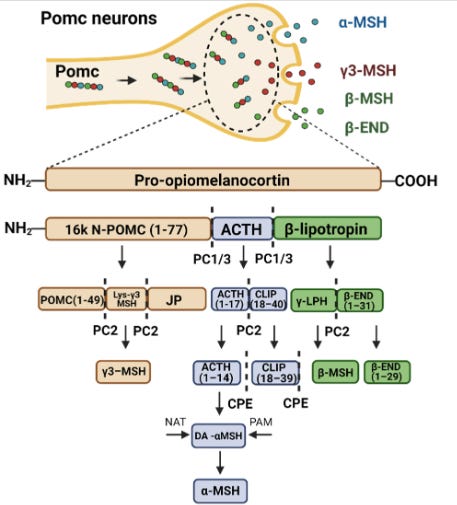
It’s a large precursor molecule produced primarily in the pituitary gland and hypothalamus.
Think of it like a master protein that gets cut into several different hormones.
Those hormones include:
• ACTH
• alpha-MSH
• beta-endorphin
Each one has powerful effects throughout the body.
One of the products of POMC is alpha-MSH (melanocyte-stimulating hormone).
As the name suggests, alpha-MSH stimulates melanocytes to produce melanin.
More sunlight → more alpha-MSH → more melanin.
This is one of the ways the body builds natural solar protection.
The tanning response isn’t random.
It’s hormonally coordinated.
Another POMC-derived molecule is beta-endorphin.
These are natural opioids produced by your own body.
They promote:
• feelings of well-being
• relaxation
• pleasure
• resilience
Researchers have found that UV exposure can increase beta-endorphin production.
This may help explain why many people feel calmer, happier, and more grounded after spending time outdoors.
The body appears to reward appropriate sunlight exposure.
POMC also produces ACTH (adrenocorticotropic hormone).
ACTH stimulates the adrenal glands and plays a role in cortisol regulation.
This creates another link between sunlight and stress resilience.
Sunlight isn’t just influencing the skin.
It’s helping organize the hormonal systems that allow us to adapt to life itself.
One of the lesser-known roles of POMC neurons is appetite regulation.
Healthy POMC signaling helps communicate:
• satiety
• energy availability
• metabolic status
This is one reason seasonal light exposure may influence hunger patterns throughout the year.
The body uses sunlight as information about environmental conditions.
Modern health often focuses on nutrients.
But sunlight is not a nutrient.
It is information.
The body interprets light signals and adjusts physiology accordingly.
POMC is one of the mechanisms that allows that translation to occur.
Sunlight hits the eyes and skin.
Hormones respond.
Behavior changes.
Metabolism shifts.
Adaptation occurs.
When sunlight exposure decreases and artificial light dominates, these signaling pathways may become less coherent.
The body loses some of the information it evolved to depend upon.
This may contribute to:
• appetite dysregulation
• mood changes
• circadian disruption
• poor stress resilience
Not because the body is broken.
But because it is missing critical environmental signals.
Thanks for reading! This post is public so feel free to share it.
Throughout this series we’ve explored:
• melanin
• solar adaptation
• nutrition and sunburn
• vitamin D
• sunscreen
• sunglasses
POMC helps connect all of these topics.
It reminds us that sunlight isn’t simply energy.
It is communication.
And the body has evolved sophisticated systems to listen.
The question is:
Are we still giving it the signal?
If there’s one thing I hope this article leaves you with, it’s that your body is constantly responding to signals from its environment.
Light isn’t just something we see.
It’s information that influences your hormones, metabolism, appetite, mood, sleep, and overall resilience.
The challenge is that most of us are living in environments our biology never evolved for—surrounded by artificial light, spending most of our days indoors, disconnected from the seasonal rhythms that once shaped human health.
The good news?
Small changes can make a profound difference.
If you’d like to learn how to optimize your light environment and support your circadian biology, I invite you to join my Get Your Light Right Webinar, where I teach:
☀️ How sunlight influences hormones, metabolism, and mitochondrial function
☀️ Why morning light is one of the most powerful health tools available
☀️ How artificial light impacts sleep, energy, and cellular health
☀️ Practical ways to create a more biologically supportive home environment
And because light and nutrition work together, my Ancestrally & Seasonally Nourished Masterclass explores how to:
🥩 Reduce inflammatory modern foods
🌱 Eat with the seasons
🫐 Incorporate nutrient-dense, antioxidant-rich foods that support resilience
🍳 Nourish your body in alignment with your environment
You’ll also receive my Recipe Ebook, filled with practical recipes designed to help you implement these principles in everyday life.
And if you’re looking for personalized guidance, I also work with clients 1:1, helping them address the deeper layers of health through a lens of circadian biology, nutrition, homeopathy, nervous system regulation, and environmental health.
You can explore all of these resources here:
https://brightlightwellnesscoach.com/
Book in a session with Vanessa here
https://brightlightwellnesscoach.com/services
Get Your Light Right Webinar & Ebook: https://payhip.com/b/T9h1x
Ancestrally & Seasonally Nourished Webinar & Recipe Ebook: https://payhip.com/b/8UKbF
If this article shifted your perspective, I’d love for you to:
❤️ Share it with a friend
💬 Leave a comment below with your biggest takeaway
📩 Subscribe so you don’t miss the next article in this series
Coming next:
Why Morning Sunlight Is Different Than Midday Sunlight: The Missing Role of Infrared Light in Human Health
Because when it comes to sunlight, timing matters just as much as exposure.
No posts
Comments
Nothing yet. Say the first thing.
Sign in to join the conversation.