
As I’ve written many times before, this blog is about huffing glue with your friends—as it is and will forever be—but at the same time there’s a world of distance between you and I right now, friends (or foes).
And by “world” in this sense, I mean the physical distance. The surface-level definition. If we were to lay out enough yardsticks between you reading this and me writing this, there would be a solid numerical distance we could make out and it’s probably not as absurd a number as either of us might initially imagine; but then that unlocks another avenue. In a more murky sense, there’s also Emotional Distance shared between us. By this I mean that intimacy and personal knowing contribute to a different sense of distance than the “yardstick” version of distance. Considering there are over 7.5k of you getting these emails/posts, the lived distance here feels quite vast indeed.
That’s not all. If it was this post would be quite a bit shorter than it’s turned out to be. The Informational Distance of this post is absurdly close. In a way, we’re right up in each other’s faces. You can comment, restack whatever. This informational distance is furthered by the closeness by which a platform like Substack might represent, mechanized systems of instantaneous distribution. Just like any of the networked messaging services that have appeared in our lives, texting, email, messaging, and social networks may make our communications more streamlined and frictionless but those traits doesn’t necessarily make online communication any closer to us in a real sense than sharing space or even the intimacies of a handwritten letter might.
What might seem closest to us in terms of Ease of Access might be actually be further away when we consider it from the perspective of a more intuitive understanding of our immediate surroundings. When you wear a pair of corrective glasses, there’s no denying the lens are physically close to your face—they’re on your face, literally—but are they close to our feeling? Are they close in terms of our unconscious understanding of our surroundings? I would argue that as glasses are more-or-less forgotten when they’re on our faces, with time they become perhaps the furthest thing away. To put it a different way: our glasses are as much a part of us as our eyes, and unless there are vision problems, we won’t be thinking about our glasses all that much.
If glasses are an extensions of ourself, if they are taken for granted (as they are meant to be), they have to be forgotten. And thus there’s distance. Emotional distance, maybe. Distance á la Vibes, you could say. In a sense your glasses are further away from you than what you’re using them to look at.
Such humdrum observations seem intuitive, obvious. But minor explorations like this tend to be the avenues through which our imagination can create something new. And breaking the idea of distance and space into different parts and different definitions feels important in the moment. We’ll get to the why in a bit.
Like our glasses in their Taken For Granted way, our phones aren’t much closer to our feeling of its surroundings. In this sense they are far away from us when they’re in our hand, they’re a little less far from us when they’re in our pocket. The only time we ever feel truly close to our phones in this Feelings sort of way is when we’ve lost track of the phone and searching frantically around the room for them, under couch cushions, etc. The same logic might go for a vape (been there). It’s a surreal feeling to lose a phone; it’s not very often that we misplace an arm or a leg. There’s certainly a difference between glasses and a phone but our phones, like our glasses, when being used properly as intended exist outside the consideration and curiosity which so much of our surroundings demand of us. Glasses and phones both depict a world: the former the real world of refracted light, the latter the digital. Both portals are meant to encourage and tend to our human curiosity, passions, and considerations, except the latter in this case has promised everyone on Earth and sandpapered down all the friction between them.
So what does this mean for the internet? Well I guess what I’m trying to argue here (and who knows where this is going) is that the Ease of Access of our network communications reduces the consideration and (empathetic) caution which intimacy has demanded of the human being’s communication with other human beings since the dawn of time. The Human Condition, in other words, is under new management.

Language barriers, body language, even the reproduction of text have all dealt their goods over hefty, daunting barriers which required nuance to cross.
Communicating to someone without taking in the consideration of their perspective has forever been a dangerous task—in person you might get pummeled, in print you might also get pummeled, etc.—but working through those barriers of consideration engendered actual closeness and, moreover, social courage.
Empathy and understanding find their use in our interpersonal lives. These are skills we learn by practice and by repetition. Love emerges out from the nuances of small cues, small understandings, small curiosities like a great stink. But we’re in a time without smells. We’re inside our phones for most of the time, and, as if we’re wearing a pair of glasses, our phones are the furthest thing in the world from us in our everyday use of them. They’re lenses into a fantasy world in which time is stretched and shrunk, distance is abolished, and our communications with one another are frictionless to such a degree that it’s only the slight lag of our fingers tapping out words that provide whatever friction there is. Most of the notable “innovations” in phone technology since the iPhone first dropped have been towards reducing this friction, be that in voice-to-text or in the autocomplete feature in iMessages. But that doesn’t change the fact that, in pursuit of perfectly efficient and instant global communications, the necessary nuances that turn communication into intimacies are scrubbed out as casualty of a defeated & unnecessary friction.
So we feel closer to one another in our heads but not in our hearts. Our lives become unnecessarily abstracted, connected by reproductions in screen, camera, microphone, or speaker all of which we’ve trained ourselves to wield as if we were born with canons for arms. And in a way, in being born in a time when all this was to take place, we were born with canons on our arms. If any of you reading this were born after 2007, certainly you could be said to have been born with your arm canon waiting somewhere in as some number in projection of future revenue for a cell phone manufacturer. But as the best Wallace & Gromit short (imo), The Wrong Trousers, pointed out: mechanized appendages—be them phones or pants—give advantage to people with ulterior motives who better understand the mechanics of the system we’ve given our trust over to. If only it had been Feathers McGraw instead of the small Straussian assembly of technofascists we were give. At least he was only after a blue diamond. That’s reasonable. Also Feathers McGraw had a coolass revolver and the swagger to pull it off.

Anyways, as I wrote a month and a half ago or whatever, the voice of a platform is more often than not the platform itself:
“As a little experiment, ask yourself whose voice is the voice of Substack? whose voice is the voice of Facebook or Twitter? The example of Reddit might be the best giveaway of the (meta) answer here in that the writerly voice of Reddit is that of Reddit itself. The ghost of Marshall McLuhan breezes through, whispering “the medium is the message,” and we’re reminded that the constraints and rules of an online platform, being the medium in which the writing, video, or audio is inscribed, dictates the voice of the content. Success on a platform’s algorithm is based not on the merits of the writing in its own terms but on its conformity to the way that the platform disseminates content. It’s impossible to write anything on Substack without writing in the voice of Substack itself.”
A platform’s public square is created not necessarily through proximity of users but through conformity of participation, and so it’s important to understand that when you read anything or write anything on Substack, the platform itself will always be third wheeling. But so will all the other network technologies that allow this to happen. They themselves communicate. Quite literally, too. Phones communicate to routers communicate to modems communicate to local ISPs communicate to Satellites and so on and so forth until the ends of the digital world. And those ends are two: you and I. While networked communication can’t embody the intimacy of human connection which makes human connection so worthwhile, it also can’t quite eclipse it unless, of course, we concede any desire for experiential distance, aka soul-distance. Let us not concede. We must keep in mind that real intimacy requires friction. The effort it takes to communicate is essential. Automating that effort out of the process also automates out understanding, curiosity, and intimacy. Living on our phones and in our concrete cities, these prisons we’ve created for ourselves, the last remaining utopian idea is that we can remain wrinkle-free forever and purely isolated from anything that might cause laugh lines: we can be as cold and detached as our electronics are.
Okay… so I got very much off track with the above; I meant to talk for a little bit about the United States. Life in the United States is strange right now. It’s always been strange. The contradictions of the country have been here since its founding and thus every generation that’s grown up here has found their own brand of eerie temperature, but the greatest contradiction I can see about this country, aside from the genocides and enslavements and global apartheids and all the rest, is that this country is predicated on physical distance. National transportation infrastructure ceased sometime around Eisenhower and as the old New Deal systems fracture, to live without a car is to exist on an island in a great, vast ocean connected by highways. There are some trains, busses, planes, but without the money to buy tickets, most of us are left to our little islands. Not to say all these islands are bad. Chicago is mine and it’s a fairly nice island. The people are nice and humble (for the most part). But it’s important to understand that the way the US works is based on structured and cultivated distance, the arrangement of peoples and electoral blocs across vast distances.
The internet as it is today is built for this distance, not despite it. It exists throughout the rest of the US-subjugated world, too, sure, but it was designed for this situation in particular, and to resolve the tension between the oh-so American dream of local and individual independence with the broader scope of the top-down national culture which developed in the latter half of the twentieth century to distract and support the ruling class’s economic and geopolitical prerogatives. Combine individualism with propaganda. It’s why Facebook, Google, and X all have elaborate backdoors for federal agencies. And this is also precisely the dilemma which has driven so much of the United States’ people so crazy because the contradiction between the gospel of individualism and the gospel of mass market pop-culture discourse are not at all compatible. As an American I was raised to worship independence and to worship mass culture. The platform economy tangles the two in a way that is simply not sustainable for the two major threads of modern american pop ideologies. Combine this with the wealthy and the not-so-wealthy-but-still-elitist talking through their teeth and between the lines, in an esoteric sort of Straussian language mastered by the likes of Bari Weiss and Ezra Klein, and people—wouldn’t you know it—go a little crazy.
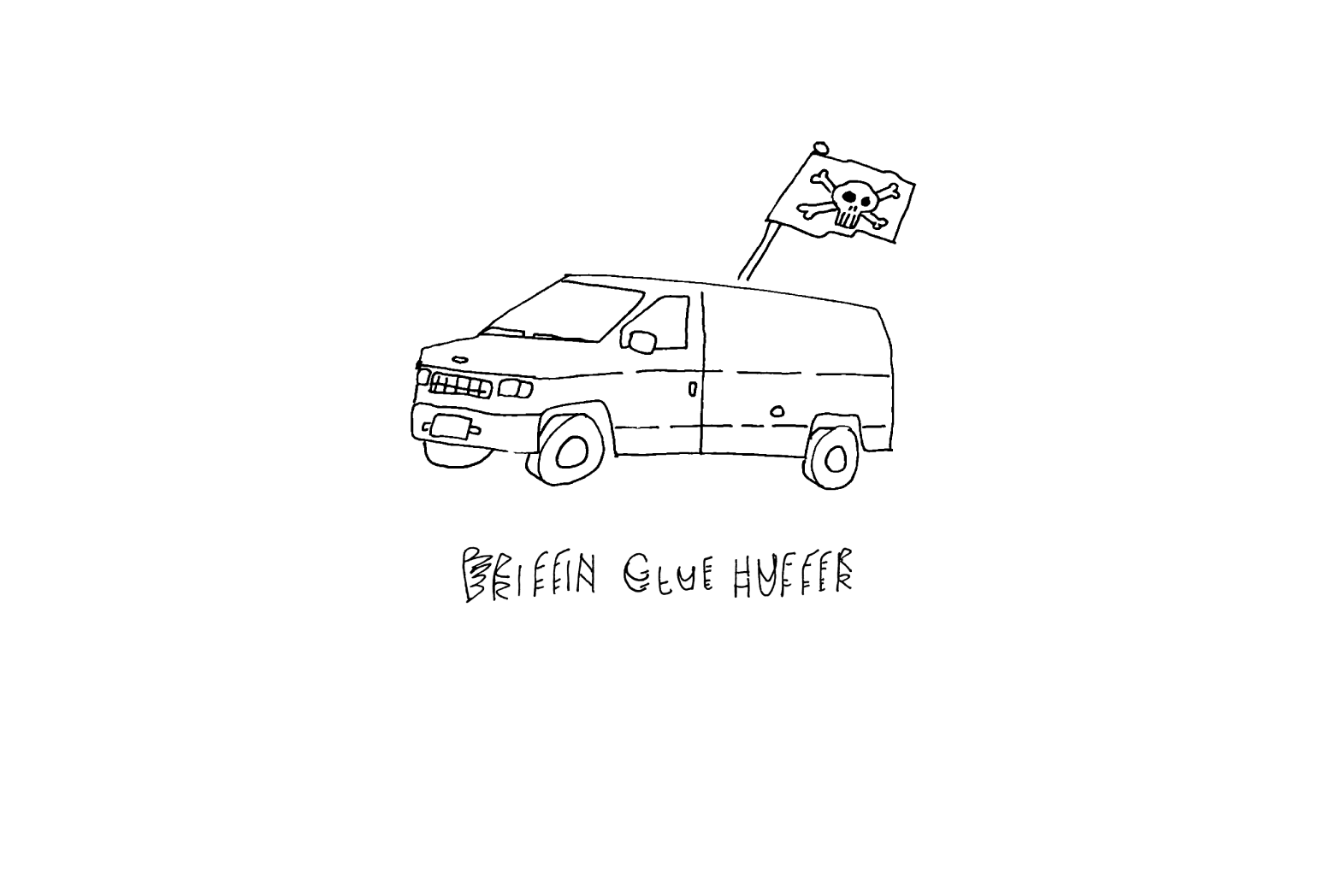
This should also help us explain the terror of the image of the unmarked, windowless van.
When the American landscape of a million disconnected islands to be abducted by masked federal agents isn’t so different from being raided by pirates—if there were the latter, we wouldn’t be able to tell much of a difference and an ICE insignia is no more than a skull over crossed bones. I mentioned above that Chicago is my island. The island where I live. It’s also the island where many of the people whom I know and love also live. Some of them are undocumented. I work in the food service industry and have been close with at least three different kitchen staffs. The restaurant where I work now is on a street where there’s been heightened ICE presence the past week. They’ve been entering restaurants, getting more bold, and in our company chats—shout out to our front of house management in this regard—we’ve been figuring out protocols to keep our staff safe. It’s a very frightening time. Because, again, in the United States our infrastructure is so rotted that if someone is to be abducted by these pirates and swept away, they’re to be swept away into the vast American ocean, into the unknown dusk of still waters under which the sharks lurk, waiting for blood.
An interesting quirk, taking into account the dynamics of physical, emotional, and informational distance, the “ICE agent” as figure is far in a physical sense, even further away in an emotional sense, but right here in our faces in an informational sense. So close, in fact, that we become blinded by how close they are physically. And closer. And closer. And by that point it’s too late. It’s an important moment to take care of one another. These are scary times. These are times when we need to rediscover the nuances of protection, of solidarity. We need to be there for each other because the ships are coming and only through local networks of support can we keep ourselves and each another safe.
Anyways, this was the first of a two-parter on the Briffin Glue Huffer emphasizing dynamics of Space & Time. Next week, duh, is going to be about lived time through the lens of Minkowski’s wonderful book Lived Time and through the lens of Yeats’ poem The Lake Isle of Innisfree. Stay safe until then.
-gbe
Comments
Nothing yet. Say the first thing.
Sign in to join the conversation.