
My day was spent with words, in words, outside of words, writing and reading. But every word spent is a word that’s been mangled and I came out of the experience feeling exhausted. The clay of a day well molded, I suppose, is that which is tired.
But molded into what? There’s some secret dark mystery beneath all these well lit trees, sidewalks, and street signs as I walked home from the park. I fear words can only dance around their periphery, that words are more the cataracts to true experience than they can ever be a center to anything. It’s such a dullness to be trapped in time with the suspicion that there’s something more where the wind meets the rain. Makes me feel foolish to have spent seven years of my life now trying to be a “writer,” and that label is in itself its own can of worms. Anyways… Moving on…
Reading is an interesting act. Whether the reader is aware or not, the interest the reader takes in text is an interest in being indicated away to some other place. The words themselves don’t do much to flesh out the moment of reading. They indicate that moment elsewhere, away; the body remains stationary but, in that steadfast connection between body and mind, the body reaches into that invisible realm which the words indicate.
Like two magnets with the positive or negative ends pushed together, an impenetrable marble is created between the reader and the text and it’s from that struggle of connection, that struggle of reading, that hazy struggle of comprehension, that the reader falls into the strange, invisible gap between reality and imagination which constitutes a good read. The word “falling” is key here. The act of reading is an act of falling just as the act of finding meaning in life is an act of falling off a similar sort of marble of magnetism. More on that in a bit. When reading, the text becomes invisible. The reader too becomes invisible. The act of reading becomes a mutually shared daydream, an imaginary movement.
So if reading could be considered an act of invisibility, how can we take this point to apply to lived experience? How does invisibility bloom?
I’ll get a little more literal. I ate lunch today, like I do most days, and I poured apple juice into a glass from a refrigerated pitcher and cold steam flickered off of its sides while it sat cold on the dining room table. I looked at this with small wonder. My imaginary glass of apple cider was soon to explode. My actual glass of apple cider was simply a cold glass in a hot room. I bring this up to illustrate the contrast I’m trying to get at: in a hot room, on one hand, the cold of condensation makes itself visible just as, on the other hand, my warm breath will float on a frigid morning in December. These make two similar visual motifs on opposite ends of the spectrum of experience.
Another example: when I was a child, I was entranced by the way hot water feels initially cold against the skin and how ice cold water initially feels burning hot. There’s no rationalization to be made here; the brain remains an irrational device in so many ways. Despite the crossing of sensory motifs, neither of these two phenomena can happen simultaneously and the mind bends backwards trying to picture a scenario in which they can.
“Syllapsies” is a greek word I came across while reading Iain McGilchrist’s wonderful The Matter With Things — in case you’re wondering why there’s no monthly reading recap for July, it’s because The Matter With Things is 1,579 pages long and I have yet to finish reading its second volume. “Syllapsies” lacks a distinct English translation but means, as far as I can tell, the graspings which take place within a moment of comprehension; More specifically in the moment of dawning of generative(!) insight which emerges out from a combination of like or unlike pairs. It is not the friction between contradictions but instead the process which emerges out from that friction.
Okay, so if we’re to continue interrogating invisibility, why not move onto the eye itself? Light can be seen as both a wave and as a particle, and what we know as “light” is both of these things at once; the phenomena we experience when we witness light sits neatly between the waves, the particles, our retinas, our optical nerve, and our inner threshold of prior experience seeing. It blossoms not as any of these individual parts or definitions but in their accumulation as “sight,” which might also — in a seeming contradiction! — be considered as a form of invisibility.
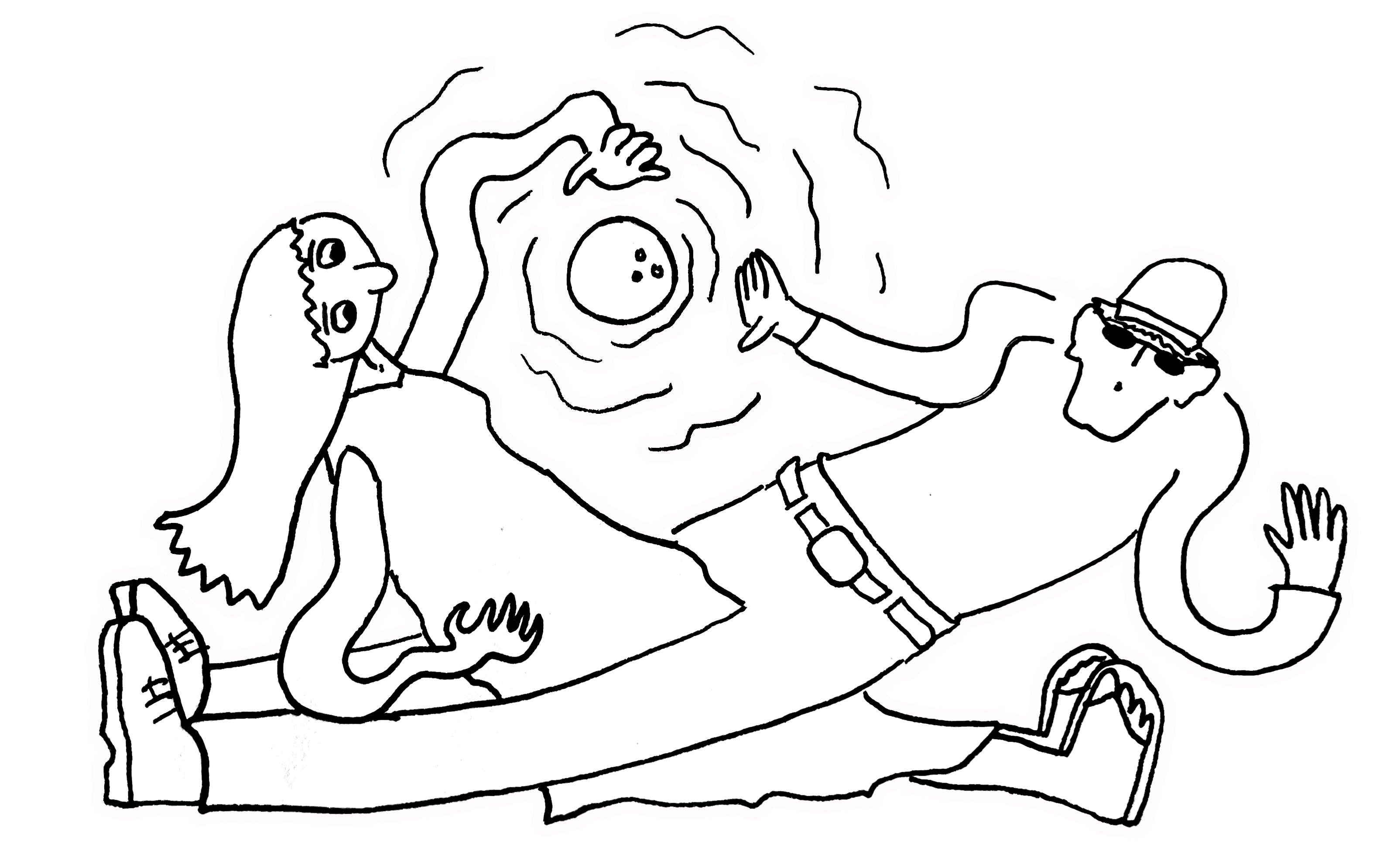
One of Martin Heidegger’s more famous quotes1 translates from the German into “nothing noths.” Nothing, as a concept, means the absence of any thing. Nothing, in its pure sense, is not a vacuum nor is it a void. Both “vacuum” and “void” presuppose something else, that things have existed within the space of Nothing or exist outside of Nothing. “Nothing” in its pure sense has no ties to things, not even relational ties. Yet, all the same, nothing does perform an action, at least in language. For Heidegger, it noths. And, in a way, this action is something. So a contradiction is formed and existence forms out of non-existence. Another marble of magnetism: one big enough to be rolled like a bowling ball. It leads us to consider a potential answer to why there’s something and not nothing, that pesky and primordial question of philosophy. All experience emerges from such paradoxes just as a negative number multiplied by another negative number gives us a positive outcome: being exists within non-being.
Returning now to invisibility as a concept, perhaps invisibility blooms like “Nothing” blooms, in the silence of night and darkness, in forgetting, in dementia and in death. And here’s the moon’s function in our dreams: a light to illuminate and mediate the forgetful night, concealing and revealing itself over the course of months. All of human mythology exists, in a small way, between the sun and the moon and I imagine we can presume most animal and vegetable life feels similar. By all means, then, we should consider the moon as an anchor for our mythical notions of invisibility. It’s nothing but a great big rock if we don’t also consider its bimonthly disappearing act and what that might imply.
Okay okay, all that being said, this is a Substack article after all, and a paywalled one at that, so what lessons can we take away from this?
Comments
Nothing yet. Say the first thing.
Sign in to join the conversation.