
When I walk downhill on a clear September day, a small personal happiness comes over me, the joy of momentum. The steeper the hill the better the fall (and the best part of the fall is when the temperature makes its dramatic descent… more on that later…). A downhill walk becomes a bounding jaunt and finally turns into a light jog on tender feet, secured by this material agreement between flat rubber and flat concrete, the friction they share, and I feel my soul itself taking flight, a quick cascade, a rolling down the slope of the Earth, my human heart seeming to align with the whole of the world rolling like a fatal action downwards, like a glorious fall, like a great sphere of existence let loose for a few moments. Sisyphus loses his grip. Atlas goes bowling.
To take flight in such a downhill way produces a flutter in the heart not too dissimilar from the knowing convulsions of a bird’s wing in flight—perhaps it is in this similar feeling that we can get an inner sense of our evolutionary relatedness to the feathery denizens of the world (or at the very least get an idea of how instinctively and ecstatically those wings might work)—and for that I can’t thank the natural landscape of a city enough; what a wonderful thing, being alive. What a wonderful thing to have a body.
And such a downwards progression of walk->run->walk gives us an answer to the question which that all-too-common (yet very ancient) image of the human heel with small wings might mean for us in our own living: our heels yearn to take flight. There are no wings on my heels when I look down but that can’t dissuade my ankles from feeling that there are. My heels, it seems, believe fully in my ability to fly.
Every step we take is a small journey, every pace a bite-sized flight. But what a great flight it would be for an ant! When I was a child, much (um) bigger than an ant, I would walk around the neighborhood bouncing on my toes, my ankles too eager to live off of the ground; now as an adult I unfortunately shuffle around more like Charlie Chaplain that I might have bounded around like a goat, but here and there I sometimes rediscover that urge in my heels, that surefire belief inside their flesh, nerves, and bone that they held the secret to oneiric—or perhaps even actual—flight.
Dreams of flying are common enough that they can be looked at, I think, as a collective imagining of humanity. Yet I can’t help but wonder whether the field mouse dreams of flight too. What might a mouse think when it sees a bat midair? Would such an encounter inspire dreams? Life aspires towards verticality, moles dig down and birds fly up, and yet verticality provokes some of our most understood fears. Vertigo, for instance, strikes all of us as the inversion of the dream of flying. Perhaps it’s the dream of flight that might teach us to overcome vertigo.
Last weekend, at a friend’s birthday party, I asked my bandmate if he had ever had dreams of flying. He responded with a nightmare of walking down the stairs, beginning to run down, two steps at a time, and then somehow taking off into a long, slow glide down the rest of the staircase to arrive fatefully at the bottom only to discover his dreamlogic—that which encouraged him to make such a leap down the stairs—had been misplaced. He looked down in horror at his legs as the bones had been broken, mangled, twisted up, and a terrible pain overcame him, the pain of a great mistake. To believe one can fly in such a way and be terribly disproven by gravity itself… I can hardly think of a more apt metaphor for vertigo…
I have certainly woken up from a flying dream in which I discovered the ability to fly—and it seemed quite obvious as to how, I felt shocked that no one had discovered this secret of flight—only to wake up to a dark bedroom where I groggily attempted the same formula I used in my dream only to simply be left standing like a chump in the dark, trying and failing to levitate off of the carpet. What our bodies tell us they can do and what they actually can do is perhaps the most base contradiction faced by all the creatures alive on the Earth. But getting back to the question of verticality, what is it inside of us, beyond the physical work of our ankles, that yearns so deeply for verticality?
As Bachelard phrases it, every graceful line
“discloses a kind of linear hypnotism: it guides our reverie by giving it the continuity of a line. But beyond the imitative intuition that obeys, there is always an impulse that commands. To one who contemplates a graceful line, dynamic imagination suggests a most unlikely substitution; you, dreamer, you are grace in motion.”
By following a horizontal motion, the viewer is freed into vertical feeling. This is likely why, when following a line with your finger, or sweeping a horizon with your eyes, or reading a line of poetry, or walking in a straight line for blocks and blocks without any traffic, might fill us with a pure satisfaction, a sense of overcoming, as in here’s horizontal, solid ground; sometimes, to satisfy our anxious twiddlings and let our minds drift, daydream, and dillydally (the three Ds), one needs solid ground for our senses to remain planted along.
Along such a horizontal structures, we drift. There’s upward movement to a daydream and downward movement to a crash out. It’s hard to explain (in “rational” terms) but it’s also hard to deny. None of this is real, to be sure, but it’s more fun to think about than most other things right now in the world. Ask yourself this: is the feeling of taking inner-flight any more ephemeral than the ways in which we live? Most of what we feel is fleeting feelings, dissapating at the edges of backlit screens and biaural speakers. At the very least this sort of diving into the ephemeral nature of our casual lives in their causal realities is more of our own than any national or international horrors might be; the matter of our souls, hearts, daydreams, and fluttering feelings can’t be taken over completely as much as they can be overshadowed. I’ve begun taking up a practice of daily yoga (advice from my roommate, who’s a certified yoga nut) and daily poetry reading and having done both regularly now for over two weeks, there’s quite a bit of similarity to be found between the two. Poetry is often scoffed at—sometimes rightfully so (in terms of Instapoetry)—but the real benefit of encountering it on a daily scale can be found in stretching the muscles already inside of yourself. Whereas the best experiences with yoga remind the practitioner of the real innermost ways of the breath, the heart, the bones, and the human body in all its physicality, poetry reminds its regular practitioner (reader) of the innermost stuff of their daydreams, nightmares, the realities of myth, the emotional ties we have to the moment, to history, and to the future.
Text within this block will maintain its original spacing when published
“Autumn is over the long leaves that love us,
And over the mice in the barley sheaves;
Yellow the leaves of the rowan above us,
And yellow the wet wild-strawberry leaves.
The hour of the waning of love has beset us,
And weary and worn are our sad souls now;
Let us part, ere the season of passion forget us,
With a kiss and a tear on thy drooping brow.”
- The Falling of the Leaves, in Crossways, by W.B. Yeats
Tuning to poetry now, tapping into the imagination of verticality is key to understanding the above Yeats poem; each line represents a movement downwards. Yeats, here, uses the downwards momentum to propose a cosmology of autumn from top to bottom. When we read these lines from left to right, we find they provoke a downwards journey inside our imagination. Such is the remarkable power of a good poem.
The the poem starts with Autumn itself, an entity in itself, above the trees, and the flow of words reaches down gently through the world as the Autumn peels away the green foliage and the summer world that kept us so warm and safe for these hazy couple months of summer. It arrives at us, you and I, parting ways as the autumn rends apart the universe to leave behind the clear, blue emptiness of winter.
To use the first line as an example, “autumn is over the long leaves that love us”—a wonderful, gorgeous line which I could spend dozens and dozens of pages excavating, a line which reads like it wants to be read, as if it’s reading itself, and I can’t help myself from mouthing out the words even while I’m sitting here in a bustling café in Chicago writing this—we can discern its downwards momentum fairly easily:
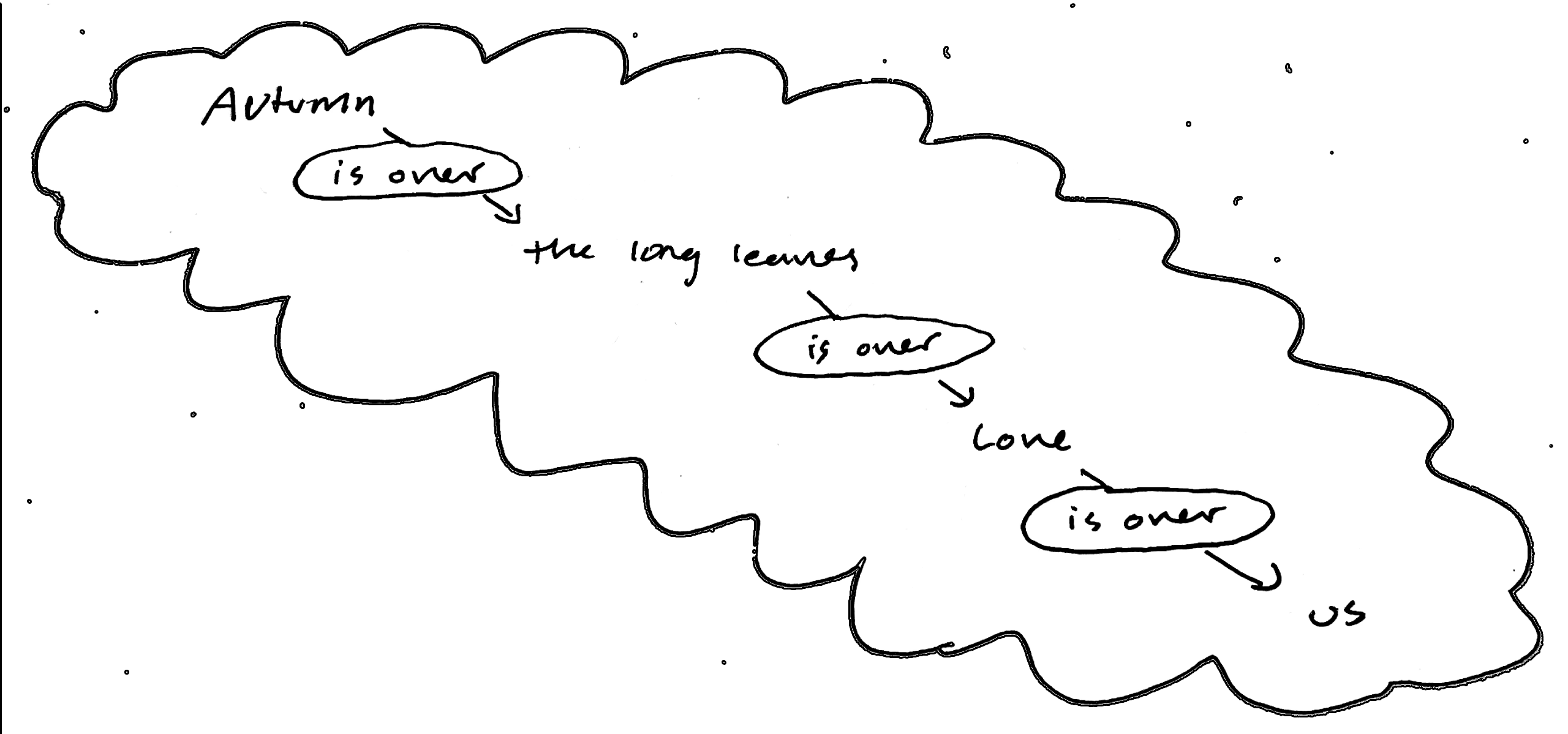
This poem presents us with The Descent of Autumn onto the world, a descent of yellow onto a green. The process of Earthly fall is no slight of hand, it exists outside of Pumpkin Spice, forces us into sweaters, and gradually dims the lights—but only after it’s gone worked through the trees and through the love we felt in the summer will it complete its desolation. The autumn is a time of beautiful unravelling. It reminds us that death isn’t so bad. The Earth forgets what it was and the “what it was” exists inside us, in its distance from us. What is distant and what is immediate form a close bond. But where does this “what is was” go? Upwards, naturally.
Okay, okay. Instead of referring to the concept which becomes distant in the winter as “what it was”, let’s call it the Oneiric Season, the season of dreams, or rather, the season which underlines our dreams and the aspirations of all life. Instead of four separate seasons with their own features, quirks, and décor, let’s believe for a moment in only one season. This season of dreams which surrounds us in the summer and is apart from us in the winter thereby making the winter into a seasonless time. The process of seasonal change would be a continual rising of this oneiric season: in the springtime, the oneiric season emerges from the soil—springs, you might say—; in the summer, the season surrounds us and we can feel its company, it exists on our level; in the autumn, the season moves past the trees while forcing apart their canopies; and then, in the winter, the oneiric season has left even the trees behind. It is far away from us. In our humanity, though, we can remember. Such is the purpose of nostalgia to not forget the summer, to keep the dream alive inside us.
So the Earth continues spinning and the oneiric season continues up from the Earth and out into space. I can’t help myself but wonder if this dream season continues upwards past the Earth and into the stars themselves as if the Earth, in its spinning, continues launching a new oneiric season into the universe year after year, one after another, like a spinning top with a flashlight fixed to its side projecting some sort of lifeforce out into the dark nothingness of space, that endless emptiness beyond our Terra which is so similar to the eternal feeling that exists inside the soul during the depths of winter. But a well-considered contemplation of the ways in which stars, constellations, and planets play in our mythical understandings will reveal the stars to be a doorway, an entrance and an exit into and from our souls. What is distant and what is immediate form a close bond, after all. And distance makes love understandable. Our imaginations provide an essential function in keeping ourselves warm. We are not creatures of flight, our dreams of flight have not evolved for us wings like they have for birds and bats; we are not creatures which burrow or hibernate, either. We’re not so lucky. We’re left instead underneath the heat lamp turned cold; we’re left below the yawning absence of all things during those burly winter months—we cannot turn away. Winter, in its eternal feeling, is the absence of God from our lives. I’m not a religious man but the depths of winter make me look longingly at the churches I walk past on my way to work.
It’s for this reason that we dream. We cannot escape by physical flight or burrowing down into the Earth with our hands to sleep through the absence of meaning that winter bestows heavily upon us every year. But evolution has played mankind a helping hand in that our imaginations—and to say it so explicitly here feels rather silly, not because of the word “imagination” in itself but rather by its conflation with Saturday morning children’s programming which go on and on about it—give us an imaginary verticality to escape the flat horizontality of winter. It may even be the secret sauce that has gotten us here to the place where we’ve manufactured our dreams of verticality into reality, burrowing down into the Earth like great hairless moles to make our cellars, taking flight across oceans in airplanes like great condors. We build great glass cities to give us the impression that we exist suspended in the sky. But then we need to ask ourselves whether the casual acts of violence imparted on the birds of the world when they encounter these glass cities of ours and crash fatally into the glass isn’t more an act of spite than an act of positive imagination. We must as whether we are, in our unconscious yearning for verticality made manifest beyond the realm of the imagination, getting back at nature for forcing us to face the absence of life, God, and meaning every year come winter. Perhaps it’s not and I’m leaning too far in that direction. Woke is dead, I’ve been told. Is caring about the birds woke?
Anyways, getting back to a discussion of Autumn, for all the reasons laid out above, we can consider Autumn to be the year when the human soul begins its yearly cycle as the oneiric season leaves us on the barren ground to suffer without. The rapid dismantling of the world around us by the drops in temperature feels somewhat like a downhill run. The world is ripped apart in marvelous reds, yellows, and browns to reveal a pure blue sky behind all of it. But it’s in our bones that when the seasons change and when the temperature drops, our heart begins a small flutter, and our imaginations begin to reengage with the flights and diggings which kept them alive last winter. This is what I feel when I open my windows to the cool breeze of autumn. The air remains warm. The time for sweaters hasn’t yet come to Chicago. But I can feel it coming when I open not just my windows but the screen panes underneath them, too, so that the mesh doesn’t break up the full force and feeling of the breeze. It’s in this way that I greet the autumn like a welcome guest (along with perhaps one or two flies) to stay and tell me stories over the coming everlong months of winter.
-gbe

Inspired by Air and Dreams by Gaston Bachelard
Comments
Nothing yet. Say the first thing.
Sign in to join the conversation.