
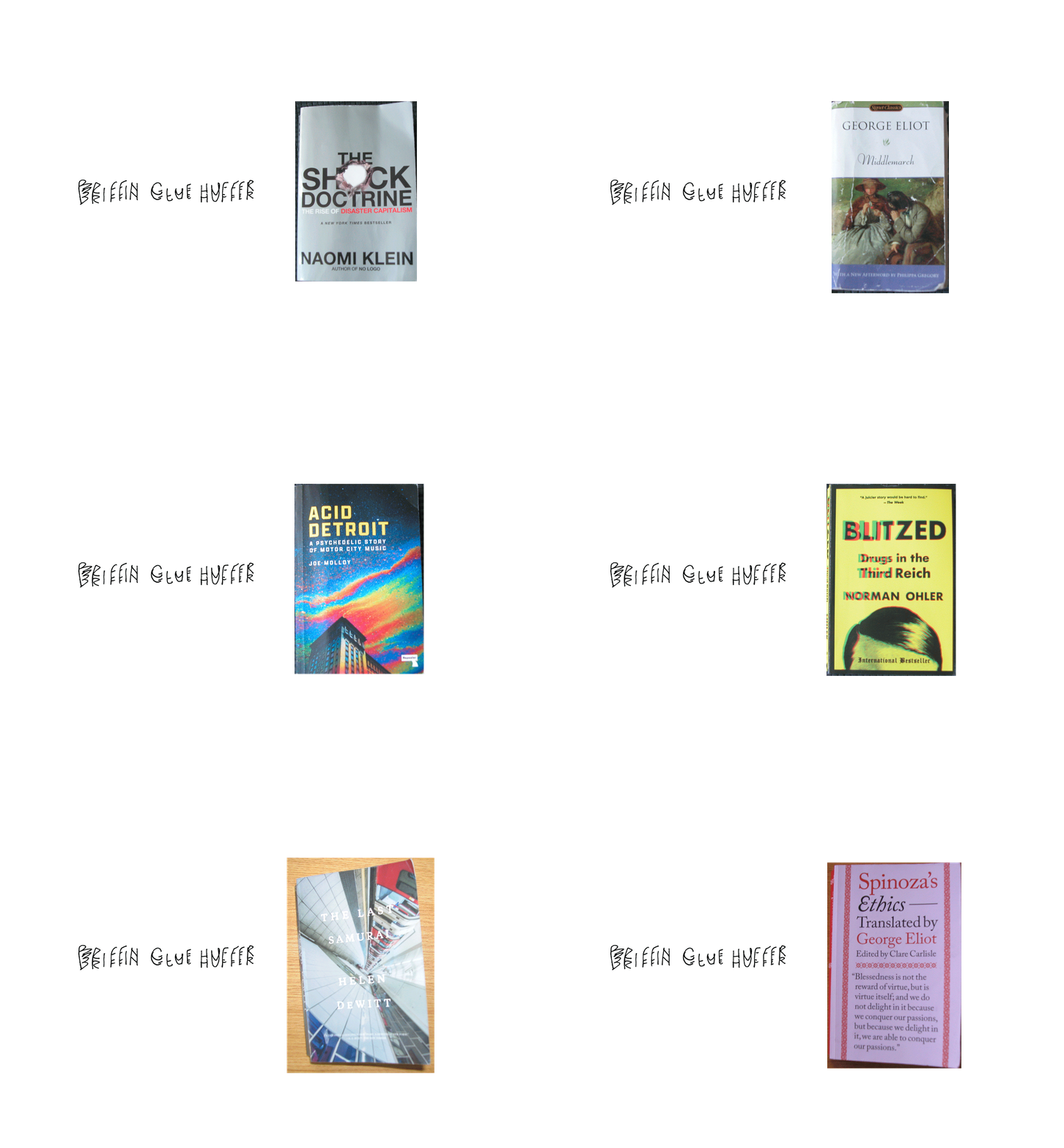
I’ve decided to ditch Goodreads since the new year and use Substack for keeping track of the things I’ve read each month instead; and in attempting to keep myself steady on my new year’s resolution to read 100 pages a day,—may seem like a lot but there are many books to read and very little time—here’s hoping a monthly recap might help me stick to it.
“Keynes proposed exactly that kind of mixed, regulated economy after the Great Depression, a revolution in public policy that created the New Deal and transformations like it around the world. It was exactly that system of compromises, checks and balances that Friedman’s counterrevolution was launched to methodically dismantle in country after country. Seen in that light, the Chicago School strain of capitalism does indeed have something in common with other dangerous ideologies: the signature desire for unattainable purity, for a clean slate on which to build a reengineered model society.
The desire for godlike powers of total creation is precisely why free-market ideologues are so drawn to crises and disasters. Nonapocalyptic reality is simply not hospitable to their ambitions. For thirty-five years, what has animated Friedman’s counterrevolution is an attraction to a kind of freedom and possibility available only in times of cataclysmic change—when people, with their stubborn habits and insistent demands, are blasted out of the way—moments when democracy seems a practical impossibility.” (25)
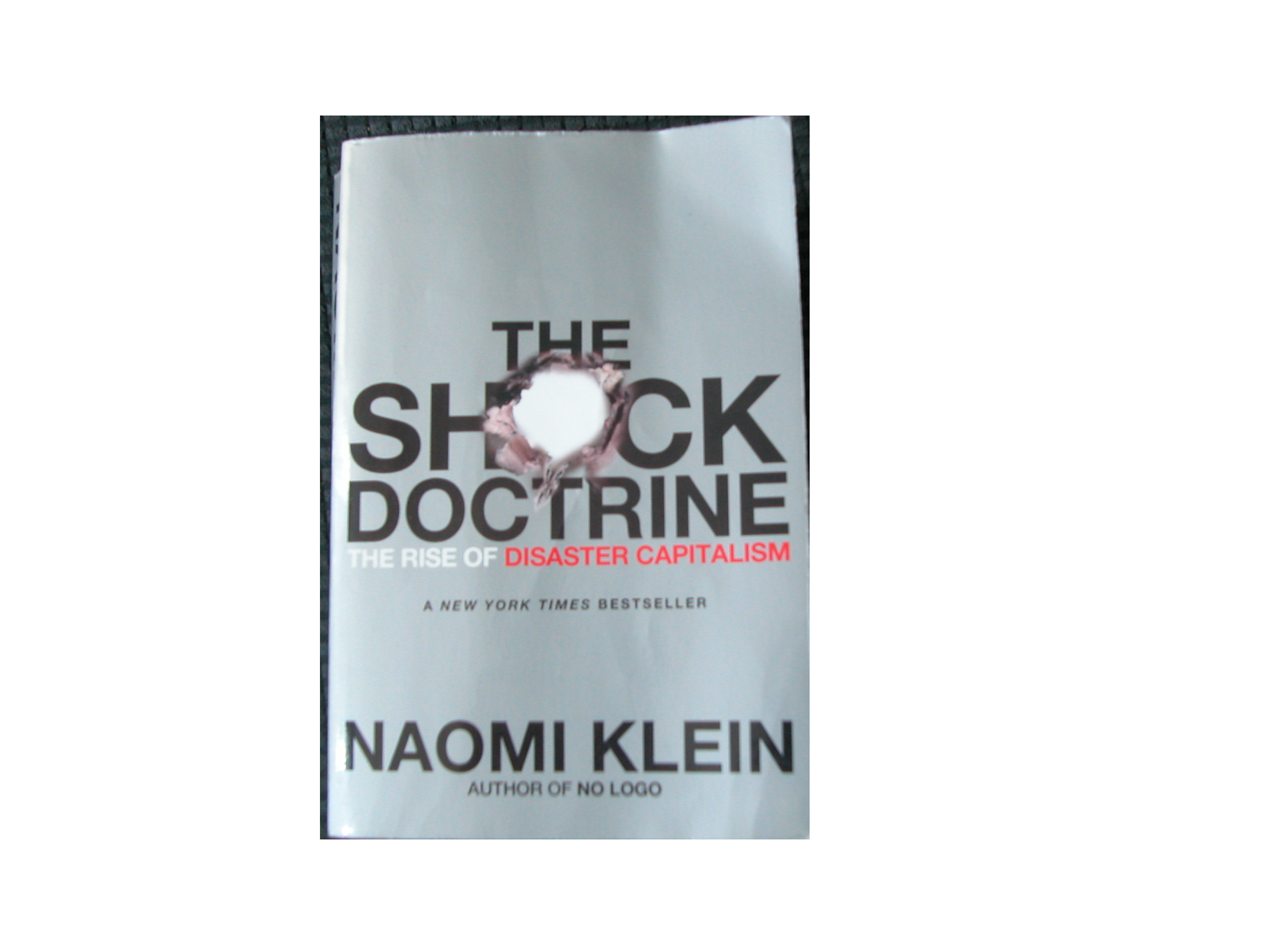
On the first day of US-Israeli strikes on Iran, 165 were killed in a strike on a girls’ school. This atrocity wasn’t even written off; major American and British news outlets nervously admitted it happened but said little more. The war was escalating rapidly and the White House had not yet turned it into a grift to buy and sell oil stocks based on the closure of the Straight of Hormuz. Expats liquidated themselves from Dubai. The gulf states are still scrambling to figure out a response as Iran targets U.S. bases with waves upon waves of cheap drones. It’s difficult to think of a more baffling geopolitical decision than killing the Ayatollah on a random Saturday but then again the Bay of Pigs did happen under someone considered more comptent. This thought was on my mind while I was walking home from the bread café on Southport where I sometimes get a soup and sandwich when I passed by a little lending library with a fresh copy of Naomi Klein’s The Shock Doctrine and this felt like an apt enough coincidence to give it a reread.
Klein’s survey of Disaster Capitalism throughout the globalized post-wwii world order, alongside Howard Zinn’s The People’s History of the United States, were foundational texts for my understanding of politics. Both are rather pop-polemical looks at history—not the worst thing if you’re still learning and know a little bit of what you’re getting into and need something in general to feel angsty about—but moreover both are good springboards into further deep-dives.
~ Important note for anyone with an interest in getting into nonfiction or theory: dig into the footnotes! Don’t write those pages of references at the end of your books off so quickly: that final listing of books and authors’ names could be considered a Choose Your Own Adventure just as easily as it could be written off as an exercise in editorial trust. You might just find your all time favorite read (sort of how I discovered Bachelard’s The Poetics of Space in the footnotes of some book I don’t remember while I was greening out in Memorial Library at UW-Madison) ~
Survey the may be, but what a survey it is! From Ewen Cameron and the CIA MKUltra program to Milton Friedman’s call to arms for market deregulation; from the beaches of Sri Lanka to Pinochet’s overthrow of Allende in Chilé; from Hurricane Katrina in New Orleans to the United States’ occupational green zones in Iraq; from Thatcher to the Israeli occupation of Palestine. If you’re at all interested in an entry-point in figuring out how globalization led the world into a steady decline (or, maybe better put, an extraction operation) over the past fifty years into our climate-shook landscape of haves and have-nots, it’s a great place to start. If you feel like you have a good understanding of it all—another great source for digging into these topics would be the miraculous Blowback podcast.
There are no easy answers in matters of international relations. Oftentimes two things are true at the same time. The Ayatollah and the Iranian government are repressive, yes; but this is also the case for other holdouts of American imperialism such as Cuba or North Korea. The trans-Atlantic cabal of financial predators in control of the United States’ intelligence and military apparatuses tend to exploit any loophole they can find to destabilize, apply economic (and oftentimes very real) shocks, and extract anything they can get their hands on—including, I might add, by exploiting loopholes in any given American-style democracy—and so condemning any country which keeps a lock and key on its sovereignty becomes much more muddled question. In any case it should be clear, after reading a bit of Klein, that if the U.S. does achieve its goal of manually replacing the Iranian regime with a handpicked government, the consequences would be significantly more dire to the regular person on the street of Iran who simply wants respect enough to be able to live a happy and contended life than it would be if the Iranian government continues to maintain its own sovereignty.

“She opened her curtains and looked out towards the bit of road that lay in view, with fields beyond, outside the entrance-gates. On the road there was a man with a bundle on his back and a woman carrying her baby; in the field she could see figures moving, perhaps the shepherd with his dog. Far off in the bending sky was the pearly light, and she felt the largeness of the world and the manifold wakings of men to labour and endurance. She was a part of that involuntary, palpitating life and could neither look out on it from her luxurious shelter as a mere spectator nor hide her eyes in selfish complaining.” (838)
Comments
Nothing yet. Say the first thing.
Sign in to join the conversation.