
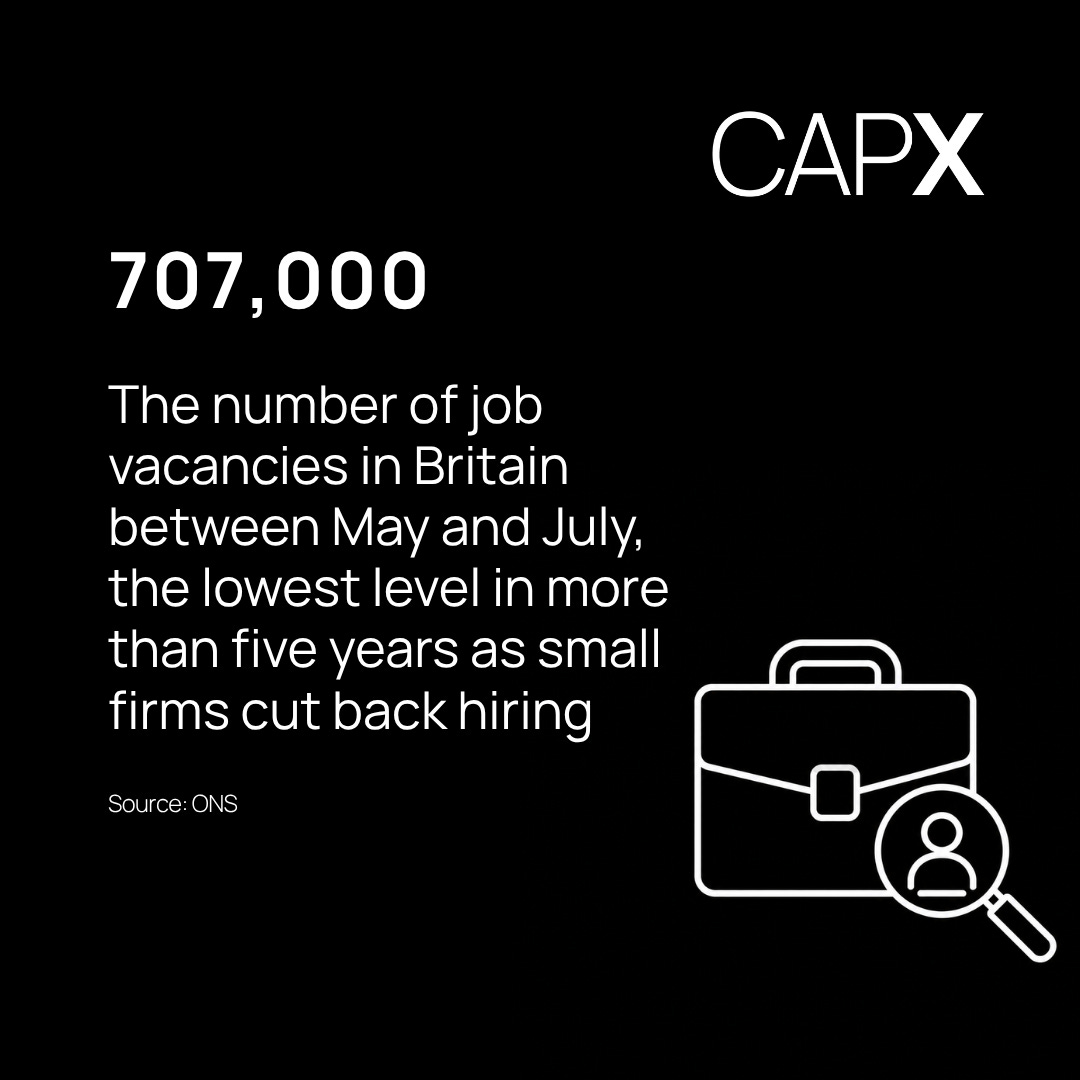
Andy Burnham likes talking about jobs for British workers, but maybe he should make it easier for employers to hire them. Today’s bleak jobs figures revealed that the decline in payrolled employment under Labour has continued for another month – see our Stat of the Day below.
There is good news on pay, however – so long as you work in the public sector, rather than the sector that pays its wages.

Michael Simmons@Simmons__
Britain’s economy in one graph

6:42 AM · Aug 18, 2026 · 3.83K Views
5 Replies · 29 Reposts · 69 Likes
Meanwhile the Trump administration is threatening the UK with 100% tariffs over the Digital Services Tax. Ryan Bourne warned this showdown was coming in CapX last January, and called for the DST to be scrapped before it caused a trade war with the US. It’s never too late for a tax cut, Andy…
Below you’ll find all the latest pieces from CapX, plus what we’re reading from around the web.
Marc Sidwell
Editor, CapX
Fresh thinking from CapX

Mani Basharzad
‘The Democratic Socialists of America is part of a larger trend of young people who graduated from top universities, mostly with humanities degrees, who see that the job market isn’t as friendly as their university years suggested it would be.’
In America, socialists are becoming more popular by the day. One of them is the mayor of New York, and another could be in line to be the next Democratic presidential nominee. Their voter base is an educated, often underemployed elite that tends towards the humanities. Their policies are catastrophically misguided, but they are speaking to real economic concerns. Read More
Valentin Boboc
‘A combination of short-termist thinking, outdated technology, high staff turnover and an over-reliance on generalists creates a culture of weak learning.’
Last year, the ONS discovered an error that rendered over a decade of producer price data unusable. In March 2022, the OBR forecast borrowing of £50.2 billion for the year ahead. The eventual figure was north of £130 billion. With a Budget looming, do Britain’s statistical institutions have the systems, expertise and memory to do the job properly? Read More
Gerard Lyons, The Telegraph 🔒
‘While high levels of welfare spending are not unprecedented, previously they were often recession-induced, or cyclical. Now they appear structural.’
Some 9.3 million working-age people in England and Wales are now claiming welfare, more than during the pandemic. The bill is heading for £406 billion by 2030-31. Are we approaching a moment of ‘hyper-normalisation’ – the term for the last years of the Soviet Union, when everyone could see the system failing and carried on regardless? Read More
Maxwell Marlow, The Critic
‘Much like with tulips or dot-com addresses, a bubble has formed and is collapsing as the wind comes out of the sails of market confidence.’
Britain has a housing crisis, so why are prices falling? Across the country, 27% of homes are seeing offers accepted at 10% or more below the asking price. It’s not, sadly, due to a sudden boom in housebuilding. Instead, high interest rates and taxes are driving the devaluation of assets long-inflated beyond anything sensible. This could get painful. Read More
Sam Dumitriu
– Why did we stop building reservoirs? (Hannah Ritchie)
– Policymaking is broken: here’s how to fix it (Joe Hill)
– The North Sea is not just about the North Sea (Ed Conway)
Or reply to this email to let us know your thoughts.
We'll be back tomorrow.
No posts
Comments
Nothing yet. Say the first thing.
Sign in to join the conversation.