
Dear all,
The two-minute summary video (Instagram | LinkedIn) of India Week encapsulates the scale and breadth of a bilateral program that is now the pre-eminent, independent UK-India forum.
This is a busy week: our Dinner with Shadow Minister for Business and Trade Andrew Griffith MP tomorrow is full, as is the Asian Achievers Awards reception with Binghatti on Wednesday (to request a last-minute space, scroll down).
The London Indian Film Festival returns for its 17th year, from 9-16 July, with a rich array of cutting-edge new cinema premieres from India and around South Asia, many of them cherry-picked from the finest film festivals around the world, plus restorations of magnificent classics of Indian cinema. It features a sold-out In Conversation With Aamir Khan, as well as showcasing the best of emerging British Asian film talent, and celebrating the cast of the landmark British comedy show Goodness Gracious Me.
During India Week, we worked with AI-driven market research company Lorefully, interviewing participants at Ideas for India and a drinks reception with the London Chamber of Commerce and Industry (LCCI). We asked them their impressions of the Indian economy, doing business with India, as well as questions about their identity - how does it feel to be Indian amongst anti-immigrant sentiment in the UK?
We also did a deep dive into responses from LCCI members. Thank you in particular to former LCCI Asian Business Association Chair Tony Matharu OBE for facilitating this relationship.
Scroll down for that exclusive data.
Like what you see? Check out our Membership options.
Individual Membership is £150 annually, a Steering Member is £500, and Corporate Membership options start from £750. Corporate Membership is for businesses, non-profits, advocacy organisations and others, looking for bespoke services that meet their strategic goals. We can provide in-depth alignment with a series of networking opportunities, policy initiatives or curated programmes.
NRI remittance service Aspora has a special offer for you: use code BI20 or 📲 download at https://link.aspora.com/DYot/9lbkljd7 to get £20 off your first transfer.
***Last chance to attend*** Binghatti reception (6pm, Wed 1 July, Knightsbridge | Request to attend)
Bridge India is a Community Partner for the upcoming Asian Achievers Awards on Friday 18 September. Before that event, Dubai-based luxury real estate developer Binghatti and EPG are hosting a (non-alcoholic) drinks and canapes reception in Knightsbridge to bring together entrepreneurs, company builders and change-makers from across South Asian communities in London.
When: 6-9pm | Wednesday 1 July
Where: Binghatti, 201 Brompton Road, London SW3 1LA (in between Knightsbridge, Sloane Square and South Kensington stations)
Who: 100+ business leaders, entrepreneurs and others, with inspirational speeches from senior business leaders
Request a space: Fill in this form (please note preference given to existing AAA ticket-holders or Bridge India Members)
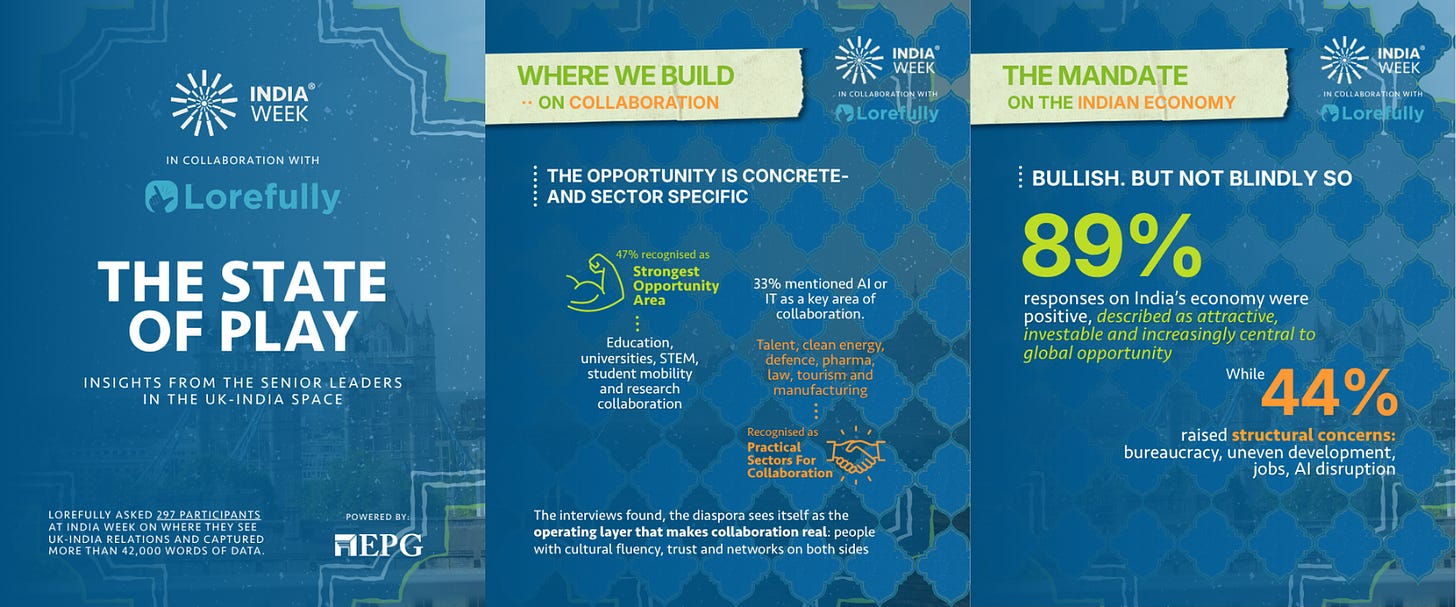
Lorefully asked 297 participants at India Week about where they see UK-India relations and captured more than 42,000 words of data, with the median contribution being around 110 words.
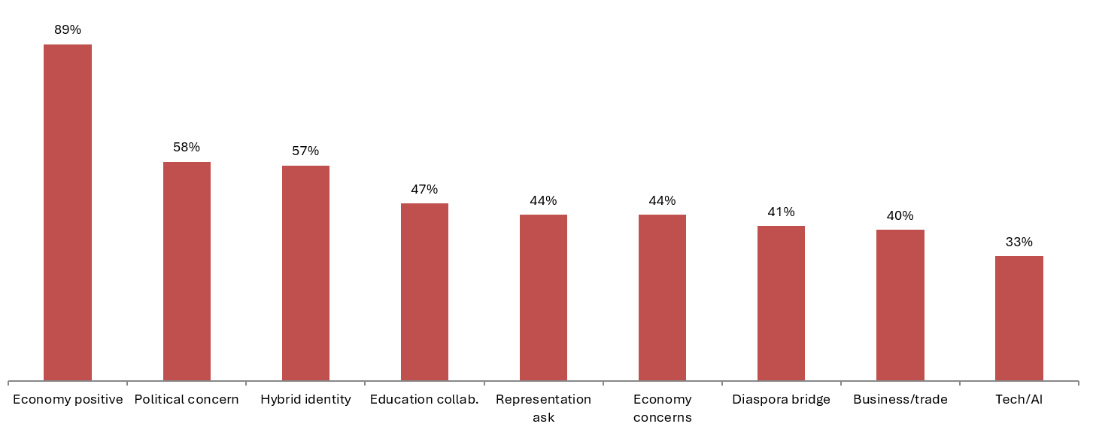
The graph below shows the strongest qualified signals from participants i.e. the keywords that came up most often in substantive responses within the relevant question set.
The headlines
India was seen as a major growth opportunity, but not a frictionless one. Optimism came with concerns about bureaucracy, uneven regional development, unemployment and AI disruption.
UK-India collaboration was framed practically: education, technology, talent, trade, law, healthcare, culture and clean energy came up repeatedly.
The diaspora sees itself as abridge, but wants more formal recognition, consultation and representation in the rooms where decisions are made.
Comments from Ideas for India attendee:
“I am a small business startup founder and I am going to market in India. It’s such a huge opportunity and what better place to meet everyone in one place? That’s genuinely the best thing, that it’s not a silo. You meet so many different people, and it’s just a good use of time.”
Where can the UK and India collaborate?
Key findings:
47% mentioned education, universities, research, students or youth exchange as key areas of collaboration
40% mentioned trade, business, investment, law, manufacturing or market-entry
33% mentioned technology, IT or AI
Several respondents saw the diaspora as the operating layer: people with cultural fluency, trust and networks on both sides.
Comments from LCCI members:
Networking was the most frequently mentioned reason for attending events such as India Week. 55% included “network” or “networking”, while 51% included “business”. That combination is important.
“Networking is a long, slow burn. It’s meeting people time and time again, maintaining those relationships and building on those. Most people don’t want to do business right away. It’s about relationships and trust. You trust people that you know and you’ve met time and time again, not that you’ve met for the first time.”
How do you view the Indian economy?
Key findings:
The dominant sentiment was strongly positive: India was described as growing, attractive, investable and globally central.
Optimism was caveated by concerns about bureaucracy, uneven development, governance, unemployment and over-dependence on IT.
Growth was seen as sector-specific rather than uniform, with references to services, travel, pharma, infrastructure, manufacturing, AI and climate.
89% of substantive economy responses were positive or growth-oriented. But 44% also raised structural concerns or caveats.
58% cited political concerns in India.
Comments from LCCI Members:
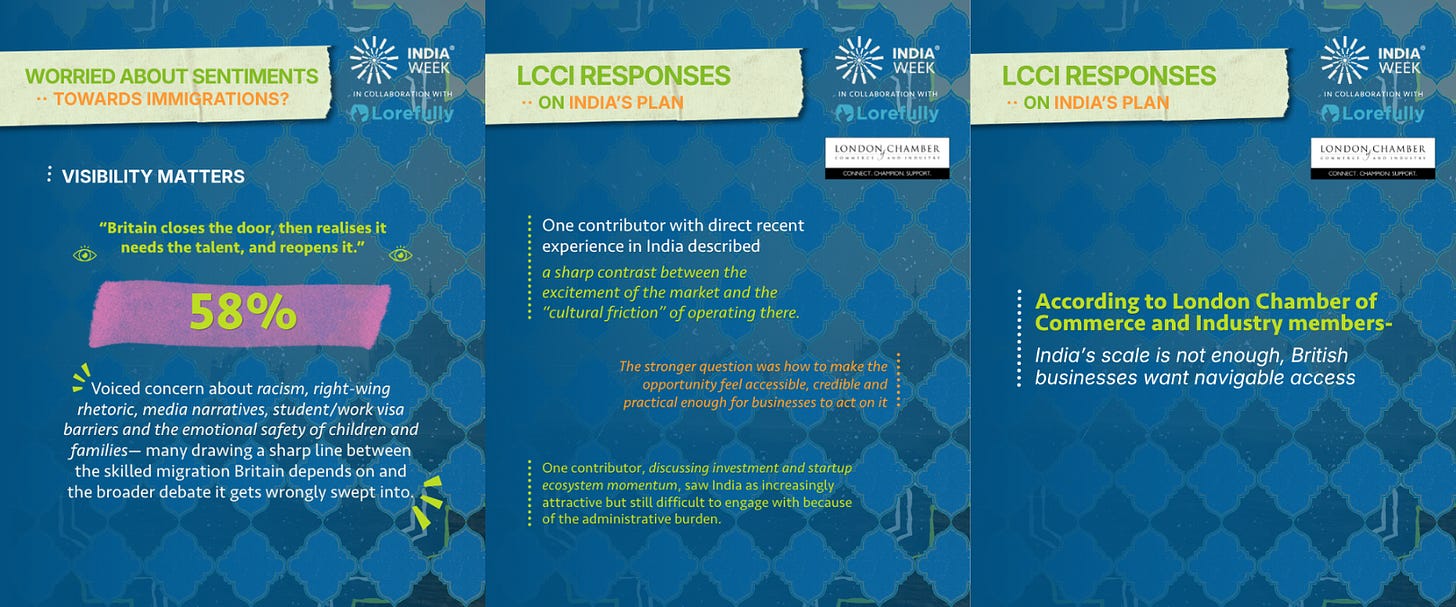
“India’s scale is not enough, British businesses want navigable access”
One contributor with direct experience in India described a sharp contrast between the excitement of the market and the “cultural friction” of operating there.
One contributor, discussing investment and startup ecosystem momentum, saw India as increasingly attractive but still difficult to engage with because of the administrative burden.
Do you feel more Indian or British?
Key findings:
Most thoughtful answers rejected a binary choice. Identity was described as layered, hybrid, messy, contextual and generational.
British-leaning respondents often linked this to where they grew up, worked or felt socially formed, while still retaining pride in heritage.
Indian-leaning or global Indian responses framed Indianness as cultural, emotional or civilisational, often alongside appreciation for British opportunity.
57% described identity as hybrid, layered, both or context-dependent.
Comments from Ideas for India attendees:
Indian-leaning or “global Indian” responses framed Indianness as cultural, emotional or civilisational, but often paired with appreciation for British work culture, institutions or opportunity.
Are you worried about UK political sentiment, including the rise of the right-wing?
Comment from Ideas for India attendee:
“Britain closes the door, then realises it needs the talent, and reopens it.”
Key findings:
58% voiced concern about racism, right-wing rhetoric, media narratives, student/work visa barriers and the emotional safety of children and families— many drawing a sharp line between the skilled migration Britain depends on and the broader debate it gets wrongly swept into.
Concern was real, particularly around racism, right-wing rhetoric, media narratives, visa barriers and the emotional safety of families.
Several respondents separated skilled and legal immigration from illegal immigration, arguing that Indian migration is economically valuable.
Some were not worried long term, arguing the UK repeatedly reopens the door because it needs Indian talent, skills and enterprise.
What could the UK government do better to engaged the diaspora?
The strongest ask was to be properly heard — real consultation, diaspora voices in policy rooms, clearer and predictable policy around skilled migration, students, business, startups and UK-India trade.
Key findings:
44% asked for representation and a “seat at the table”.
41% positioned the diaspora as bridge-builders, ambassadors or connectors between the countries.
Are you interested in conducting detailed research about business with India, or gain insights into its policy environment. Get in touch with Bridge India today.
To find out more about Lorefully, click here and its co-founder Dr Amrit Chandan, visit his Substack here.
Comments
Nothing yet. Say the first thing.
Sign in to join the conversation.