
Dear all,
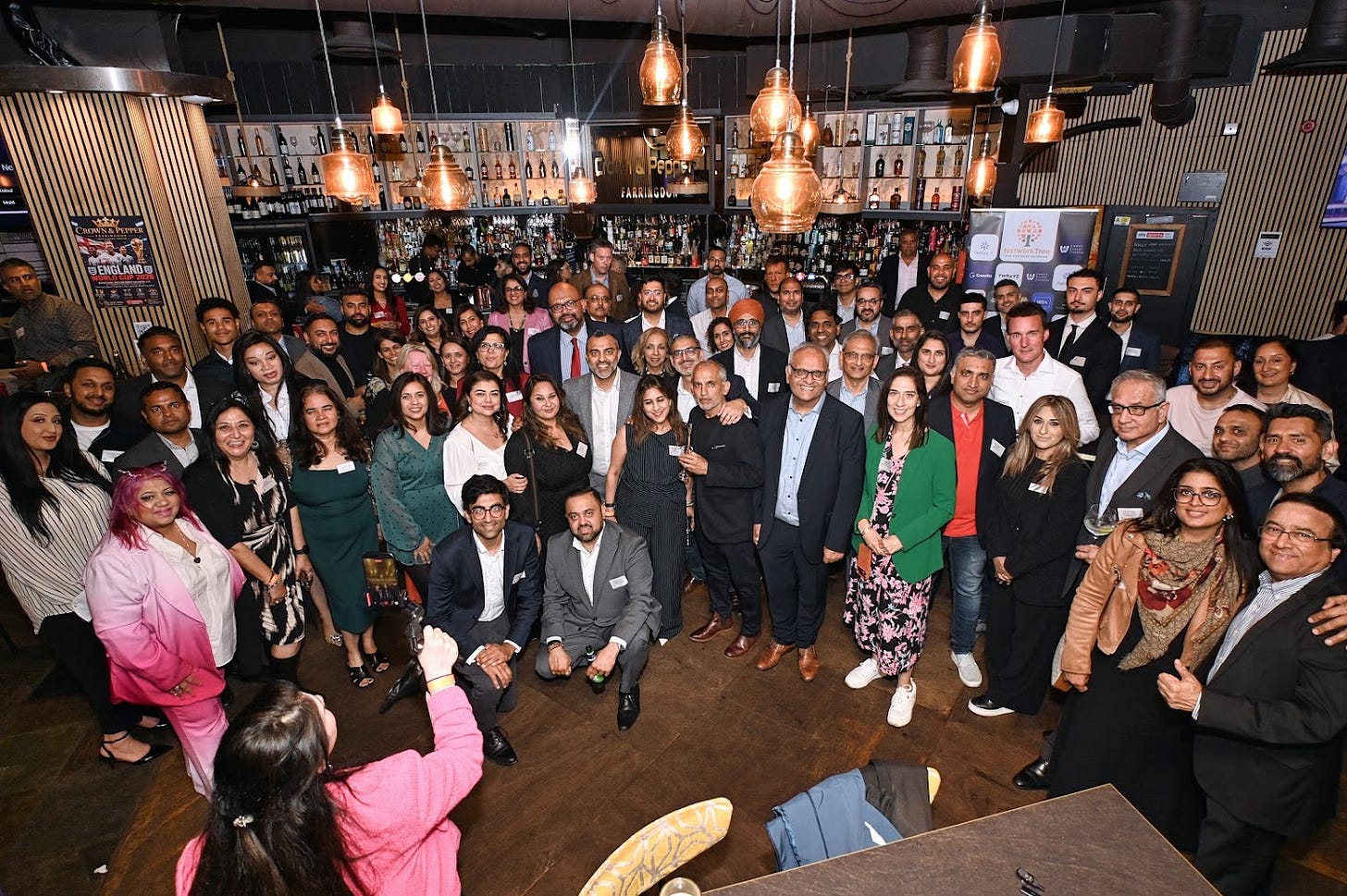
With our policy-heavy annual conference in the rearview mirror, it was last week to get back to one of our core objectives of bringing people together. Thank you to over 100 people that came to our Summer reception with Network Tree (see picture above).
If you missed Ideas for India®, here’s a peek into what we did that day: Instagram | LinkedIn.
And if you missed the Jaipur Literature Festival in London, here’s what you missed: Instagram | LinkedIn.
On the day, we worked with AI-driven market research company Lorefully, interviewing nearly 200 participants. We'll publish the exclusive insights from this research in the coming days.
Member Simran Prajapati hosted a fireside chat with Lutfey Siddiqui, the former Chief Adviser's envoy for International affairs of Muhammad Yunus, head of the recent interim government of Bangladesh, at the LSE last week.
This week’s Policy Watch looks at the biggest threat to India’s macroeconomic stability - a rapidly depreciating Rupee - by Raya Mahmood. Scroll down for more.

At Artium Academy, technology meets world-class music education through personalised LIVE 1:1 online classes, industry-led mentorship, and an internationally aligned curriculum. Recognised by TIME Magazine & Statista as one of the Top 350 EdTech Companies in the World, Artium is the only music education platform on the list offering this format of learning at scale, and is today one of the preferred destinations for music learning for Indians worldwide.
Under the patronage of legends like Sonu Nigam, K. S. Chithra, Shubha Mudgal, and Aruna Sairam, learners gain access to exclusive masterclasses, weekly global showcases, artist development initiatives, and flagship IPs like Artium Unmute, Artium Superstar, Artium Originals, and many more.
Today, Artium powers a thriving community of 43,000+ learners globally with the support of 400+ educators and 1000+ classes conducted every day.
Visit artiumacademy.com to book your free trial class and begin your musical journey.
Like what you see? Check out our Membership options.
Individual Membership is £150 annually, a Steering Member is £500, and Corporate Membership options start from £750. Corporate Membership is for businesses, non-profits, advocacy organisations and others, looking for bespoke services that meet their strategic goals. We can provide in-depth alignment with a series of networking opportunities, policy initiatives or curated programmes.
NRI remittance service Aspora has a special offer for you: use code BI20 or 📲 download at https://link.aspora.com/DYot/9lbkljd7 to get £20 off your first transfer.
Chetan Nayak is a Course Director at Coventry University in London. He has a strong focus on employability-driven curriculum design and skills integration. He is particularly interested in areas related to higher education collaboration, student mobility, and aligning academic provision with industry and global workforce needs.
Sivakumar Narayanaswamy was a Partner Solution Director for Central Banks at fintech Ripple, and before that a Director in Financial Services and Technology at Accenture and earlier at SWIFT. He has a Master’s from Henley Business School.
Humraaj Singh spent the last 25 years leading, developing, and fundraising for charitable organisations that make a real difference. His career has spanned senior leadership roles in the not-for-profit sector working with govt, corporate partners and HNWI’s. Now, he’s involved in organic farming, through a Franco-Sikh alliance of a forest ecologist and an earth scientist. They bring their love of the environment and respect for world cultures to commit to contributing to a movement for a greener, healthier, and more harmonious world for all.
Basava Alapaty has over a decade leading technology initiatives as Director and Software Architect at HARA Solutions, where he specialises in Microservices, RESTful architecture and API development. His role involves overseeing technology strategies and solutions, emphasizing innovation and efficiency to address complex challenges.
Binghatti reception (6pm, Wed 1 July, Knightsbridge | Request to attend)
Bridge India is a Community Partner for the upcoming Asian Achievers Awards on Friday 18 September. Before that event, Dubai-based luxury real estate developer Binghatti and EPG are hosting a (non-alcoholic) drinks and canapes reception in Knightsbridge to bring together entrepreneurs, company builders and change-makers from across South Asian communities in London.
When: 6-9pm | Wednesday 1 July
Where: Binghatti, 201 Brompton Road, London SW3 1LA (in between Knightsbridge, Sloane Square and South Kensington stations)
Who: 100+ business leaders, entrepreneurs and others, with inspirational speeches from senior business leaders
Request a space: Fill in this form (please note preference given to existing AAA ticket-holders or Bridge India Members)
Prime Minister Narendra Modi’s recent appeal sounded unusually personal. Buy less gold. Avoid unnecessary foreign travel. Conserve fuel. Work from home where possible.
But the message was not really about consumer behaviour. It was about dollars.
India’s economy remains heavily dependent on imports. Most critically, crude oil. The country imports nearly 85% of its oil needs, meaning every spike in global energy prices immediately increases India’s import bill. As conflict and instability continue across West Asia, oil prices have become volatile again. That matters because oil imports are paid for in US dollars.
This creates pressure on the rupee.
When India imports more than it exports, dollars leave the economy faster than they enter. Economists refer to this as pressure on the current account deficit. If the imbalance widens too quickly, the rupee weakens against the dollar. A weaker rupee then makes future imports even more expensive, creating a cycle of imported inflation.
Gold worsens the problem
India is one of the world’s largest consumers of gold, importing $72 billion just in FY26. Unlike industrial machinery or infrastructure inputs, gold does not directly expand productive capacity. Economically, it is often viewed as a “dead asset” in balance-of-payments terms: high import demand with limited export generation.
Yet Indian households continue to treat gold as security. It functions as savings, social status, inflation protection and intergenerational wealth. During periods of uncertainty, demand often rises further. That means more dollars flowing out of the country precisely when the rupee is already under stress.
This explains the logic behind Modi’s appeal.
Reducing discretionary imports can temporarily ease pressure on foreign exchange reserves. Less fuel consumption reduces oil demand. Fewer overseas holidays slow dollar outflows. Lower gold imports reduce pressure on the trade deficit. Even remote work has an economic rationale if it cuts fuel usage in large urban centres.
The government has already moved beyond rhetoric. Import duties on gold and silver have been raised to 15% in recent weeks in an attempt to curb demand and stabilise the currency. Policymakers are also watching inflation closely, since a weakening rupee increases the domestic cost of imported goods across the economy.
But the weak currency reflects deeper problems than just the Iran war
The broader issue is structural. India’s growth model still depends heavily on imported energy, external capital and commodity stability. As long as oil remains central to economic activity, global shocks will continue feeding directly into domestic currency pressure.
Mukesh Ambani flagged an “unprecedented dislocation in global supply chains,” thanks to the US-Iran war.
Foreign capital flows are leaving
The external capital is becoming a challenge. For example, while Indian equities generated double-digit gains in rupee terms in 2025, rupee depreciation cut NIFTY return from 10.47% to 5.44%, the lowest, among major global equity benchmark indices. It coincides with record Foreign Institutional Investor (FII) outflows and renewed concerns over India’s relatively high market valuations.
In 2026, the depreciation has been even more pronounced. FIIs are continuing to use this as an opportunity to reduce their holdings in India. The macro conditions are part of the story, but also because India doesn’t really have much of an AI story or opportunity.
But there’s a caveat.
FIIs invest in large caps. Domestic investors invest in mid-cap, where 28 or 29x forward earnings against 11–12% expected earnings growth are common. That’s a market ripe for correction.
But in reality, Indian retail investors are less price sensitive, because for most, you put money in fixed deposits or equities. You can really reallocate your portfolio to equities abroad as easily as FIIs can, because of capital controls.
Energy transition is a macro issue too
The importance of oil is why economists increasingly argue that energy transition is not only a climate issue, but a macroeconomic one. Expanding renewables, domestic manufacturing and export competitiveness ultimately strengthens currency resilience by reducing dependence on imported inputs.
Khavda in Gujarat is central to the energy transition. It’s 726sqm, roughly seven times larger than Paris, and combines solar (during the day) and wind (when there’s no sun) power to produce energy around the clock. Nothing on this scale exists anywhere else in the world.
A visible sign in urban centres is how tickshaws are helping too, with the e-rickshaw market booming now a decade after it started, thanks to more competitive pricing and increasing imported gas prices.
Modi’s appeal was therefore less about patriotism and more about macroeconomic management. The immediate goal is stabilising the rupee. The long-term challenge is building an economy less vulnerable to external shocks in the first place.
Raya Mahmood is a graduate of UCL and Cornell. She is an emerging policy analyst, with an interest in climate governance and global development.
Comments
Nothing yet. Say the first thing.
Sign in to join the conversation.