
Dear all,
Thank you to everyone that came our Member meetup with Dr Keshav Kumar, from the Indian Police Service 1986 Batch, Gujarat cadre, last week.
“I want to have clones of me around the world” - that’s what one of our speakers from Ideas for India, Vee Bharkhada said in this exclusive podcast with journalist Loveena Tandon.
And in this podcast from the sidelines of Ideas for India, John Hemmings from the Henry Jackson Society discusses whether India really remain neutral in a fragmented world.
The Shortlist for the Asian Achievers Awards on Fri 18 Sept is out. Click here to check it out. It includes US PGA Championship winner Aaron Rai, leading property developer and entrepreneur Kamal Pankhania, President of King’s College London Prof Shitij Kapur, iconic restauranteurs Karan Gokani (Hoppers), Subodh Joshi and Sujay Sohani (Shree Krishna Vada Pav), model Neelam Gill and human rights champion Prof Sunita Toor.
Film and arts programming director Aman Dhillon will be hosting her meetup in New York for her programming and PR company ReelN 7-9pm on Thurs 13 August, with film makers and commissioners. If you’d like to be invited, get in touch with her on LinkedIn here.
Donald Trump’s administration has moved to significantly tighten immigration to the US through stricter visa screening, expanded travel restrictions and tougher scrutiny of foreign students and skilled workers. But South Asians still continue to seek entry to the country in large numbers, with India overwhelmingly dominating visa issuances across almost every major category. This week’s Policy Watch comes courtesy of the South Asian Herald. Scroll down to read more.
NRI remittance service Aspora has a special offer for you: use code BI20 or 📲 download here to get £20 off your first transfer.
Like what you see? Check out our Membership options.
Individual Membership is £150 annually, a Steering Member is £500, and Corporate Membership options start from £750. Corporate Membership is for businesses, non-profits, advocacy organisations and others, looking for bespoke services that meet their strategic goals. We can provide in-depth alignment with a series of networking opportunities, policy initiatives or curated programmes.
Bridge India Member and radio presenter on LycaRadio Anuj Radia will be discussing Nayanika’s journey from investment banking to becoming an acclaimed novelist and screenwriter, her collaboration with Imtiaz Ali on Diljit Dosanjh’s new film Main Vaapas Aaunga, and the role of storytelling, history and cinema in preserving memory and identity.
When: 6:30-7:30pm | Thurs 13 August
Where: Lecture Theatre 1, Bush House, Strand Campus, King’s College London
RSVP: Register here
This is consistently recognised by the South Asian community as the most prestigious and highly respected such Awards. Bridge India is Community Partner for the event. Sir Keir Starmer said of the last event “It is wonderful to see so many British Asian change-makers being recognised tonight by the team” where a net worth of over £30bn was amongst the guests. Book your tickets here.
When: 6pm-1am | Fri 18 September
Where: London Hilton on Park Lane
Who: 550 business leaders, entrepreneurs and others, with world-class entertainment and drinks flowing the while night
Book here: Click here | Get in touch for BI Member-only prices
A five-course tasting menu and welcome drink from Michelin-starred chef Atul Kochhar, inspirational speakers and an opportunity to hear about Pardada Pardadi, an Indian NGO that aims to socially uplift and economically empower girls and women in Uttar Pradesh through education, health and hygiene, community development and economic empowerment. In partnership with Network Tree.
What: Bridge India Diwali Dinner x Kanishka by Atul Kochhar
When: 6pm arrivals and welcome drinks, 6:30pm speeches, sit-down dinner, 8:30pm close
Where: Kanishka by Atul Kochhar, 17-19 Maddox Street, Mayfair, London, W1S 2QH (closest station Oxford Circus)
Dress code: Formal attire or ethnic wear encouraged
Tickets: £0 Corporate Members, £80 Members, £100 Non-Members | Details here
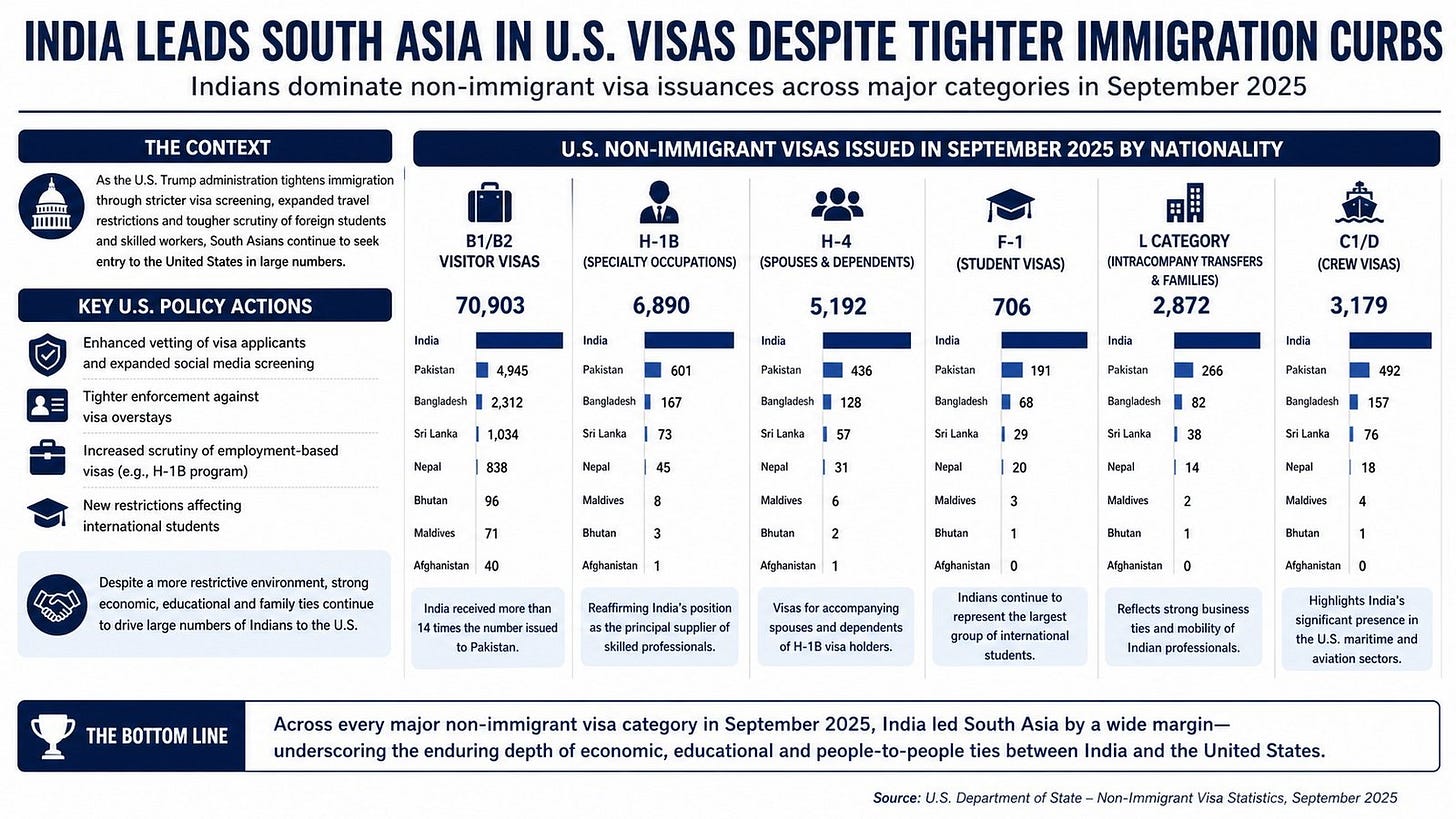
Newly released US State Department data for September 2025 show that India remained the region’s largest source of visitors, students, professionals and business travellers to the United States, underscoring the depth of economic, educational and family ties that continue to bind the two countries despite an increasingly restrictive immigration environment.
The figures come as the Trump administration has stepped up efforts to curb both legal and illegal immigration, including enhanced vetting of visa applicants, expanded social media screening, tighter enforcement against visa overstays, increased scrutiny of employment-based visas such as the H-1B program and new restrictions affecting international students. The measures have sparked concerns among universities, technology companies and immigrant communities that obtaining U.S. visas could become more difficult even for legitimate travellers and skilled professionals.
Against this backdrop, India accounted for by far the largest share of U.S. non-immigrant visas issued in South Asia.
Indian nationals received 70,903 B1/B2 visitor visas in September 2025, more than 14 times the number issued to Pakistan, the region’s second-largest recipient. Indians also secured 6,890 H-1B visas for specialty occupations, 5,192 H-4 visas for accompanying spouses and dependents, 706 F-1 student visas and 2,872 L-category visas for intracompany transfers and their families, reaffirming India’s position as the principal supplier of skilled professionals to the US economy. The country also recorded 3,179 C1/D crew visas, reflecting its significant presence in global aviation and maritime industries.
While India dominated every major employment and travel category, other South Asian countries continued to register steady demand despite the uncertain policy climate.
Pakistan received 4,826 B1/B2 visitor visas during the month, along with 109 F-1 student visas, 93 H-1B visas and 95 H-4 dependent visas. The figures suggest that family reunification, higher education and skilled migration remain important drivers of Pakistan-U.S. mobility despite tighter immigration controls.
Bangladesh was issued 1,541 visitor visas, 78 F-1 student visas and 16 H-1B visas. A notable feature of the data was the issuance of 141 F-2 visas for dependents of international students, indicating continued family-based educational migration. Nepal received 1,020 B1/B2 visas, 31 H-1B visas and 28 F-1 student visas, while also recording 14 G4 visas for employees of international organizations.
Sri Lanka’s non-immigrant visa volumes were more modest, although the country continued to record travel across visitor and employment categories. Bhutan and the Maldives saw relatively limited movement, receiving 23 and 15 B1/B2 visitor visas respectively, reflecting their smaller populations and lower migration volumes.
The employment-based figures underscore India’s continued dominance in supplying skilled workers to the United States. Indian nationals accounted for the overwhelming majority of H-1B visas issued in South Asia, receiving nearly 74x the approvals of Bangladesh and more than double the combined total of Pakistan, Nepal and Bangladesh.
Corporate mobility also remained concentrated in India. Indian executives and professionals obtained 1,390 L-1 visas for intracompany transfers, while 1,482 L-2 visas were issued to accompanying family members, highlighting the extensive operations of Indian multinational companies and global technology firms.
Educational mobility, though seasonally lower than during the May-August admissions period, also remained robust. India received 706 F-1 student visas, followed by Pakistan (109), Bangladesh (78) and Nepal (28), reinforcing South Asia’s status as one of the largest source regions for international students in the United States.
On the immigrant visa side, Sri Lanka continued to record steady permanent migration, with the US Embassy in Colombo issuing 102 Diversity Visas, 22 F4 family-preference visas for siblings of U.S. citizens and 22 IR5 visas for parents of American citizens during the month.
The September statistics provide only a snapshot of visas issued and do not reflect applications, refusal rates or future demand. However, they illustrate that despite increasingly restrictive U.S. immigration policies, South Asia—and India in particular—remains a critical source of visitors, international students, skilled professionals and business travelers.
Immigration experts say the coming months will determine whether the Trump administration’s tighter visa regime translates into a sustained decline in issuances. For South Asia, where remittances, higher education and technology-sector employment have long been linked to access to the United States, any prolonged tightening of legal immigration pathways could have significant economic and social consequences extending well beyond the region’s borders.
This is an edited version of the original article. Read the original article here.
Comments
Nothing yet. Say the first thing.
Sign in to join the conversation.