
We’ve often credited the media bias chart from Ad Fontes Media as inspiration for the origin of Bridge Grades.
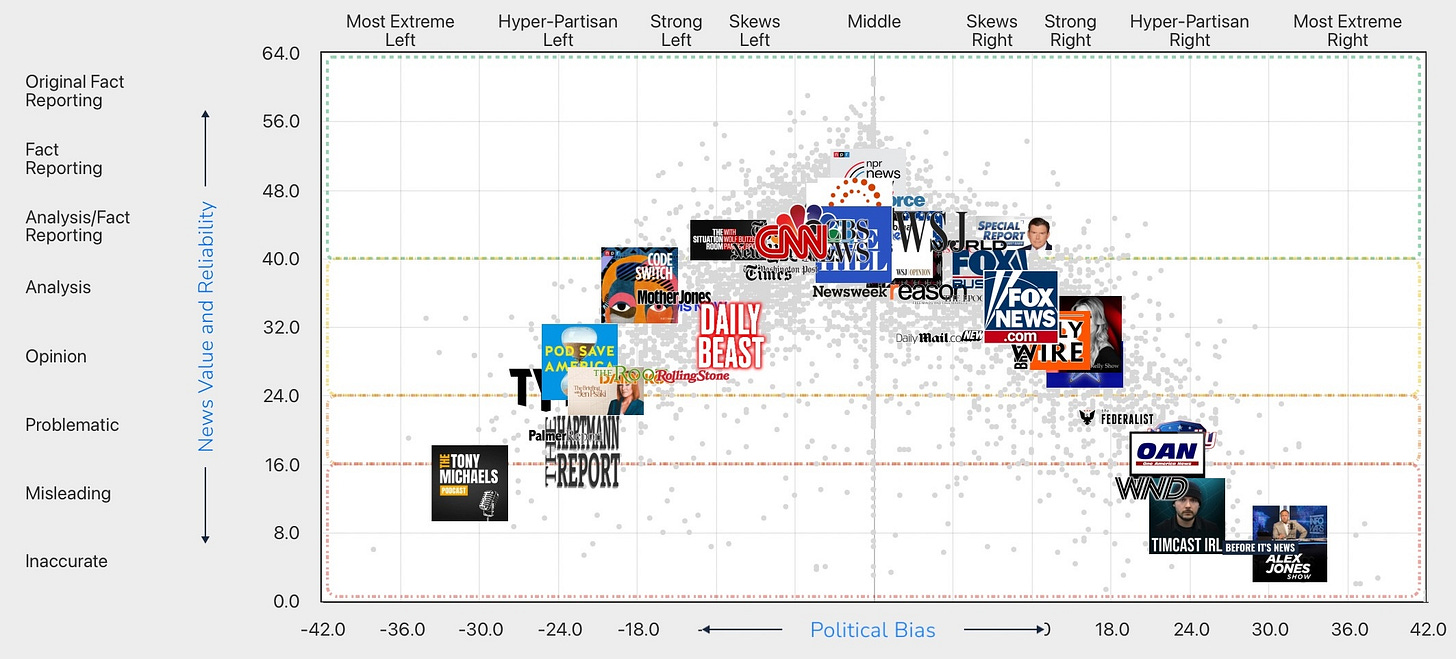
The thinking was, if they can plot the media on two distinct dimensions, why couldn’t we do the same for Congress? So, we did.
Thanks to a nudge from Mosheh Oinounou of Mo News to build a similarly styled visualization, Bridge Grades tech guru Serge gave it a shot.
Note that each of these charts are fully interactive on our website (www.bridgegrades.org) and clicking on any of the faces there will link to their up-to-date Report Card which visualizes the elements that go into their grade. These screengrabs just don’t do them justice.
Each member’s ideology is represented on the left-right horizontal axis. We use real-time ideology scores (DW-NOMINATE) from voteview.com. The faces on the far right are the most conservative while those on the far left are the most progressive.
Each member’s score on collaboration is plotted vertically—high Bridge Scores toward the top, low Bridge Scores toward the bottom—using the non-partisan methods we’ve developed based on 3rd party data.1
Plotting both dimensions simultaneously on a 2x2 matrix lets us visualize where every Senator and every House representative sits relative to one another across either or both dimesions.
The first is obvious and glaring: our voting population lacks meaningful representation on Capitol Hill by centrists and moderates. This should surprise no one.
The second, and more intriguing observation, is that earning high marks for bridging does not require legislators to be centrists and is not connected to ideology. Note the wide left-to-right spectrum of ideological beliefs represented in those earning A grades at the top of the chart.
The top of the chart is where it’s at.
A wide range of ideological representation is critical for a healthy Legislative Branch. Our system is strongest (“pluralism”) when we fight for eachother’s freedom to have one’s own beliefs, yet come together to collaborate on win-wins in the many places where our interests overlap. Bridgers2 earn high marks for being more pragmatic than dogmatic—and our system rewards bipartisan lawmakers who govern collaboratively without ceding their ideology—because collaboration and ideology are independent variables.
Bridge Grades, a project of 501(c)3 Mediators Foundation, is an educational tool and neither endorses nor opposes individual candidates for public office. We are citizen-funded with a mission to build a non-partisan public utility to nudge incentives toward a more collaborative, less polarized, and healthier Legislative Branch and a stronger check-and-balance.
The top 50% of each class earn As and Bs (we call them “bridgers”) and the bottom half earn Cs and Fs (“dividers”)
Comments
Nothing yet. Say the first thing.
Sign in to join the conversation.