
In the rapidly evolving business landscape, public affairs professionals are presented with a transformative opportunity to elevate their role from being perceived as a cost center to becoming a trusted strategic partner for the business. While most public affairs professionals are now familiar with ChatGPT and Generative AI (LLMs), only leveraging these tools for content creation alone will not provide a significant competitive edge and is missing the larger point. To truly excel, public affairs professionals must harness the power of these technologies in combination with open-source, internal, and alternative data to conduct robust statistical analysis and modeling. By doing so, they can deliver invaluable insights and strategic guidance to navigate the increasingly complex realm of policy, geopolitics, trade, and business. Those who embrace this approach will find their roles gaining considerable impact and value within their organizations.
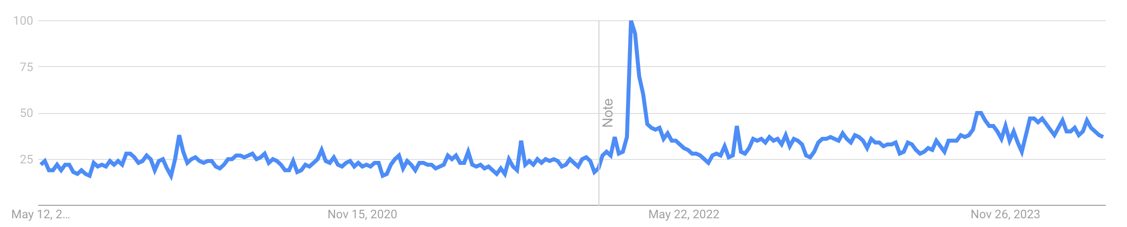
The significance of public affairs in shaping business strategy cannot be overstated. In an interconnected world, policy decisions, geopolitical events, and trade dynamics can have far-reaching consequences for a company's bottom line. Google search trends, an excellent open-source dataset, reveal that searches for geopolitics have experienced a two-fold increase over the past five years, underscoring the growing importance of this domain. A large reason is that geopolitics and regulation have become CEOs' most important focus areas. A KPMG survey of over 1,300 CEOs found that geopolitics and political uncertainty are now ranked as the greatest risk to business growth despite not being considered a top-five risk in 2022. According to PWC's annual CEO survey, nearly 40% of global CEOs believe their organization will no longer be economically viable in 10 years unless it significantly transforms. One of the key areas of concern is regulation and political polarization.
Worldwide Google Search Interest in Geopolitics has Doubled over the Last Five Years (from 25 to ~50).
Public affairs professionals have traditionally relied heavily on intuition, communication skills, and anecdotal evidence when engaging with the C-suite. Although these soft skills and expertise remain crucial, they are no longer sufficient in today's data-driven business environment. Other departments, such as finance, strategy, product marketing, and operations, have long utilized data to bolster their arguments and inform decision-making processes. However, due to the nascent nature of political policy regulations, sourcing data and AI to model or measure the impact of various scenarios has proven challenging since many of those leading these teams have no technical knowledge. Even more challenging is that technical teams have little understanding of political strategy, complex policies, cascade effects, and how to use AI and data to model geopolitical events. For example, it is much harder and more abstract than forecasting profits or customer preference.
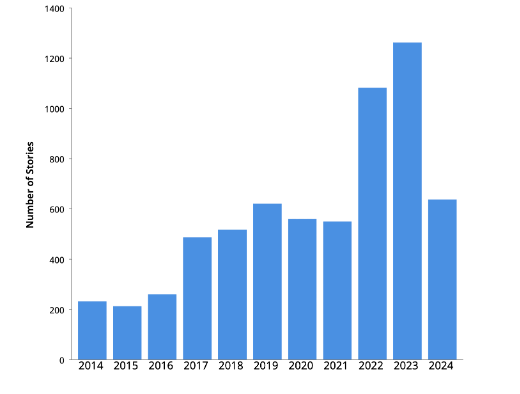
English News Mentions of Geopolitics Dramatically Increased over the Last Few Years.
Interestingly, none of these reports that highlight the CEO’s concern about political and geopolitical events mention AI and data as solutions vs traditional strategic planning frameworks. There is no question that the geopolitical and regulatory environment is becoming more complex, uncertain, and fast-moving. In this environment, it is much harder to predict outcomes or assess what key areas of focus should be, especially when using only anecdotal evidence and experience. Across organizations, these uncertainties and risks are amplified and harder to assess strategically because of algorithmic capture, i.e., personalized news and social media feeds, GPT Chats, and search results, which can cause firms to be both oblivious to risk and isolated from other issues that may affect their firm and opportunities, as well as what political movements and trends to engage with or avoid. Policy strategies can no longer be viewed in isolation or decided by a few meetings with NGOs or stakeholders. Organizations must consider all the issues, viewpoints, and variables—which could be just as easily three or hundreds. If not, a company will fail to distinguish between being overly reactive, business focuses, and public backlash. Developing strategies focused on “clean information” needs should be every organization's agenda, but this is especially difficult, given the diversity of viewpoints on political and policy strategies. The reality is that humans have a finite processing ability, and it is impossible for one person, let alone hundreds, to consistently analyze and contextualize the thousands of signals and millions of data points that are now present and available in the modern information environment.
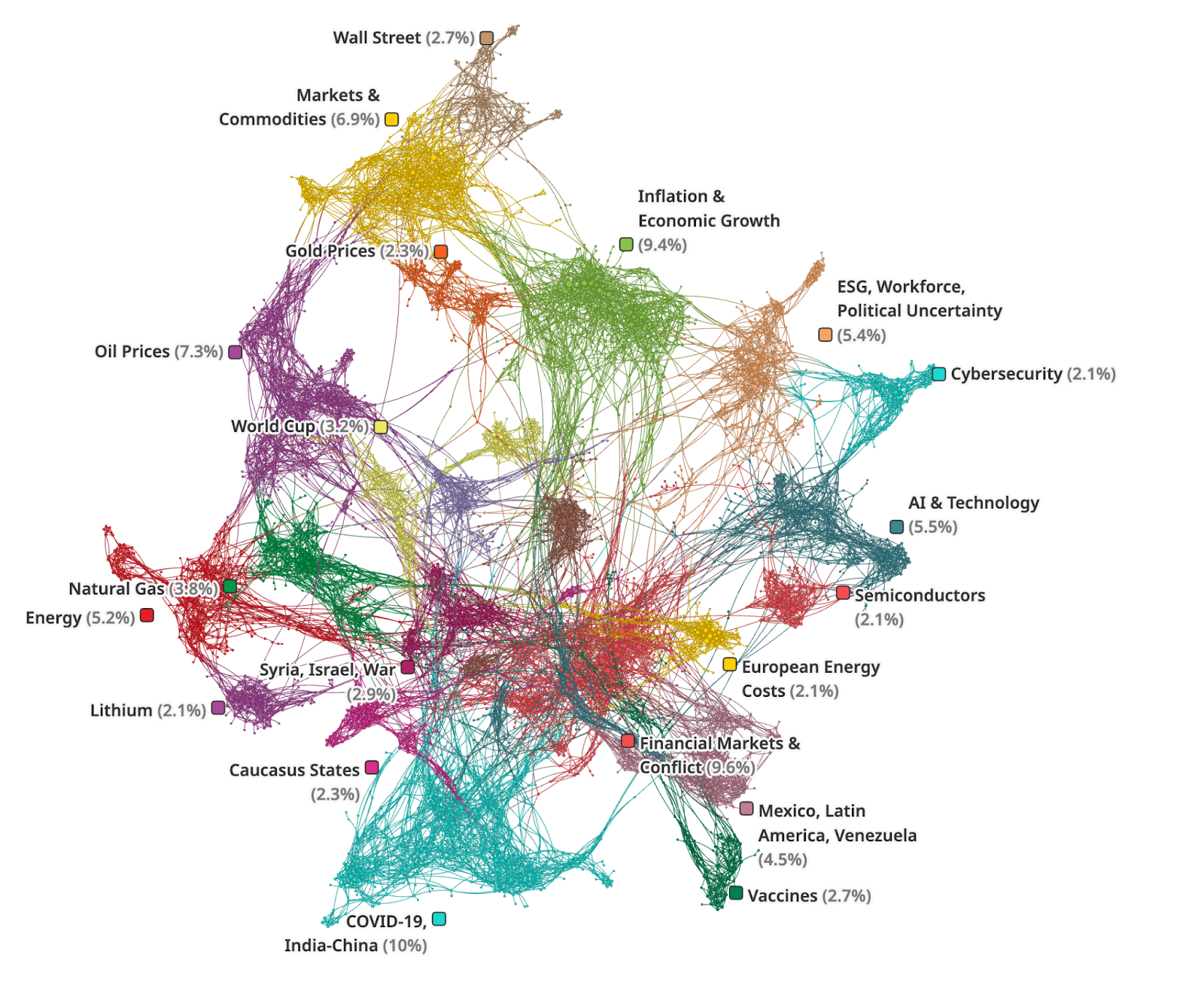
Same news data from the prior chart but leverages AI to create a network analysis that extracts and connects key thematics from over one million news articles that mention geopolitics over the last ten years. This would take a human more than a decade of 24/7 reading to analyze. Say nothing about error, bias, and reporting.
The only way to effectively process the vast amount of information and data available today is by leveraging AI and data analytics. Organizations that fail to do so will be constrained by their own biases, isolating their leadership from critical risks and opportunities outside of their limited perspective – a phenomenon known as groupthink, often leading to the downfall of companies and organizations. Public affairs professionals who can bridge this gap by effectively analyzing and interpreting complex factors and translating them into hard numbers and evidence-based insights will be in the driver's seat. By providing strategic recommendations that align with the company's objectives and forecasting political risk with mathematical precision that goes beyond expertise and experience alone, these professionals and teams will be invaluable to their organizations.
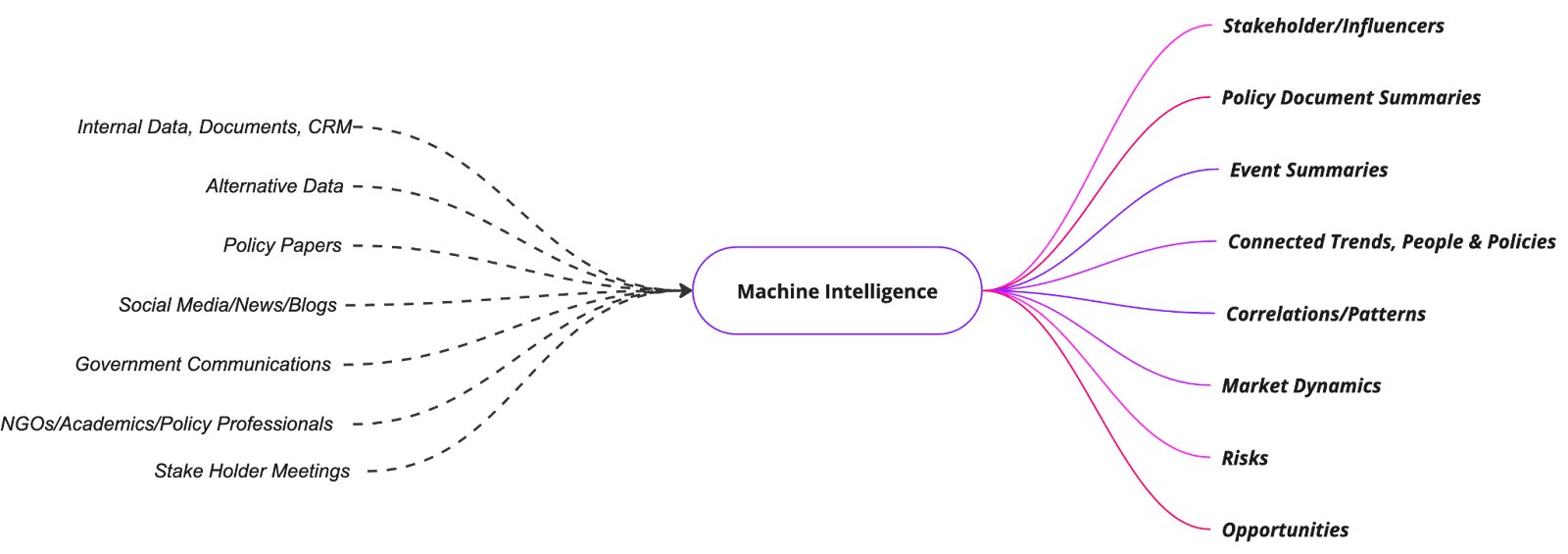
To seize this transformative opportunity, public affairs professionals must prioritize the development of their data literacy and analytical skills. Collecting, interpreting, and communicating data effectively is crucial to gaining credibility and buy-in from the C-suite. Achieving this may require forging strategic collaborations with data analysts, investing in cutting-edge data visualization tools, and maintaining a constant pulse on emerging trends and best practices in data analysis. Moreover, public affairs professionals should strive to seamlessly integrate data into their storytelling and communication strategies when engaging with institutions. By presenting compelling narratives underpinned by robust data, they can influence decision-makers and key stakeholders more effectively. This approach will be instrumental in bridging the gap between the qualitative nature of public affairs and the quantitative expectations of the business world.
Among the various functions within most organizations, few are as well-positioned as public affairs teams to navigate ambiguity, tackle nascent complexity, and steer their organizations toward success. By wholeheartedly embracing AI and cutting-edge technology, public affairs professionals can usher in a golden era that will redefine their role and cement their position as indispensable strategic partners to the business. The time to act is now.
Comments
Nothing yet. Say the first thing.
Sign in to join the conversation.