
Almost every mom I work with falls into it eventually: a nervous awareness of their child’s first five years of development.
“I just need to get through these first few years, then I can focus on myself again.”
“She’s still in her first 5 years, what if I’ve already messed it up?”
“If I don’t breastfeed/co-sleep/stay at home/play with him all day, I could harm him because this is his first 5 years.”
I get it. But when I hear these wonderings from my clients, a wire trips in me.
I start to hear from some of my own early motherhood parts who are still hypervigilant, still worried about Messing It All Up, still feeling responsible for the entire psychic makeup of my two daughters.
It activates another part who is furious about the pressure on mothers to Get It Right in early childhood. I have yet to meet a single dad who bears this anxiety, a fact that gets me sweaty with outrage if I let it.
Then too, my therapist parts want to just flip the table. It takes so long for most mothers who struggle to get to therapy, if they do at all. As the brilliant Karen Kleiman says, “postpartum women do not want to go to therapy.” So many things have to happen first: She has to feel bad enough to accept that she might want, need, or deserve support. She has to find the time, money, energy, and mental space to pause the relentless mental chatter long enough to hear herself. She has to give herself permission to heal.
Yet: when a new mother starts to care for herself – whether that’s with therapy or anything else – invariably the guilt and worry start to creep. Guilt about the time away from a beloved child, worry about the cost, shame around not feeling okay, embarrassment for struggling with motherhood.
And here come the first five years. Led by the drive to Get It Right, mothers focus in on early development as a target for all this distress. It’s an inner critic’s feast.
The general guidance is that the most rapid and significant brain development occurs during the first 5 years of life. It’s a super-powered time of growth: we literally learn how to breathe, sleep, eat, move, feel, communicate, socialize, maybe even read and ride a bike. Clearly, these vulnerable new minds deserve our protection.
Unfortunately though, the facts around how early development works have been wildly misunderstood and skewed in opposition to the health and wellbeing of mothers. Under the influence of scientific-sounding names like “attachment parenting” (developed by Dr. William Sears in the 1980s), our culture has slowly shifted toward a suffocating form of intensive parenting that makes no space for moms and women to care for themselves.
The original studies that explored the importance of these early years in the 1960s and 70s identified multiple influences on the growing brain, not just parents. The research was clear that other adults, teachers, peers, environment, and culture all play an essential role. But these days, when we talk about tending to our kids’ early development, we are usually talking about one person:
Mama.
If she misses the boat, she risks a child with developmental delays, poor social skills, neurodivergence, or worse yet: an improperly bonded child who is not a wellspring of joy and happiness.
Yes, I’m being snarky. At the core, I think most of us understand that perfection and constant joy are not the goal. And yet.
When you layer this social pressure with the isolation, lack of support, emotional turmoil, and hormonal upheaval that so many new mothers face, it isn’t difficult for many women to imagine they’re doing it all wrong. Hypervigilance moves in and we lie in wait for any hints that we’re not Getting It Right, even if we know there’s no Right to Get. In other words, we know it’s a trap and still fall right in.
Session after session, I hear working moms, stay-at-home moms, self-employed moms, corporate moms, single moms, co-parenting moms grapple with this formula. What amount of time spent with children in the precious zero-to-five window will yield the best results?
I sit and listen and hold in mind but don’t often share: There is literally no answer to this impossible equation.
*
The first five years (in particular the first three) in the life of my oldest daughter were rough. Due to unforeseen circumstances, I ended up unemployed, an unintended stay-at-home mom, which I’d argue is the worst kind of stay-at-home mom to be.
In a series of too-small apartments where her dad worked remotely across the room in a way that made him unavailable to help but also made him look as though he were reading the internet all day, I spent most of the day holding the baby, unable to leave home, and seething with a white bonfire of rage that stunned me.
When I became a mother, I held a braided sense of understanding about early development. One strand was what I’d learned in human development class in social work school; another what I’d noticed in friends who looked like highly competent mothers; a third was covert messaging from my own mother – a lifetime of passing reflections about the Sacrifice of Motherhood, in the first five years in particular.
After stumbling out of the land of infertility, I arrived in motherhood ready to direct all my natural-born stubbornness toward my new role. I would do Whatever It Took and in exchange, my baby would give me definite signals of health, secure attachment, and satisfaction. If x then most definitely y.
Lol.
None of these expectations were noted by my firstborn, who crashed into our world chunky and unaware. She struggled to eat, then ate always, slept too much at first, and then barely at all. I intensive-parented my heart out. Skin to skinned, breastfed against all odds, babywore, offered her wooden toys, read to her constantly.
I performed my role mightily through gritted teeth. It all had a vaguely theatrical feel.
Meanwhile, my internal landscape was crumbling like some fun-house-mirror Dali knock-off. I’ll save this story for another day but will happily borrow from Adrienne Rich to say: “I was fighting for my life through, against, and with the lives of my children.”1
After months of no sleep and very little adult human contact, my mental health, marriage, and entire sense of self cracked open. This led me to the crucible of modern-day nuclear family life: sleep training. We decided to rip the bandaid off and let her cry. And wow did she take to the task.
When I think of my oldest’s first year, a core memory is sitting on the couch while she lay in her pack-and-play in the closet (aka the nursery of Brooklyn studio apartments) and wailed while I listened to heavy metal on noise-canceling headphones, watching the baby monitor and sobbing.
I lost myself further in an avalanche of guilt, furious at the situation I found myself in. I had family around me but no one was helping. My body and mind were losing their grip on reality. I froze with fear, unable to face what kind of mother I had become.
I convinced myself I was transmitting the despairing loneliness I’d experienced not just as a new mom but also as a child myself directly to her brain. That the darkness in me had laid down to rest in the clean slate of my child’s mind. All while she wept and called for me and I ignored her.
This horror show went on for what felt like 100 years and was actually two weeks, after which we found we had created one of the most consistent and wonderful sleepers of all time - for many years.
After she settled in, forgetting her past life with parents who held her all the time, I became a sleep-training proselyte. I told anyone who would listen about its benefits, insisted that the shame was a scam, a grift meant to inject mental illness into the vulnerable souls of women and mothers. Chances are if we’re talking about this today, I might still tell you this.
But the truth is that’s still a cover-up. More performance. More paving over the low-grade background fear that I did something very wrong and ultimately harmful. Those first 5 years. What had it meant to interrupt them with my own selfish need to sleep? What nightmare of damage had I wreaked on her nervous system, attachment style, bones, brain, and soul?
For a while, I forced this out of mind, in part because of how well she slept. My youngest arrived on the scene a few years later, and I found myself evermore determined to put myself first in order to stave off mental collapse. I enrolled them in daycare, went back to work, sleep-trained the baby in an easy two nights, and rested easy in my confidence that those important needs of the first five years could be met in many different ways. Not just through a sacrifice of my body, mind, and sanity.
When my oldest was eight though, we found that what we’d previously understood to be her little-kid emotional swings had settled into a pronounced anxiety. She started waking at night, seized with fear – unsettling and nonspecific. Occasionally at first then nightly, she’d come to my room, waking me over and over. The younger parts of me who were still sitting on the couch watching the baby monitor panicked.
I was certain some long-ago exiled pain was waking her in the night – sending her back to me, terrified and determined to seek comfort.
At first, it was all I heard whenever she creeped in: those first 5 years! What if I had botched them after all? Hadn’t I been so sure that choosing my own health was what served her best?
I started to hear the question at other times too – whenever she lashed out, fought with her sister, had a meltdown, struggled with math. Everything felt like proof that I had completely failed the early development test.
And so I found myself alongside so many of my clients. Admittedly, this is part of why I love working with mothers so much. Our work together sometimes offers a sneaky backdoor back into all my own parts – their fears and long, dark passageways. Every time a client brought it up – how do I get the first five years Right? – I found I was facing myself.
I asked my own therapist the same question. She reassured me, like I have so many of my own clients, that no one escapes childhood unscathed.
Eventually, more parts of me started to chime in, reminding me of another deeper knowing, one that Bethany Saltman wrote an entire brilliant book about: When my kid wakes up at night, afraid and lost, it’s me who she seeks out. She doesn’t even have to be fully awake to lead herself to my room, where she now has a mattress on the floor. I don’t have to wake up or even do anything – just our proximity is what brings her comfort.
As Saltman references throughout her book, she knows “where her bread is buttered.”
I feel it repairing her and me. Her first five years. Her first year. I spent a long time hating myself for spending the first stretch of motherhood in a depressed cloud. For not playing with both kids more. For yelling. For sleep training. For the closet nursery. For breastfeeding too long, then not long enough. I felt bad about having them sleep in their crib, then I felt bad for letting one sleep on my floor.
Now I watch her sleep sometimes, keenly aware of how little time we have left together. Time folds in on itself and I hold so much compassion for the parts of me that did not Get It Right.
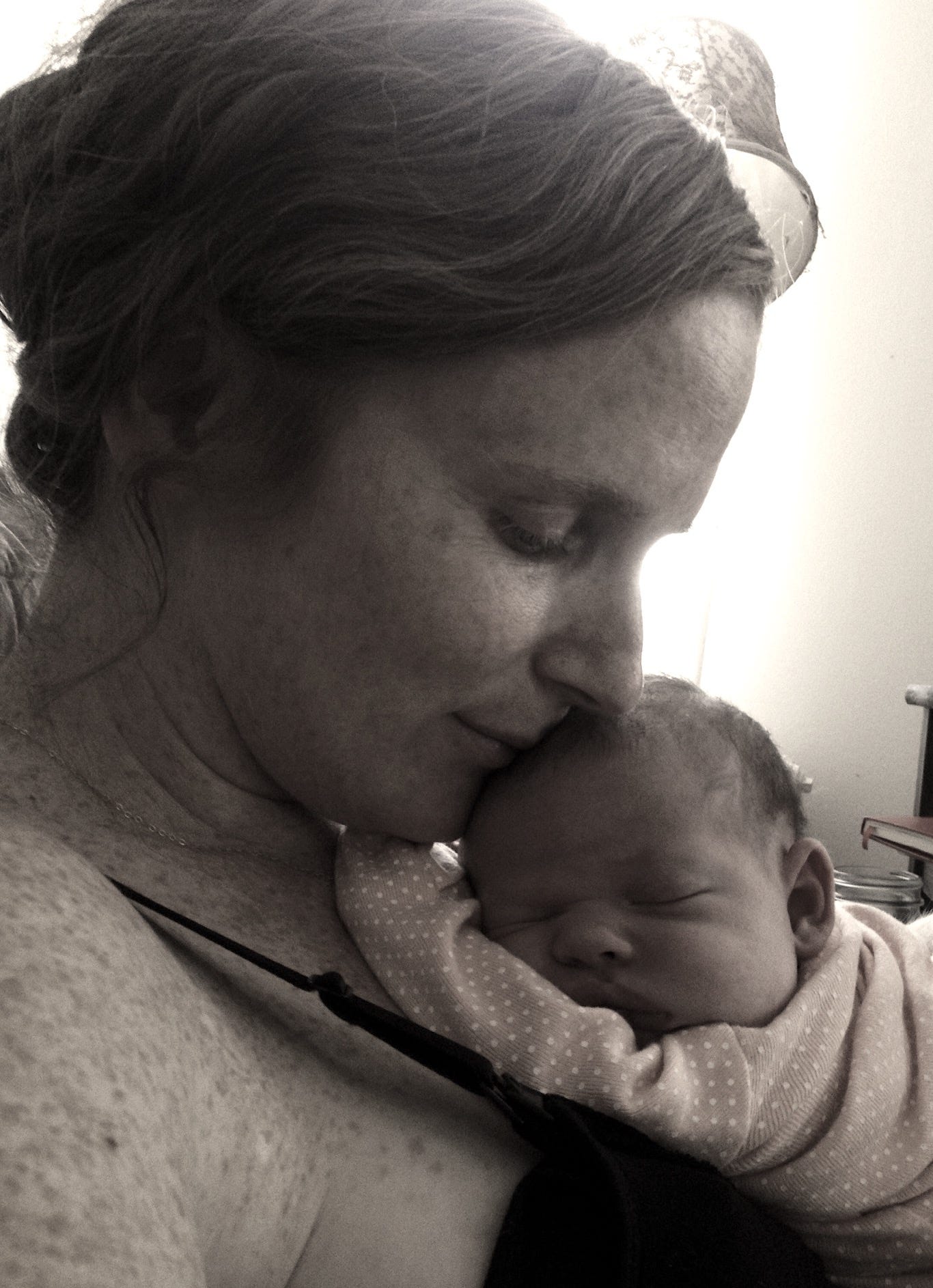
Saltman writes: “I didn’t understand that the love between us is ultimately not even a feeling, or anything to do, but a way of being. And that it gets passed down – not like a name, but more like a face, something you’re born with but that changes over time.”2
Their dad has joked to (at) me that I take credit for every problem they face but I don’t take credit for any of their strengths. In truth, I think none of it belongs to me. They are their own humans on their own very human path, and though I’ve contributed heavily to the deepest unconscious landscapes they pass through, I know they have their own places to go.
These days I wake up in the middle of the night frequently, not from kids but from my next developmental challenge: perimenopause. It’s no fun at all, but one thing helps: Three feet from me, my now almost pre-teen oldest baby lies on her disheveled floorbed, vaguely snoring, her anxiety and maybe even her deepest fears and memories dissolved in a clean wash of sleep.
Listening to: “Ruby Falls,” Waxahatchee
Reading: Doppelganger, Naomi Klein
Learning to play: “1000 Times” by Hamilton Leithauser
Adrienne Rich, Of Woman Born, 1976.
Bethany Saltman, Strange Situation, 2021.
No posts
Comments
Nothing yet. Say the first thing.
Sign in to join the conversation.