
In 2017, Professor James Barlow (Imperial College Business School) and I published a study in Organization Science.
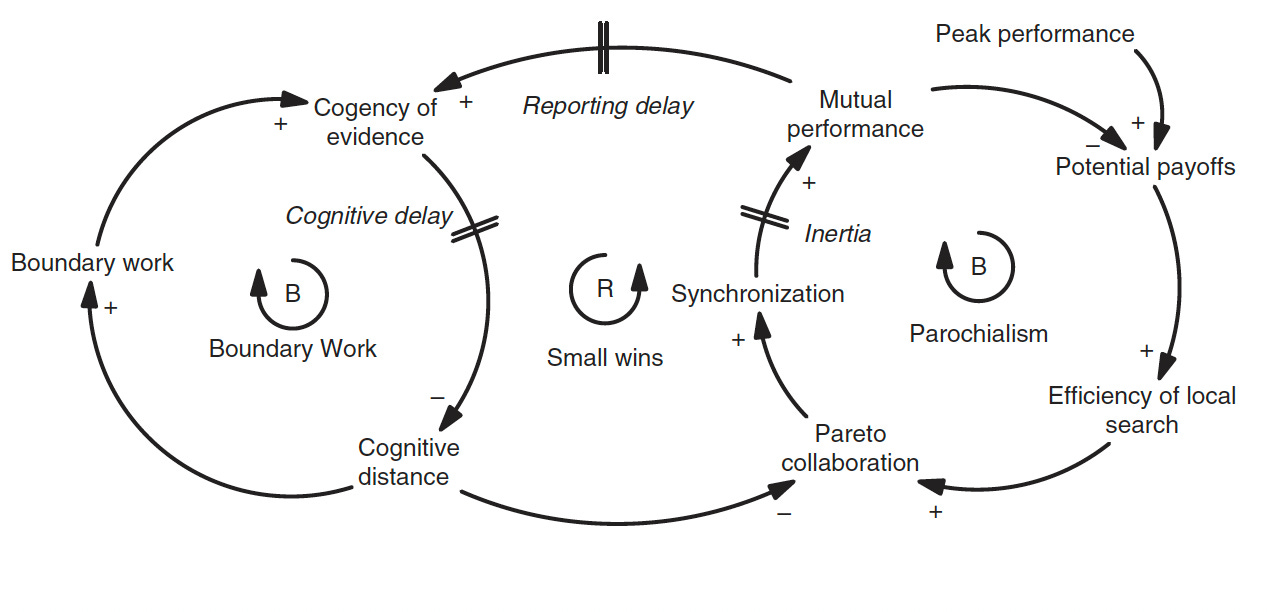
In this work, we used a detailed, longitudinal case study of a major "whole-system" change program in the Scottish National Health Service (NHS) to explore the dynamics of organizational adaptation. We found that the process isn't a simple, linear progression. Instead, it's governed by a constant and dynamic interplay of three core feedback loops that operate at every level of an organization.
This research showed that the initial obstacle to system-wide change is something we call
cognitive distance. This is the gap that exists between the causal representations of agents—the mental maps individuals have of their roles and the system they work within. An agent's cognitive map often simplifies their environment, inadvertently hiding the complex interdependencies that connect their work to others.
For example, a doctor in a hospital ward may not intuitively see their role as being linked to a national waiting time target for A&E departments. To overcome this, agents driving the change must engage in what we termed
boundary work. This is the deliberate effort to use rhetoric, data, and credible messengers to demonstrate these hidden interdependencies. We found that boundary work is a crucial balancing loop in the system: the greater the cognitive distance, the more effort is required to close it.
Our findings revealed that once cognitive distance is sufficiently reduced, it triggers two competing feedback loops that dictate the success or failure of the adaptation process.
The first is the small wins loop. When agents begin to recognize their interdependencies, they can engage in
Pareto collaboration—cooperative efforts that improve performance in one area without harming another. These collaborations lead to a series of incremental, tangible improvements, which we refer to as "small wins". These successes provide compelling evidence that the change is working, which in turn further reduces cognitive distance and encourages more collaboration, creating a virtuous, reinforcing cycle.
However, the system also contains a
Parochialism loop. As performance improves and approaches a target, diminishing returns set in, and it becomes harder to find new improvements. This can lead to "change fatigue," causing agents to shift their focus back to their own local goals and priorities. The parochialism loop is a balancing loop that counteracts the gains of the small wins loop, often leading to an erosion of performance over time.
One of the most significant contributions in our research is that while this feedback structure is
scale-invariant—meaning it operates at every level of an organization—the relative strength of each loop is scale-dependent. At lower levels (e.g., within a department), cognitive distance is minimal, and changes can produce immediate results, allowing the small wins loop to dominate. But as you move to higher levels (e.g., across health boards or national organizations), the cognitive distance is greater, system inertia increases, and time delays become longer. This makes it far more difficult to achieve and sustain small wins.
The process of change is also constantly hampered by
dissipation—the loss of effort and progress. Sources of dissipation, such as staff turnover and shifting priorities, actively work to counteract adaptation efforts and can lead to
organizational forgetting, where newly acquired knowledge is lost. We found that the strength of these dissipative processes increases with scale, which makes it an ongoing challenge to sustain improvements at higher organizational levels.
My work suggests that leading change in a complex system is not about implementing a one-time solution. It is a continuous, recursive process that requires a clear understanding of these dynamics. It's about persistently engaging in boundary work to combat cognitive distance, nurturing small wins to build momentum, and actively fighting the forces of parochialism and dissipation at every level.
For those interested in the full details of my research, you can access the paper here: https://pubsonline.informs.org/doi/abs/10.1287/orsc.2017.1113.
Or
and access the full text here:

No posts
Comments
Nothing yet. Say the first thing.
Sign in to join the conversation.