
Many senior executives leading technology-driven firms rely on the “S-curve” as a foundational mental model. This framework suggests that technology diffusion follows a predictable path: a slow start, a rapid climb, and a gentle tapering off toward obsolescence. However, empirical evidence from major industrial transitions reveals a more abrupt reality.
In a 2017 article, published in the Journal of Engineering and Technology Management, I challenged a fundamental comfort zone: the belief that a currently growing sales curve implies a safe runway for transition. I addressed this blind spot by introducing the concept of “Convex Drops” to describe radical departures from an expected smooth sales lifecycle.
These drops are sudden, sharp plunges in sales that occur while a technology appears to be in its prime. Such collapses are particularly challenging for strategic planning because they can materialize exactly when traditional models are most confident—even shortly after the peak of sales. At this stage, conventional wisdom suggests there is little uncertainty left regarding cumulative volumes. Yet, in many cases, sales collapse while the technology still possesses significant momentum, often shrinking remaining market potential by 30% to 55%.
Standard business forecasting assumes an incumbent technology will decline gracefully as a successor arrives, suggesting a smooth transition into a concave end-of-life phase. I used historical data from mammography equipment, IBM mainframes, and memory chips to show that sales curves often collapse from anticipated forecasts.
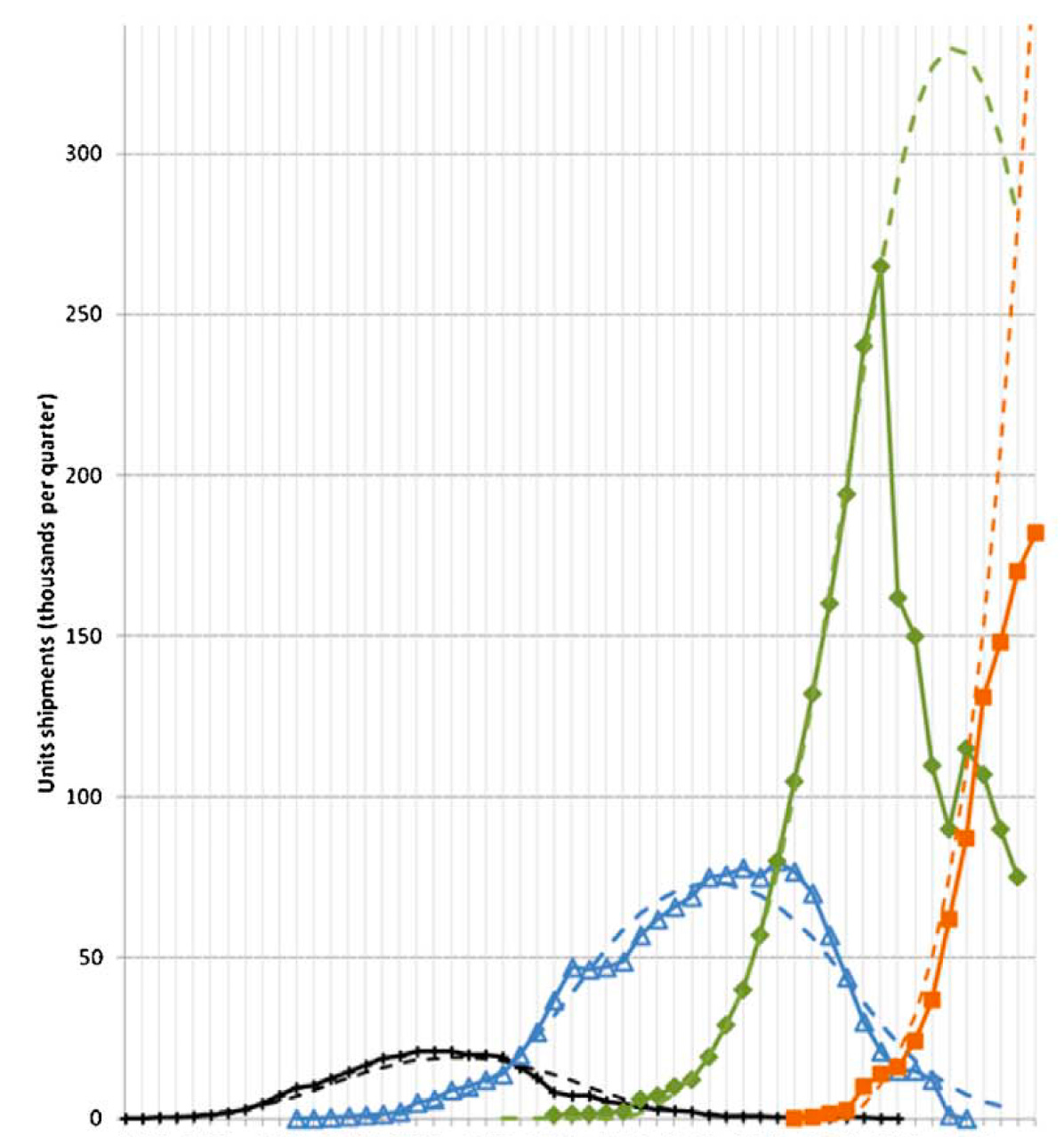
In the mid-1970s, for example, certain medical imaging sales were growing, and statistical models predicted continued expansion. Instead, sales dropped by over 35% in a single year as a new generation of dedicated equipment entered the market. These convex drops represent a bifurcation point where anticipated demand essentially evaporates.
A common strategic error is conflating technical performance with market readiness. My research distinguishes between two distinct crossover points that dictate the timing of a substitution:
Performance take-over: When a successor technology first surpasses the incumbent in raw performance, its initial high price often limits its appeal to a narrow segment of innovators and early adopters. During this phase, these users may upgrade, but the technology is not yet superior in terms of utility-price.
The false sense of security: Because the new technology’s utility-price ratio remains inferior during this period, the incumbent technology continues to drive overall market penetration. Executives often see their sales continuing to grow and mistakenly believe the competitive threat is still contained with the new technology have gained only a minimal market share.
The situation changes fundamentally at the Utility-Price Crossover. When the new technology achieves a superior value proposition for the mass market, it does not merely compete for market share; it preempts the flow of new customers into the category. The successor technology becomes the primary driver of market growth.
From growth to depletion: The moment the incumbent loses its utility-price lead, its inflow of new customers effectively hits zero.
The mathematical shift: Adoption of the old technology is instantly restricted to a “depleting stock” of potential adopters—those who were already in the consideration phase but had not yet finalized a purchase. This triggers a switch to a negative exponential decay, forcing the sales trajectory into a convex plunge well before the “concave” tapering predicted by traditional models.
Inventory Depletion: Once the incumbent technology loses its lead in utility-price, its inflow of new customers stops. Adoption is then limited to a “depleting stock” of potential adopters—those who were already considering a purchase but had not yet acted. This causes the technology lifecycle to switch instantaneously to a negative exponential decay. The sales trajectory moves directly into the convex phase that is normally only expected at the very end of the lifecycle.
These market dynamics are further complicated by adopter behavior. While adoption models often assume that customers transition through every generation, I used a system dynamics simulation model to demonstrate that when technological cycles are rapid, upgrading customers often leapfrog. In the semiconductor market, for instance, many customers skip an entire generation of products to move directly to a more advanced version. This leapfrogging behavior further slows sales of the current flagship well before its anticipated end-of-life.
Understanding these dynamics shifts the focus of technology management from tracking “market dominance” to identifying preemption points.
The fallacy of the sales peak: For an incumbent, a sales peak is not a sign of safety or a confirmation of achievable total volumes. Once a competing technology reaches the utility-price crossover, the addressable market for new customer acquisition effectively hits zero.
The 15% threshold error: Waiting until a competitor achieves a 10–15% market share before reacting is often a strategic error. By the time a disruptor reaches that level, the convex drop has typically already occurred.
Defensive levers: Firms can postpone disruption by managing their utility-price ratio. Aggressive pricing and defensive performance increases are strategic mechanisms to (temporarily) delay the crossover that triggers a market collapse.
To maintain a competitive advantage, technology-based firms must move beyond lagging indicators like market dominance or the 15% share threshold. Abrupt collapses in sales are triggered by utility-price crossovers that preempt new customer inflow much earlier than traditional models anticipate. Failing to forecast these bifurcations leads to significant overestimations of market potential. Strategically, survival depends on identifying these early preemption points to pivot before the core technology’s terminal phase unexpectedly accelerates.
No posts
Comments
Nothing yet. Say the first thing.
Sign in to join the conversation.