

Christian Nationalism is wimpy. For all its macho bluster, crusader fantasies, and tough talk about a masculine faith, Christian Nationalism is wimpy. By Christian Nationalism I mean a Christianity that not only seeks but needs the apparatus of the state to be its protector. Think of it as nanny state Christianity. The swagger that characterizes Christian Nationalism is compensation for its insecurities. Deep down the Christian nationalist is afraid that following Jesus might be, well, hard.
And it is hard to follow Jesus in any serious way. As my Costa Rican friend said years ago, “Christian life no is easy, Christian life is possible.” Søren Kierkegaard insisted that Christian faith requires “a break, the most profound, the most incurable break with this world.” And that is what Christian Nationalism is unwilling to do. It doesn’t want to break with the world; it wants the world to make Christianity easy and acomodating. A demanding countercultural Christianity is too much to ask of Christian Nationalism. It seeks a soft Christianity that is little more than following the crowd. This is not Christianity at all, but Christendom—a distortion of Christianity defined, not by a radical commitment to Jesus Christ, but by ethnicity, geography, and culture.
Christian Nationalism is enamored with King David and King Solomon, and the Quixotic attempt to turn faith into a political project. But in reading the book of Kings it’s as if they stopped with the queen of Sheba’s famous visit to Solomon as the queen coos, “the half was not told me.” If they would keep reading the biblical story, they would discover that the project led to a long line of mostly corrupt kings, the rise of idolatry, and the ultimate failure of the whole project. The worshipers of Yahweh then had to learn the hard lesson of how to be faithful while living as exiles in Babylon—an experience that the early Christians saw as analogous to their own situation. The true Son of David establishes the kingdom that endures forever not by the sword but by the cross. This is Kierkegaard’s “incurable break with this world.”
Nevertheless, the project of “God-on-our-side” in a violent political way viz-à-vis the nations of the world was again taken up and continued into the first century AD. Jesus warned and wept over this folly, telling Jerusalem repeatedly that it would only lead to the horrors of Gehenna—a prophecy that was miserably fulfilled in AD 70. Faith-based religious nationalism led to the destruction of Jerusalem . . . twice.
But this seems to be a lesson that Christian nationalists are unwilling to learn. The most zealous attempt at a Christian Nationalism in the last hundred years was championed by the German Christian Movement—and where did that lead? When in a whorish way we attempt to make faith easy by riding the back of the beast we only end up being devoured by the beast. There is no free ride in the Christian faith. The call to discipleship remains defined by the same demanding imperative: Take up your cross and follow the way of Jesus. It’s not wielding the sword of Caesar but taking up the cross of Christ that makes Christianity authentic. An attempt to wimp out of the rigors of discipleship and make Christianity easy through the apparatus of the state always ends as a cautionary tale.
Even into the twenty-first century we continue to be haunted by the ghost of Constantine. Many still imagine that Christians can serve the interests of Caesar and remain faithful to the Sermon on the Mount—and this despite its obvious chequered history. At some point we have to choose between the Mount of Beatitudes and Palatine Hill.
Several years ago I was at an Orthodox conference where a well-known theologian was defending Constantine. Alan Kreider and I argued that this position is, in fact, indefensible. When the defender of Constantine said, “I cannot imagine how Christianity could have survived without Constantine” (despite the fact that Christianity was growing at forty percent per decade in the late fourth century), my response was to ask, “Why then did Jesus not establish an earthly political kingdom during his ministry?” Mr. Defender didn’t seem to understand the question, and when I pressed it a second time, he simply muttered, “That’s not what he came to do.” Precisely!
And if we set out to establish what Christ himself refused to establish, we become like Dostoevsky’s Grand Inquisitor “correcting” Christ’s “mistake.” In The Brothers Karamazov the Inquisitor’s argument to Christ was that he had made Christianity too difficult, and that it was now the task of enlightened others to make it easier. In their late-night dungeon “conversation” (Christ doesn’t say a word), the Grand Inquisitor says this:
If you had accepted the world and the royal purple robe of Caesar, You would have established a universal kingdom, and bequeathed humanity universal peace . . . We accepted Caesar’s sword, and in doing so, of course, we have rejected You and followed him.
Well, there you have it. It seems Christian Nationalism sides with the Grand Inquisitor on this one. And that’s a bad look. Dostoevsky suggests that to side with a Constantine-inspired imperial Christianity is to side with an ominous him—the dread spirit who offered Christ the kingdoms of the world in the wilderness.
Christian Nationalism is wimpy. It seeks a soft Christianity supported by Caesar under the guise of glory. But a Christianity made easy by the might of the state is not the hard, narrow path that Jesus spoke of—it’s a paved six-lane highway that the masses can comfortably cruise down without any real commitment. Of course, Jesus tells us where that highway leads.
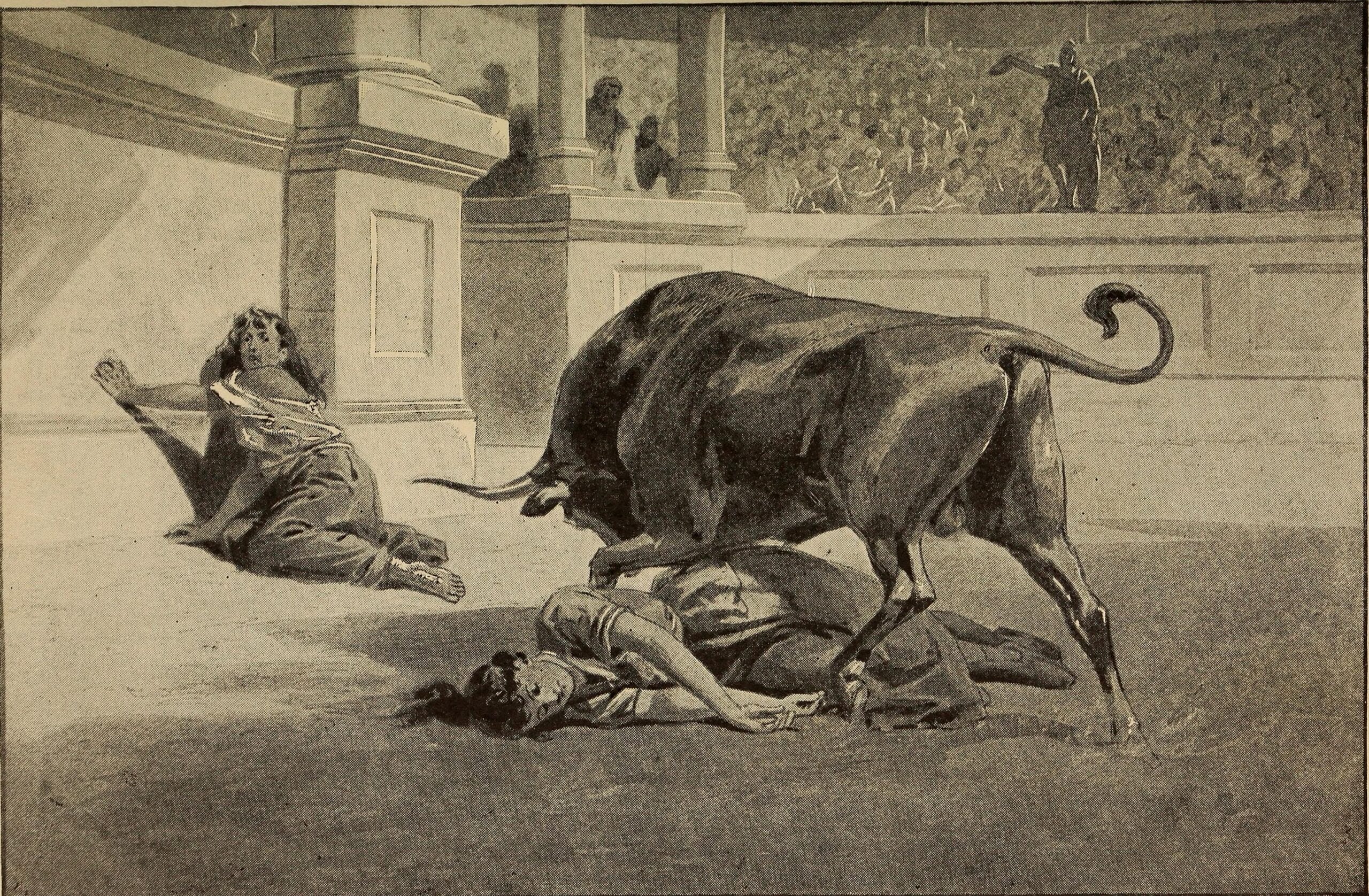
While the online theobros are crowing about their masculine Christianity, I think of Perpetua and Felicity—two female Christian martyrs executed in a Roman arena in Carthage in 203. These two young women entered the arena without a trace of fear and were carried out as martyrs. There you go, boys. That’s some tough Christianity! It’s the martyrs, not the crusaders who should inspire us. But while the early church venerated the martyrs, Christian Nationalism is an attempt to make martyrdom unthinkable.
So I insist that Christian Nationalism is wimpy. And though you make think this piece overly polemic, I’ve actually been more fair to Christian Nationalism than it probably deserves. To say that Christian Nationalism is wimpy because it needs the apparatus of the state to make it easy to be a Christian is the nicest thing I can say. As it plays out in real life, Christian Nationalism is more often bigoted nativism and ugly racism disgustingly masquerading as if it has something to do with Jesus. When I think of Christian nationalists parading around with police protection, covered faces, shouting ugly slogans, that’s when I know that Christian Nationalism is not only wimpy, it’s also cowardly.
BZ
No posts
Comments
Nothing yet. Say the first thing.
Sign in to join the conversation.