
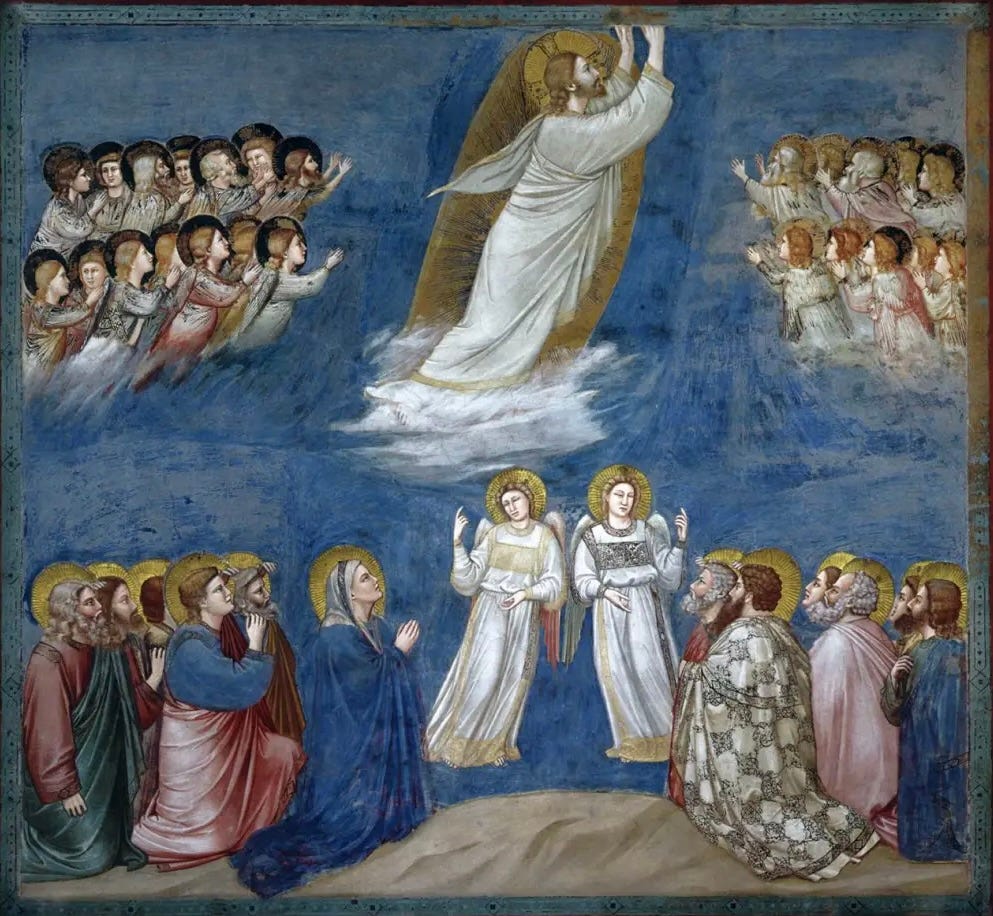
The Ascension by Giotto di Bondonne, 1303
Text within this block will maintain its original spacing when published
          God has ascended with a shout
          Sing praises to our King, sing praises
          For God is King of all the earth
          God reigns over the nations
          God sits on his holy throne
          –Psalm 47
Today is Ascension Day—perhaps the least celebrated and least understood of the major holy days on the Christian calendar. Coming forty days after Easter, it commemorates the Ascension of Christ. In our sacred calendar we tell the gospel story from Advent to Pentecost—from the anticipation of Christ to the outpouring of the Holy Spirit. Unfortunately, too many of us think the gospel story can be told with Christmas, Good Friday, and Easter alone. It’s safe to say that Ascension Day will largely come and go unnoticed by most American Christians. (It may have a bit more recognition in Europe where in many countries it remains a public holiday.)
The fact that Ascension day for most American Christians is just another Thursday in Spring is telling—it tells of a deficient gospel and reveals a central problem in our political theology. What is even more telling, is what happens, when by the occasional quirk of calendar, Ascension Day and the American National Day of Prayer fall on the same date: I don’t have to tell you which one is given attention and which one is ignored by American evangelicals.
The Ascension is not about the absence of Christ, but about the ascendancy of Christ. The ascension of Christ to the right hand of God is the ascendancy, the rise, the elevation, the promotion of Christ to the position of all authority in heaven and on earth. (Matthew 28:18) The right hand of God is not a cosmological location, but a poetic way of saying that God has now given all authority to Christ. The ascension of Christ does not lead to the absence of Christ, but to his cosmic presence everywhere. This is why just prior to his ascension, Jesus said to his disciples, “Behold, I am with you always, even to the end of the age.” (Matthew 28:20) In his Ascension Christ now fills all things everywhere, so that now there is no time or place when or where Christ is not, and there is no domain over which Jesus is not Lord. The Apostle Paul says it like this:
Now he is far above any ruler or authority or power or leader or anything else—not only in this world but also in the world to come. God has put all things under the authority of Christ and has made him head over all things for the benefit of the church. And the church is his body; it is made full and complete by Christ, who fills all things everywhere with himself. (Ephesians 1:21–23 NLT)
A failure to embrace Paul’s robust theology of Ascension has a detrimental effect on our political theology. If we end the gospel story by saying something like, And then Jesus went off to heaven, but someday he will return and bring the kingdom of God…we then inevitably imagine we are free to run the world as we will during what we wrongly assume is the absence of Christ.
What this mistake does is demote Jesus from being the eternal Lord “seated at God’s right hand in the heavenly places, far above all rule and authority and power and dominion,” to being Lord-Elect in exile. No! The Ascension is ascendency, not absence! Jesus is Lord. Now. Not Lord-Elect, not Lord-Gonna-Be, not Lord-Someday, but King of kings and Lord of lords right now! Whatever the world may do, the church is obligated to live under the reign of Christ here and now. As Yves Congar said, “The church is the world as believing in Christ.”
Nevertheless, just because we acknowledge a distinction between the church and the world in this age, we do not say the kings (governments) of the world are free to ignore Jesus Christ and his commands so they can run the world by violent and self-interested pragmatism. Instead we say with the Psalmist,
Text within this block will maintain its original spacing when published
          Therefore, O kings, be wise
          Be warned, O rulers of the earth
          Serve the LORD with fear
          And rejoice with trembling
          Do homage to the Son
          Lest he be angry
          And you perish in the way
          -Psalm 2:10-12
This is our prophetic witness. It’s not the task of the church to “make America (or any other political nation-state) great again.” The contemporary task of the church is to make Christianity prophetic again. We must recover our vocation as a prophetic witness to the risen and ascended Christ. But to do this we must actually believe that Jesus is Lord of the nations here and now, and that all kings and governments, peoples and nations are called to obey the Son of God. This is what the pre-Imperial (pre-Constantine) church believed and lived.
A proper understanding of Ascension theology should make it impossible for the baptized to support any so-called “Christian Nationalism.” Christ has not been given all authority in heaven and on earth in order to assert American dominance over Mexico or Canada, or to assert Russian dominance over Ukraine, or any such machinations of empire. Christ has no interest in making some nations rich and powerful at the expense of poor and vulnerable nations. Christ is not an agent of injustice. God forbid!
To state the obvious, Christ does not serve the petty nationalisms that divide a fallen world under the sway of the evil one. What Christ the Lord commands is “peace to the nations” and that “nation shall not lift up sword against nation, and neither learn war anymore.” (Zechariah 9:10, Isaiah 2:4)
The church is to be the present anticipation of a future universal kingdom. Jesus himself prayed for the unity of his ecclesial body, and there must be no nationalistic divisions within the body of Christ. That in Europe millions of baptized Christians killed one another in the name of their national allegiances in the two World Wars should be the final repudiation of any attempt at Christian nationalisms. And yet this tragedy is being repeated as Russian Orthodox soldiers kill Ukrainian Christians at the behest of their mad emperor with the blessing of their craven Patriarch. This is a grave sin…and a Patriarch should know this!
The body of Christ is universal and pledges no allegiance to any particular nation. By an accident of birth having nothing to do with my baptismal identity I happen to hold an American passport; but my enduring citizenship is in heaven, from whence Christ shall come again in glory to judge the living and the dead, and his kingdom will have no end.
These are the eternal truths we remember and celebrate on Ascension Day.
BZ
P.S. Astute readers may recognize that I have published this piece previously. So be it. Some things bear repeating.
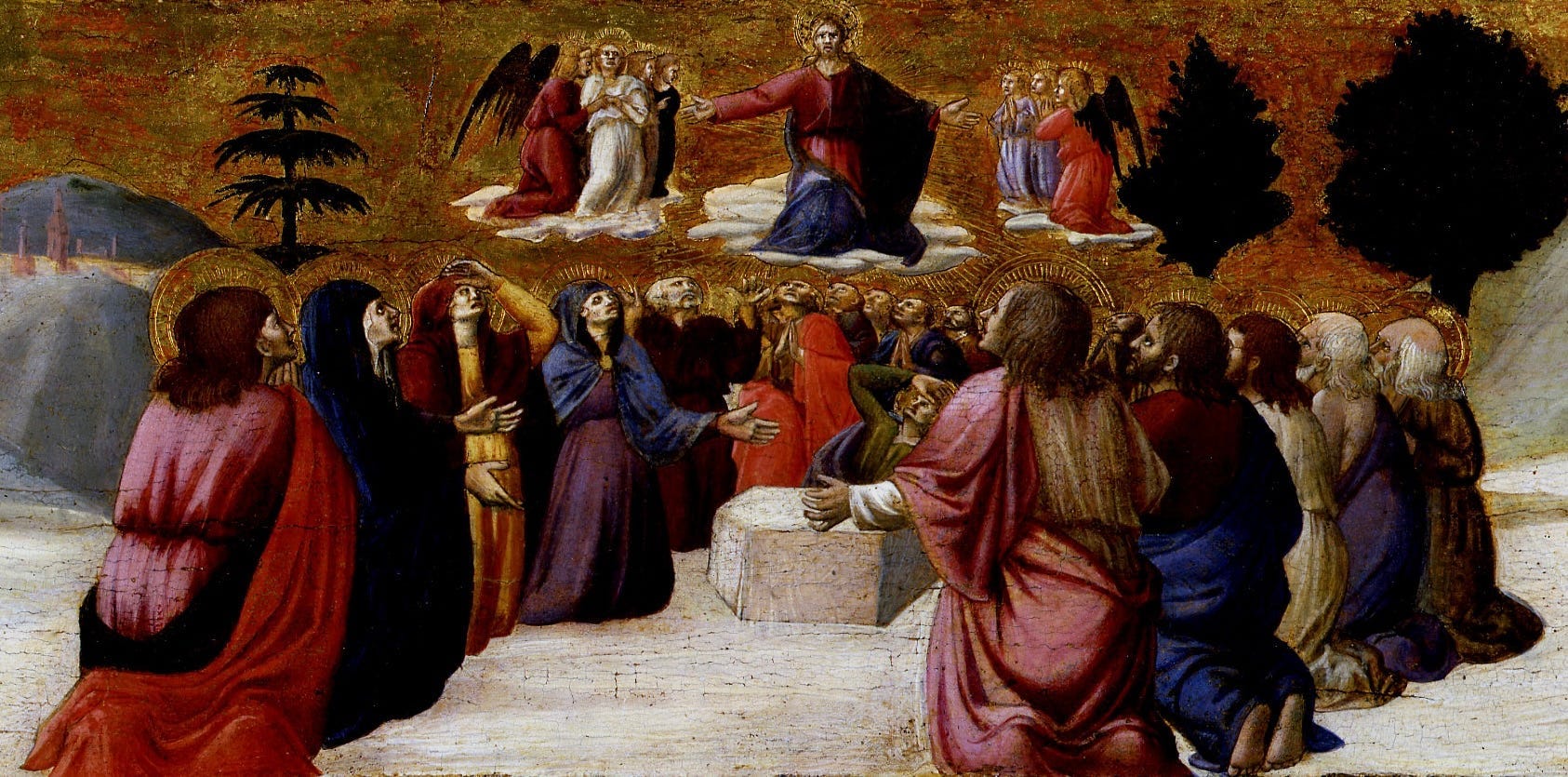
The Ascension of Christ by Giovanni Angelo d’Antonio, c. 1440
No posts
Comments
Nothing yet. Say the first thing.
Sign in to join the conversation.