
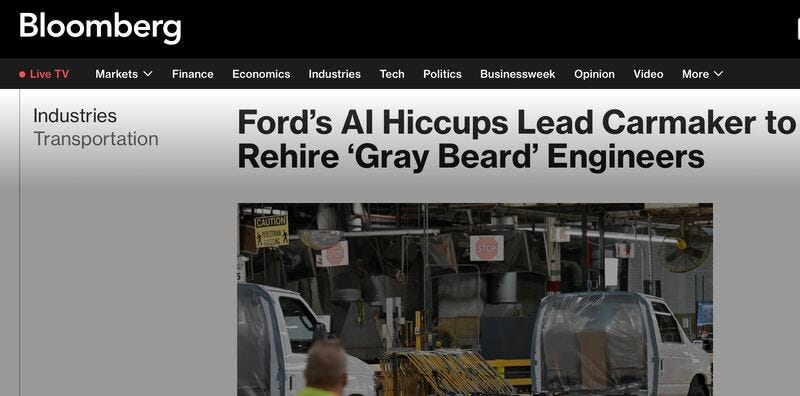
AI is creating a dangerous illusion in the executive suite. If a task can be automated, the person behind it can be eliminated. Not so fast. Tasks are not jobs, and judgement isn’t software.
Ford just learned why that assumption can become very expensive.
After leaning more heavily on AI and automated quality systems, Ford brought back, hired, or promoted roughly 350 experienced technical specialists, including veteran engineers sometimes called “gray beards.” Their job wasn’t to compete with AI. It was to make AI, and the work surrounding it, better.
What happens when a company cuts people in the name of AI only to learn that AI couldn’t cut it, forcing executives to rehire the very people they cut? This is a story about rethinking the role people and AI play in business transformation and why executives need to think beyond efficiency gains and cost-cutting to remain competitive in an era of AI Darwinism.
AI has seduced too many executives into believing the wrong thing. But AI itself is not a strategy. The mistake many executives are making is believing that because AI can automate tasks, it can also replace the human judgment, context, empathy, and hard-earned expertise that make those tasks valuable in the first place.
This perception can lead to leadership and AI getting very expensive, or rather costly.
The early promise of generative AI was intoxicating. Faster service. Lower costs. Fewer people. More output. Less friction. Suddenly, “efficiency” became a proxy for strategy, and AI became a convenient answer to questions leaders had not fully asked.
But speed is not the same as quality. Automation is not the same as intelligence. And replacing people is not the same as reinventing work.
Ford is now offering one of the clearest lessons yet.
Ford reportedly hired, promoted, or brought back about 350 experienced technical specialists after concluding that AI and automated quality systems alone were not delivering the results it needed. These veteran engineers, sometimes referred to internally as “gray beards,” are now helping mentor younger staff, lead design reviews, and improve the AI systems Ford uses to find defects earlier, according to Business Insider.
While this may sound like a story about AI failure, it is a story about leadership learning and trying again. And let that be the mantra of AI business reinvention. We can’t stigmatize mistakes. We have to celebrate companies that right their errs and lead the way by learning and growing in public.
In this case, Ford corrected its operating model around AI.
“We had been relying more and more on automated quality systems” and not getting the desired results, Ford COO Kumar Galhotra said. “We brought back technical specialists” and “they hunt for failure points before a part ever reaches the plant floor,” as published in Ford Authority.
This sentiment reframes AI from replacement to reinforcement.
These experts were brought back to raise quality standards and scale wisdom in ways that make humans matter, even with AI.
Charles Poon, Ford’s vice president of vehicle hardware engineering, was refreshingly direct.
“Artificial intelligence is a fantastic tool, but it’s only as good as the information you use to train it,” Poon toldBloomberg. “Mistakenly we thought that by just introducing artificial intelligence and ingesting the design requirements that we had, that that would produce a high-quality product.”
He added, “We recognized that for us to enhance some of our automation and machine learning and artificial intelligence tools we needed to ensure that they were trained by the most experienced individuals,” according to Ford Authority.
That should be required reading in every boardroom and conference room.
The issue was not AI. The issue was the assumption that AI could produce excellence from incomplete inputs, disconnected workflows and data, and institutional knowledge that lives in the heads of the company’s most experienced experts.
Every company has its version of this problem. It lives in the judgment of knowledge workers. In the exceptions that never make it into process documents. In the handoffs between departments. In the difference between what the workflow says happens and what happens.
When that knowledge leaves the organization, AI does not magically recover it. It simply automates around the absence.
Ford is not alone.

Klarna became one of the most cited examples of AI-driven efficiency after its AI assistant, built with OpenAI, handled 2.3 million conversations in its first month, managed two-thirds of customer service chats, and performed the equivalent work of 700 full-time agents, according to OpenAI.
Those results were impressive, and they still are.
But Klarna later shifted its posture, investing again in human customer service and emphasizing that customers should be able to reach a person when they need one. CEO Sebastian Siemiatkowski acknowledged that cost had become “a too predominant evaluation factor,” leading to “lower quality,” and said that “really investing in the quality of the human support is the way of the future,” according to Sifted.
A Klarna spokesperson put the lesson this way, “AI brings speed. Human talent brings empathy. Together, they let us deliver service that’s fast when it matters, and personal when it counts.”
Again, this is not a reason to ridicule Klarna. It is a moment to celebrate changing direction vs. doubling down on mistakes.
Klarna is learning in public what many companies still have to learn in private. AI can handle speed, volume, and repeatability. People handle ambiguity, emotion, trust, accountability, and the moments that define the brand.
This is the point Dave Wright and I make in our new book Infinite: How Visionary Leaders Transform Today’s Businesses into AI-Forward Companies.
AI adoption is not the same as becoming AI-forward.
AI adoption installs tools into the existing organization and into existing workflows. AI-forward leadership redesigns how value is created, how knowledge compounds, how humans and agents collaborate, and how the business learns faster than change itself.
The companies that win with AI will not be the ones that simply reduce headcount. They will be the ones that increase human-agent leverage.
That requires leaders to move from org charts to work charts.
Org charts show who reports to whom. Work charts show how value actually flows: across functions, systems, data, decisions, approvals, exceptions, agents, and humans. They reveal where AI can accelerate outcomes, where it can remove friction, where it should not act autonomously, and where human judgment must remain central.
Ford’s quality reset is a work-chart lesson. The breakdowns were not confined to one team. They lived where design, manufacturing, software, hardware, supply chain, and quality intersected. AI could help detect problems, but experienced people were needed to understand why those problems emerged and how to prevent them upstream.
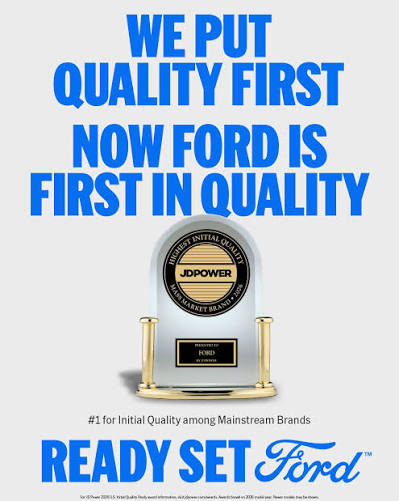
After Ford brought back the ‘gray beards,’ the results speak volumes, and are also worth studying carefully.
In the 2026 J.D. Power U.S. Initial Quality Study, Ford ranked highest among mass market brands, improving to 152 problems per 100 vehicles, according to Reuters. Ford also said it was the first time since 2010 that it ranked No. 1 among mainstream brands in the study, according to Ford.
Ford improved by pairing intelligent systems with experienced humans, cross-functional collaboration, and a prevention mindset.
That’s leadership…knowing when to right the ship even after a wrong turn was ordered.
First, stop asking where AI can replace people. Ask where AI can multiply expertise.
Second, redesign work before automating it. If the workflow is fragmented, AI will scale fragmentation. If the process is built around find-and-fix, AI will help you find and fix faster. But the real breakthrough is prevention, prediction, and reinvention.
Third, treat knowledge as infrastructure. Data is not enough. Prompts are not enough. Requirements are not enough. AI needs context, edge cases, feedback loops, institutional memory, and human judgment.
Fourth, measure AI by value creation, not activity or headcount reduction. The goal is better products, faster learning, stronger customer experiences, lower risk, and new capacity for growth.
Finally, build for human-agent leverage. The future is not human versus machine. It is people with agents, experts with systems, judgment with automation, wisdom with scale.
Ford and Klarna are leadership lessons because they learned how to use AI better.
The right people make AI worth scaling. Put AI to work for people.
This story was originally published in Forbes. Now I can share it here too…

No posts
Comments
Nothing yet. Say the first thing.
Sign in to join the conversation.